


While 35 games is an unfairly small chunk of games with which to judge any coach’s tenure, it’s also been more than enough for Stars fans to start acknowledging that Glen Gulutzan seems to know what he’s doing behind the Dallas bench.
Gulutzan has taken a team riddled with injuries to key players early in the season and led it to the second-best record in the NHL. He’s helped the Stars to withstand various levels of adversity while also, by the way, completely re-jiggering their entire defensive structure, as we’ve discussed here in detail.

But one thing that jumps out about the Stars is that, in spite of a .729 points percentage that would easily be leading the league in most seasons, they aren’t dominating puck possession. Not even close, in fact.1
It is absolutely true that public models that use shot attempts as a proxy for puck possession (since the NHL reserves its best tracking data for rights holders and other privileged folk) tend to see Dallas as a team often without the puck, I think it’s worth looking at how the Stars themselves might be evaluating their “puck possession,” or what amounts to it.
Because, sure: if you sort teams by Corsi/shot attempts2 at 5-on-5 at a place like MoneyPuck or Natural Stat Trick, the Stars will be among the lowest-ranked teams in the league right now. (Interestingly, the Stars were also below-average last season, while above-average in Pete DeBoer’s first two years.) That’s simply not ideal, because it means you’re asking your skaters to defend and your goalie to goaltend more often than not, and that means energy is being expended in situations with far more risk than reward. The Sharks’ first goal last night was an example of that sort of risk, as a point shot with relatively low danger bounced kindly for San Jose, resulting in a goal.
If you measure teams by which one is shooting the puck more than the other, the Stars are consistently coming out on the short end of that comparison. Of course, we also know that teams (other than Carolina) generally eschew shooting for shooting’s sake, preferring instead to focus on creating “chances” or “looks,” which is the vernacular more commonly used by players and coaches alike. The earliest days of NHL statistical squabbling involve coaches scoffing at terms like “Corsi” by pointing to how teams might get “credit” for a shot attempt when it comes from the blue line, despite that action not materially helping the shooting team whatsoever.
We are, mercifully, far beyond that banal level of discourse. Nowadays, most every team boasts a respected analytics departments, and the Stars are no different. The difference, however, is that teams have access to way more data than we in the public do—zone entries, slot passes, and actual possession time, rather than shot attempts as a proxy. They don’t have to try to “game the system” by generating shot attempts, because they’re working on a far more granular level than the public can usually see.
Still, all of the rigorous public research confirms that nuanced models based on shot attempts are still a very valid proxy, as far as they go—and some of them go quite far indeed. Micah McCurdy, who runs HockeyViz, is a brilliant mathematician whose decade and counting of public NHL data visualization work has developed far beyond the level of just counting Corsi and slapping labels on hockey dudes.
(NB: I’ve had the privilege of meeting Micah as well as listening to some of his lectures and discussing hockey in general with him, and it is abundantly clear that he is pushing every bit of data and research we have in order to enlighten the public about what is actually happening in hockey games, with all the implications therein.)
As for the Stars, it’s no secret that Dallas has lost the shots on goal battle more often than not this season, which has largely correlated with their losing the shot attempts battle, too. That is not ideal as a systemic approach or a resulting trend.
You can see this for yourself, if you like. Go to Natural Stat Trick and scroll down to the Stars’ games and sort by “CF%,” and you’ll see very few matchups in which the Stars were over 50%, which means their opponent generated more than half of the shot attempts in that game, which has been most games.
So, have the Stars been getting lucky? Are they due for major regression? These are all valid concerns, when you look at the public data. But one thing about the Stars’ offense that the often-gimmicky NHL EDGE data actually does tell you about is this: the Stars are fourth in the NHL in high-danger shots on goal, and first in the NHL in high-danger goals. So although they may not be racking up pucks at/on net, they are still managing to generate premium looks with the best teams in the league—even Colorado.
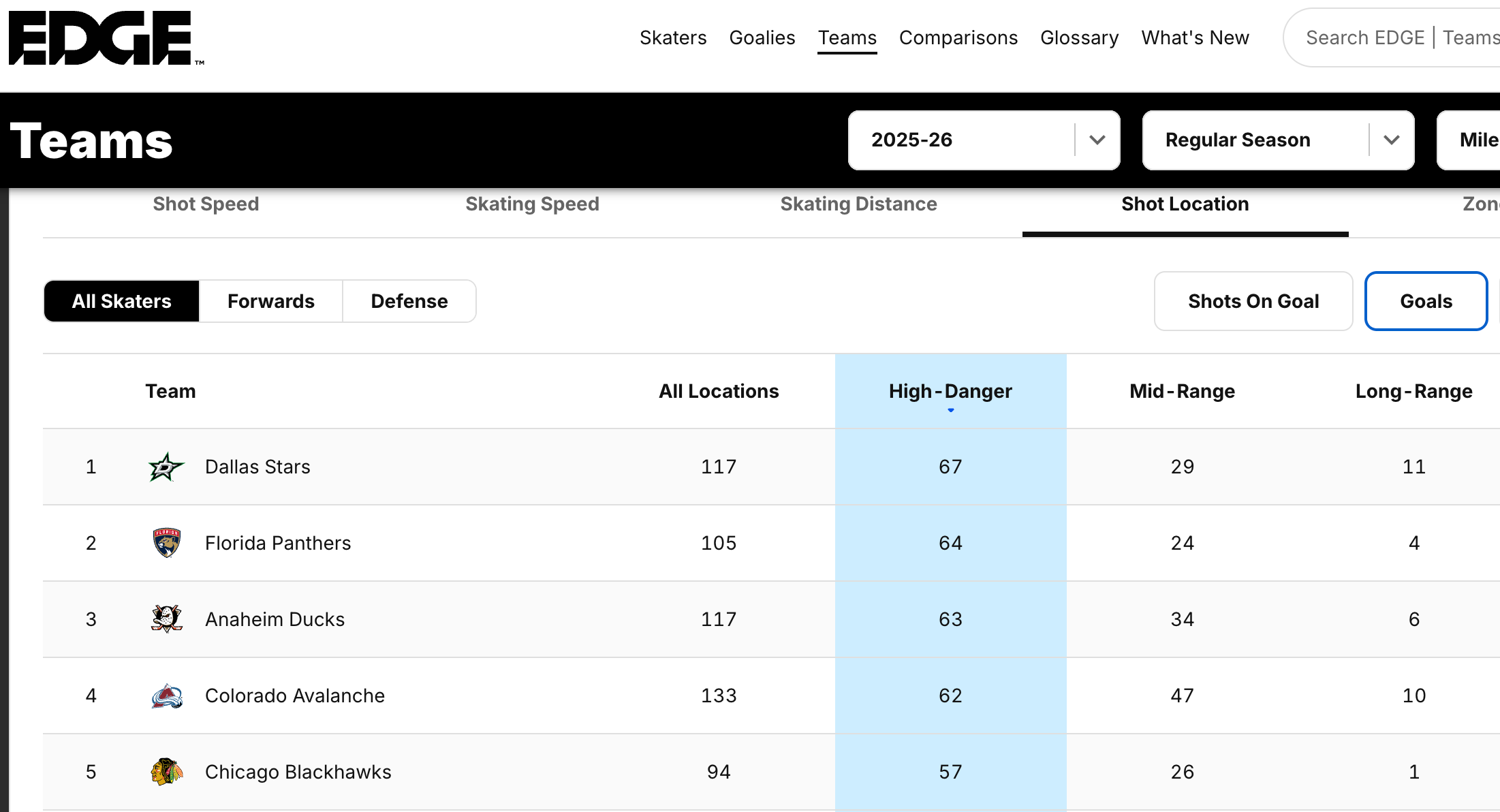
In other words: there is a process here. The question is whether the Stars are happy with it as-is, or whether they still need to raise the floor in order to ensure they keep reaching their ceiling.
So, here’s the question: What does Glen Gulutzan think about the Stars’ shot numbers?
Well, in his media availability after practice on Wednesday, we had the chance to ask him just that, and Gulutzan gave a very thoughtful and nuanced answer that I’m going to include more or less all of below.
The question was: Given the Stars’ 13-4-4 record when they’ve been outshot this season, are shots on goal a misleading indicator in the modern NHL of teams’ actual dominance in a game? And here’s how Gulutzan answered.
“Honestly, I’ve had teams that were less skilled that created more shots,” Gulutzan said. “But it didn’t create more wins and chances—it just created more shots.”
Now, any time you put this sort of conversation in writing, there’s a risk of taking comments out of context. But to editorialize a bit, these responses came across as considered, measured, and thoughtful. That’s just my subjective assessment, but none of this felt remotely defensive so much as reflective, which is why I think it’s enlightening.
Here’s the rest of Gulutzan’s answer, which I’ll put all together here:
Gulutzan: I know you get a little tick for every shot you take on the expected goal meter, but that’s not always the case. I’m going to throw out a team that’s really hot right now: Minnesota. I don’t know where their attempts are, but I know their expected goals from ticks and all that isn’t where you would see Colorado. But they’re good. So each team has their own style, and I find that I love balance.
You guys have heard me say that. I’m not going to force Mikko Rantanen to take a shot from the hashmarks when he doesn’t feel it, when he can hold onto it and look for a different play. I’m going to let him play hockey.
I’m going to let all the guys play hockey, but I am going to ask the bottom-six players: You got to create a little bit more chaos to get your opportunities than maybe a Mikko or a Robo, you know. And I do want all my players to hold on to the puck too. I don’t want them to give it up for, you know, some whipped shot that goes to the front of the net and comes back out the other way. So, there is a balance. There is a balance.
But I’m making it clear here, we do need more attempts. We do need more attempts, because we do pass up, for me, too many shots that look like, that should be a shot, not a pass.
-Glen Gulutzan, 12/17/25, on whether shots on goal can be a misleading statistic
(Emphasis added)
So, Gulutzan is being clear here that while the Stars probably aren’t generating quite as many shots as he’d like to see, he’s also not overly concerned about juicing the shots on goal numbers at all costs. I don’t think it’s taking liberties to say that his quotes here are more about making sure each player is making the best play they can (and should) make, given their situation, skill level, and position on the ice.
Sure, you can quibble over whether you think Minnesota is “actually good” or not, but their white-hot record since November 1 is hard to hand-wave aside when they have league-best goaltending, Quinn Hughes, and Kirill Kaprizov buttressing the work of Matt Boldy and Brock Faber and company. Dallas didn’t lose because of bad luck the other night, certainly.
This is where one media member pointed out a play by Matt Duchene against Los Angeles the other night, when Duchene elected to try a pass back against the grain to set up a teammate rather than taking a shot from a high-quality area himself. And Gulutzan was similarly honest about the risks inherent in micromanaging that process with skilled players like Duchene, so let’s get into his next two big quotes about when he wants to see players shoot or pass, and how he views statistics like Expected Goals.