
How the Dallas Stars' Defensive Zone Coverage Has Changed under Glen Gulutzan
Let's look at some pictures, moving and otherwise

We’re 31 games into the Dallas Stars’ season, and there is a whole lot of good to talk about.
The team is 2nd in the NHL in points with a sparkling 21-5-5 record. In any sane year they’d probably be in first, but the Colorado Avalanche continue to channel the Montreal Canadiens of the ‘70s, so they have to settle for 2nd in their division for now.
Dallas’s special teams continue to be red-hot: the Stars’ penalty kill has vaulted up to 7th in the league, with the power play just 0.1% shy of Pittsburgh for the top spot in the NHL. Scoring in general has also been a delight for fans, with Mikko Rantanen (4th), Jason Robertson (7th), and Wyatt Johston (13th) all among the league-leaders in points this year. Rantanen also has the outright lead in assists in the NHL, with 29.
As a team, the Stars rank 4th in the NHL in goals scored and goals allowed per game. You can’t really ask for much more than that, right?
Well, unless you’re a coach, that is. Because coaches are never satisfied, and the Stars’ 5-on-5 game is clearly in focus right now when it comes to next steps for this team to take.
You’ll recall that the start of the season was a bit choppy, as the offense had to be buoyed early on by their scorching power play. And while even-strength goal-scoring has now risen to 5th-best in the league, the Stars still aren’t controlling play at 5-on-5 to nearly the degree they would like, and Gulutzan has said as much in recent days, too.
“I think we’re a good defensive team,” Gulutzan said on Monday. “But offensively, there’s room for growth for us.”
The numbers back this up, too. Despite their hearty goal totals, the Stars could be in for some regression as the season wears on, given that their underlying offensive numbers are mostly bottom-ten: Shots on goal (29th), Expected goals for (26th), and High-Danger shot attempts for (23rd). They also boast a league-best shooting percentage of 13.3% in all situations, which is generally the first place you look when trying to anticipate some cool-down.
But something that has become increasingly apparent is that this Stars team was able to weather some slower goal-scoring early on not just because of their power play, but also because of their defensive structure as a whole. Even if that hasn’t been perfected yet, according to the new coach.
“What I’m finding in that whole big picture is that the better defensively we play, the more structured defensively we play, we actually increase our offense,” Gulutzan said on Monday. “We still need to dial in on a little bit of the offense, but also defending a little bit better, especially through the neutral zone with some structure, and that’ll allow us to play a little more offense.”
This was even more apparent on Tuesday in Winnipeg, when the Stars got out-shot and out-chanced at even-strength, only to win the Special Teams battle by two goals—enough to win the game 4-3 in regulation.
“We need to improve 5-on-5,” Gulutzan said. “Specialty teams will carry you a long way when you win that battle, especially with the goaltending we’re getting with Casey and Otter. So we got three of the four working, but there’s a lot of room for improvement in our 5-on-5 game.”
But today, I’m going to add a quibble. Because as much as the Stars are getting out-shot and out-chanced at 5-on-5, I think their new defensive structure has made life a lot easier by limiting the most dangerous chances against, thereby making life easier on goaltenders and defensemen alike.
So today, let’s dig into a few clips illustrating the changes in their defensive zone coverage under Gulutzan compared to life under Pete DeBoer.
Man-on-Man Defense
First, let’s look at the good of DeBoer’s defensive system. Because as much as the Stars’ defensive aptitude weakened last season, they were a very good defensive team in the first two years of DeBoer’s tenure, and he deserves some credit for what worked well.
(And of course, the Stars were consistently one of the best offensive teams in the NHL under DeBoer, ranking top-10 in the NHL in 5-on-5 goals, expected goals, scoring chances, and high-danger shots.)
The good was very good, too. In 2024, for example, the Stars outplayed Vegas in Game 7 (and the entire series, really). And you can see how the old man-on-man defensive structure frustrated a lot of the Golden Knights’ attempts.
Even when a juicy rebound pops out here, for example, there weren’t any open Vegas players to grab it:
You can match up every Dallas Stars player with an opposing skater pretty easily. At risk of oversimplifying, Vegas didn’t have the speed to really beat Dallas in a lot of those 1v1 matchups, which gave Dallas enough of an edge to minimize the Grade-A chances against.
In fact, Game 7 was the Stars’ best defensive game of the series, as they kept Vegas almost entirely out of the low slot.
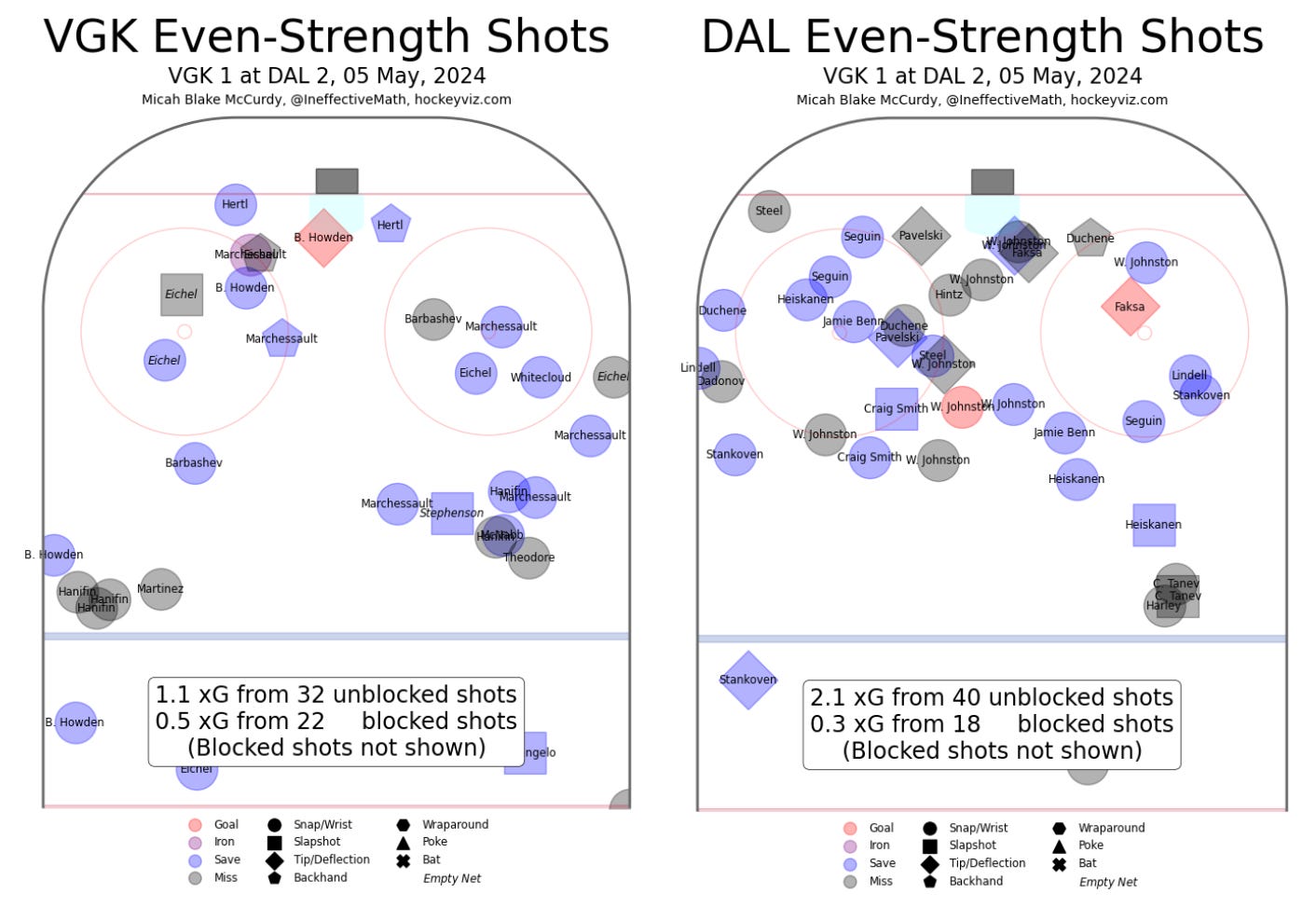
And again in this clip, you can see how Dallas did it: Vegas just had trouble getting open enough to make dangerous plays, and Dallas usually cleaned up rebounds without too much trouble.
But there was also bad, as teams began to get better at exploiting Dallas’s weaknesses.
Take, for example, this goal from Game 1 of the Western Conference Finals last year, when Leon Draisaitl opened the scoring:
This is a great example of the Stars’ man-on-man defensive system under Pete DeBoer, as well as some of its weaknesses, which Edmonton was able to exploit.1 Watch the clip again, and look at how much criss-crossing happens, and how tough it is for everyone to keep track of their “man.”
You can watch Wyatt Johnston (#53 in green) sticking to Leon Draisaitl right up until a subtle pick by Connor McDavid gives just enough space for Draistail to shoot. Or, more pertinent to our discussion today, you can watch John Klingberg (#36 in white) head all the way to the net without the puck, drawing his old pal Esa Lindell (#23 in green) away from the net, eventually leading to Lindell being above the hashmarks on the weak side, because that’s where his “man” went, and that’s where he was supposed to be:
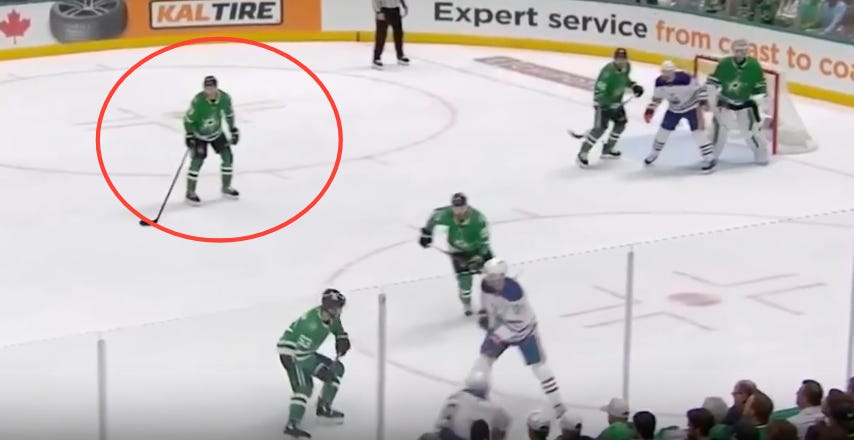
Edmonton (and Colorado) were consistently employing these tactics last spring, with all five skaters trying to draw the Stars’ man-on-man defense wider and wider apart, searching for just one breakdown. Because one breakdown is all it took when everyone was so spread out defensively, and it’s how the Avalanche kept piling up chances in the first round, out-shooting and out-chancing Dallas by a wide margin at even strength throughout the series.
You know the ending though: Thanks to outstanding goaltending from Jake Oettinger and even more outstanding penalty-killing from Dallas (as well as a key tip from Jeff Reese), the Stars stole the series in the final period thanks to Mikko Rantanen’s heroics.
Against Winnipeg, the Stars also won the goaltending and special teams battle, though without getting held underwater at 5-on-5, as they broke even with the Jets in goals: 8 apiece at 5v5.
But against Edmonton in the third round, the Stars’ 5-on-5 scoring completely withered: Edmonton outscored them at 5-on-5 by a humiliating 13-5 margin, and the Stars moved on from DeBoer shortly after he blamed Jake Oettinger for his team’s inability to score at evens.
It’s up to us now to anticipate how Gulutzan’s changes (or “tweaks” as he called them at his introductory press conference) might be better-suited to handle what the best teams can bring. So let’s dig into what’s changed.
Gulutzan’s Hybrid Defensive Zone Coverage
Let’s look at a few shift from the last couples games against Winnipeg and Pittsburgh to illustrate where things are now.
Lindell is a little busier than usual here, even following his man behind the net. But he switches off once he gets to the face-off circle on the far side, in order to stay close-ish to the left side of the net.
Note how Hyrckowian (#49 in white) covers for Lindell at the netfront with Heiskanen when Lindell goes behind it with the puck-carrier. But when Lindell eventually recovers back to the net, Hryckowian then moves out to support the play, shoveling the puck up along the wall, where it gets picked off and fed towards a man at the net—only to have Lindell there to block the pass and clear the zone.
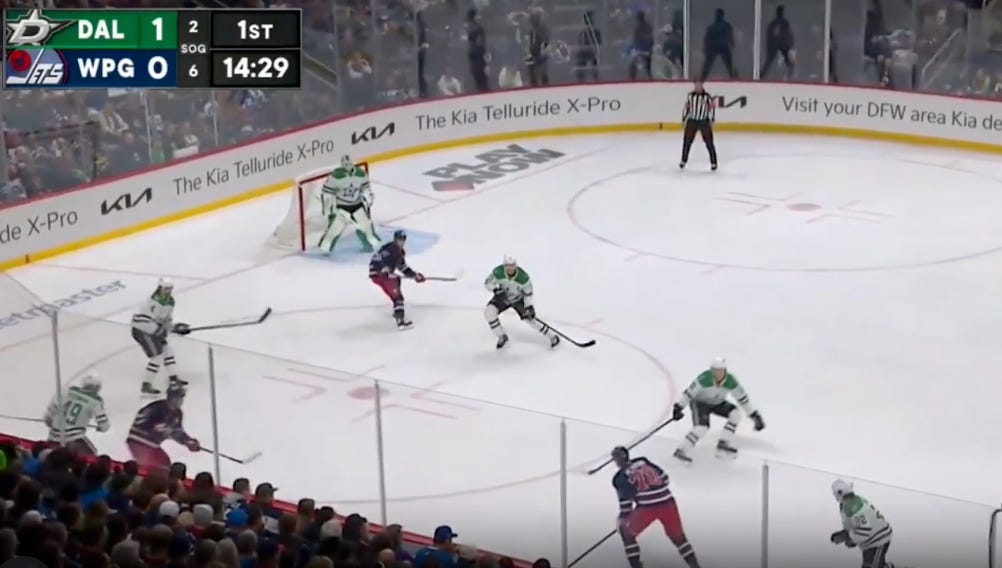
Here you can see the Stars are clearly not marking individual players, as they used to. Instead, the two defensemen are playing “loose” around the netfront, occasionally moving out to attack a puck, but always getting back there, regardless of how many players are there or not.
Centers have more responsibility here, too. In DeBoer’s system, every forward had a man to mark, whereas now, centers are asked to cover the middle of the ice, then attack into the corners while wingers stay further out, ready to close down higher along the walls or support lower if the defensemen go below the goal line.
Watch how the center here (#12 Faksa in white) activates to support a puck battle on the wall, while the wingers (#14 Benn and #95 Duchene) stay higher on either side, anticipating that the players up on the points might be creeping down into the circles. You can see Benn shoulder-check at least twice here, making sure Morrissey (#44 blue) is still back up high. He is not at all sticking to one man, as we saw in the old system.
Against Pittsburgh this sort of structure is also evident, as you can see here:
Faksa (#12, playing center) is in the middle, with the wings having come down low again to support defensemen who have gone underneath the goal line. Duchene closes down his man and blocks a shot, and the Stars have numbers to easily collect the puck and head out of the zone.
Back to the Winnipeg game, here’s an extended look at how Dallas sorts itself out after a 3-on-2 rush gets saved initially:
Again, note how active the center is here (Johnston), covering everything from the slot to the corners, and even blocking a centering pass just by virtue of being in the middle of ice.
You can also note how a winger (#95 Duchene) covers the net-front for the defensemen when they head over to battle for a puck.
But watch Lindell and Heiskanen after the 0:15 mark of the clip. Both of them experience an almost immediate pull-back when they start to go above the face-off dots, and they return to the net-front quickly.
That’s how Lindell is able to box out his man as the shot comes in, and DeSmith is able to get the fairly routine save and give his teammates a whistle.
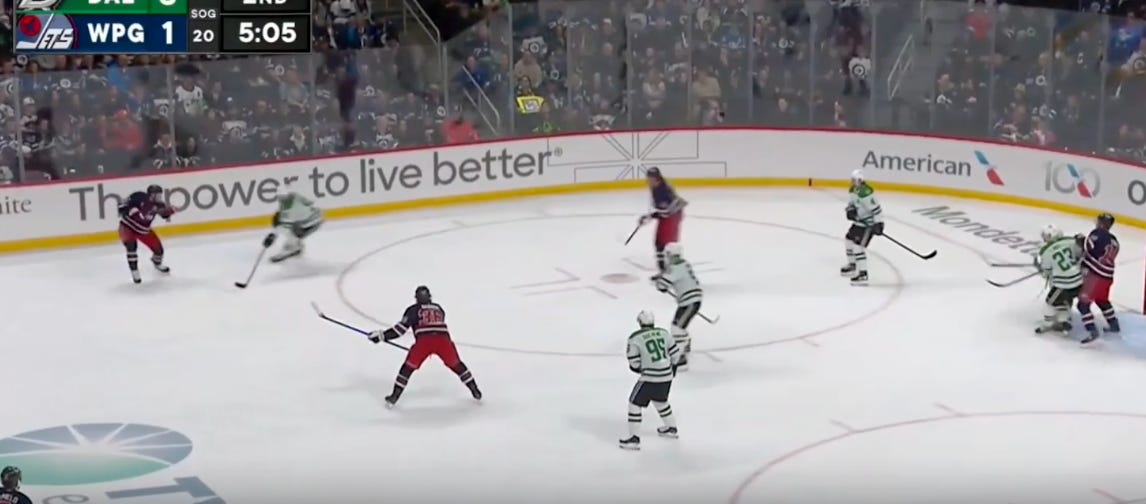
Some basic principles in this system, as near as I can tell, are:
Defensemen are loosely positioned at the net front, activating to attack pucks and passing lanes as their judgment dictates
Centers support in the middle, activating to attacks pucks in the corners and support defensemen along the boards
Wingers stay generally higher and closer up along the walls, supporting closer to the net when puck battles draw multiple teammates away from the net
The virtues of this system are clear from this sequence, where the Jets get a lot of possession, but they never manage to pull the Stars’ structure “apart” the way we saw increasingly last year:
Just watch Heiskanen and Lindell here, and notice how much easier this job is than the man-on-man coverage in the old system. They’re sort of elastic, heading out to attack pucks, but always returning back to the net front shortly afterward.
You can see #49 Hyrckowian (the center) covering more ground than the wingers, as is the center’s job. But when things settle down a bit, you see a sort of 2-1-2 alignment, with the center both vertically and horizontally between the two wingers and defensemen.
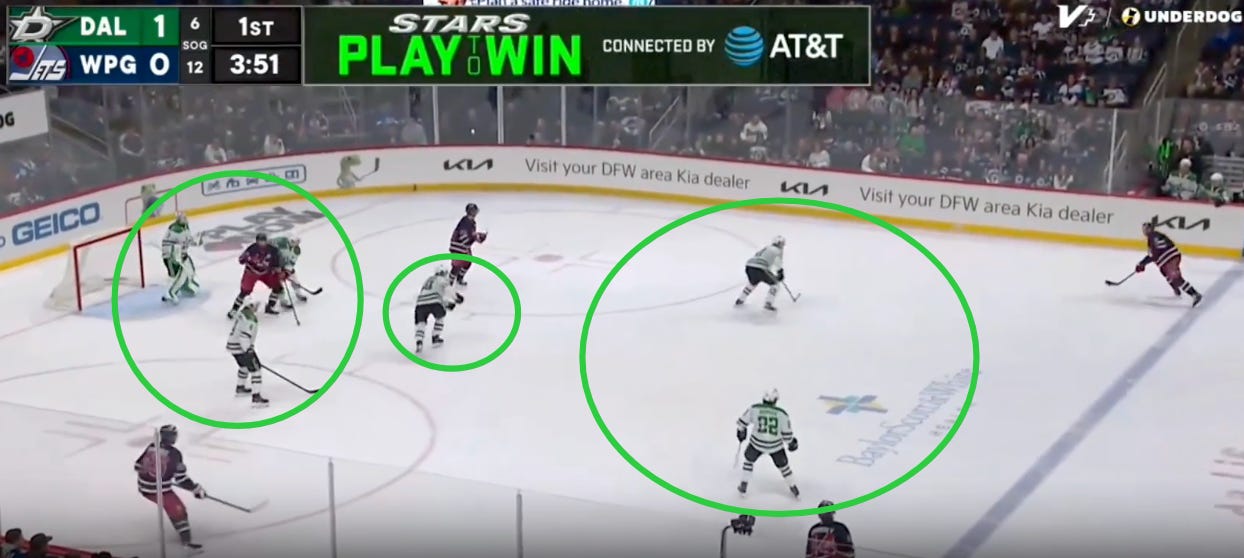
It’s also worth noting how Heiskanen can use his intelligence, speed, and stickwork to intercept the pass down here and get a stoppage. He hasn’t had to traverse the whole zone or battle continually with his man the whole shift. Instead, he and Lindell generally outnumber Winnipeg in the most dangerous areas, such that he can step out and deflect this pass out of play without taking much of a risk in the process.
In talking to a few players about the changes between last year and this year, some common themes have emerged: Defensemen find it easier to play, and goalies are generally more comfortable with the shots they’re facing. Of course there are going to be breakdowns, and of course execution isn’t going to be 100% even when there aren’t; nevertheless, the Stars through 31 games appear to have rebuilt their defensive structure entirely, and they’re already reaping more benefits than you would have imagined as a result.
That’s why the raw shot volume that Dallas is giving up might not be quite as problematic as you would think. Because this isn’t just a team hunkering down and weathering shot after shot, but rather a group of players making tactical choices to cover the low slot both aggressively (any of the five skaters might need to be there) and flexibly (defensemen and centers can attack other areas as needed).
When they’re at their best, that approach forces the opposition to settle for point shots with traffic—a viable but low-percentage approach, even when it generates a couple of goals, as Edmonton managed to in the Stars’ 8-3 drubbing of the Oil last month.
The goalies’ numbers have reflected this as well, as the Stars’ netminders have the 11th-best high-danger save percentage at 5-on-5, compared to sporting the 5th-worst last season. I’m not ready to say that’s entirely due to systemic changes as opposed to just better performance or luck over 31 games, but I do think it’s an interesting number to keep an eye on as the year goes along. Correlation is not nothing, even if it’s not everything.
Individual goalie performance from year to year is probably the trickiest thing to tease apart from all the other factors that affect a hockey game, but both the improved statistics and the Stars’ record overall would suggest that they’re finding a new way to do what they were doing early in DeBoer’s tenure: Score a lot of goals without allowing too many.
And that’s a pretty good way to win games at any time of year.
Overall, you can’t really argue with the Stars have done, because they’ve done so quite effectively, especially in recent weeks.
Since winning 5-4 in Nashville on November 8th, the Stars have gone a white-hot 13-1-2, outscoring opponents by an absurd 62-30 margin during that span. And during those 16 games, they have not allowed a single team to score more than 3 goals.
If you want to cite a metric that undergirds that run, look at high-danger shot attempts, where the Stars are actually on the positive side of the season as a whole. Despite ranking only 23rd in High-Danger shot attempts generated (HDCF) all season they’re seventh-best in High-Danger shots allowed (HDCA)—right next to Colorado, who are sixth.
And if you check back to that November 9 starting point, the difference is even starker: the Stars are 9th-best in HDCF% since then, which is to say they’ve been winning the battle for the front of the net consistently, and capitalizing on doing so overwhelmingly.
If that trend continues, the Stars’ success will begin to look a lot more sustainable than it sometimes felt like earlier in the season. And just maybe, it will prove even more sustainable after the regular season concludes.
I think Edmonton just as equally killed Dallas with rush chances in that series. When you go back and watch all the 5v5 goals in that series (which makes for a fun morning), there’s an inordinate number of Oilers’ chances exploiting space in the neutral zone to get numbers attacking Dallas with space. But we’ll save that for another time.
Great Breakdown Robert.
One thing that I noticed that is much cleaner now than early on when the team was getting used to the system - the first month or so, there were a good number of times where two Stars would start toward an opposition player (especially if they were down low) - so there would be a momentary, and sometimes longer, lapse of coverage in the crease.
The defenders have now gotten much better at communicating and have largely eliminate these coverage lapses. I haven't watched it as closely, but there seems to have been a similar learning curve between the defenders and the forwards. So much here is dependent on efficient switching, so communication is key, and it seems like the Stars have reached the point where much of this is happening just as a matter of course.
Seeing it in action, I love it.
Kinda similar to what Cassidy brought to Vegas after they fired ... wait for it ... Pete DeBoer.
Remember how Vegas players were openly so happy about the change, wonder how that season went for them as well.