
Founder's Choice: "Why Do the Stars Always Seem to Get Goalied?"
It's time to answer an age-old question, or at least a decade-old one

Today, we’re featuring another Founder’s Choice story. Today’s piece was requested by one of the Founding Members of Stars Thoughts, Jason H.
Founding Members get to request an essay to be published on Stars Thoughts of at least 1,000 words on a topic of their choice, subject to my approval and modification. Today, we’re attempting to answer a question that Stars fans have been asking for ages: Why do goalies always seem to have the game of their life against the Stars?
If you would like to become a Founding Member, you can do so at starsthoughts.com/subscribe.

Confirmation bias is real.
To prove this, you have only to read a story from a partisan news source to find them highlighting a story that appears to reinforce the worldview of their fanbase. For example, if you think crime is on the rise, you can easily find a story about a crime being perpetrated, and voila! That will probably be enough to validate your assumption, even if the data we have shows that crime has actually dropped pretty substantially over the past 30 years. We look for patterns that confirm our experiences and opinions, just like how you notice more people driving your same model of car after you get it than you did before.
So, when a reader asked me to dig into why it seems like the Stars constantly face a goalie playing the game of his life, my first assumption was that this was the same phenomenon, which I will call “The Stuart Skinner Principle,” for no reason in particular.
Well, maybe for one reason: Last spring, in the Western Conference Final, Stuart Skinner put up an absurd 5-on-5 save percentage of .945, while the Stars’ goalies combined for .852%. (which was only Jake Oettinger, until Casey DeSmith came into Game 5—not sure why the goalies changed, maybe someone covered that, seems like it could be a story).
Skinner actually got hot in the preceding series, when he shut out Vegas in back-to-back contests to lead Edmonton to a 4-1 series victory after taking over for an injured Calvin Pickard, who had himself displaced Skinner after his struggles against Los Angeles. But that hot streak stopped soon after Florida arrived, and Skinner ended up getting pulled for Game 5 against the Panthers after surrending 16 goals in four games (which averages out to a 4.00 GAA, if I’m doing my math right). Calvin Pickard wasn’t any better, so Skinner came back in for the Game 6 loss.
And of course, the season before, Skinner also outdueled Jake Oettinger, putting up a sparkling .922 save percentage in the six-game series in 2024, which was actually more competitive than the 2025 version, if you can believe it. (You can probably believe it.)
So, Stuart Skinner has kind of owned the Stars for two straight years in the playoffs. Would it make you feel any better if I told you that, during the regular season, Skinner has actually gone 1-3-0 against Dallas over the last two years?
2023-24: One game against Dallas, a 3-4 loss in which Skinner managed a .852 save percentage.
2024-25: A 1-2-0 record in three games against Dallas, across which Skinner gave up 3, 4, and 4 goals. That one Oilers win was that crazy 5-4 game the day after the trade deadline, when the Oilers went up 5-1 on Mikko Rantanen’s new club, but ended up having to hold on for dear life after the Stars scored three goals in the third period, capped off by Matt Dumba’s only tally of the season, only to have the comeback fall just short.
Okay, I am now being told that this did not make you feel better. Sorry! I tried.
But Jason didn’t ask me about Stuart Skinner, or even about Mackenzie Blackwood, who allowed just seven goals across his first four games in the first round against Dallas, before the Stars finally solved him in Game 5, after which they turned Blackwood’s .939 save percentage from Games 1-4 into a pumpkin with the number .806 caved into it across games 5-7.
In fact, Reader Jason didn’t even ask me if this always seems to happen, becuase he’s smart enough to know that it absolutely does, sometimes. Instead, he asked me why this always seems to happen to the Stars. And that’s a question that I remember asking myself more than once.
Because, full confession here: I am still occasionally haunted by visions of James Reimer racking up 43 saves against Dallas in November of 2015…
…followed by Reimer making 36 saves just eight days later.
I mean, this save right here still kind of annoys me, so much so that I had to clip it again just to make sure you all saw it:
No goalie has any business making this save, in this fashion. Just let the puck go in, man. It’s November! Read the room, smh.
Still, it wasn’t a uniquely Dallas curse. Reimer also “goalied” the Hurricanes and Canucks just as much that season. The Stars were in his top-three favorite opponents, in terms of overall saves, however, so it’s nice to know you’re appreciated, I suppose.
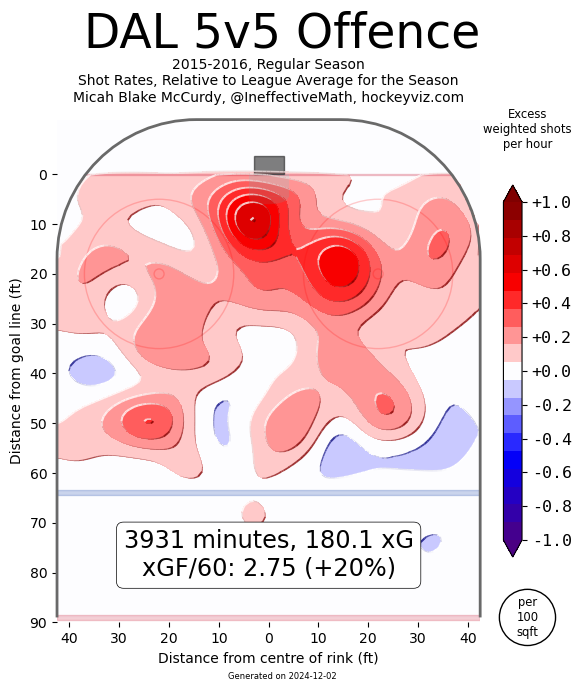
I feel pretty confident in using those two games as a pretty good example of said confirmation bias in my own life, too. If anything, they stick out in my memory to this day because the Stars actually had the best shooting percentage in the league during that ‘15-16 season, along with the second-most shot attempts per game. So for them not to get rewarded for peppering the opposing net was absolutely an outlier that year, and in general under Lindy Ruff, from 2013-2016.
Here’s what that menacing 2015-16 attack looked like en route to finishing atop the Western Conference after 82 games:
(2016-17 also happened the next year, but everyone was injured from the World Cup of Hockey thing, and the penalty kill was made up entirely of cardboard boxes stacked in front of the crease, so it’s best not to talk about that season.)
Skipping ahead to Rick Bowness (2019-22), the Stars were mid-pack in terms of shot attempts per game, but they were bottom-ten in shooting percentage. And when you dig into a season like 2021-22, you can see the emphasis was a bit more on tips and deflections. In fact, those Stars were 2nd in the NHL in goals scored on tips or deflections, but 21st in the league in goals scored overall. Furthermore, 55 of their 233 goals were scored in those two ways—nearly a quarter of their entire total!
A Pavelskian design, to be sure, but DeBoer’s Stars got into the top-10 in the league on snappers and wristers, and that revitalized the club in a massive way, not to mention making them a whole lot more fun to watch, too.
Back to the current decade for a moment: Last season (‘24-25), the Stars had the fourth-best shooting percentage in the NHL during the regular season in all situations, but they were a middling 15th in shot attempts per game. In other words, they were picky about when they shot, but when they did, they made it count, as you can see:

This is a trend that was less stark in 2023 and 2024, when both shot attemps and shooting percentage were among the league’s top ten. But Dallas’s high-danger shooting percentage (all situations) was consistently among the best in the league, too. that’s a good combo.
In other words, the Stars have generally been more choosy with their shots under DeBoer (though Bowness also discouraged indiscrimately shooting the puck from the walls and other low-quality areas, to his credit), and Dallas has generally been more successful than most with high-danger shots since 2022.
So in terms of wider trends, I think it’s fair to say the Stars haven’t been getting “goalied” more than most teams in recents years (which you’d expect from the NHL’s points leader over that same span). But there have, undeniably, been some moments that really stick out.
I mean, there were some odd ones even last year, like Lukáš Dostál’s Vezina-channeling performance on November 18:
The breakaway stop on Hintz was one thing, but the Lyubushkin shot off the elbow on a 2-on-1, then the Tyler Seguin shot off the crossbar on his own breakaway…well, there was clearly a curse on this game. Esa Lindell broke it by shooting a puck off a Duck stick early in the third, and Duchene would fight through a hook to score on a breakaway of his own at last, but Dostál was still doing ridiculous, hippity-hoppity things like this as time ticked away from Dallas.
I’m pretty sure that’s a cool nineties skateboard move of some kind, just without the skateboard. Anyway, the Ducks won, because remember how the Stars were kind of scuffling for a bit last fall? I am sure you do remember.
Still, the Stars were far from the only opponent to get stymied by Dostál last season. If you sort his gamelog by save percentage, you can see that he dominated the Islanders, Predators, and even the mighty Oilers more than he did Dallas. Sometimes, goalies just get hot for a while, and he certainly did.
More systematic approaches to this question are possible. If I were Elias Sports Bureau with a fancy computer, I could download every game for every team from the past decade and look at team losses with the biggest shot-differentials, then filter out the high-caliber goalies (since I think it’s fair to say it doesn’t really feel the same to get “goalied” by Connor Hellebuyck as it does to get “Reimer’d”). I did not do that, but maybe they will. I will ask them when I see them.
I could, and did, look at the Stars highest shots-on-goal losses from last season and compare them with my notes from said games. But I should warn you beforehand that score effects tend to mean that extra-high shots-on-goal totals tend to happen when a team is trailing, and the other team is sitting back. Thus, a lot of high SOG games actually turn out to be losses, while a team’s fewest SOG games tend to have more wins in them. Sort it out for yourself if you don’t believe me!
Nonetheless, let’s start with Dallas’s highest shot total of the year last season: when they shot 42 pucks on goal against the New York Rangers.
And, of course, they lost by the score of 3 to 1. But I think the answer to this one is pretty easy: Igor Shesterkin was incredible, as Vezina Trophy winners often are. No great mystery to this game.
(Fun fact: that game featured a Jamie Benn goal called back for off-side. I am not saying that the offside review rule robbed Benn of his 400th goal last season, but also I am definitely saying that. Abolish the rule, and also the dumb trapezoid behind the net already. It’s been 20 years!)
Dallas’s next five highest shots-on-goal totals that ended in losses last year were as follows:
40 SOG: December 6th: 3-2 loss to some guy named Adin Hill in Vegas (featuring another goal called back after a GI review). The shot-on-goal total really ramped up in the third period with Vegas sitting a lead, so score effects were a factor. But overall, Dallas deserved better, given the shot quality they generated. Then again, we’ve seen Adin Hill do this before, unfortunately.
39 SOG: December 18th, 5-3 loss to Joseph Woll and Toronto. Sam Steel and Wyatt Johnston scored on partial breakaways, but Roope Hintz got stopped on his own chance, and then William Nylander and Nick Robertson went off as the Toronto third line racked up three tallies). But Woll really was outstanding, including robbery on Heiskanen late. Also, the Stars were missing Thomas Harley in this game due to the flu (which was almost certainly affecting others, too).
36 SOG: November 1st, in Finland. The Stars were down 3-1 after one period and generally got outplayed through 60 minutes. Less of a “goalie-ing” than a “These are the champions are you are not”-ing.
36 SOG: November 18th, the loss to Anaheim mentioned above.
36 SOG: December 12th, the 4-1 loss to Nashville in which the Stars just didn’t look good, and which also may or may not have been the death knell for the Darkness music.
I suppose you could also include the Stars’ 33-shot losses to Connor Hellebuyck and Jakub Dobeš, which would be the next two games on the list, but I think the big theme of those top-five shooting gallery losses was pretty clear: they all happened before Christmas.
Remember, the Stars were dealing with slow starts by a few players, as well as (and related to) recovery from injuries to Robertson, Bourque, and Johnston early in (or before) the season. The power play was also struggling, and that meant they were frequently trailing these games in the third period and having to muster late presses with frustrated shooters. Problems like that can compound themselves in stressful times.
This matters. Science says so.
Frustration is the enemy of accuracy. Confidence is everything to NHLers, because when you don’t completely believe you’re going to score when you release a shot, you tend to do more than you need to, rather than relying on muscle memory and training.
In baseball, the “yips” are the most severe form of this lack of confidence, leading to a breakdown in the ability to even throw a ball accurately—the most fundamental skill of that game. And the most research that’s been done on the yips, the clearer it’s become that fear of the consequences of a missed throw lead to worse accuracy.
You can read this brain study if you’re really into it, but here’s one relevant excerpt:
All of this suggests to me that the novice is too emotionally involved with their result and also cannot organize themselves to repeat any success he may or may not have. Milton also noted that only the novice golfers would ask questions concerning factors such as whether the distance given to each of the holes was similar, and if there was wind or not (despite being told beforehand to assume there was none). Milton thus concludes that novices were actively participating in the task, but were unnecessarily preoccupied with details that were irrelevant for the required task. Hence the reason efficiency in the mind of an athlete is so important is to filter all the unnecessary stimuli and focus on the task.
Last year, when the Stars were getting “goalied” in a few of those games early on, I really think it was as simple as that. Shooters who were still trying to build up their confidence after slow starts to the season weren’t operating completely naturally, which might have led to more preoccupation during the shooting process.
Conversely, each save a hot goalie makes tends to boost his confidence (or at least that’s what a few NHL goalies said last year when I or others asked them about it), allowing that goalie to move even more naturally. Skinner in particular has always struck me as a goalie who is more susceptible than average to these swings for better or for worse, but that’s anecdotal and subjective. I’m hardly qualified to say that with authority, though that doesn’t seem to stop much of the media up in Skinner’s home province.
The old saw about “gripping the stick too tight” isn’t always true, but I do think decreased shooting accuracy is more common when players face recurring frustrations, or when a player gets nervous for any reason, really. Rookies in particular tend to be viewed as more susceptible to the latter (and who could blame them)—though of course there are always those who buck the trend, like Wyatt Johnston in a Game 7.
When it comes to the Stars, however, I think the nature of “getting goalied” has been highly dependent on the team Dallas has. Two points here:
Under rich offensive regimes like DeBoer and Ruff, great goaltending performances stood out especially strongly. The offense had conditioned us to expect more goals, so great goaltending sticks in our memories more because it was an aberration from the norm.
Thus, during lean periods, like when the Stars were 21st in goals from 2017 to 2019 across Hitchcock’s last tour and Montgomery’s debut, it tended to feel—I think—less like the Stars were “getting goalied,” and more like they were “getting beaten.” They weren’t generating high-quality chances as often, so it felt more like they were being well-defended that robbed by the goalie, even if both happened at times.
I mean, do you remember the Stars getting “goalied” much in, say, 2010? I’m sure Jamie Benn probably does, but I am betting you probably do not. Generally, I think, only really good teams make observers feel like a goalie is playing out of his mind against them.
For instance, let’s go back to a season we skipped earlier, and let’s look at how many of their highest-shooting games the Stars lost under Ken Hitchcock 2.0 back in 2017-18:
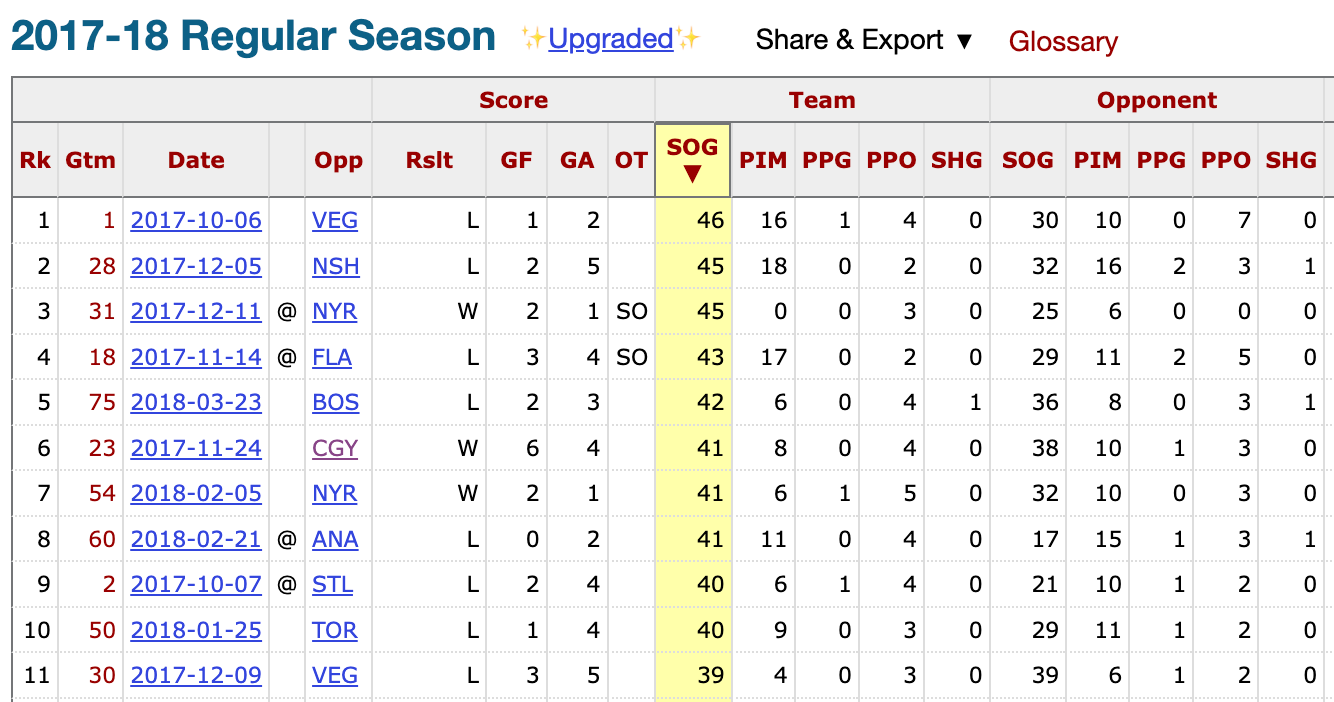
Hitchock’s team generally won the expected goals battle from night to night, because they played a solid, defensive system that kept games close at even-strength, where they had a +19 goals differential. I think they deserved to make the playoffs that year, but injuries to Ben Bishop came at the worst possible times (including the opening night game against Vegas), and a 19th-ranked power play didn’t help. Combined with the fact that they had the 5th-worst penalty differential in the NHL that season, those Stars just weren’t firing on all cylinders, even as Hitch did begin to fix some things that had become seriously broken in the preceding season.
That club also ended up going on a late-season skid every bit as bad as last year’s Dallas team did, and it got to the point where this was the lineup Hitch rolled out late in the season after the Stars returned home to play Boston following a disastrous 0-4-2 road trip:
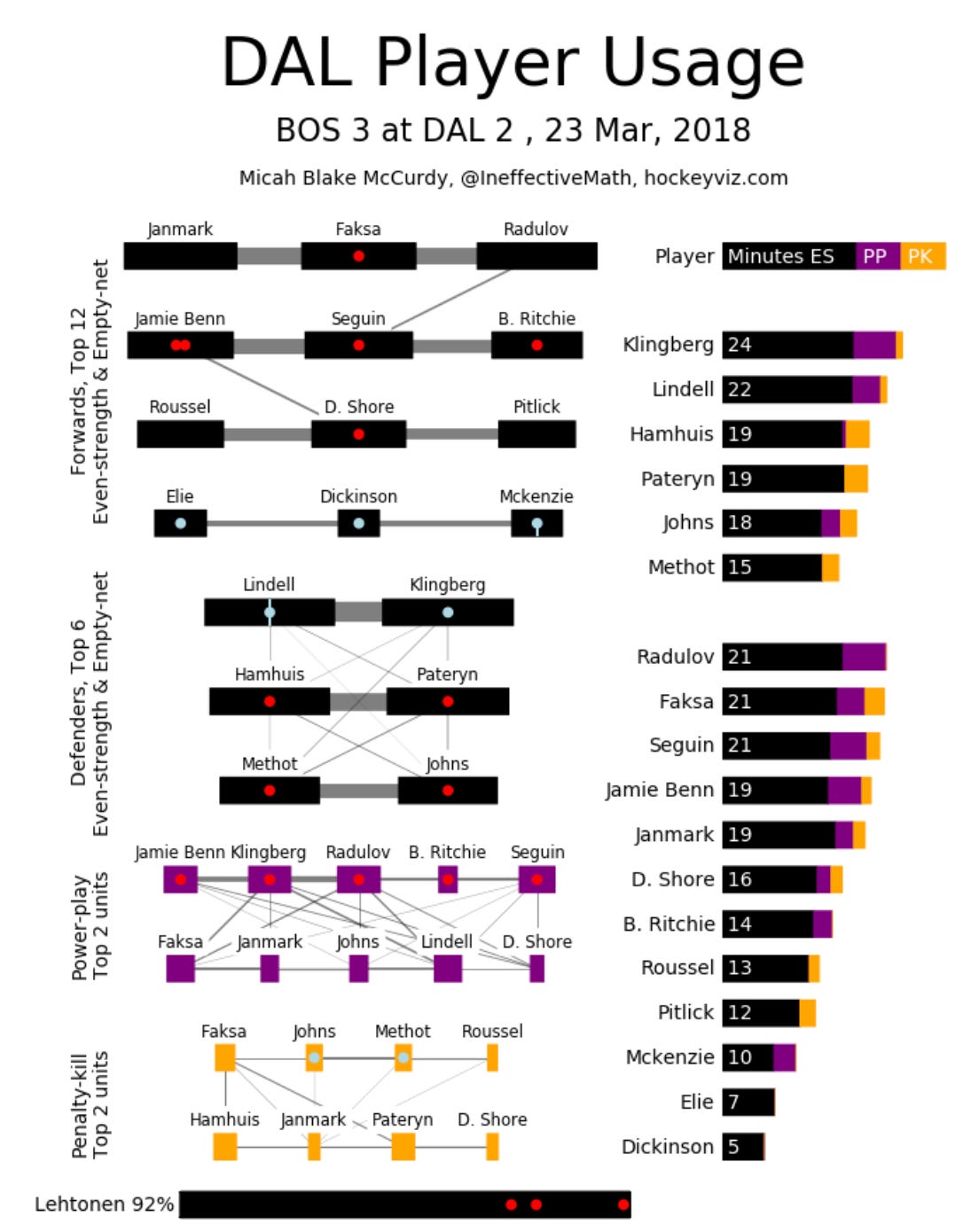
They lost, again.
Were those Stars “getting goalied” every night? Well, not really, except when randos like Curtis McElhinney were putting up .975s on them. Then, yes. But mostly, they just plain weren’t good enough or deep enough (or healthy enough) to tip the scales in their favor often enough. And that means the other goalies tended to look pretty good. Or at least good enough.
They played solid defense, absolutely, which was the whole idea behind bringing in Hitch again. But when they did get behind, they didn’t have that extra gear to make up the gap, or the depth to grease said gear. In fact, those Stars were just 3-24-2 when trailing after two periods. They would end the season with a +9 goals differential across all situations, as a team. Fine, but not quite good enough.
All told, after this trip back through the decade, I believe question of whether and why the Stars get goalied is a pretty straightforward one. The more I look at the data (and the 27 open tabs I have right now give me confidence that we’re good with data, thank you, no more please), the more I think you can really boil it down to three phenomena:
When you have a dangerous offensive team, you’ll meet a hot goalie once in a while, and those games will stick out in your memory, because your offense will keep generating shots and high-quality chances, forcing more and more saves from the opposing goalie, which you will remember. But those games usually won’t happen all that often in good seasons.
When you have a less-deep offensive team, your margins of victory will be slimmer. That means every goal will feel like it takes large amounts of effort to produce, especially against quality defensive opponents.
Remember the Calgary series in 2022, or St. Louis in 2019? In those cases, you’re not “getting goalied” so much as you are failing to push the opposing goalie past his breaking point. It’s a failure of creation as much as finishing.
For an example of what it looks like to find a goalie’s “breaking point,” you might recall this game from Jim Montgomery’s fourth game coaching the Stars, in 2018.
(This was one of two games that season where the Stars put up 50+ shots on goal. They won both times. Little did we know this team would end up 28th in the league in goals by season’s end.)
And sometimes, a goalie like Jakub Dobeš comes along and wins the first five games of his career by winning an all-out goalie duel against Jake Oettinger, in a game decided by a deflection to break a tense, 1-1 tie. NHL players are pretty good, you know, and sometimes these things just happen. There doesn’t really have to be a reason for it. Sometimes you just get Hamburgled.
By the way, Jakub Dobeš’s first victory of his career came just a couple weeks games before that win against Dallas. It was a 4-0 shutout victory, and one that was against a pretty darn good team, too.
Even when hot goalies do come along, you can rest assured that it doesn’t only happen to Dallas. Because, if anything, it’s been happening for Dallas. Even if you can’t stop thinking about a certain Edmontonian netminder, I’m not sure the last two Edmonton series have been anywhere close to balancing out the excruciatingly impotent offenses dragged to their absolutely ceiling by goaltending that we saw in Game 7s back in 2019 and 2022.
In both of those cases, the Stars were the ones on the cusp of the goalie-ing of the year against a better team. Lest you forget: Dallas lost in overtime in both of those Game 7s despite Ben Bishop (52 saves) and Jake Oettinger (64 saves) putting on goaltending clinics that many goaltenders never do in an entire career. It remains criminal that Dallas couldn’t get one more goal for either goalie, but I suppose robbery is also criminal, so maybe it’s a wash.
Yes, Dallas has sometimes gotten goalied. All teams do. And in seasons where offense has been harder to come by, they’ve racked up lots of shots in losses that rankle, even in great seasons.
But the when of those moments has been much more painful in recent times, on account of its coming in the third round of the playoffs. And the Stars are probably still on the positive side of that ledger, all things considered.
Sometimes, it doesn’t only happen to you.
Can we get the boys some flu shots this year? Make CVS or whoever pay for it, it's the easiest marketing opportunity in history
Interesting observation about Blackwoods’ success through the first couple of games in the first round.