
What We've Learned about the Combat Readiness of Glen Gulutzan's Dallas Stars after Just Two Games
A fair bit, really

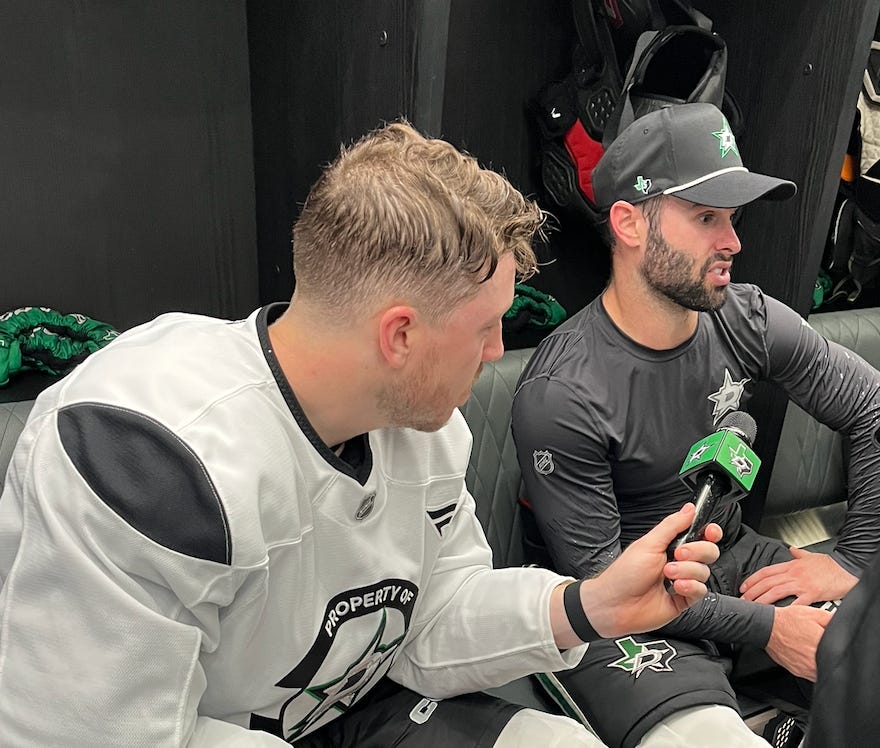
The Stars have earned four points in their first games of the season, which is quite literally the best outcome they could have hoped for. Two wins on the road against two tough opponents is a dream start for any new coach.
How those wins happened isn’t quite so dreamy, of course. A 5-1 lead in Winnipeg was narrowly preserved after the Stars gave up two ugly shorthanded tallies in the blink of an eye, and only a clutch penalty kill late in the game saw them escape with a win. Still, their 5-on-5 play was extremely strong, and Mikko Rantanen and Jason Robertson looked every bit like the top offensive forces they are.
In Colorado, things were a bit less glass-half-full. But when the bit of water that is in the glass is named “Jake Oettinger’s Super Duper Goal-Saving Water” (do not drink a bottle of this water should you ever find it so-labeled), you can still make lemonade out of misused metaphors. A win is, technically, a win. And I’m sure knowing that win drove Colorado nuts was just a little bit extra special, too.
It’s important to note that Glen Gulutzan was not terribly pleased with the Stars’ play in the Colorado game, which is to say he thought they lost battles and didn’t have their legs. Still, to score five team goals against a team like Colorado when you don’t play a very good game is an accomplishment almost as big as breaking down Nathan MacKinnon’s psyche to the point where he’s still hearing the home crowd’s booing well after the game.
But we’re getting off track, so let’s get back to Gulutzan, who has thus far been pretty forthright when asked about what he has and hasn’t liked about a given game. What has Gulutzan learned about his team after two games?
“We have a bunch of guys that don’t need much to score,” Gulutzan said in answer to just that question today. “But what we need to do is keep pushing the territory battle into our favor, because if you just counterpunch, like we did the other night, it’s not a good recipe to take out the top guys, the top, top teams. You can’t do that by counterpunching your way [there]. I think if we gain more territory, with the players we have, and win the territorial battle, it will even increase how good we can be.”
When Gulutzan talks about “territory,” I take it as a proxy for puck possession and forechecking, though of course there’s more nuanced ways to break it down, including everything from Grade-A scoring chances to odd-man rushes in general.
And the Stars have a lot of X’s and O’s approaches to all those things, including some new breakout tactics and defensive zone coverage, the latter of which was pretty apparent on Colorado’s first goal the other night, when you could see Lundkvist and Johnston get caught betwixt and between when it came to someone going out to cover MacKinnon before he fed it across to Martin Nečas:
(EDIT: Commenter “Chebad” perhaps correctly points out here that Lundkvist is actually gesturing for Rantanen to come down the wall to MacKinnon, which would have allowed Johnston to stay in the center of the ice. Either way, Lundkvist can’t let that pass get through like it does, though.)
As far as the systemic adjustments, I think it’s worth waiting a few more games before rendering even preliminary judgments. There are three years’ worth of old habits to unlearn in certain situations, and even a team full of the best hockey players in the world (as all NHL teams are) is going to take a bit before they completely re-program their instincts.
But tactical shifts are not what I’m most focused on right now when it comes to what Gulutzan is trying to do with this team. They’re important, but even Gulutzan is pretty up-front about the fact that everyone scouts everyone, so nobody is expecting to catch another team completely by surprise. By and large, they’re tweaking things far more than re-inventing them.
There’s an exception to that step-by-step approach, however. I talked about it briefly today as a guest on the DLLS show, and I think it’s the same thing Gulutzan has been saying every since his introductory press conference, and probably even during the interview process with Jim Nill, Tom Gaglardi, and whoever else was in that room.
In fact, it’s even related to what we saw them doing at the end of practice today, where players paired off to compete in 1-on-1 battle drills.
(Side note: Jamie Benn was at practice as a spectator again today. I have to think it was hard for him to be sitting out of a drill like this one.)
This was an exhausting drill, and this rep was the third of three, so you can see how tired a lot of the players are by this point. Gulutzan compared it to wrestling, and anyone who’s ever wrestled even just with friends knows how incredibly quickly full-on battling like that can sap your energy.
The gist of the drill is that two players raced off the wall to get a puck in the middle of the ice, after which you tried to get the puck and keep it by whatever means necessary. Then whoever had possession of the puck after 15 seconds won the competition, while the “loser” had to do push-ups, as you can see in the above clip.
“Some of the messaging today was, when all talent becomes equal on both sides, it comes down to hand-to-hand combat a little bit. Just a little battle drill.” Gulutzan said with a smile.
And that, I think, is what Gulutzan wants to see from this team immediately, and for the next 80 games and afterward: he wants the Dallas Stars to become more combative.
Now, it’s easy to resort to narratives here rather than talking about what is actually happening when a team wins or loses hockey games. But in the Stars’ case, they’re uniquely positioned as a team with a ton of talent and a lot of depth. Gulutzan even pointed to how “highly evolved” the penalty kill is under Alain Nasreddine today. This isn’t a bubble team relying on hype and “will over skill” to make up a huge gap in talent between them and the teams they’re trying to catch.
Instead, this is a team that pretty clearly hit a wall three years in a row, and it’s a wall that Jim Nill himself has said you have to be very careful about assessing, lest you end up taking a step backward in trying to overcome it. You can’t tear everything down when you’re as close as the Stars have been to getting over it.
But what you can try to do is adopt an approach that can help a team withstand the brutality of the playoffs; a combat mentality, if you will. I really believe that Glen Gulutzan (and other folks in the organization) believe that the Stars’ more tactics-based approach in prior years was enough to get them precisely as far as it did: second-best in the Western Conference, behind the Oilers, Oilers, and Golden Knights.
One of those series, of course, was lost for good after an overeager Jamie Benn got suspended for getting, ah, too combative with regard to Mark Stone.
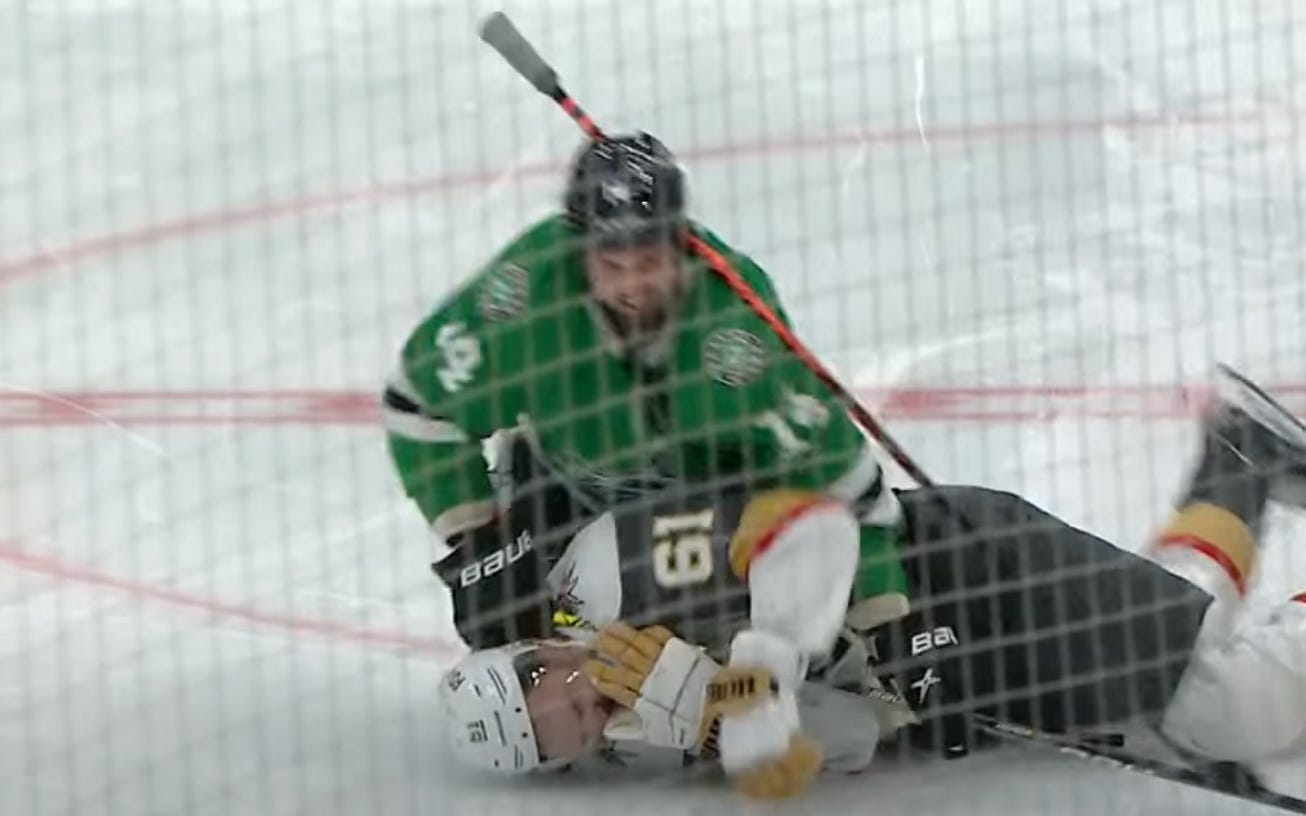
Then in 2024, a Stars team that had played most of two rounds willfully shorthanded on defense finally ran out of gas after going up 2-1 on Edmonton, as the top players DeBoer had leaned on for two rounds finally had no more to give. Joe Pavelski and the power play got stifled, and Miro Heiskanen looked completely drained.
And most recently, in 2025, Dallas survived two rounds without a healthy Robertson or Heiskanen, thanks in large part to heroics from Mikael Granlund, Mikko Rantanen, or even Tyler Seguin in Game 1. That’s when Edmonton once again subverted the Stars’ tactical approach, this time at 5-on-5, and they rubbed it in with multiple slashes to Roope Hintz, who suffered a broken foot. And as the team ran out of answers, the pressure started getting to everyone, with Jake Oettinger drawing the bulk of DeBoer’s blame in and after the final game.
Each of those three playoff eliminations happened on its own merits (or lack thereof), but when you take a look at all three of those Western Conference Finals, as Stars management was surely doing before Gulutzan was hired, I do think you can see a pretty common theme: They were getting pushed around too much, whether literally or tactically, far before those defining moments took place.
In 2023, Benn’s penalty came with the Stars already down 2-0 in the series and 1-0 just 90 seconds into Game 3. In 2024, McDavid danced around Heiskanen in Game 6, well after the Oilers had already turned the series around. And in 2025, it was with a 3-1 series deficit that Oettinger was pulled from Game 5.
The real problems in those series weren’t as much about the defining moments, but about how the Stars got pushed out of those games repeatedly, whether tactically, physically, in net, or all of the above.
Gulutzan, this time around, is pretty clearly dedicated to finding the best answers in every situation, but to also deploy them with a battle-harded and combat-ready team. Even today, Gulutzan said a lot of the decision process about forward pairings and overtime combinations involves combining analytics, scoring chances, and what the coaches’ sense on the bench has been. This isn’t a team thinking that they need Ryan Reaves or Pat Maroon to Kool-Aid Man their way through a more skilled opponent, or even something much dirtier and infamous.
I really think that Gulutzan’s approach has been focused on not leaving meat on the bone. That includes his own coaching approach and tactics, as well as the data he’s getting from his analytics team. (You’ll repeatedly hear him talk about the latter, by the way, and I don’t think that’s an accident. He, like the Stars organization under Jim Nill in general, genuinely believes that more information is better, and they’re trying to synthesize every bit of information they can find in order to build the most efficient lineup they can.) They believe this team has a bit more to give, and they’re going to find that little extra bit in every situation they can.
Sometimes, that will mean juggling forward lineups rather than being married to certain players on certain lines. Jason Robertson “should” play on the “top line,” for instance, but the coaching staff hasn’t been afraid to start him on a different line with Wyatt Johnston, even if Robertson has ended up playing more minutes with Rantanen and Hintz, all up.
They’ve even chosen to put Colin Blackwell and Sam Steel into top-six roles (at least in terms of original lineups), even if their practical usage has resembled third-line deployment when all is said and done.
I believe Gulutzan knows exactly what people are likely to say when they see Steel or Blackwell taking line rushes in those combinations, but he’s not focused on outside perceptions right now. Part of that is the luxury of being 2-0-0, and part of it is the nature of joining a team that has been so successful for three years. But all of it goes back to who Gulutzan is as a person, and as a coach.
In terms of forward lines and defense pairings, we’ve learned that Gulutzan is stubbornly flexible, sticking with things like Harley-Lundkvist and Johnston-Robertson (at least to start) even if everyone knows there are other possibilities that can and will be explored.
In terms of messaging, we’ve learned that Gulutzan is not afraid to speak plainly about some of the basic (and well-known) tactics the Stars (and most teams) use, such as the neutral zone wedge teams try to employ during 3-on-3 overtime without the puck, before going man-on-man in the defensive zone, like he mentioned today.
In terms of accountability, Gultuzan has been clear that he is going to call out his team in the preseason or even Game 2 if he sees correctable issues. That’s included the lack of response after Lian Bichsel’s fight in their final preseason match, as well as the Stars’ lack of legs in Colorado. I don’t expect that his blunt honesty will change any time zone, so long as he isn’t actually giving away real secrets (which he has noted he can’t talk about, at times).
Two games is impossibly early to panic or celebrate (unless you’re the Buffalo Sabres), but it’s not at all too early to recognize what we’ve seen: Justin Hryckowian, sticking up for Miro Heiskanen; Mikko Rantanen, bullying Winnipeg Jets players around in the first game of the season; and even Esa Lindell, coming down low in the offensive zone because he can see that Nate Bastian has won the net-front battle against a terrifying Colorado team, and deserves to have a puck put onto his stick.
And we’ve seen Jake Oettinger shaking off four goals against to lock down two wins in a row, including wins that required robbery on Cale Makar, Nečas, and Nathan MacKinnon in the shootout.
I wonder: Could a consequence of being made more ready for “hand-to-hand combat” wind up being an enhanced sense of calm, even after the other guys land a punch or two, or four? This is nebulous and speculative, but also, I am kind of wondering if it might actually wind up being so.
Nevertheless, it’s only two games, and we’re not even halfway through October. Just as you would have been foolish to judge Pete DeBoer after the Stars lost four out of six games early in 2022, so also would it be silly for us to make any pronouncements about the viability of Gulutzan’s nascent plans right now, whatever we do or don’t understand them to be.
But being silly can be fun, so don’t let me stop you. If nothing else, at least now you can’t say I didn’t warn you.
(Or I mean, you can say that, it just wouldn’t be true.)
Eh. Wyatt was on the right side of the ice, opposite from McKinnon. Nils and Rantanen were on the left. Nils pointed at Rantanen to pick up McKinnon…Wyatt, seeing this, rushes over to help. McKinnon wasn’t even his man to pick up….Nils stays put, while Lindell? gets moved by his man…Which causes Nils and Lindell to basically crowd each other on the left side of the net. Lindell and Nils (realistically) should have rotated over…I disagree with the “Nils and Wyatt were confused”. Nils seemed confused. If you look at the clip, he was actually pointing at Mikko to pick up McKinnon. Wyatt (seeing this) traveled from his side of the ice to “help”.