
The Uncertain Luxury of the 2025-26 Dallas Stars
Don't forsake the good in search of the perfect

After successfully getting Vladislav Kolyachonok through waivers and assigning him to Cedar Park over the weekend, the Stars also sent Justin Hryckowian and Arttu Hyry down to Texas a day before the NHL’s roster deadline, which is Monday afternoon (today).
However, I wouldn’t read too much into those two moves just yet. Battle-hardened Stars fans know that many seemingly odd transactions can happen in the final days before rosters get codified. In fact, just last season, we saw Lian Bichsel get assigned to Texas for the final game of the regular season as a purely clerical necessity in order for Tyler Seguin to be activated off LTIR. These things happen, but we’ll have to wait until 4:00pm or so to find out precisely what the Stars will do as they shape their roster this year.
Right now, the Stars have 22 players on their roster, or 21 since Jamie Benn is on IR (though not yet LTIR). Here’s a speculative lineup just to more easily illustrate their situation as it stands at this moment (salary cap information per PuckPedia):
22 players, $1.18 million in cap space
Forwards (13)
Robertson - Hintz - Rantanen
Steel - Duchene - Seguin
Blackwell - Johnston - Bourque
Bäck - Faksa - Bastian
Benn (IR)
Defensemen (7)
Lindell - Heiskanen
Harley - Lundkvist
Bichsel - Lyubushkin
Petrovic
Goalies (2)
Oettinger
DeSmith
Now, had everyone been healthy going into the season, the Stars could have carried a full lineup. In all likelihood, they probably would have opted to carry 22, banking the extra cap space each day in order to give themselves more flexibility as the season went on. That was the plan, I believe, until Jamie Benn suffered a collapsed lung.
But with Jamie Benn’s surgery and Oskar Bäck’s uncertain status, suddenly things look a bit dicier. If Bäck is even slightly questionable to play before the Stars head to Winnipeg on Wednesday, Dallas will have to bring up another forward just to make sure they actually have four full forward lines to start the season. Thus, I think we’ll almost certainly see them add another forward before Thursday, whether as a free-agent signing like Adam Erne, a recall like Hyry or Hryckowian, or a waiver-wire claim from one of the myriad players available.
(Or, as Sean Shapiro has been stumping for, Jack Roslovic.)
The Stars may do any of those things with the nearly $1.2 million in cap space they have left after sending Hryckowian and Hyry down on Sunday, but remember: The Stars are also playing their first game of the season on Thursday in Winnipeg before heading to Colorado to play just two days later. If even one more forward wound up with a knock after one or both of those games—and if Bäck still wasn’t ready to come back in—then the Stars would already be in the position of having to play at least one game with fewer than 12 forwards. That’s hardly an ideal way to start the season.
When you consider that worst-case scenario in light of the Stars’ sending both Hryckowian and Hyry down on Sunday, I continue to think that the most probable course of action on Monday is for the Stars to bite the bullet and put Benn on LTIR, just to give themselves the additional flexibility.
And before they do that, they would want to close that $1.18 million gap as much as possible. In other words, if the Stars had a player making, say, $1.17 million in the AHL, this would be the perfect time to recall them before putting Benn (and his $1 million salary) on LTIR, thereby giving the Stars an additional $999K in cap space by way of the LTIR pool until Benn returns.
Take this suggestion for how and why the Oilers might make a similar move, for example:
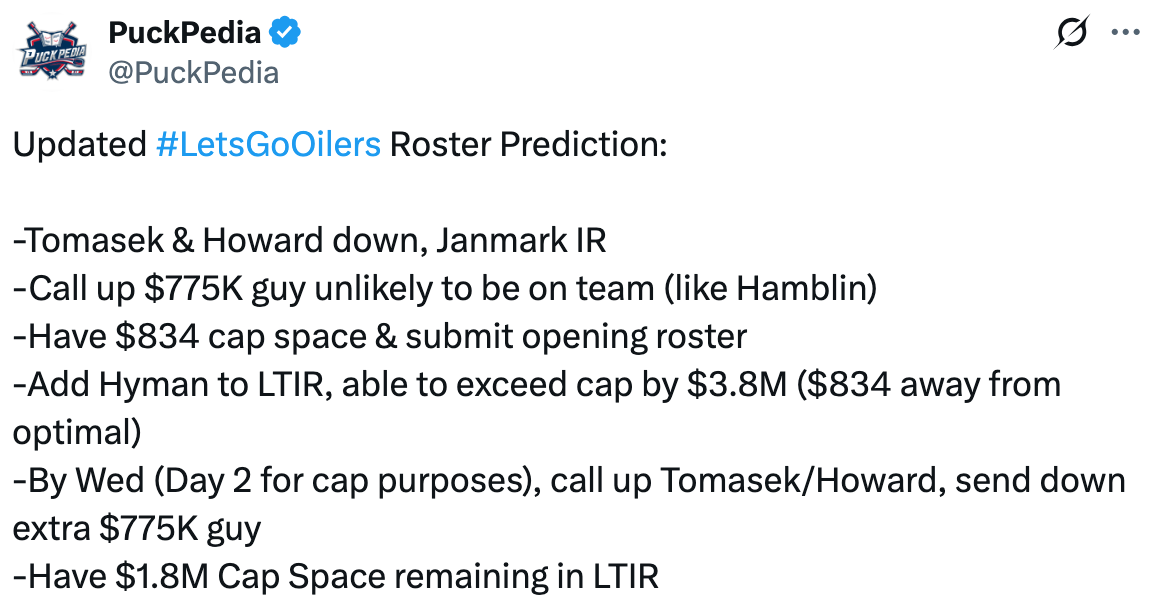
The Stars do not have a player making exactly $1.17 million in the AHL. But because Benn’s absence (as far as we know) only only projects to be a matter of four weeks plus recovery rather than something more long-term (like Aleksander Barkov’s ACL injury), the Stars would probably be satisfied with recalling someone like Harrison Scott for this purpose, as he makes $975K. That would get them to within roughly $200K of the salary cap ceiling, which would mean that putting Benn on LTIR at that point would still allow them to exceed the cap by $800K.
At that point, the Stars could then send Scott back down and recall Hryckowian or Hyry, giving them an insurance forward in the short term. Since both of those players make about $100K less than Scott, the Stars would be able to do so with room to spare.
Or, the stars could sign Adam Erne (or Roslovic) to a $1 million contract (or hey, how about a $1.17 million contract?) and get even closer to the ceiling before putting Benn on LTIR.
Getting as close to the cap ceiling as possible before utilizing LTIR early in the season would certainly explain why the Stars didn’t keep one of Hyry or Hryckowian on the NHL roster with what sure looks like an apparent need for at least an insurance forward, if nothing else ahead of Thursday night’s opener.
I’m not so foolish as to think I know the intricacies of the salary cap anywhere close to as well as the people paid handsomely to manage it, but for now, I’ll be content to hazard these guesses and see how the Stars end up addressing their situation. The goal, as ever, is just to become a little less ignorant every day.
Backing up further, though: the Stars are in a pretty great situation, all things considered.
Last year, the Stars entered the season hoping that Matt Dumba could be a right-hand option to keep Miro Heiskanen on his strong side. That did not pan out, of course, but the emergence of Lian Bichsel as the season wore on wound up being almost exactly as impactful as everyone was hoping.
And as we’ve said before, Game 1’s roster will almost certainly be different than how the team’s playoff roster looks. Take the Stars’ opening night roster in 2024, for example:
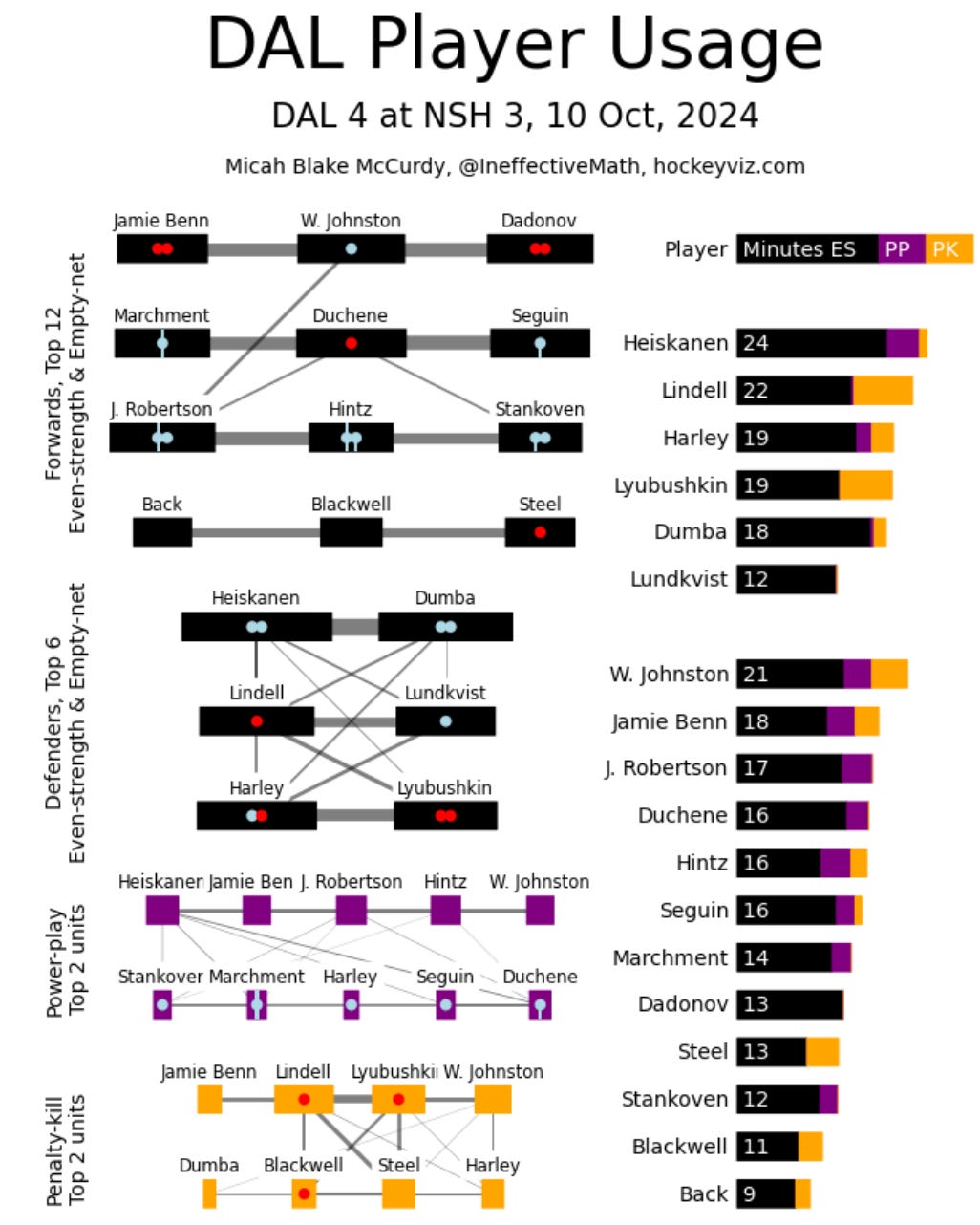
Four of the six defensemen in this game weren’t in the lineup for Game 1 against Colorado last April. Jamie Benn was on the top power play opening night, but he wasn’t even getting time on the second unit later in the season. Things change.
And for Dallas, their depth has never been more apparent than when disaster has struck. How many teams could have lost their number one defenseman in January (as well as their number five blueliner in Lundkvist), while also doing without Tyler Seguin—only to go on one of the hottest runs in the league in the second half and hold onto what turned out to be a crucial home-ice advantage against Colorado in the first round?
Even without Mikko Rantanen really turning on the jets until the Colorado series, and even with some patchwork done on the blue line, the Stars were a very intimidating team (until they faced the back-to-back Western Conference champs, at least). They had depth and youth and talent at every position, and had have enough redundancy to weather even more than the usual amount of misfortune.
This year, there’s no denying that their forward group is more top-heavy than it was last spring. Perhaps that’s why Glen Gulutzan appears to be focusing on more of a traditional checking line, though. Without 20-goal contributions from players like Dadonov and Marchment, trying the “roll four lines” approach of the DeBoer era probably would have met with less success no matter how you sliced it. Thus, the team is pivoting to a new system entirely, one in which—as one player put it last week: When you’re a winger, you’re a winger. And when you’re a shutdown fourth line, it sure looks like you’re going to be a shutdown fourth line.
I’ve always been of the mind that a team should value “goals over roles,” as I think it’s far too easy for a team to convince themselves that replacement-level NHL players with “grit” or “sandpaper” are more valuable than they are. You might even say that such an approach was what kept Connor McDavid from getting past the second round until 2022, as some of those earlier Edmonton rosters simply didn’t have enough talent beyond the top guys to consistently win in the modern NHL.
But the reason I’ve found myself being a little more optimistic about the additions of less goal-y players like Radek Faksa or Nathan Bastian is because the Stars are chock-full of talent in the positions where they need it. They’ve given themselves the luxury of adding Grit for a specific purpose in defined deployment because it’s more of a finishing touch than a foundational concept.
Jim Nill has packed this roster with two marvelous defensemen who can move the puck up the ice and control the play, and he also has a hulking young phenom on the third pairing who isn’t being asked to do too much too soon. With Esa Lindell also providing more defensive stability in a major role, the Stars are able to afford looking at players like Lyubushkin, Lundkvist, and Petrovic in complementary roles. And that’s the most ideal way for those sorts of players to grow into the best versions of themselves.
Likewise at forward, the Stars have offensive forces like Mikko Rantanen—Mikko Rantanen!—Jason Robertson, Roope Hintz, Wyatt Johnston, Tyler Seguin, and Matt Duchene. That could well be your top-six on any given night, should Johnston wind up playing the left side with Duchene, as Gulutzan has indicated could happen. Hold that up against five of the best teams in the NHL, and you’re going to feel pretty darn good about what the Stars have there.
That top-six allows the Stars to give Mavrik Bourque some room to play with, since he doesn’t have to jump into a crucial role right out of the gate like Logan Stankoven did last year (and you could see him struggling under the weight of those expectations). If all goes to plan, Bourque can build on his great preseason and have the campaign his one-year contract appears to be betting on. He doesn’t have to score 25 goals or anything, but the upside is there to be found on its own time.
And while Jamie Benn is irreplaceable, it’s a testament to his leadership that the team still seems very loose and confident while they wait for him to work his way back. Sure, Sam Steel isn’t the ideal middle-six winger when it comes to scoring potential, but he’s also not Milan Lucic or anything, either. The Stars have flexibility in their roster even after losing their left wing depth from last year, and that means a (yes) Grittier fourth line such as the one Dallas is likely to roll out might be as likely as such a line can ever be to serve a useful purpose for this squad—in limited minutes.
And remember, that fourth line also happens to have a couple of players who are defensively outstanding. The goals might not come like they did last year, but the goals against should also improve a fair bit, too. Dadonov scored 20 goals and 20 assists last year, but he also wound up with just a +1 rating after the season was over. Just sayin’.
Gulutzan will have to show he can deploy his own fourth line more judiciously rather than incessantly, as Rick Bowness tended to do (even in overtime). But when I zoom out and look at as much of the picture as I can see, I find myself being more curious about potential than concerned about depth. And that’s not something that I would have expected to be saying after July 1 of this year or last.
We’ll see how the roster shakes out today, and we’ll see how the season begins after a tough opening week. But even with all the unknowns, there’s still a lot we do know that gives some pretty good reasons not to be too pessimistic. And that’s as much of a luxury as any team can ask for on October 6, right?
Addendum: We have a big fat season preview for all of our paid supporters coming in the next day or two, so stay tuned for that. If you’re a free subscriber who’s been sitting on the fence for a while, keep an eye on your e-mail, as there might be an added incentive for you to take the plunge this week.
Interesting read @ change in personnel and deployment to fit new game plan.