
The Dallas Stars Wouldn't Ever Trade a Micah Parsons or a Luka Dončić...Right?
Sports make you feel things. Like pain, for instance.

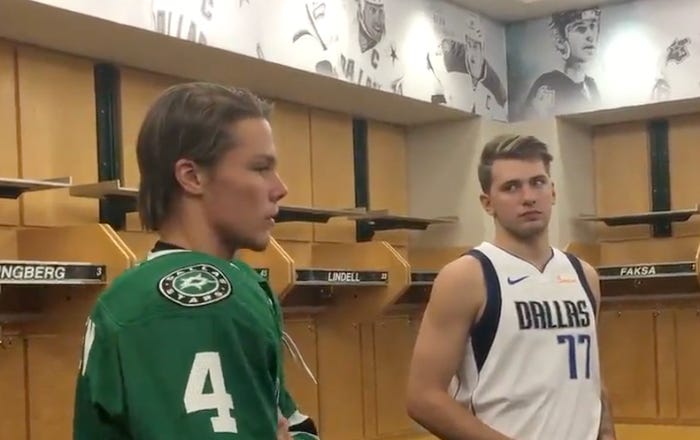
Thursday afternoon featured the second mind-blowing, heartbreaking departure of a top-tier player from a Dallas sports team in the last seven months. You either know who I’m talking about, or you’re lucky enough to be far away from here.
If you haven’t already done so, interested folks should check out Saad and Bob’s pieces on the trade. Those two dig into the football and Dallas implications of the whole mess with the benefit of the perspective that comes from closely following the NFL for decades.
For those of us here at Stars Thoughts in the last vestiges of August, I’ve been thinking about something more germane: Specifically, the Dallas Stars, who peacocked a bit yesterday after the Parsons news broke.
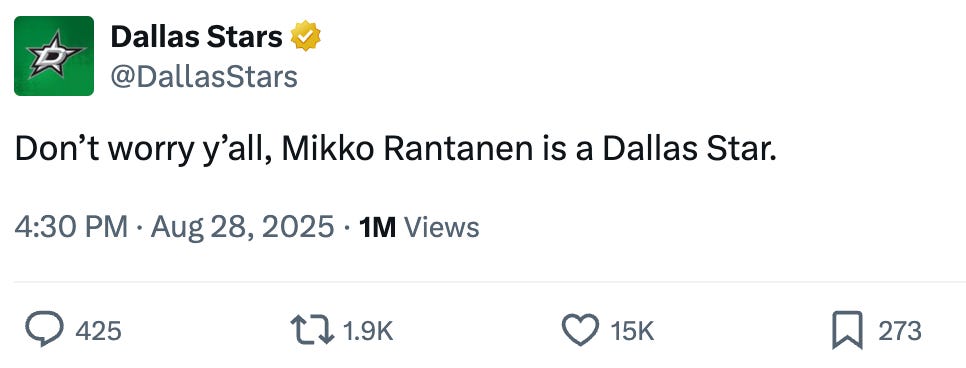
And, yeah, that echoes a sentiment I saw a lot yesterday: “Wow, thank goodness the Dallas Stars wouldn’t do the dumb things the Mavericks and Cowboys have been doing lately! Thank goodness for Jim Nill!”
That’s a pretty well-founded assumption, in fairness. Historically, the Stars have much more frequently played the other side in the sorts of deals that channel the Luka Dončić and Micah Parsons trade energy.
Just go back a few months, in fact. Mikko Rantanen and Colorado couldn’t agree on an extension in January, but everyone was assuming the Avalanche still had plenty of time to work things out, just as Cowboys fans thought Jones and Parsons did (relative to the perpetually dysfunctional way the Cowboys do things, at least).
For Rantanen, things were being written back before the start of the season about how Colorado wasn’t worried about losing him at all. And then, two months before the trade deadline, they shocked Rantanen, Nathan MacKinnon, and the entire NHL world by shipping a beloved superstar off to Carolina because of contract differences in a trade that looked a whole like like a team looking for an excuse not to pay him than good-faith negotiating for a superstar.
A month or so after that, the Stars played the part of Carolina in the, uh, Carolina trade of Rantanen that we’ve covered in detail. And like Green Bay did yesterday with Parsons, the Stars also signed Rantanen to a massive extension on the same day of the trade: An eight-year deal for nearly $100 million. (If you don’t know, you may prefer not to look up how much Parsons is getting for half that term.)
Like a certain Slovenian basketball superstar, Tyler Seguin was a young, budding franchise player who had ample team control left in Boston—lots of it—when they decided they simply couldn’t afford not to trade him, what with the lack of a cultural fit, discipline, and so forth.
It wasn’t a perfect parallel to the Dončić trade, but the similarities are there if you look for them. And like the Lakers did a few months ago when that player became available, Jim Nill pounced on a team looking to ship out a young superstar.
You know all this. So, that means the Stars are the nice and smart gunslingers in the white hats, while the Mavericks and Cowboys are the big galoots who use stacks of money to push people out of their way as they waddle down main street on their way to blow money at the saloon, entirely self-satisfied despite shrieks and wails from onlookers that signal their eventual comeuppance. Right?
If you have ever read any sportswriting before, then you know I’m setting you up for one of those classic and very original “Well, I’m not so sure!” lines. And you’re right! Good job, for having read something before. You are already in the top 8% of readers in the country by default. This is perhaps not something to celebrate, it occurs to me.
Here’s the thing though: Don’t think for a minute that the Stars aren’t like the Cowboys because they don’t want to be. Any other sports owner on the planet would love to have the Cowboys, who have been the most valuable (and arguably most popular) sports franchise in the world for a long, long time. Jerry Jones can act like a wacky billionaire because he has the power, prestige, security, and accompanying delusions afforded to people who never have to endure the discomfort of the word “no.” The NFL is bigger than any other league, and the Cowboys as its biggest member maintain their vicegrip upon it despite continually dropping the ball on the field. (Sports metaphor)
The main reason people continue to chant “Fire Nico!” I think, is because the Mavericks aren’t the Cowboys, much as they held onto that number two spot in the market for most of Luka’s time here. Fans screamed (or lip-synced) those two words because Nico Harrison is, in theory if not in practice, still accountable to someone else, whereas Jerry is almost a caricature of himself in his willingness to make his team’s paying fans suffer in order to prove a point, or at least to feel like he’s done so.
Nobody is yelling at anyone to fire Jerry, becuase he has all the power, and he has the team that makes all the money. “Fan” is short for “fanatic,” but that doesn’t mean even Cowboys fans are that dumb. Perhaps more than most, they know hopelessness when they see it.
On the surface, the Stars have been largely free of exhibiting the worst vicissitudes of billionaire hubris1. But perhaps that’s less by design, and more a matter of circumstance. Let’s go back to two specific moments from the last few years, if you will indulge me.
You surely remember That One Moment when the Stars, from the top down, decided to blast their two highest-paid players for not playing well. In one sense, this was a less cowardly version of what the Mavericks have done with Luka, where the basketball folks decided to leak a bunch of their dissatisfactions about Luka’s workout and diet habits right after making a trade that still stands as one of the worst deals in sports history.
No, that’s not what Jim Lites did. Instead, Tom Gaglardi’s right-hand man told Sean Shapiro very, ah, clearly, what the problem was:
“It’s not about how much money. I don’t resent the money,” Lites said. “It’s about what we expect the money to be. You just can’t win if your best players aren’t your best players. And they [Seguin and Benn] aren’t best players.
“I am sick and tired and listening to bloggers and others talking about Brett Ritchie, Julius Honka, or Gavin Bayreuther, or Taylor Fedun2, pick a guy,” Lites said. “We’re just too good. The fans deserve more and the owner deserves more. And I share that opinion with the owner, the fans deserve better and Benn and Seguin aren’t getting it done. Until they do we aren’t going to be good enough.”
I can never bring myself to call a profane tirade sewering two superstars anything close to admirable, but it also wasn’t cowardly. The owner was willing to let the world know how frustrated he was with his best players and attach his name to it, with all the implications that follow. Whatever you might say about Gaglardi, you can’t deny that he has, time and again, put his money where his mouth is.
But Gaglardi has also done something many sports owners fail to do: He’s surrounded himself with smart people, and he listens to them. That, for me, is the biggest difference between Gaglardi and the Adelsons and the Joneses, bar none. Gaglardi has a whole lot of money and power, but he’s plenty smart enough to know that you need other smart people working for you, and with you. Because sometimes, your desire to keep a beloved player like Logan Stankoven might need to be balanced by a more dispassionate viewpoint. And sometimes, that decision will result in one of the greatest Game 7 performances in franchise history.
For our second moment, we don’t need to go back quite as far. It was in August of 2022 when Gaglardi hopped on the Cam & Strick Podcast (real thing) and talked about the Jason Robertson negotiations going on at the time (emphasis mine):
''You know the two big things that have changed. I think in the last few years, you know, the absence of the second contract. And so you see, the kid in the third year of his entry-level deal puts up 40 goals. Now he wants to make seven million. So and you know, if you want term with that player, he's gonna take you higher than that. So, so that's a big change.''
''And you know, what's really happening is, the stars are taking all the money, and the guys in the middle are getting squeezed. So the, you know, the differences are, you know, the veterans? The veterans who don't score a lot are getting squeezed. And, you know, I don't like it. I think there's a lot of players in the league making a million dollars who are better players. And then the guys who can put the puck in the net are getting, you know, too big, too big, a piece of the pie.''
This was about two months before the Stars signed Robertson to a four-year, $7.75-million-per-year average contract that runs through the end of this upcoming season. Gaglardi ended up compromising on those statements to sign Robertson to a bridge deal that has worked out well for both sides, but now, with Robertson’s deal ending next summer with one season of team control left, I continue to believe that all the trade rumors about Robertson this summer were far from nothing. The 2022 discussions were just a warm-up for the next deal, which will have to buy up UFA years.
The Stars, from the top down, have been pretty clear that they see Robertson as a valuable player, but not one on the level of, say, a Mikko Rantanen. DeBoer himself never shied away from pointing out Robertson’s flaws—I can think of a couple good-natured jabs he made about his skating alone just last year, when Robertson was coming off foot surgery—and Gaglardi said, quite clearly a couple years ago, that he doesn’t believe scorers like Robertson merit the high dollars they’ve been demanding to get in the NHL.
Now, things have changed a bit in the last few years. The salary cap is rising, and fast. The Stars would still love to keep Robertson for what they feel is a reasonable price, and they should be able to do so, even while also giving a massive raise to Thomas Harley. But defining that “reasonable” range is always the sticking point. I guarantee you that Jones felt the same “reasonable” way about Parsons, as I’m sure he would say (and did, yesterday).
The main difference between the two situations (though there are lot of other differences, too) is that the Stars are at the apex of their competitive window. They are absolutely, completely in win-now mode, whereas the Cowboys, despite having the highest-paid player in the league, are closer to a Minnesota Wild right now. (No offense to the Wild, [which is the first and last time I will write such a sentence].)
As much as the Joneses will always say the opposite, this wasn’t actually the worst time in franchise history to sell a great player for a bit of a rebuilding starter kit. (They didn’t actually get such a thing, but I digress). Now, their 32-year-old quarerback might disagree (as he should) about how it helps the team to get worse in the final years of his prime (or what’s left of it), but the Cowboys trade is a bit more like if the Stars traded Miro Heiskanen three years from now, when Mikko Rantanen will be (like Prescott now) 32, and the window will likely be past its zenith. The Cowboys will always posture and blame—again, who’s going to hold them accountable?—but it’s not like they’re shooting a championship team in the foot or anything.
This is why the Robertson situation remains so fascinating to me. The Stars know they need scorers, and Robertson is as scorer-y a player as they have. Just look at their final playoff series this spring, when the same Robertson and Seguin were the only players to score multiple goals for the team, accounting for six of the team’s paltry 11 goals against Edmonton. And this was with Robertson coming off an injury.
Football teams have 53 roster players, and basketball teams max out at 15. Hockey is between those two, but it’s a distant third in terms of any single individual player’s perceived potential impact on a game (perhaps other than goalies). Thus, the 23-man roster of an NHL team tends to see money spread around more evenly than the other two leagues. That, combined with the overriding pressure in NHL culture to exhibit obeisance rather than start a renaissance, has probably been as big a reason as any for the Stars’ avoiding the disastrous outcomes of the Mavericks and Cowboys trades.
NHL teams tend to keep good players, because the free-agent market tends to be thin and overpriced. Thus, when you find a Jason Robertson later in the draft the way Nill did, you tend to look for reasons and ways to keep him, even if it means paying a premium to do so. Because the “premium” in NHL terms is, at worst, going to be like 12% of the salary cap, like Rantanen’s deal is. Even that is usually something you can stomach, as the alternative will almost always be worse, and perhaps just as expensive in aggregate as the Stars recently demonstrated when trying to replace Chris Tanev by committee.
But if ever there were a player with whom the Stars would be willing to go to the mat on a contract discussion, I think Robertson would be the candidate. Sure, he’s not quite as bombastic as Micah Parsons, and he puts in a ton of work year-round—July 4th is his only scheduled off-day all year, he has said—to get his game in its best possible shape, unlike the leaked criticisms of Luka allege.
Still, Gaglardi has been pretty unequivocal in saying that players like Robertson have been asking for the moon, and the Stars finally compromised late in training camp in 2022. Robertson, to his credit, responded with one of the best seasons in franchise history, scoring 109 points in 2022-23, but his next couple years have fallen short of that record-setting standard.
The Stars haven’t done what their NBA and NFL have counterparts have recently done partly because of different league economics, yes; but the time is fast approaching, and may already be here, when they are going to have to make a similar decision about a player whose value they have similarly disparate views on.
The Cowboys opted not to make Parsons the highest-paid non-QB in the NFL, but Green Bay happily did so. That deal will continue to suck the oxygen out of the airwaves for weeks to come, but don’t think the Jason Robertson decision isn’t going to have its own pitfalls and disagreements, too. There is a number the Stars don’t want to surpass, and it seems unlikely to me that the Robertson camp is going to happily reduce their asking price with the cap continuing to increase, particularly given the $12 million annual values that Mitch Marner and Mikko Rantanen just got.
As the Stars approach the point of no return with Robertson, they have to decide either to fork over an uncomfortable (for them) amount of salary cap space, or to ship him to a team willing to pay that money in exchange for a package that will not feature Jason Robertson coming back in return. Probably, there will be more than one suitor for such a deal, and one suspects the Stars may have been gauging the market over recent months in order to find out exactly how many there would be, should things go that route. In this regard, they are at least a step ahead of their basketball and football counterparts.
Still, the Stars are not a franchise run by people devoid of the same emotion, stubbornness, and pride of their fellow DFW organizations. The difference for them, thus far, has been their ability to check those traits with business savvy and long-term vision. It’s easy to throw stones at other franchises right now, but by this time next year—and perhaps a whole lot sooner than that—we’ll see how the Stars deal with the decision to pay an unappetizing (for them) amount of money to keep one of their own best players.
This is also why, I suspect, Gaglardi has been vocal about his desire to see a more critical Dallas media when it comes to his team. It’s hard to win a public negotiation with a player like Robertson if you feel like the media never points out his flaws. And while I personally loathe the idea of my writing being a means of reducing player salaries in order to make jobs easier for billionaires, I do think Gaglardi has a point. The most critical voices in this town tend to get pointed at the biggest targets, and the Stars only tend to get big attention when things are going really well. I mean, the Ticket is not doing multiple segments on how Nill kind of blew it with the whole Matt Dumba deal and subsequent trade, or how Wyatt Johnston had his worst postseason performance in his young career after signing his own lucrative long-term extension. In the past, the Stars have generally avoided stepping on the biggest sorts of of land mines. If anything, they’ve preferred to set and detonate them all by themselves, for specific reasons.
It’s almost always a better bet in the eyes of the fans to keep a superstar right now, even if it means paying them more money and for longer term than good sense dictates you ought to down the line. Ripping off the band-aid is a lot scarier than kicking the can down the road, even if it might be less prudent from a long-term perspective.
Robertson may not be quite on the level of Dončić or Parsons, that sort of player who could stake a reasonable claim to being the best at his position in the league for multiple years in a row. But given the relative importance of his contributions on this team, and where the Stars are as a whole, the differences might not be that stark when the decision finally gets made. Because sometimes, you can’t even see the glass house until you start throwing stones.
Look, you know what you get when you click on links to read stuff here, don’t blame me.
I remain fairly confident that I am the main one who has to wear that Fedun remark, by the way. I refuse to apologize, because:
Scorer-y?? I think Robo should lead with that when it’s time for contract negotiations. “You know Jim, I’m quite scorer-y.” 😂
For me, the biggest value that Jason Robertson brings to any team is not just his talent and elite scoring ability, but above all his hockey intelligence and work ethic. You can’t replace either one in any trade. He is a constant example to the rest of the team of how they should be as professional hockey players, something that the Stars lost in part when Joe Pavelski retired. He is the team’s Joe Pavelski, but even better.