
The Complicated Cost of Growing the Game
Hockey is not cheap in DFW, or in most places

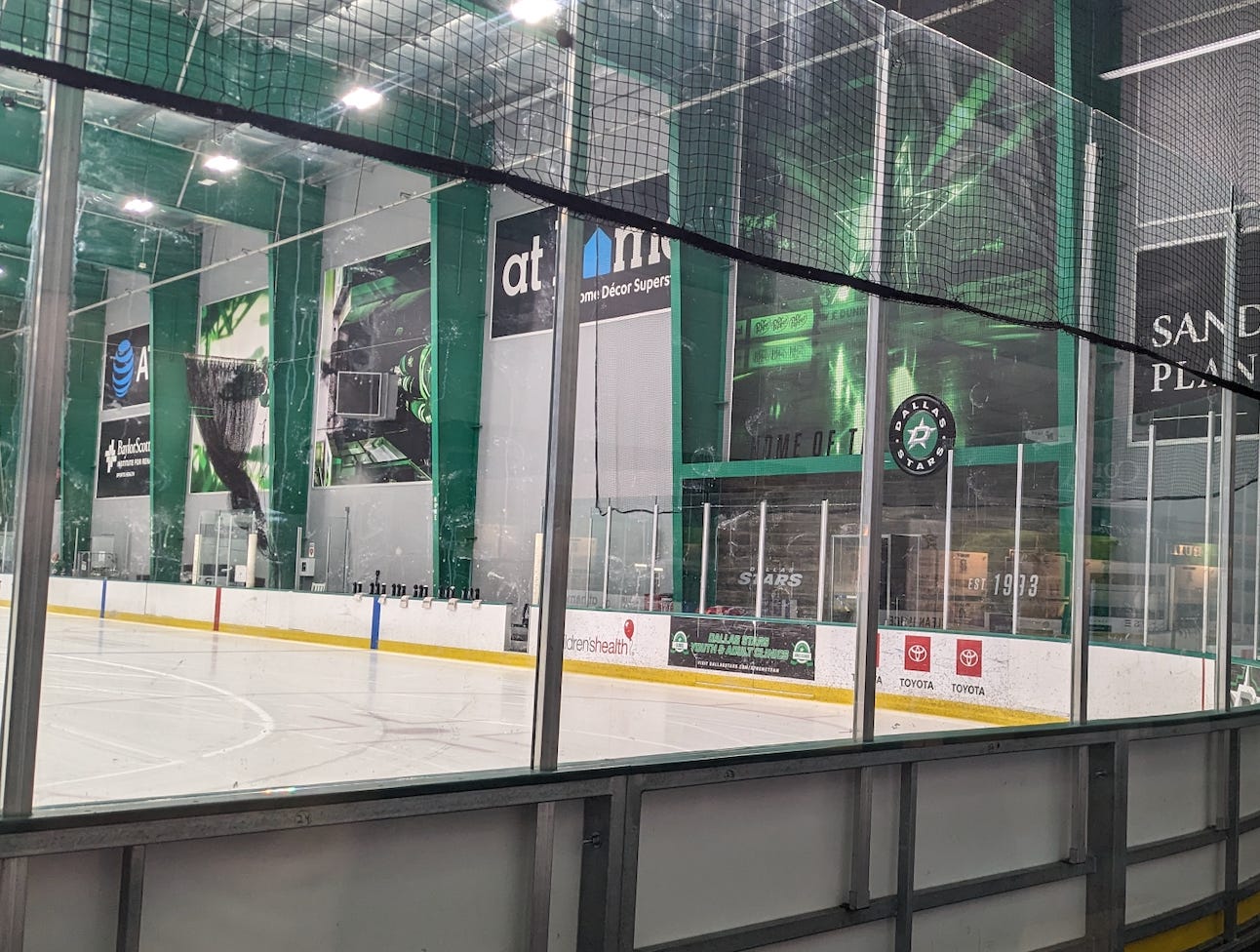
In case you didn’t see it, USA Today has another piece on hockey in Texas out today, following their prior story on some former Stars employees back in March. This one focuses on the cost of youth hockey and the ramifications of the Dallas Stars’ owning and operating eight of the 11 ice rinks within the larger D/FW area.
It’s a very big story, but I had a few thoughts and questions about it, and that’s sort of what this place is for. So, let’s get into it.
Ice time is in high demand in a place like Texas. The growth of youth hockey is a very good thing, as it means more people have access to the sport. Most people I’ve talked to agree that only a fraction of that growth would have happened, let alone at anything close to the current scale, without the Stars organization.
Dan Stuchal would also say so, and did. Stuchal was moved into his current role as Chief Operations Officer, StarCenters and Multisport just a few months ago, after the departure of Damon Boettcher, the former VP of StarCenter Facilities who was named in the first USA Today piece back in March.
Stuchal is a well-respected figure1 around the Stars hockey scene whose tenure goes back to the Minnesota North Stars days. So when he talks about the growth of hockey in Dallas, he’s talking about what he’s seen, firsthand.
“We have the expertise, we have the staff, we have the resources to bring the best-quality hockey facilities and programming to the entire marketplace,” said [Dan] Stuchal, the Stars’ chief operating officer. “I can’t speak to other businesses that have come into play here, but without our investment in growing the sport here locally, there just wouldn’t be the hockey landscape that exists today.”
Remember, the city of Plano was entirely without ice rinks in 2012 after Plano Sports Authority decided to get rid of one ice sheet, while the Plano StarCenter rink began sinking into the earth. Jim Lites and some other investors then stepped in and bought the latter facility and remodeled it, and the Plano StarCenter is still there today, now above sea level.
But when any business begins to grow, so does the opportunity for profit. And as an internal document in the story appears to show, prices are continuing to go up this year.

The affordability of hockey is an issue that transcends any one market, though. This piece from the Hockey Think Tank is a fantastic rundown of the real costs for families trying to genuinely “develop” their children into great hockey players. Ice costs have been on the rise for quite some time now, and here’s the biggest reason why:
Where rinks used to be more community based and partly funded by tax payer dollars as a building for community activity…they are increasingly now being turned into revenue generating facilities whose purpose is to bring in money.
This has caused the ice costs to increase to levels that are becoming unsustainable. The range for an hour of ice at privately owned facilities depends on where the rink is located…but around the US and Canada it can range from around $200-$700 per hour. If you are at that low end, you are extremely lucky. Most rinks, from the people that I’ve spoken to, are around the mid to higher portion of that range.
As Jacoby reports in his own story, the Stars partnered with individual cities to help fund rink construction with a loan that would repaid as rent in the next 2-3 decades. But with those facilities being leased exclusively to the Stars, they’re effectively private facilities as far as any competition is concerned.
City contracts lay out the details. The cities each put up around $10 million or more up front to build the rinks. Once built, they leased the rinks exclusively to the Stars, who agreed to repay the cities in rent payments over 20 to 30 years. In theory, the cities would eventually get their up-front costs back, while the Stars would keep the profits.
-USA Today, “How the Dallas Stars Monopolized Texas Youth Hockey”
The reality of this situation is the same as many, many other places around the USA. Unlike simpler, more common facilities for baseball or soccer that are built for the good of the community, ice rinks require a far greater amount of investment, upkeep, and maintenance, which mean generally higher prices to participate.
The city of Allen does have one community rink, and it’s a nice facility that hosted some of the Men’s U-18 World Championship games last spring. But even there, signing up your child for the Jr. Americans 2025-26 season is still going to run you $1,300, unless they have the misfortune of being a goalie, in which case it’s just $500.
Other than that, it’s mostly StarCenters around DFW. Because when you have a relatively newer hockey market without the longstanding cultural value a state like Minnesota places on hockey, you are naturally going to have a tougher time building momentum for the resources required to build truly communal ice hockey facilities.
Thus, the Stars have led the growth of hockey in the Metroplex, and cities have been apparently happy to partner with them in order to do so. And that’s happened in the same way they’ve grown their own hockey franchise: by increasing its value.
So, for my money, with regard to any monopoly the Stars may or may not have in the region, I think any complaints should start with city and community leaders. Expecting any professional sports team to operate expensive, high-demand things like ice rinks with complete altruism is naive at best, and giving any entity an exclusive 30-year lease to a building built with a loan from taxpayer dollars while allowing them to keep all the profits is something that you should absolutely have to justify to those who put you in office.
Still, it’s all well and good to point to how the StarCenters appear to be getting more expensive. But with only a handful of alternatives, that seems more of a sad reality of the non-traditional hockey landscape in general than anything else, as Jacoby admits:
As ice goes, Dallas isn’t necessarily more expensive than other warm parts of the country where one company controls much of the ice. Ice is cheaper in states like Minnesota and Michigan, where the competition is robust and many rinks are community-owned and -run.
-USA Today, “How the Dallas Stars Monopolized Texas Youth Hockey”
My own experience with this sort of thing came in another market: Orange County, California, where the Anaheim Ducks have been embarking upon similar efforts to “grow the game” in a similarly non-traditional hockey market. You can see their own team-branded list of facilities here, one of which I played at for a year or two.
It’s a very similar setup to the Stars in some ways, though I won’t pretend to know all the ins and outs of it beyond my own experience. If you’ve played adult hockey, you know the drill: late game times, substandard officiating, and the occasional big hit that shouldn’t ever happen. And the prices are high there, too.
Looking at the prices to play just a few games in the AA/AAA stay-in-shape league at the Yorba Linda facility, it’s quite expensive, as you’d expect. There just aren’t a ton of options, so supply and demand end up hitting parents pretty hard, whereas the abundance of competition and facilities in states like Minnesota make even more organized leagues a bit less expensive.
And in places like Minnesota or New England, lakes freeze over most winters and organically (heh) make ice sufaces available for the masses. Even if you don’t want to sign up for a league, you can still growing up playing hockey, or at least shinny, without investing a ton of money, the way I grew up playing football in the park with friends while wearing just soccer cleats.
Without serious community resources like cheaper, secondhand equipment and more ice surfaces, the barrier to entry will remain high in places like Dallas until the ice surfaces finally begin to catch up with demand. In the meantime, the Stars do offer things like the free Little Rookies camp, where players get to use free equipment for a few weeks’ worth of free lessons. It’s a cool program, but with the huge growth in more serious youth hockey in Dallas, the financial burden immediately increases when the stakes do.
The Stars are not perfect, and they never have been. But until community leaders start seriously pushing to build more community rinks for hockey that aren’t tied to for-profit organizations, the Stars are providing something that would otherwise be largely absent, and Seth Jones’s recent return with the Stanley Cup to Valley Ranch StarCenter is a pretty clear reminder of what can come of a result of that investment.
It would be nice if that were the only part of the story, but we have to discuss one other aspect of this piece.
The story leads off with an anecdote from the former president of the Frisco Ice Hockey Association talking about how the association decided to move on from two youth hockey coaches who had gotten “dismal” reviews in parent feedback surveys. We don’t get any details about what prompted those reviews, or how many parents actually complained, but when the Stars took over running the league the following summer, they took charge of all operations, and they reinstated the two coaches. But again, we only get a generic description—“strong track records”—from the organization about why the coaches were brought back.
Another recurring theme in the story is how a few people in charge of some individual ice rinks responded when parents or coaches have been critical. Some accounts are contested by the different parties, but one e-mail shows the interim GM of the Mansfield StarCenter (who didn’t return requests for comment from USA Today) explictly telling a participant that he would no longer be allowed to play in a particular league because of how he was talking about StarCenter programming on social media, using words and phrases like “your consistent and prolonged attempts online to draw people away from our programs and facility” and “defamation.”
The interim GM cited the social media policy that all of the league (this was for SSHL hockey) participants sign before playing. If that’s the same one the Stars have listed on their website, then I’m guessing the below is the relevant portion:
The Children’s Health StarCenters and Comerica Center expects those who use our facilities to conduct themselves in an appropriate and professional manner at all times. Social media communications targeted towards our membership that are used to commit abuse or misconduct (e.g., emotional, sexual, bullying, harassment, and hazing) are considered violations of policies and will not be tolerated.
-Excerpt from the Children’s Health StarCenter & Comerica Center’s Social Media Statement
On its face, this is an example of a league enforcing its own policies. “Trash talk us, and you’re out of here.” And hey, personally I would’ve loved to have that option when I was umpiring Little League as a high-schooler way back when. Some of those parents were only there to boost their own egos, and it was not pleasant to experience it.
But with regard to criticism of the facility and its operations in general, the alleged stories of retaliation against those who were critical of StarCenter operations sound petty, at best. There’s just no need to be threatened by those sorts of things if you’re really running a good operation.
It’s not hard to believe that people putting in the work to run the facilities would get their hackles up when people using those facilities grew disenchanted with their operations, sure. But from a larger organizational perspective, one would hope there would be enough confidence in the product—which is, again, undeniably growing—along with sufficient internal accountability among coaches and rink managers to reassure everyone that any outside criticism was nothing to be too worried about. Indeed, the healthiest youth sports organizations welcome such feedback, so long as it’s in good faith.
For example, I’ve written more than a couple things that were critical of something the Stars did over the years. But to their credit, I haven’t ever felt retaliated against. My experience, whether it’s representative or not, is that they have enough faith in what they’re doing to withstand any critcism, or else to learn from it and get better.
This is where I’m eager to hear the results of USA Hockey’s ethics investigation (mentioned in the story) into two of the former Stars employees who were involved in the aforementioned Stay2Play LLC shenanigans. Because if a culture of no real accounability was the norm under the older StarCenter leadership, that would have a lot of bearing on some of the stories in Jacoby’s piece.
As a reminder, this was Tom Gaglardi’s comment on the matter a few months back:
“It was a very unfair article, in terms of what it was trying to say,” Gaglardi says. “There was an internal issue with it. Once we became aware of it, we addressed it, and so we’ve got a new team of folks running that business now, and they’re fantastic.”
“The old team just made some mistakes and didn’t tell us about them,” Gaglardi says. “But the [USA Today] article was really flawed, quite honestly. But we’ve addressed it, and off we go.”
While Gaglardi understandably declined to get into the weeds about the perceived flaws and unfairness of the first USA Today piece at the time, one thing the Stars can do to demonstrate real evidence of change is to create a healthy, transparent culture in the youth hockey market. You won’t ever make everyone happy in youth sports, given that half the parents drive home consoling a child after a loss. But you can earn respect in the long run by always trying to get better.
One last personal anecdote: When I was working in public education, a few of us in leadership knew of one prominent such Facebook group where school parents would commonly complain about the school, teachers, leadership, the weather, or the lizard people supposedly running the country. At the time, it was moderated by someone with close ties to the school, and they would routinely choose which comments to delete in order to avoid things getting too nasty.
It became clear to us early on that the best thing we could do was to ignore that group entirely and let parents discuss things as they saw fit, because expecting social media not to be negative is as naive as expecting a pro sports team not to try to be profitable.
I say all this because the USA Today story reports that StarCenter folks were apparently monitoring negative comments in a private Facebook group of Texas hockey parents, and directing the moderator to to take them down. If that’s true, it’s hard for me to understand any benefit to that approach whatsoever. If the product is strong, word will spread, and trust will follow, regardless of what people say on Facebook.
Let people moan and groan if they want. Prove them wrong where it matters: on the ice.
I’ve heard from many people over the last year who have many opinions about the good and bad of youth hockey in Dallas these days, but one thing I keep coming back to is this: Youth sports are never going to be perfect, particularly as the scale and stakes increase.
The richest rewards of competitive youth sports are borne out of of parents and coaches investing their time, energy, and money into helping children learn to love the game. In a perfect world, there would be a ton of ice rinks available, with plenty of resources to make hockey as affordable as possible. In other words, hockey truly would be for everyone.
In the meantime, hockey will continue to be for those who can afford it. Hopefully that category continues to grow.
Apropos of nothing, Stuchal’s name is also on the Stanley Cup from 1999.
One important thing to add here: Gavin Spittle talked with the reporter who wrote the USA Today piece, and he gave more details about why those two coaches were fired, including things like showing up late to practices and not taking things seriously. It's a good listen if you want to get a little more background: https://www.audacy.com/podcast/spits-suds-podcast-67080/episodes/usa-todays-kenny-jacoby-on-the-dallas-stars-monopoly-on-dfw-youth-hockey-f5c20
This has been a hot topic for a while now. As a parent with a kid in DSMHL and first year in the high school hockey program, I look at how is the organization fostering hockey development. The Stars have done a GREAT job in getting kids interested in hockey. We did "Try Hockey for Free" in 2019 and he our son was hooked; and we got into the Rookies program. With the help of private lessons (again, hockey is not cheap) he grew fast but that was individually. As kids get older and into middle and high school, there is little hockey development. Enhancements focus on individual skills and "team" practices again focus on individual skills but not the team game. Youth hockey runs also on the backs of parents that volunteer to be coaches; and like myself, may have never played hockey before therefore may not know how to coach the team game. This is no fault of the volunteering parent coach, they only know what they know. This is where the Stars could improve hockey in DFW. Early ages they do great but zero benefit to grow the knowledge of how to play the game. Focus all team practices on the team game, give the volunteer coaches information and guidance on hockey strategy are just some thoughts. While we are new to the high school program, the fact that high school teams get one practice a week is a challenge. Unless your kid is travel hockey ready (and your pocket book and life are travel hockey ready), the development of hockey is in the hands of the parents that volunteer their time and effort as coaches and the few coaches that offer private lessons which we are very thankful for.