
Talking with Radek Faksa and Miro Heiskanen about Family, Playing through Injuries, and a Longer Summer than Expected
Hockey requires some pain tolerance, it turns out

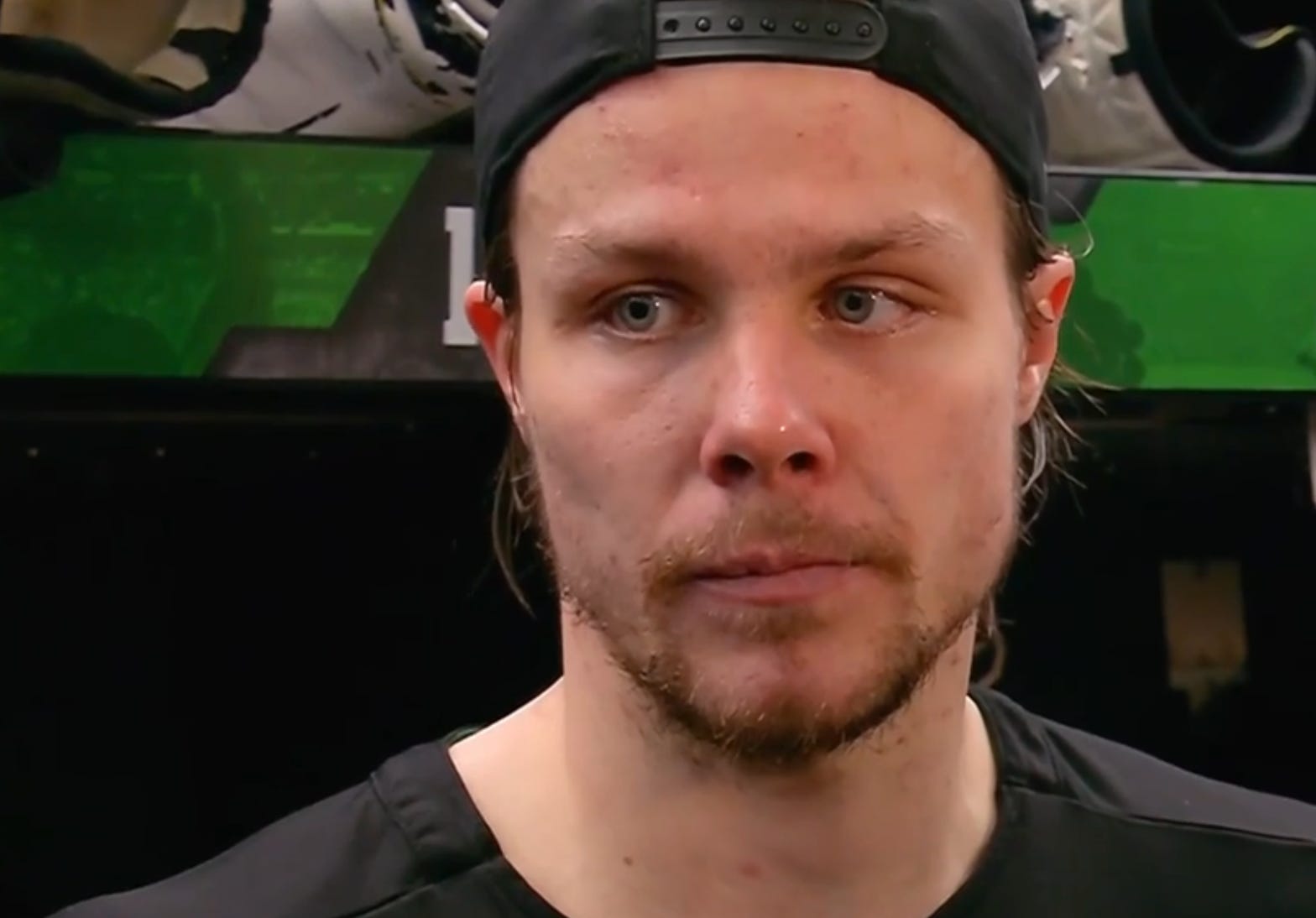
Miro Heiskanen had a very good regular season. But his playoff run, and the Stars’ as a whole, was one that ended in some disappointment.
Heiskanen was a point-per-game player in the Stars’ six-game loss to Minnesota, and that includes two goals. Those were scored in Games 4 and 5, both of which the Stars narrowly lost. But you can’t talk about stats in a vacuum, because the biggest talking point during and after Dallas’s exit was their lack of even-strength offense.
Nowhere was that more noticeable than when the Stars’ top defensemen were on the ice. When Heiskanen was on the ice at five-on-five, Dallas was outscored 6-0, and Thomas Harley was likewise drummed 7-2. Esa Lindell’s minutes saw the Stars outscored 6-1.
As we found out yesterday, however, Heiskanen might have had the best reason for that margin. Because it turns out that the Stars’ number one defenseman was playing through an oblique muscle tear suffered three games before the end of the regular season, likely as a result of a hit from Marcus Foligno—not on a hit from Ryan Hartman, as was initially speculated.
“I tore my oblique,” Heiskanen confirmed on Monday. “It wasn’t actually that situation with Hartman, but the shift before that. But yeah, I had an oblique tear, and I had to play with that.”
Perhaps that injury was a contributing factor in why the Stars’ top defensemen were outplayed by Brock Faber and Quinn Hughes, but the theme of media day on Monday was simple: no excuses. Every team was dealing with injuries of some kind, and Dallas simply didn’t get the job done.
In a one-on-one chat with Heiskanen yesterday, he echoed the same thing.
“Yeah, disappointing for sure to be out, especially this early,” Heiskanen said. “You want to get to the playoffs, and you want to go far. It’s disappointing. Probably take some time to forget it, and move on.”
The Stars’ head coach had acknowledged during the series that Heiskanen was coming back from an injury of some kind that had kept him out for the final three games of the regular season, but he also said Heiskanen appeared to be getting stronger each day, and Heiskanen said the same thing: the injury “got a little better and felt better” with each passing game.
Heiskanen said it’s the first time he’s had an oblique injury. But when reflecting on the series, he focuses more on what the Stars had within their control than what they didn’t.
“Special teams were really good,” Heiskanen acknowledged. “Both power play and PK was working. Just five-on-five [wasn’t]. I felt like we had some chances too, but probably we didn’t get inside enough and get greasy goals from there. So I think that was the biggest issue, probably.”
That accords with what Gulutzan said on Monday, too. The Stars had to grind away for scraps of offense. They had the puck in the offensive zone a fair amount, but Mavrik Bourque’s five-on-five goal was their only truly “greasy” goal of the series at five-on-five (perhaps joined by Robertson’s deflection immediately off a faceoff win in Game 2, if you want to be charitable).
But Heiskanen also points out something we can easily forget in sports: the other team is trying to win, too.
“I mean, that’s a good team too. They defended well,” Heiskanen continued. “We didn’t get any easy chances or easy offense, but just have to get inside a little more. In the playoffs especially, probably most of the goals are scored close to the net, bouncing off guys. I think that was the probably biggest issue, that we couldn’t create enough offense.”
And in the end, Heiskanen agrees that falling as short as the Stars did, even to a good opponent, is a bummer of a way to end their season.
“I mean, it’s always disappointing when you lose in the playoffs,” Heiskanen said, “But I think we had a great team. Everybody was excited and pumped to get to the playoffs, but that’s how it goes sometimes. Yeah, it’s for sure disappointing, especially with what kind of team we had. Everybody thought we were gonna go for a long run.”
One positive from this season was Heiskanen’s chemistry with Esa Lindell. The two longtime Finnish teammates were on the same defense pair for the entire season, as well as at the Olympics for Team Finland.
They were split up in the Stars’ final playoff game, when Thomas Harley was moved up to Heiskanen’s left in one of a couple last-ditch lineup changes. But until the playoffs, there’s no doubt the Lindell-Heiskanen pair was a very effective one.
“Yeah, it was working well,” Heiskanen said of playing with Lindell. “He’s an easy, easy guy to play with. He’s a reliable guy. You know what he does and where he is. We can read each other well. Easy guy to play with. You know you can always trust him when you’re out there with him.”
One thing has changed for Heiskanen since arriving as a rookie in Dallas in the 2018-19 season: he’s now a husband and a father. And while Heiskanen generally isn’t that public about his family life, he admits that coming home and seeing his daughter gives him a new perspective on things, even after a disappointing playoff loss.
“For sure it’s easier,” Heiskanen says before smiling. “She doesn’t care if I played good or played bad, you know? She’s acting the same way. So it’s a lot easier to kind of forget about hockey and be present, and do stuff with her. It’s a lot of fun, for sure. She’s two years old and a couple months right now, and we can do a lot of stuff together. It’s been a lot of fun.”
Nobody on the team wanted to have a long summer, but now that they no longer have a choice, Heiskanen is one of a few players who is looking forward to enjoying a bit more time with his family back home—though he says he’ll be back in Dallas before long.
But the first item on the checklist for Heiskanen’s summer won’t surprise you.
“Just get healthy, [get my] oblique good again, and be back here,” Heiskanen said. “Going to Finland for sure, see family and friends. You know, they’re really excited, especially my family to see their granddaughter. They can’t wait for that. But yeah, go back to Finland, train there, and come back here in June to watch some World Cup soccer. But yeah, most of the time in Finland, training and getting ready for next season.”
Sadly, Teemu Pukki and Team Finland didn’t qualify for the World Cup this year, but soccer is the world’s most popular sport for a reason. I’m sure Heiskanen won’t be the only Stars player to be checking it out this summer.
Heiskanen also won’t be the only Star who has some healing to do. Radek Faksa played through pain himself this playoff run, and now that the season is over, he was able to disclose a bit more of his injuries—yes, injuries—suffered at and after the Olympics.
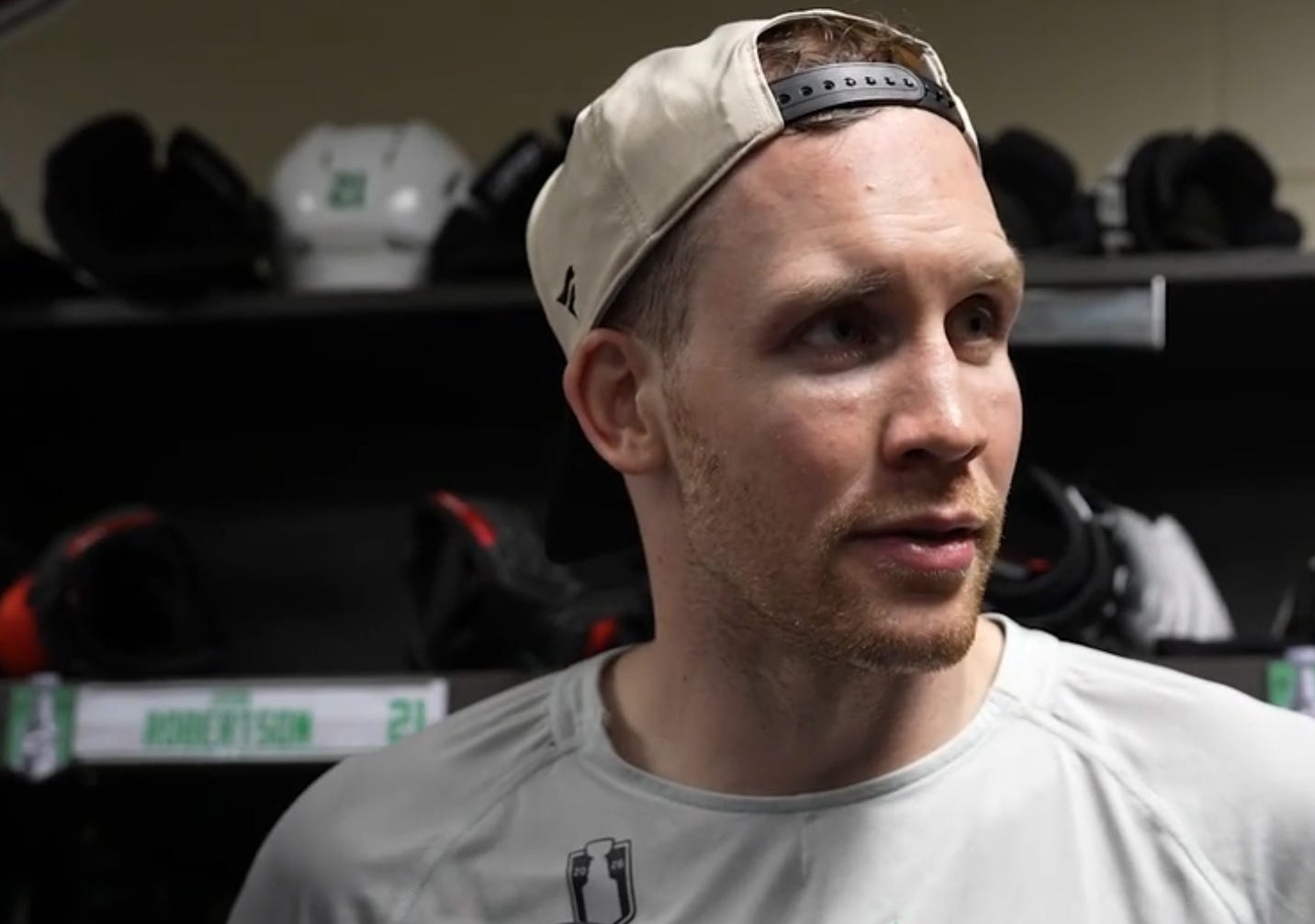
“Yeah, obviously during the whole year, we didn’t have a healthy roster,” Faksa said. “Nobody talks about it because nobody wants to make excuses. It would be great [to be healthy], because obviously we’re missing Roope a lot, Seggy in the playoffs, but no excuses. We were battling through it the whole season. The regular season was perfect for us. We did a great job, and a tough ending. Tough first opponent in the first round, but if you want to win a Stanley Cup, you need to go through everyone.”
Despite the bitter ending to the year, however, Faksa says he was grateful to be back in Texas, where he spent the first decade of his career.
“Me and my whole family, we enjoyed being back in Dallas. You don’t take it for granted, you know?” Faksa said. “I was just so excited to be back, competing for a Stanley Cup, having a great regular season. I’m just looking forward to that. I got two more years here, and we need to learn from this for next season and be better.”
Faksa had said when he returned at the end of the regular season that he had initially thought his season might have been over when he got injured in Dallas back in late February after returning from the Olympics.
But he also suffered an injury at the Olympics, too. Faksa ended up missing Czechia’s final games of the tournament, and now we know exactly why.
“Well, at the Olympics, I had a concussion,” Faksa said. “So I missed the last couple games at the Olympics, came back, and thought I’d miss just one game, and ended up missing over 20 games. After the concussion, I was having practice, and I got another injury. Nothing related to the head, like completely different. A lot of people thought it was my head, but it was a completely different injury.”
This lines up with what Jim Nill said back in March. But while Faksa would end up getting back into the lineup at the end of the regular season, he said it wasn’t without some cost.
“I’m still not 100%,” Faksa said. “I’m actually going in for an MRI tomorrow, and we’ll see what’s going to happen. But right now I want to make sure it gets better. I don’t want to go home until I figure out what the doctors will do, and what will be next. That’s the most important [thing], for me to get ready for next season and be 100%.”
I ask Faksa if he’s willing to tell what exactly that injury is, and Faksa thinks for a moment before deciding to reveal it.
Faksa says the Stars were having practice in Frisco when one of his teammates [whom he preferred not to name] accidentally lost their balance. And by freak coincidence, the heel of that player’s skate blade went through the laces on top of Faksa’s skate, and into his foot.
“It kind of stabbed me through my skate and cut my tendon for my toe,” Faksa said.
The cruel part of the injury is that it’s one that probably would have been mitigated had it happened in a game, when players like Faksa are often wearing things like shot-blockers on their skates for extra protection. No such luck at practice, though.
Faks said the tendon was surgically repaired, and he managed to get back into the Stars lineup after just under two months. But until all the medical questions are sorted out this summer, it still remains to be seen what a full recovery will entail.
Jim Nill is speaking to the media on Thursday morning this week, so he may have additional updates at that time.
It’s worth pointing out that in spite of his injury, Faksa was still one of the Stars’ better forwards in the playoffs. He played over 22 minutes of penalty kill time against Minnesota’s third-ranked power play, yet was only on the ice for a single power play goal against.
Faksa is a player whose hard-nosed, battle-driven game translates well to a playoff series like Dallas/Minnesota. It did, however, require him to do some in-game management this year because of his repaired tendon.
“It was getting better and better,” Faksa said. “I just had to take off the skate every intermission because I could feel the pressure, but it wasn’t the tendon. It was more from the surgery, where the incision was.”
If that was holding Faksa back, you wouldn’t know it, as Faksa’s underlying numbers at even-strength were among the best in the forward group. Despite starting the majority of his shifts in the defensive zone, Faksa was 55% or better in shot-differential, expected goals, and scoring chances in almost 60 minutes of five-on-five time, per Natural Stat Trick.
Signed for two more seasons, Faksa will likely continue to be a pillar of the Stars’ bottom six and penalty kill. And if all goes to plan, he’ll have at least a couple more playoff runs to give Dallas, too.
Great stuff Robert!!
Thanks for the insight!