
[Almost] Everything We Learned from Dallas Stars End of Year Interviews: System Changes, Jamie Benn's Decision, Jake Oettinger's Urgency, Jason Robertson's High Standards, and Injury Updates Galore
Lots of information, so let's get into it

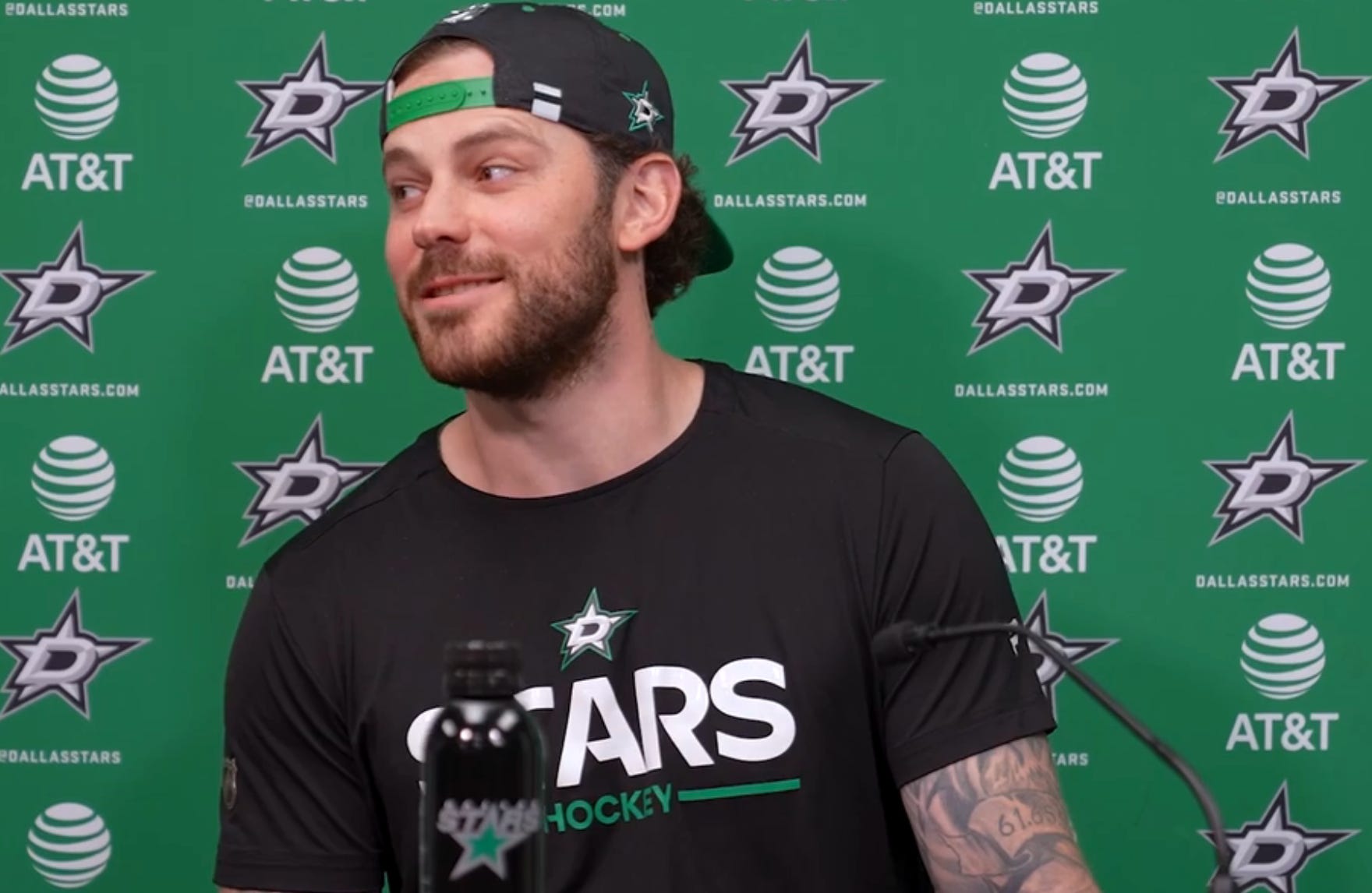
End-of-season media availability is always a bit of a strange time. Last year, it came after the Stars lost four straight to the Edmonton Oilers in the Western Conference final. This year, it came after they lost three straight to Minnesota in the first round.
To open things up today, Glen Gulutzan spoke to the media. I’ll include the full press videos in this post, with a few notable takeaways below, and then we’ll get into a few individual players, too.
It’s a big one, so tuck in.
Glen Gulutzan on offensive production, defensive breakdowns, and neutral zone adjustments for next year
A common theme in Gulutzan’s comments was that while the team’s five-on-five offense certainly wasn’t good enough in the playoffs, he sees some of the defensive breakdowns the team made as even more fixable—though the team will also be making some changes to the system next year in pursuit of shoring up their playoff readiness.
Gulutzan said the team “overachieved” during the regular season, specifically citing how getting to 112 points despite all the injuries they had was a remarkable accomplishment.
“I think we lost 380 man games through the 82 [regular season] games,”Gulutzan said, “And 112 points is nothing to sniff at.”
“I think that 112 [points] with our injuries is overachieving,” Gulutzan said. “112 with our team relatively healthy all year would probably be par for the course.”
Gulutzan likewise said the team “underachieved” in the playoffs, calling the first round a “winnable series” against Minnesota, regardless of their injuries.
The Stars’ coach said Minnesota made it harder for Dallas to score than Dallas did for Minnesota to score.
“We didn’t make them grind to score,” Gulutzan said. “I think we lost a little bit of our defensive identity in that series. They defended better than we did. We gave them too many easy looks on our net. If you look at our defensive metrics, some of the areas we were very strong, we became weak in that series.”
Gulutzan compared some of the easy goals Dallas allowed to getting punched in the nose. (Here I couldn’t help but think of Vladimir Tarasenko’s goal in Game 6 a minute after Mavrik Bourque had given Dallas the lead.) That felt about right.
“I think we came in very excited and hungry,” Gulutzan said of the Game 1 blowout loss. “And I think you have to come in with hunger and conviction. And after that first game, I think we thought, ‘Okay, this is the playoffs,’ but we didn’t realize. I’m speculating, but it just seemed like we were excited. We weren’t ready. We didn’t have the hunger and conviction right off the bat, and it cost us a game.”
Gulutzan acknowledged that the offensive production was a concern during the season as well.
“Things that we were worried about during the season kind of [came back to bite] us,” Gulutzan said. “We never scored easy. We scored at the 19th—our expected goals—at the 19th rate of league play, and then we were 11th in the playoffs out of 16. So, we were always in the bottom half of generating offense.”
Gulutzan pointed to a system adjustment the Stars will be making next year in the neutral zone, though he didn’t elaborate on the details:
“I thought our neutral zone was always an issue that we talked about. I never spoke to you guys about [it] at all probably this year,” Gulutzan said, “ And that’s an area that we weren’t good enough in. I thought we allowed Minnesota to control a little bit too much of the play, and that’s an area that we’re going to try to nip up next year for sure, with a little bit of a system change.”
“We talked about it all year, talked about making a change,” Gulutzan said of the neutral zone play, “And it came to fruition at the end. We wish we maybe would have made a change.”
Gulutzan deferred talk on injuries to Jim Nill (who will do his end-of-year presser later this month, presumably). But Gulutzan did say that Mikko Rantanen returned earlier than expected from his injury at the Olympics, and while he was “healthy,” Gulutzan compared Rantanen’s play post-injury to that of Duchene earlier in the year when he came back from his own injuries and took a while to finally get back into his best form.
And if I may be so bold as to editorialize here: There is a big difference between a player being healthy and being 100% effective.
Gulultzan said that while they absolutely did not accomplish their ultimate goal, he sees a lot of their improvements as “building blocks” going forward, citing defensive numbers, offensive zone stats (I’m presuming overall O-zone time is one, though that’s not publicly available) and rush chances against in particular.
“We check as good as anybody throughout the league,” Gulutzan said. “But now everybody checks in the playoffs. Can we find some more ways to create offense and continue to check at the level we check at?”
We asked Gulutzan if he saw an issue with how increased offensive-zone time still didn’t translate to better Grade-A chance-creation, and he agreed: “A hundred percent,” Gulutzan replied.
Gulutzan also pointed back to how Dallas’s suboptimal offensive work was exacerbated by defensive breakdowns at the other end:
“I’m gonna give them [Minnesota] a lot of credit in the playoffs for how hard they made us grind to get looks,” Gulutzan continued. “But we didn’t create enough looks off our grind. That’s an area we can look at, whether it’s in transition or in the O-zone. We did improve in that area. We kind of controlled play in that area, but again, if you can connect the dots […] we didn’t get the looks, but we gave up way too many looks on the other side of it when they weren’t controlling play there, and that cost us.”
Jake Oettinger on stepping up the urgency
When asked if this was the most disappointing season of his NHL career, Jake Oettinger said yes—at least in on-ice terms, Oettinger added (which is a good qualification for a relatively new father to add.)
Oettinger said it’s one thing to get eliminated from the playoffs late into a deep run and feel like he gave everything he had, but that it’s even worse to have been knocked out early, feeling like he still had more to give. He then went on to highlight the importance of holding himself to a high standard, and having coaches and fans who also hold him to a high standard, even if that means being hard on him and expecting more from him.
The Stars’ goalie said that Game 5 at home was the one that he really felt they let slip away, but he then added that the Game 1 performance was a personally disappointing one for him, too.
“Why can’t I play great in Game 1? Why can’t we come out guns blazing? You know, we’re at home,” Oettinger said. “Crowd’s awesome, everyone’s pumped. There’s no excuse to come out and get beat 6-1 at home. It’s obviously something we all need to look at and have a real conversation about.”
Oettinger acknowledged that in a vacuum, his record for this season (35-12-6) was a good one. But Oettinger also knows that his numbers were around league-average in the regular season and below-average in the playoffs. So, he was blunt when asked if he had accomplished some of his own goals for himself.
“I don’t feel like I accomplished any of my goals,” Oettinger replied. “I want to win a Stanley Cup. I want to win a Vezina trophy, and I want to be a starting goalie for Team USA at the Olympics. And none of those three things happened. I think it’s important to set big goals for yourself, and obviously, those are three really hard things to do. But I think I can do it.”
Oettinger said he’s a more strategic goalie now than he was when he was younger, and he wants to go into games well-prepared to execute a gameplan rather than just trying to play his heart out every single night and react to whatever the other team throws at him. In pursuit of developing that strength, Oettinger also said he plans to reach out to former Dallas Stars goalie Ben Bishop about how to plan for shooters’ tendencies. Bishop was a director of player development for the Stars from 2023 to 2025, after which he left to spend more time with his family.
Oettinger was also very honest about the fact that his team is running out of time to capitalize on their Stanley Cup window.
“You know, these next four or five years for our team,” Oettinger said, “I mean, we need to win one. No one’s getting younger. Contracts, all that stuff plays into it, and you don’t know what the deal is with everyone. You know, you sit here and you’re like, ‘Yeah, we have a great team,’ but you gotta win a Cup. We have great guys. We all believe that we can do it, but no one’s getting younger.”
Oettinger then recounted how a former veteran teammate used to impart a similar sense of urgency late into his own career in Dallas. And that teammate knew what he was talking about.
“Even playing with Pavs [Pavelski], I remember I used to sit next to him on the plane,” Oettinger said. “He was like, ‘Dude, you know you only have a real chance to win the Cup so many times.’ We gotta realize that, and the sense of urgency, I think, needs to be elevated. And everything I’m saying is speaking for myself. I think I need to step up the urgency.”
Those are pretty candid statements from Oettinger, and I think pretty honest ones. Given the circumstances of last year’s end to the playoffs, this year’s elimination sure seems to feel especially gutting to the Stars goaltender.
Oettinger was also asked about playing for Team USA in the World Championships, but he said he hasn’t heard anything from the team.
“I haven’t had any conversations, so I’m guessing no,” Oettinger said. “But yeah, I also have a six-month-old, so I’m really looking forward to spending a ton of time with him.”
Oettinger and Jason Robertson did both play for Team USA at IIHF World Championships way back in 2021, as you may remember hearing about from a certain familiar writer at the time. And hey, speaking of Robertson…
Jason Robertson is optimistic, but also realistic
Jason Robertson mentioned today that he made a plan with the Stars’ head strength and conditioning coach Mike Donoghue as well as some of his personal coaches back in Michigan. Robertson said everyone collaborated to make a plan for Robertson to improve in certain areas, and the Stars’ winger said he thinks a lot of those plans came together to help him improve.
“I thought I did that in certain ways,” Robertson said of taking another step in his game. “Really trying to improve and really do things differently this year on the ice: moving my feet more, shooting the pucks in better areas, getting better scoring chances and everything, and then obviously, everything worked out, it was great. And obviously, as a team, definitely disappointed [in] what happened.”
Robertson was one of the Stars’ best players this year, full stop. The work he put into his skating was noticeable all year, and the Stars were better offensively and defensively with him on the ice. His 45-goal, 96-point season couldn’t have come at a better time for both him and the team, and his team-leading five goals in six playoff games included the bulk of Dallas’s paltry five-on-five offense in the postseason.
“I don’t really think I need to prove anything,” Robertson said. “If anything, I think I owed it to myself to get back to where I wanted to go and just take the next step in my game.”
Robertson said he moved his feet more this year than ever, and that was clearly a big factor in his strong play this year. (In fact, during a radio interview today, Gulutzan also cited Robertson’s moving his feet more as a big improvement this season, too.) But Robertson said the ultimate goal is still to continue pushing himself to get better.
“I think this is the biggest step I’ve taken in my career this season,” Robertson said. “Obviously it wasn’t like it was three years ago when I put up those numbers, but I think my play this year has been the best it has [been] in my career. That’s what my standard’s gotta be, and I hope to reach a different and higher peak.”
Now, of course, the Stars have to decide just how much Robertson is worth as he enters his final year before unrestricted free agency still in need of a contract. Robertson recently switched agents to Andy Scott (with Octagon), and Robertson said the last couple months have involved him and Scott getting to know each other better as they prepare for the summer’s negotiations.
By the sound of things, both Robertson’s agent and Jim Nill have simply been encouraging him to play his best during the season rather than worrying too much about negotiations. But with the season now over for Robertson and the Stars, it sounds like both sides will gear up to engage in contract talks.
If this were another hockey market, you could analyze the tense and tone of every word Robertson used today. I don’t think that’s a fair or informative way to look at things. My main takeaway from today is that Robertson was being careful not to sound too committal one way or the other, because he remembers how tough negotiations can be from his last RFA round of talks four years ago that stretched into training camp.
As always, we’ll know about Robertson’s future in Dallas when we know.
“I understand it’s a business on both sides, right?” Robertson said of his negotiations with Dallas. “I’m optimistic, I hope. But it’s not like what it was when I was ten years old, getting to the NHL anymore, right? It’s a business and everything. I learned that, what, four years ago. It’s not my first time, so I’m just excited that I’m healthy going into this offseason. That’s the only positive. Obviously you wanna be playing, but healthy, ready to improve this summer. I mean, we played a lot of hockey in the past three years. It’s the longest summer we’ve had in three years, so use this extra time to lick our wounds. Maybe [I’ll] go back to LA for a little bit, get some sun there. I haven’t had that since four years ago. Definitely bittersweet, but a lot to be excited about.”
When Jim Nill does speak to the media, you can bet he will be asked about the Robertson negotiations. In fact, I think it’s entirely possible that Nill chose not to speak today specifically because he knew there was a chance he’d be doing another press conference at some point in the coming days to discuss a couple players: Robertson, yes, but also another player, whom we’ll discuss now.
Jamie Benn has a decision to make, and so do the Stars
Gulutzan said he’s still conducting all his end-of-year meetings with his players, and Jamie Benn’s will be the last one he does. It’s customary to end that round of sit-downs by speaking with the team captain, and that will happen on Wednesday.
But with Benn once again heading into the summer without a contract for next year, the same question came up today as did last year: will Benn return as a Dallas Star next season?
“I don’t know where he’s at. For me, it’s a slam dunk,” Gulutzan said. “He needs to come back. But that’ll be a decision for him, and I won’t know until I talk to him on Wednesday. I think that’s [when] his meeting is scheduled.”
Gulutzan cited Benn and Seguin as “pure players,” by which he meant they are content to play in a lesser role if it’s in service of helping the team win. As for Benn? Well, he said today he hasn’t made up his mind yet.
Tyler Seguin was asked what his conversations with Benn have been like, and Seguin began his answer with a joke.
“You ain’t allowed to leave. I got one year left [on my contract] here. You gotta stay,” Seguin cracked before continuing. “I don’t think anyone knows what Jamie’s gonna do until Jamie does it. I’ll stay out of his way and let him come to his own decisions. I’d obviously love to have him for one more shot.”
In a perfect world, Seguin and Benn should absolutely have at least one more shot to win a Cup in Dallas together. Maybe that can still happen.
But before we get into Benn’s own comments, I wanted to reiterate something I’ve said a couple other places so far: I don’t see how the Stars can put Benn into the position he (and the team) were this postseason, where the captain wound up being the most logical player to scratch in favor of inserting an offensive player like Michael Bunting later in the series, but was also unable to be scratched, because you really can’t scratch your captain in the playoffs without causing a lot of other drama and noise from the outside (though Benn himself would almost certainly handle it perfectly fine, as he has almost any sort of diminished role in his career).
Benn has been a captain in Dallas for 13 years. Glen Gulutzan is not going to healthy scratch him for the first time in his career right in the middle of do-or-die playoff games. The Stars either need to figure out how Benn can be a more meaningful contributor next April, or else they need to discuss tougher decisions. He deserves that level of clarity, because repeating this situation ties the coach’s hands, and it also highlights the player’s limitations in a way that was further magnified in the final minutes of Game 6, when Benn’s turnover in the offensive zone led to the series-clinching empty-net goal for Minnesota.
Benn is still an NHL-quality bottom-six player, no question. The fact that he came back from multiple severe injuries this season to post solid point totals in very limited minutes was impressive. But on this team as it’s currently constructed, Benn struggled to be effective in the heat of the playoffs, and that led to some pretty rough criticism that the franchise icon shouldn’t have to be subjected to. Jamie Benn deserves better.
The Stars and their captain will have to have a very frank conversation about the reality of his capabilities as a player and how he does or doesn’t fit into the lineup going forward. More importantly, they need to do so in the context of everything he means to this city and organization. Because Benn has given too much to this city and this team not to have a clear path forward.
Maybe there’s a way for Benn to give it one more go next season, but Benn’s least productive playoff performance of his career certainly makes that path a trickier one than ever—especially after a playoff elimination when the Stars didn’t get a single goal from their bottom-six forward group.
All right, enough nonsense from me. Let’s hear from the captain himself.
Benn said he had to “grind” to get back into the lineup after his collapsed lung in the preseason, and that getting his body back to where it needs to be also took some time.
“Felt pretty good in the regular season and then playoffs,” Benn said. “Pretty much the same [as the team]: just not good enough.”
As for Benn’s decision on returning next year, he was slightly less direct in his replies about his future than he was last year, when he pointed to contract negotiations as the main sticking point before eventually agreeing to his one-year deal.
However, Benn did say the disappointment of losing leaves him with a desire to take another shot.
“Obviously the goal is to win the Stanley Cup and when you don’t do that, there’s an empty space, a little pit in your stomach where you
have some fire to change things up for next year.”
“We feel as a group it’s too early,” Benn said. “We felt we should have made a longer playoff run. Hopefully with some extra rest, get healthy again, get motivated again to come back here and do something even more special next year.”
When asked more directly about how that desire fits with his own bodily fitness, Benn smiled before replying.
“I'm going to take some time just to relax. We'll see.”
When pressed again about whether Benn has a sense for how much time his decision will take, Benn said it’s tough for him to say right now.
“Probably just wake up one day [and know], to be honest. Right now I’m just hanging out, you know, being a dad. I’ll figure it out later.”
And what of Gulutzan’s “slam dunk” comments? Again, Benn smiles.
“We’ll see. Hopefully.”
The Stars put all the other press conferences from today up on their website, so you can check them all out there. But for now, let’s end with a list of all the injury updates we got today.
Injury Updates Aplenty: Lundkvist, Hintz, Heiskanen, Seguin, and more
Tyler Seguin said that while there’s “a few different timelines” for returning from ACL surgery, the average timeline is nine months, which would put his return right at the beginning of training camp.
Seguin is skating now, but he’s also doing all of what he calls the “boring, meticulous training” off the ice to strengthen his own lower-body mucles, too.
“I feel, deep down, I’ll be as strong as ever,” Seguin said.
Nils Lundkvist said today that his injury “looked way worse than it is,” which was good to hear.
“I was pretty lucky in an unlucky moment,” Lundkvist said.
Full disclosure here: I was doing a different one-on-one interview while Lundkvist was talking to the assembled media, but it sounds like he declined to go into details about what exactly it was about the injury that kept Lundkvist out for the rest of the playoff series. We’ll ask Jim Nill about that when he speaks to the media in the coming days.
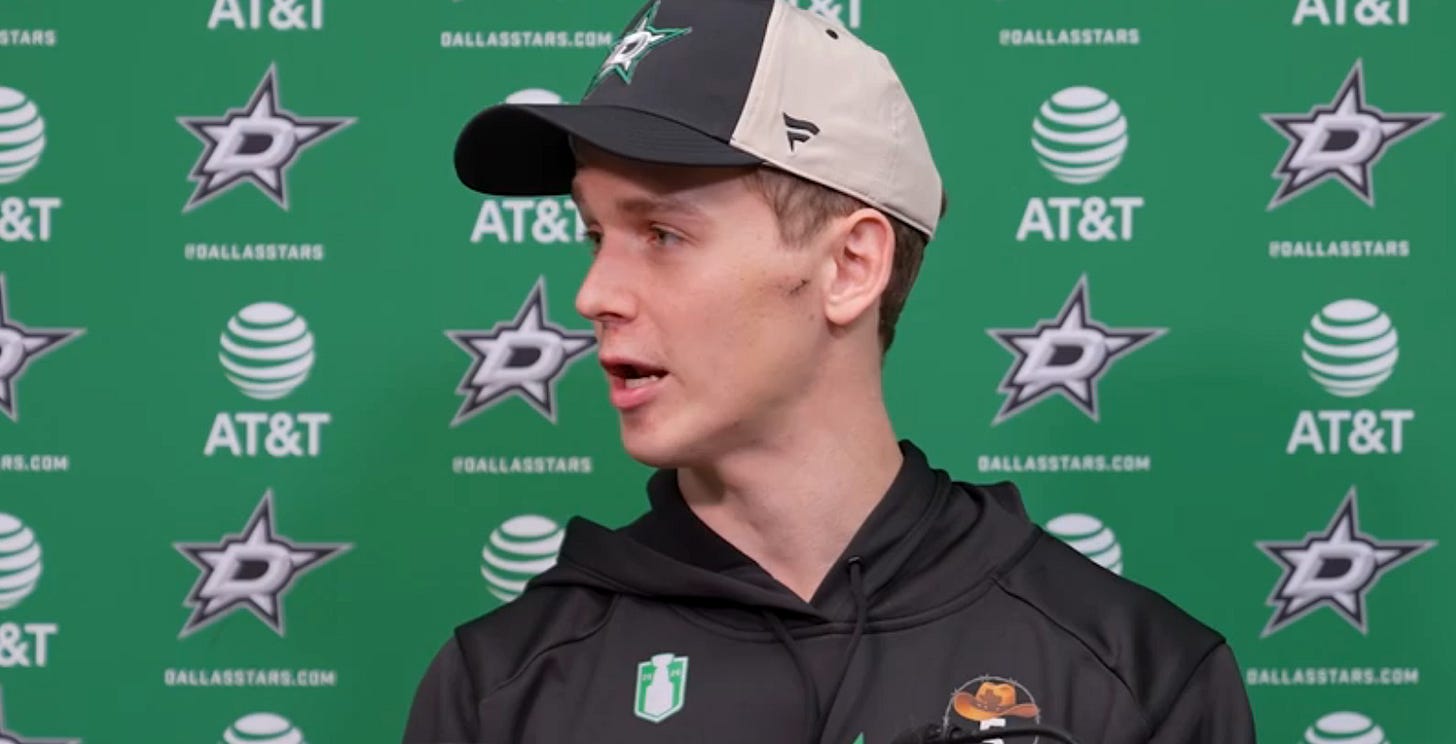
Roope Hintz confirmed that he tore his hamstring in two different places during that wrestling match with Nathan MacKinnon a couple of months ago.
“It was kind of a battle,” Hintz said of when the injury happened, “And I just kind of overstretched it or something, and then it just popped. I don’t know what really happened there, but yeah.”
Hintz said he was getting close, and then had a setback in his recovery, but Hintz said he believes he would have been able to return by perhaps the second or third game of Round 2.
Hintz was very complimentary of Neil Graham’s work on the power play, giving him specific credit for the suggestions and strategies Hintz and company were able to implement during the season.
“He had so many good things to add on the power play,” Hintz said of Graham. “The way he brings that to you and shows the clips and everything, he’s a great coach.”
Miro Heiskanen told me today that he tore an oblique muscle in Game 79 of the regular season, but that he actually did so the shift before he had the awkward collision and fall after contact from Ryan Hartman—which we had assumed caused the injury, but in fact, had not.
Here are the two moments on that prior shift that I think probably contributed to that injury: hits from Marcus and Nick Foligno, respectively:
Heiskanen said it was the first oblique injury he’s ever had, and that it “got a little better and felt better every game,” but he also conceded that his oblique muscles still have to fully heal, which will be his first priority for the summer. (I’ll have more on Heiskanen tomorrow.)
Mikko Rantanen declined to go into detail about his injury at the Olympics.
“It’s unfortunate because I was feeling really good before the Olympics,” Rantanen said, “Then it takes a little time. I still felt good body-wise and power-wise in the playoffs, so it’s not an excuse. But yeah, always you want to stay healthy and play all 82 and stay in a rhythm, which didn’t happen. Hopefully next year.”
“I think coming back at the end of the regular season, I didn’t feel like I got to the level where I was probably before the Olympics,” Rantanen said. “Like I said, the body was feeling pretty good, but just didn’t find the same [level]. Even though I was trying to work, and working hard, sometimes when things don’t go to your way right away, you start working too hard. Working too hard is never good. You wanna be right in the rhythm.”
“For me individually, I gotta be better in a year when the playoffs start,” Rantanen said.
Rantanen acknowledged that the losses of Hintz and Seguin were big ones for the team, but he also said multiple times that every team deals with injuries, and that it’s up to them to find a way to do better, starting with himself.
Radek Faksa confirmed today that he did indeed suffer a concussion at the Olympics. However, just when he had recovered from that concussion after the break, Faksa then suffered a freak injury to his foot during a practice in Frisco that kept him out until late in the regular season.
That injury necessitated a surgical procedure. And after returning to the lineup, Faksa said he had to take his skate off every intermission just to lessen the pain in his foot from the spot where the surgical incision had to be made.
We’ll go into more detail about Faksa’s second injury in a separate piece tomorrow, but I’ll end with this: the fact that Faksa was able to return for the playoffs, get heavy defensive-zone and penalty-killing usage, and still be one of the Stars’ strongest play-driving forwards in that Minnesota series was genuinely remarkable.
Great article. Just a quick question: could the problem have been that the roster was built more for PDB’s system (man to man defense, work more for transition chances and odd man rushes even if they sometimes leave you exposed defensively)? Gully’s system is built more for a grinding, cycling team. I’m not sure that this style works best with the Stars top 6 group,
I do like that Gulutzan is heavily into the analytics, but as always the math has to translate into wins in the ice.
Game one of the Wild-Avalanche series really made me reevaluate Dallas’ defensive performance in round one. I know that was just one game but I was surprised that Minnesota was as effective in transition as they were against Colorado.
I still think the entire team and all phases of the game need detailed and thorough review. As Jake said the window is open for a few more years but you can’t count on health as we saw this year. You also have to make some changes rather than roll the same team out and hope they’ll win more playoff games.
I have the feeling that there will quite probably be as much change this summer as there was last summer.