
Talking with Dallas Stars GM Jim Nill on the NHL Playoff Format, Olympic Hockey, Potential Roster Moves, and What's Holding Up the Trade Market
We talked with Nill this week about a few topics

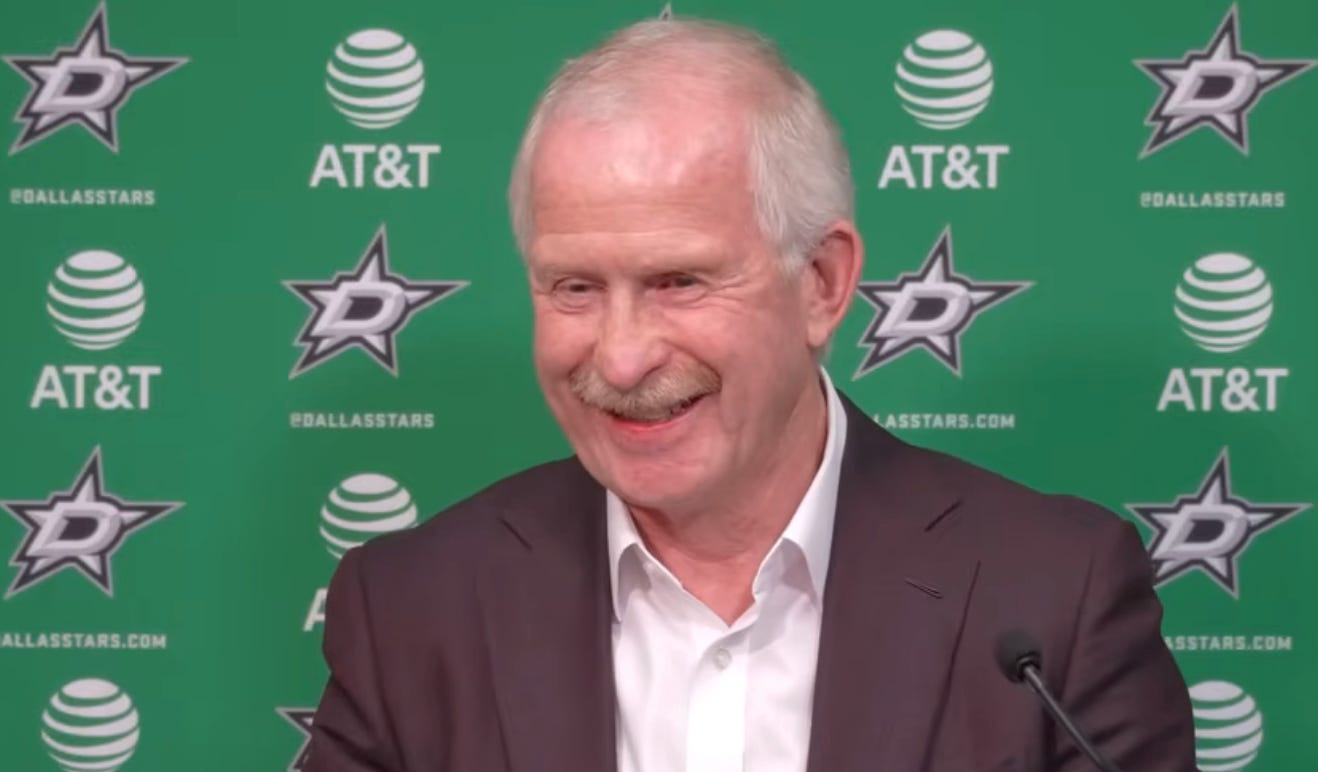
After 44 games, the Dallas Stars are in a very good spot.
They’re still the second-best team in the NHL, despite having just snapped a six-game losing streak. They’ve scored the second-most goals in the NHL, and they’re also top-ten in goals allowed. They even boast the exact same road record (14-4-5) as the Colorado Avalanche, if you can believe it.
Still, there’s a lot of work still to be done. And as always, the person responsible for a lot of that work is Stars’ general manager Jim Nill. The Stars may not have as many draft picks to trade as they used to, but this is still a team very much in hot pursuit of a championship. You don’t trade for Mikko Rantanen if you’re not planning to win it all right here, right now.
The Stars’ path to playoff glory looks as tough as it ever has, with all three of the league’s top teams being in the Central Division. That led me to start off a conversation with Nill the other day by asking if he thought there was any chance of the league’s changing the playoff seeding format any time soon.
Sadly, no such momentum sounds imminent.
”I don’t know,” Nill said. “Do you ever go back to one versus eight? I’ve lived it my whole career. When I was a player, I lived it. We were in a division with Edmonton, Calgary, and Winnipeg, all three really good teams. All had 100-plus points. It is what it is.”
For Nill, however, the job remains the same.
“You know, I think if you look over the history of the last probably 15 years, Pittsburgh, Washington, you know, Tampa Bay, Florida, and Toronto have lived it in their division,” Nill said. “You deal with it. It’s the way it’s set up. To be the best, you’ve got to beat the best. It is what it is.”
In an effort to do just that, the Stars went out and made a coaching change last summer. And while you can talk about Jake Oettinger or Pete DeBoer and Edmonton all you want, I wondered if one of the reasons Dallas made that change was more simple than that: The Stars’ defensive structure simply wasn’t that effective last year.
So I asked: Was there a plan to make changes to the defensive structure of the team even before hiring Glen Gulutzan? Some of Gulutzan’s tweaks to the Stars’ defensive-zone coverage have been well-documented, but it seemed at least feasible that Nill and the Stars might have had some ideas about solidifying the team’s defensive structure—with whatever new coach they ended up signing.
“You know, when unfortunately we had to make that change, and when I talked to the new coaching staff that’s coming in, you’re always working to get better,” Nill said. “And those are things that we discussed. They had some ideas, and they’ve implemented some of their ideas. I think some of it is internal growth with the team, too. So it’s kind of a combination.”
That internal growth has been especially noticeable with players like Justin Hryckowian and Oskar Bäck, who have both taken on big checking-line and penalty-killing roles after working their way to Dallas after a season (or a few) with the Texas Stars.
But Nill places a lot of emphasis on what the people behind the bench have done to set those players up for success, too.
“The coaching staff has done a great job,” Nill said. “You know, we started the year and didn’t know where it was gonna go. A lot of injuries, and we fought through it. And we’ve been rewarded for it.”
Another topic Nill touched on was Wyatt Johnston, whom he confirmed remains in the discussion as a possible alternate for Team Canada at the Olympics.
“Oh he is, definitely,” Nill said of whether Johnston was still in that conversation for a Team Canada spot, should more openings occur. “And he continues to be. I hope there’s no injuries, hope there’s no sicknesses, whatever happens. But he’s definitely a player that’s on the radar screen. He’s been in the mix, right from last year with 4 Nations to now. He’s in a good place.”
The phrase “good place” is entirely accurate. Johnston is signed to a $8.4 million salary cap hit through 2030, and the 22-year-old center has played primarily with Mikko Rantanen this year, and he leads the NHL with 15 power play goals—four more than Leon Draisaitl, who is the next-closest player to Johnston.
Little wonder, then, that Team Canada has their eye on Johnston, should the need arise.
“We have a list of players we keep an eye on that were very close to making it,” Nill said. “He’s one of those guys.”
Speaking of the Olympics, with all the talk about some teams looking for the types of players that are best-suited for tight-checking contests, I wondered if Nill expected any carryover from the Four Nations Face-Off, or if his expectation is that Olympic hockey would end up looking much different than what we saw in February.
“There’ll be carryover,” Nill said, “Because Four Nations was the best players of those four countries, other than guys that were injured or different guys that have come in like [Macklin] Celebrini, where they’ve put themselves on the roster.”
But don’t mistake carryover for complete and total continuity, Nill cautions.
“It’s the best players in our game right now, but it is different hockey, because it’s one game and out. You’ve got to win games, and you’re playing good teams every night. Four Nations was good teams every night. I think everybody understands now what it’s like. But the Olympics are different, like the world juniors that you just watched. It’s a different animal, because every game is so important.”
That’s where roster construction becomes so important, Nill goes on to say. It’s a tournament, not a prize fight.
“Something we talked about is, you can’t build your team to beat one specific team,” Nill said. “You’ve gotta win the tournament. So it’s not like it’s the best of seven in the playoffs where, okay, we gotta make adjustments here. You’re going in, you gotta win that game. So it is a different format that happens quick, and there’s not a lot of practice time. European time zone change, different times for games. So it is a different animal.”
The final portion of our conversation touched on the trade deadline, and where Dallas may be hoping to add.
I asked specifically about wingers, but Nill wasn’t revealing any details about the Stars’ shopping list. However, one thing he did confirm is that the timing of any trades the team might make will be different this year than last, when they made two big moves: one in early February for Mikael Granlund and Cody Ceci, and another in March, when they added Rantanen.
“We have our amateur and pro meetings coming up here [this week],” Nill said. “It’s a different year this year because of the Olympics. We’ve got to get through the Olympics first. That’s the big thing. We’ve done a great job managing that so far, but let’s see how we end up. Where is our team at, at the Olympic break? What’s gonna happen at the Olympics?”
It’s a concern that makes a lot of sense. The last thing a team would want to do is spend a lot of assets to acquire a rental player, only to watch that player get knocked out for the season while playing on a rink still under construction in Italy.
“I hope there’s no injuries,” Nill said. “I hope there’s no setbacks for anybody on any team, but there may be. That might change our thinking. It might change the thinking of how other teams look at themselves.”
But the Olympics aren’t the only thing that might delay the next big move for the Stars—if they decide to make one. The almost unheard-of parity around the league is making a lot of teams more reluctant to start selling than you might see in other NHL seasons. And from the sound of it, teams that haven’t made the playoffs in recent years might also be the ones most reluctant to concede that it’s time to start selling.
“Right now, I’ve been talking to teams, and everybody’s in it,” Nill said. “I don’t know if people understand how important it is to make the playoffs for an organization. If you’ve missed the playoffs for four or five years, and you have a chance to make the playoffs, that changes a franchise. Business-wise, recruiting-wise, signing-wise. So with so many teams in it, I don’t know what the market’s gonna be. I don’t know who’s available, who’s not. I don’t know our situation, health-wise. We’ll know once we get to that March deadline. We’ll get into March, we’ll see where we’re at. But we’ve got two months to go here, to see where it’s at.”
Of course, Nill admits that his stated March timeframe is subject to change, should the Stars find themselves in a similar situation as they did last year. Though of course, he hopes that won’t be the case.
“Last year, I kind of got a read on the market,” Nill said, “And I said, ‘I want to get these guys now, before [the trade deadline].’ Now, there’s no teams in the market. So, I hope that [injury situation] doesn’t happen, but it might. That might change. But right now there’s so much uncertainty in the market.”
That’s good for the NHL, Nill says. But it also makes it a lot trickier to sort out buyers from sellers, as a team’s perception of itself could wildly shift from one game to the next.
“If you look at the standings,” Nill said, “I sit and watch games at night, and I listen to announcers say, ‘Yeah, we’re in last place or second-to-last place, but if we win tonight, we’ll be two points out of the second wild card.’ It’s nuts.”
Buffalo is a perfect example, as Nick Kypreos mentioned this week. Alex Tuch was one of the top names on lists of pending UFA rentals for much of the first half of the year. But after the Sabres’ recent run, suddenly Buffalo might not only keep Tuch, but actually become buyers themselves.
Being in that kind of bubble position after missing the playoffs for multiple seasons is something the Stars haven’t had to wrestle with for a few years now—perhaps as far back as 2013-14, when they grabbed the final Wild Card spot after a five-year playoff drought.
But of course, recent history has set the bar much higher for Dallas.
“You know, we’ve been spoiled here, we’ve had some pretty good runs,” Nill said. “But if we had missed the playoffs two, three years in a row, and we get a chance to make it now? What that does to your business and everything else, that’s huge. I don’t know what the market’s gonna be, who’s selling, who’s not selling. It’s wide open.”
One thing we can say for sure: Whenever that wide-open market does start to come into focus, Jim Nill will surely be ready to act.
“Something we talked about is, you can’t build your team to beat one specific team"
Subtle jab at Bill Guerin? Sounds like it to me.
As always, terrific work Robert. The sheer volume of output is amazing.