

The most noticeable difference between Dallas Stars broadcasts this season compared to last year actually came before the regular season started.
For perhaps the first time in recent memory, every one of the Stars’ preseason games received a Dallas broadcast1 along with full play-by-play and color commentary, all streaming free of charge on Victory+. Brien Rea and Brent Severyn called the first five preseason games (including three road contests), before Josh Bogorad and Daryl Reaugh took over for the final preseason game and beyond.
It was the most preseason game coverage Stars fans had ever gotten. But that wasn’t the end of the changes for game broadcasts—not by a long shot.
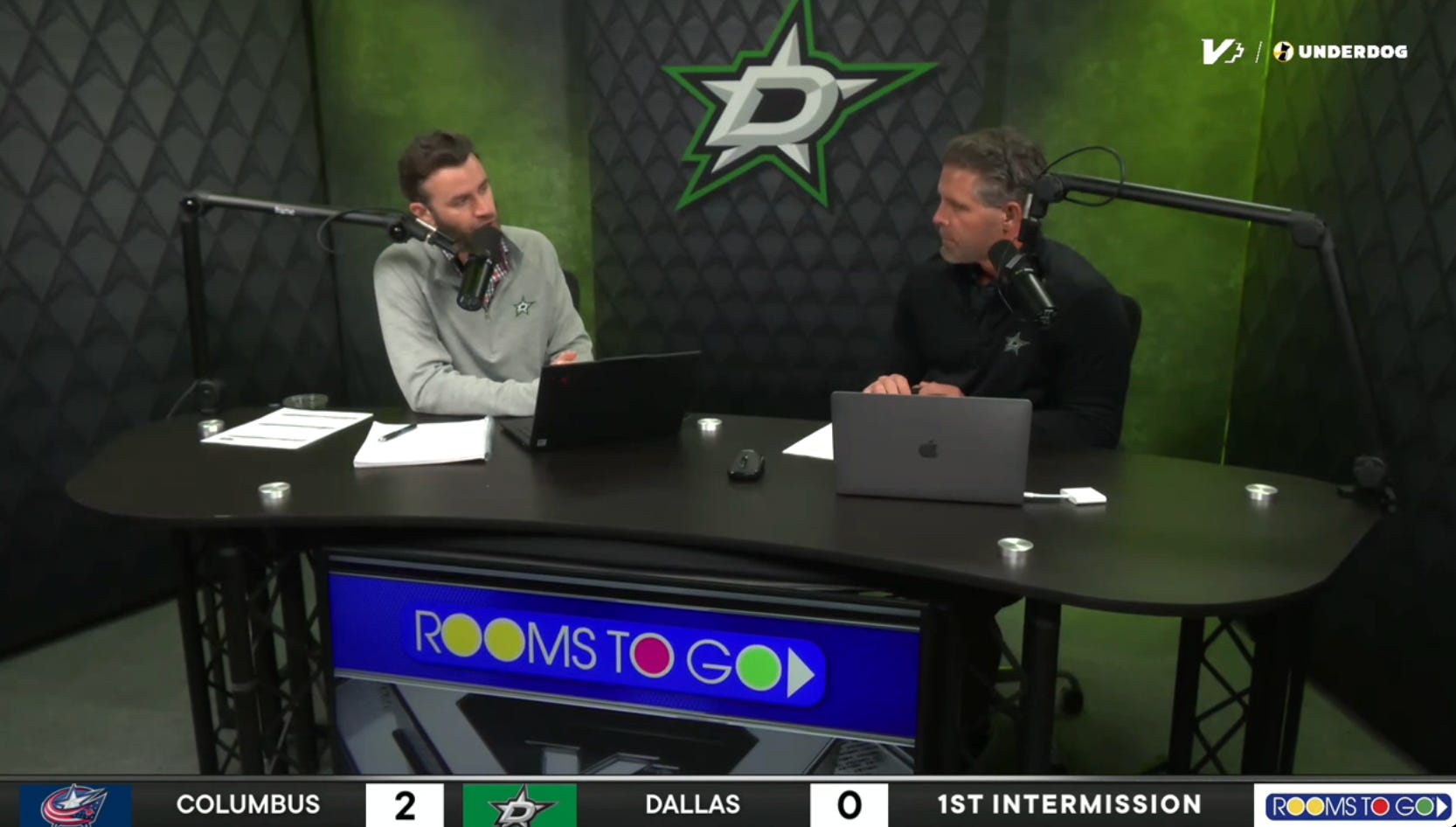
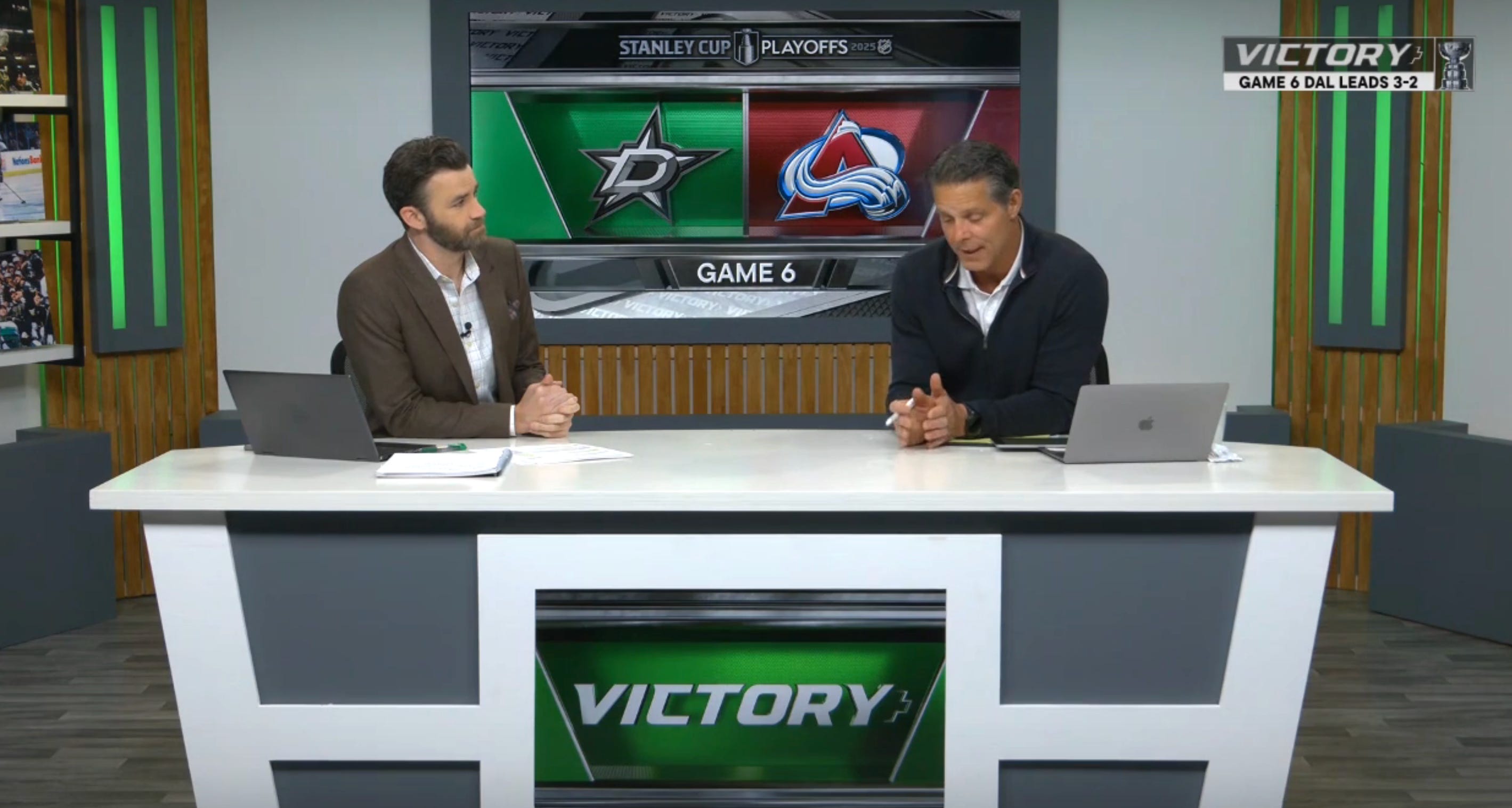
In the first game of the regular season, a road contest in Winnipeg, Stars fans saw Rea and Severyn begin Stars’ pregame coverage 30 minutes before the game was scheduled to start. But instead of the studio viewers had been seeing ever since the days of Bally Sports Southwest (and Fox Sports Southwest before that), Rea and Severyn were hosting a pre-game show with a more scaled-down, podcast-style format at a table with microphones, rather than behind a desk in a television studio.
The new format is called Stars Aligned. And the changes are part of a vision for Rea and Severyn to be able to use the new format outside of just game-day broadcasts. But more on that in a moment.
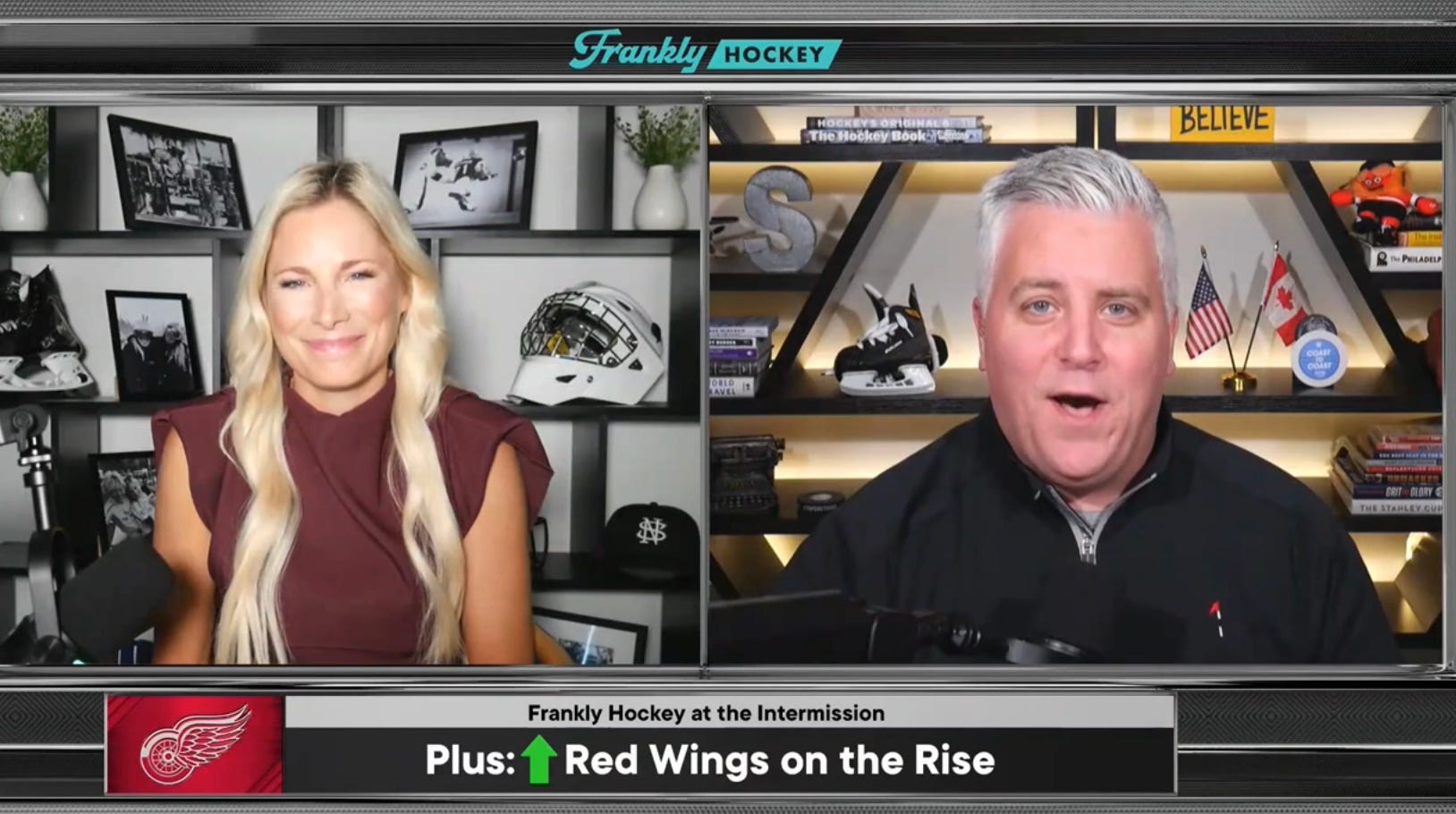
Another change fans would notice early on came during the first segment of the first period intermission, which began, not with Rea and Severyn, but with a pre-recorded segment with Philadelphia-based Frank Seravalli, who hosts the new Frankly Hockey show on Victory+.
I was curious about the rationale behind the changes to such longstanding features of Stars broadcasts. So to learn more about them, I spoke with Jason Walsh, Chief Operating Officer, Sports, of A Parent Media Co., Inc. Our conversation took place over the phone on Wednesday, after the Stars’ first six games of the regular season (one of which was nationally broadcast by ESPN).
Walsh is a longtime veteran of Stars game presentation, having started with the team way back in 1996 before moving to a production role with Fox Sports Southwest beginning in 2016. That network then became Bally Sports Southwest for the regional sports network’s final years, before the Stars decided to retain their broadcast rights and launch Victory+ in 2024.
But just because Walsh has been around that long doesn’t mean he wants to keep everything the same as it’s always been. And with the real-time access to viewership data they have now, the team at Victory Plus is looking at everything and anything in hopes of finding the most effective ways to evolve game broadcasts in order to bring viewers what they want.
“One of the beautiful things about being a digital app-based product,” Walsh said, “Is that you are able to sit down and take a look at what your viewership is at any given time. And we sat for one year and evaluated everything, from our pre- and post-game show, to our game, to our intermission, to to VOD (Video on Demand) content that’s outside the scope of a live game.”
The viewership numbers Walsh refers to are something the Stars have direct access to with a streaming platform like Victory+—access in a way that they didn’t beforehand, with linear television.
Walsh even read off some live streaming numbers from the Stars’ preseason game against the Minnesota Wild last month on an episode of Spits and Suds. That viewership data is also critical for an ad-driven service like Victory+, which is free for viewers of Stars games.
“We see what the viewership is—how many people are watching, what have you,” Walsh said. “And we decided to make some adjustments with what we used to call pre- and post-game show.”
More jarring than the visual adjustments, perhaps, was a nagging issue in the audio quality of the first couple of broadcasts from Rea and Severyn’s new studio—something the engineers at Victory+ spent days “pulling their hair out” trying to solve. That involved troubleshooting a whole host of things in the new broadcast room, which is located in an office building next to American Airlines Center—a space that Walsh says the Victory+ team had to kit out essentially from scratch in the final month leading up to the season.
The engineers finally found the culprit of the audio quality issue a couple days after Stars Aligned debuted. And it turns out that even in the brave new world of streaming, some classic hardware problems can still cause headaches.
“It ended up being a cable that was soldered incorrectly,” said Walsh. “We just couldn’t figure out where it was, so it took us a couple of days to figure it out. But it’s all been rectified.”
That technical hiccup’s unfortunate timing may have dampened viewer reception initially, but Walsh is confident that over time, the new changes viewers will see (and hear) will be worth the acclimation process. Because without the restrictions of linear television, Walsh says more experimentation will continue to happen in the second year of the new platform.
“I’m generally of the belief that we need to look at our broadcast as a whole and say, What is it that we can do differently now?” said Walsh. “What is it that we want to do going forward? How can we be different? Because we have to morph—and we have to morph for a variety of reasons.”
This is where the financial factor comes into play. Gone are the days of regional sports networks paying enormous broadcast rights fees to every NHL team for straightforward linear television deals—rights fees that (and this is just my assumption) cover all the costs of on-air talent, studio rentals, production crews, broadcasting equipment, and all manner of things that go into putting an NHL product on screen—with plenty left over besides.
These days, broadcasting and rights fees have become much more complex in the world of streaming and declining linear television viewership, with some such networks (including Bally Sports Southwest) outright defaulting on their payments in recent years. Those giant rights fees aren’t quite as much of a given as they used to be.
That’s my own conjecture, to be clear. But to return to my conversation with Walsh, he throws out some cold, hard numbers that underline that point.
When he first went to work with Fox Sports in 2016, their revenues were $350 million. But just eight years later, Walsh says, the 2024 “revenue” was negative-$125 million.
That decline is emblematic of the much of what’s prompted change across the industry, to put it mildly. For the Stars’ part, they decided to launch their own streaming, ad-supported platform, which has grown into the home of games for the MLB’s Texas Rangers, the NHL’s Stars and Anaheim Ducks, the entire Western Hockey League, and even Texas high school football, among others.
But as exciting as the “fresh and new” feel of Victory+ can be, says Walsh, his team isn’t content with just doing the same things in the same ways they’ve done in the past.
“The regional sports network industry has gone through a seismic shift when it comes to revenue, and how revenue is generated and created,” Walsh said, “Both for the teams and for the station. Some of that has to do with the way people are consuming content, and some of that has to do with, what other things can we do during the day with the pieces that we have?”
Shifting those pieces might even involve utilizing more on-air talent—something Walsh believes the Stars have a lot of.
“I’ve always looked at Brien and ‘Sevy’ [Severyn] and thought they’ve done a tremendous job with anything we’ve ever asked them to do,” said Walsh. “And last year, I was watching the pre- and post-game show, and I thought, why can’t we have Brien and Sevy do more content on our service on non-game days?
“What if there’s a trade on a Tuesday, but the Stars played on Sunday, and don’t play again until Thursday? How do we get it set up so that we can address anything in any given moment if we wanted to? Stars fans want to immediately hear from the people they trust the most. That’s Josh, Razor, Brien, and Sevy, from the TV and broadcasting angles.”
That’s where Walsh says the advantage of having their own studio every day of the year comes into play. They don’t have to restrict those trusted voices only to game-day broadcasts.
“The goal here, over the course of the next couple of months, as we get our feet wet and get comfortable doing these shows, is to be able to do them on Tuesday at 1pm, or Thursday at 9am, depending on what kind of content we feel is necessary.”
Walsh says those sorts of shows could include things like trade talk or Stars discussion in the midst of a stretch with multiple off-days between game broadcasts. But the goal is to keep creating—whatever it is.
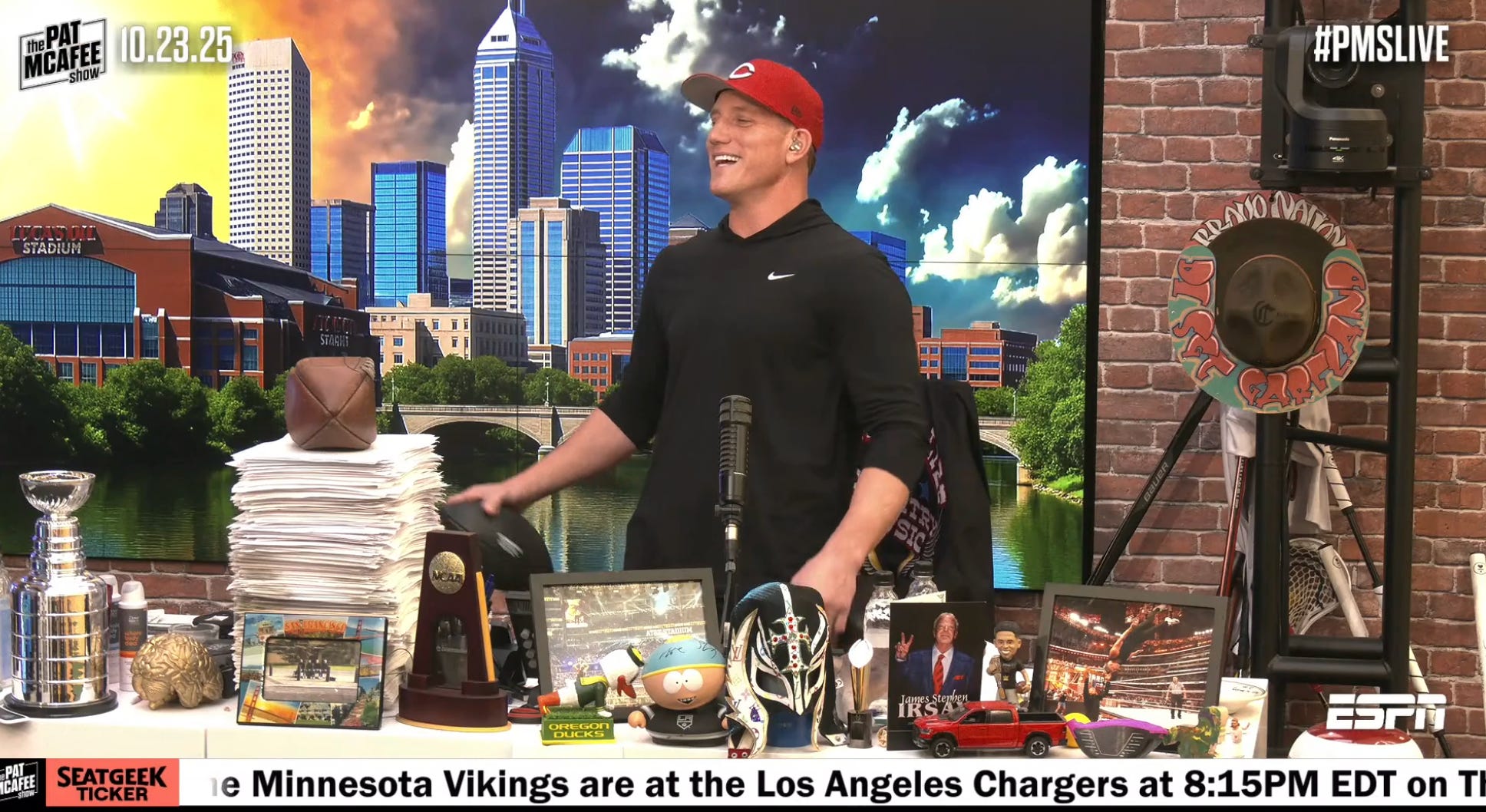
“Our job at Victory Plus is to create as much content as humanly possible,” says Walsh. “Rather than go and rent a studio to only be able to use it for certain times of the day, why don’t we build our own small studio? Let’s do it in more of a podcast format, like the Pat McAfee show.”
Walsh sees that kind of flexibility as a major benefit of the decision behind what he has previously said drove the Stars to leave the RSN space and launch Victory+ in the first place.
Still, with so many of the revenue models having to be figured out anew, that begs the question: Were economics a factor in the decision to scale down the studio?
“I think economics are a factor in every decision,” Walsh responded. “Like I said, the regional sports network model has changed quite a bit.”
As different as things might look, Walsh also says it’s worth remembering that Victory+ is barely a year old. Nonetheless, he says his team has “grandiose” plans for the future, including for the podcast set Rea and Severyn are using right now to get eventually upgraded into a bigger, purpose-built space.
“Our plan as a company is to grow bigger and better,” said Walsh. “Our plan is to build our own studio. Our plan is to be able to do national content out of a studio. So, we have grandiose plans, and we’re going to take steps to get there, but you don’t just get there in one day.”
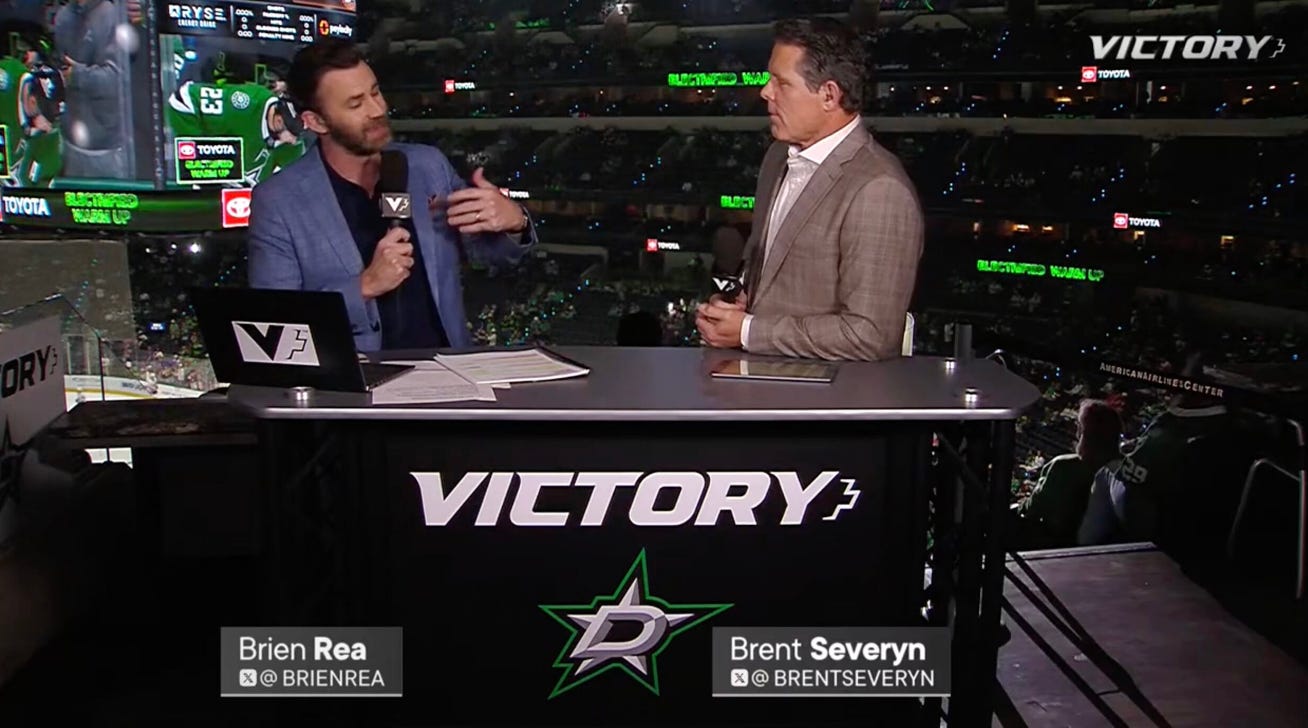
Another change in the format of Stars Aligned compared with previous year’s telecasts is that Severyn and Rea are in their new studio for both home and away games. Previously, the duo had broadcasted home game segments from a desk on the Platinum level at American Airlines Center.
So, do any of the Stars’ big plans for the future involve Rea and Severyn being back in the AAC for home games, or is this change a permanent one?
“I would say that everything is on the table,” Walsh said in response. “Like I said, we’re taking steps to build Victory+—which one year ago, was nothing—and build it into something. This is gonna be an orchestrated, step-by-step process.”
However, for the time being, Walsh says Rea and Severyn will continue doing home game broadcasts from the same set as they have so far this season.
“I’m not saying we would never be back in the building,” Walsh says, “But there are logistical issues that people don’t see as to why we’re going to do this in our studio setting for right now, until we can take the next step to evolve the show.”
That evolution, Walsh says, could involve a whole host of things, including going back into the arena, making the show longer, or even doing something entirely different.
“Right now, we’re just having to take a logistical step-by-step [approach] to get to something fresh and different,” Walsh says. “That’s just part of the growing process.”
Another part of that process is tweaking existing programming to better fit live game broadcasts, Walsh says. And nationally focused content like Frankly Hockey will be an integral part of that.
“The decision was made to bring Frank [Seravalli] on board because we needed a national, daily broadcast that was NHL-based,” Walsh said. “Not Dallas Stars-based, not Anaheim Ducks-based. We wanted an NHL-based show.”
The Philadelphia-based Seravalli is a former president of the Professional Hockey Writers Association who wrote for Daily Faceoff, as well as hosting video segments on their YouTube channel.
“We think Frank has the ability to build something here that could become really, really great,” Walsh said. “We do want to add elements into the Stars broadcast that could give it more of a national feel.”
With that said, Walsh says that balancing the “national feel” brought by NHL-focused segments like Frankly Hockey during intermissions is one of the adjustments they are already planning to make.
“I can tell you already, we’re five games into the season, five broadcasts in right now,” Walsh said. “We know already that we’re gonna make some tweaks to some things.”
Walsh says they’re looking at shortening NHL-focused segments like Frankly Hockey that air during live game broadcasts, as well as getting back to Severyn and Rea a little sooner in the intermissions than they did at the beginning of the season.
“As the fans have been watching this, I’ve been watching it for the very first time, too,” Walsh said. “And I already see things overall with the show that I want to tweak. Part of that will be, we’re gonna have a faster around-the-league segment coming very shortly.”
A recurring theme of our conversation is that Walsh and his team are trying to experiment with new formats and content while also retaining existing things that people have grown to love about Stars game broadcasts.
One example is the breakdowns that Severyn has done involving things like the Stars’ penalty kill or Roope Hintz’s elite skating mechanics. Those segments involved Severyn (a former NHL player) talking with Stars personnel to help highlight things that might be tougher for the average fan to understand during the flurry of a live game.
Walsh says those are elements Victory+ still wants to keep. The key, he adds, is not to get rid of new elements after only a couple of games just because they’re different from what viewers are expecting.
“I used to tell everybody, especially when someone new came around and we did something different, that I didn’t really didn’t want to talk about it until we were 20 games in,” Walsh said. “Let’s get 20 games in, and then let’s step back and take a look and see what we want to change, or fix, or tweak.”
As someone who’s been in the broadcasting game for years, Walsh says patience is a big factor in making good long-term decisions.
“You’ve just got to give it a good sample size, and then sit down and decide what’s working and what’s not working, and not be afraid to make changes if we need to make changes.”
Still, Walsh knows that all of the progress will continue to require some fine-tuning as they go.
“It’s new and different,” says Walsh. “We’re seeing it for the first time along with the fans, and I can tell you that already there are going to be some adjustments to the show, whether it be some lighting and maybe a little bit of the backdrop. We might not have the camera move as much. That’s what we’re doing right now.”
As much as the space for Severyn and Rea looks a bit smaller, Walsh reiterates that the new, scaled-down, podcast look doesn’t mean more limitations.
“This show, just to be very clear, has all the same capabilities that the show last year had,” said Walsh. “We can do the same show. It just feels a little different, and that’s okay. We’re gonna keep pushing with new ideas and see how it goes, and we aren’t going to be afraid to adjust if we feel that it needs to be adjusted. But we need to give it a chance to see how it really shakes out.”
“We’re taking some steps to try to be different and try to do some new things,” said Walsh. “We ask for everybody just to give us a chance to get there. Believe me, all the eyes of both the Dallas Stars and Victory Plus are on this every single day.”
The Stars did technically have a road game broadcast during the preseason in 2024-25 right after the launch of Victory+, but the format was more casual, with guests in studio talking with Rea and Severyn about a variety of topics while game action was shown on a smaller inset display, with occasional pauses to comment on the action.
Stars fans do not want Seravalli. Period.
Thanks for looking into this, Robert! Some important context in here.
But now I wonder if I should turn off my victory+ stream during the Frankly hockey portion to demonstrate a point 😂