


I’m told football happened last night. And by “I’m told” I mean “I have read roughly forty-six headline puns on the phrase ‘drop the ball.’” Or at least, that’s what I assume I will read. Research is for suckers.
The great thing about the first game of any season, in any sport, is how it simultaneously reveals and obscures all the things you’ve been speculating about during the offseason. It’s just one game, so how much can it mean, really? In fact, it probably does mean a lot in football, since teams only play like five games all season or whatever (note to self: fact check this before publishing), making one game like 30% of the entire season (note to self: do actual math before publishing).
In basketball and hockey, they play 82 games in a season (though hockey will be adding another couple starting next year), followed by four rounds of playoffs. In baseball, they play a ridiculous, outlandish 162 games during the season. 162! And then they follow up that marathon by playing a comparatively tiny amount of playoff games to determine the World Series champion, because even the teams are kind of worn out by that point, and who can blame them.
Did you know that the Los Angeles Dodgers (the best team in the history of baseball, which I have fact-checked) won a championship last year after three playoff series victories, across which they played just 16 total games—under 10% of their entire season’s worth? That’s right, the Dodgers won the entire thing by playing fewer playoff games than the Dallas Stars needed just to lose meekly in the third round last season (which total was 18, or 22% of the Stars’ entire season’s worth of games).
When the Stars open their season in 34 days, they will have three tough contests: At Winnipeg, at Colorado, then back home against a Minnesota Wild team that could low-key end up being the best of those three (but I’ll save that for some obligatory Central Division Rundown thing next month).
In fact, that first trio of games could end up being a playoff preview, as the Stars could have ended up facing all three in 2024-25, had the Wild had defied their genetic instincts and gone on a playoff tear rather than getting bounced by Vegas (who got bounced by Edmonton). But nature will out.
For the Stars, those first three games of their season will amount to like 3.5% of their 82-game total (note to self: math is for nerds). But because those three opponents are all divisional rivals with their own lofty aspirations, there is little doubt that the results of those games will be scrutinized somewhat disproportionately, being the only hard data on the season to that point.
Folks looking for holes in the defense, flaws in the goaltending, or weakness in the forward depth will probably find something to seize upon across those three games. And conversely, you crazy Pollyannas will anoint the first goal-scorer of the season as the inevitable playoff savior when the time comes. Don’t think you won’t. I know you.
For now, however, there are no regular season games (or even preseason ones) to squeeze until they give us the data we want. So instead, I went back to last summer, fresh off Joe Pavelski’s retirement, when the team was trying to decide who would be the top-line right wing, among many other things.
Last September, I wrote this a month before the season started:
But without Chris Tanev or Joe Pavelski, the roster has gotten one year older and a couple of spots thinner. The bones of the thing are still the envy of most teams in the league, but the Stars have to start showing they can elevate their game to an elite level the same way that the Panthers and the Oilers did for long stretches last season. Consistency is great when the pieces are all reliable, but the Stars can’t expect to get tons of double-digit goal scorers again when they don’t have the reinforcements ready to pick up the slack.
[…]
We’ll see what these coaches do if the new old guys (and the old new guy) fail to bring that same repeatable play in their own roles. Certainly we’ve seen what the Stars have done when a young defenseman failed to take the next step in the past, tossing Matt Niskanen into a trade like an afterthought. We’ll see if Dumba or Lyubushkin get the Dan Hamhuis treatment this time.
Well, the Stars ended up having to weather a very different sort of season than they’d planned, as it turned out. Neither of Lyubushkin or Dumba ended up featuring in their final playoff game of the season, and they ended up filling Rantanen’s spot with some guy named Mikko Rantanen.
Still, the early going was rough, though never quite disastrous. The power play started off stagnant, with a variety of players starting the season cold, injured, or ineffective. Illness wiped out a bunch of the defense corps at one point, and everyone was getting hit in the face. It was an up-and-down season early on with a couple of pretty rough lows, but the Stars never fully stumbled as winter approached.
And after the ignominious loss to Minnesota after Christmas in which Mason Marchment got his face shattered—the Stars’ costly bit of extra practice didn’t end up helping either—they regrouped and put up seven straight wins (the first of two times they’d do so that year). Suddenly everything was coming up Millhouse: The power play was back, Jason Robertson was scoring, and all the pressures of their early struggles were beginning to subside.
Then in Game 48, Miro Heiskanen went down for the rest of the regular season, and Nils Lundkvist followed him, and everyone tensed right back up. Not only was Chris Tanev still noticeably Not In Dallas, but now their other defensemen who’d been asked to play top-four minutes on the right side of the defense were gone, as it was clearer than ever that the Stars didn’t quite have the pieces to cover that much of a gap.
However, a few days later, Mikael Granlund and Cody Ceci arrived, and Jim Nill ended up looking like a genius, as the Stars stayed red-hot for the next couple of months. I am not exaggerating, either. Here is what the Stars did in the 28 games after Heiskanen got Mark Stone’d in Game 48:

It really was nuts. But of course, things under the hood weren’t quite as rosy, as the Stars were wildly outperforming their bottom-ten expected goals numbers during that stretch, thanks in no small part to Jake Oettinger and Jason Robertson buoying them. So despite the Mikko Rantanen blockbuster trade in early March, folks watching the Stars did kind of get the feeling that a bill was eventually going to come due.
And boy, did it ever, as Pete DeBoer’s team finally lost three regulation games in a row for the first time of his Stars’ tenure, which somehow sounds better than it actually was, given the meltdown against Vancouver that was embarrassment enough all on its own. It all ended up being seven straight losses to finish the season, as the Stars decided it was finally time to really test that classic theory about building momentum going into the playoffs:
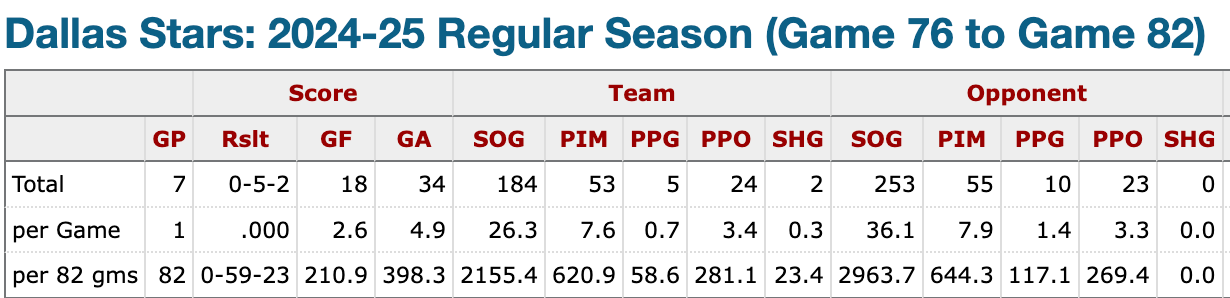
I’m not a genius (no fact-checking needed), but I do wonder how much that late-season skid factored into Jim Nill’s ultimate decision to move on from DeBoer. Obviously coaches cannot put pucks into the back of the net themselves, but anyone who remembers how Lian Bichsel looked and sounded after accidentally nicking Jamie Benn’s 400th goal in the 81st game of the season could tell you that the mood was somber around the team in those days leading up to a playoff rematch against Colorado. Answers were simply not being found.
Even when Tyler Seguin returned in the 82nd game and his line immediately got on the board, the boost was quickly negated by not only five Nashville goals, but by Jason Robertson’s horribly timed injury, too. I suppose all injuries are badly timed, really.
The team was in a funk unlike anything they’d seen under DeBoer, and that carried into Game 1 against Colorado, which featured another 5-1 loss in another Game 1 loss under DeBoer.
Game 2 could have been a stake in the heart for the team, even after Tyler Seguin and Thomas Harley scored early to keep the game close. But Logan O’Connor’s goal to make it 3-2 Avs right before the second intermission was really tough to watch the Stars surrender, and suddenly they were staring their ninth straight defeat in the face with 20 minutes to go, and two games in Denver awaiting them.
That’s when two forwards nobody was really talking about last September came up huge: With ten minutes to go, Evgenii Dadonov scored a goal followed by one of the biggest celebrations I’ve ever seen him display to tie things up. Life!
And then, with about 90 seconds to go before overtime, Mikko Rantanen got nailed for hooking, putting Colorado on the power play. Which usually means death.
So many things about last season look different if that Game 2 doesn’t make it to overtime. But as happened time and time again last year, the Stars found a way to get off the mat. Esa Lindell and Thomas Harley played all two minutes of the kill, and Jake Oettinger flashed the glove to snag a Martin Nečas shot that was labeled for just over his shoulder while Oskar Bäck and Sam Steel tried their best to be everywhere, all the time, at once.
But the Stars survived, and then waited. And the eventual hero turned out to be their least-used player all night, and the least-used regular all season: Colin Blackwell.
Watch how Blackwell drives at Erik Johnson as soon as he starts heading north in that clip. Blackwell can see that the veteran defenseman’s gap is rubbish on account of Johnson’s having just hopped over the boards before the turnover, and Blackwell doesn’t back off or look for someone else to make the play. He sees Johnson trying to sort out his skates, and he forces the issue and creates a shot for himself just before Miles Wood gets back to disrupt him.
This would end up being Johnson’s last shift1 of 2024-25, as the Avalanche would scratch him for the next five games. In fact, Johnson remains unsigned as of this writing, meaning that could have been the final shift of his NHL career.
After creating the initial shot, Blackwell doesn’t coast. He hunts for and finds the rebound from his own shot, cutting in for the shot before either Johnson or Miles Wood (number 28) can do so. Blackwell would not miss the second time, and his killer instinct finally got the Stars their first victory in three weeks.
Wood, as the backchecker who failed to prevent either the initial shot or to box out Blackwell from the ensuing rebound, is aghast. You’ll note Wood’s face, buried in his gloves in the classic “What have I done?” pose right after a goal.
This also ended up being Wood’s last shift for the Avalanche, as he likewise didn’t feature in the rest of the series and was traded to Columbus along with Charlie Coyle this offseason in what was basically a salary cap dump for Colorado.
Colin Blackwell, after scoring a goal that ended two Colorado careers, got a two-year extension of his own in Dallas this summer. And that is something nobody was predicting back in September.
We all want to know the future. That’s part of sports, the speculation and discussion, the debating and pontificating. They’re something we can point to with whatever authority our observations grant while produly proclaiming we know something that someone else might not have noticed. We want to interpret them through whatever lens we bring, to prove that Player X was always going to do, or not do, the thing we kind of felt like their actions deserved to have happen, or not happen. I’d imagine we are all grateful that nobody watches our own workplace performances with the same degree of scrutiny and video replay.
The most beautiful part of gearing up for a new season, and hockey most of all, is that there are going to be a ton of games that feel like they come out of absolutely nowhere. You’re going to get that one goal of the season from Brendan Smith or Ilya Lyubushkin, or perhaps you’ll get a disaster against Anaheim that features a penalty shot called almost out of nowhere.
And if someone told you last September that Mikko Rantanen would score a Game 7 hat trick to win a Stars/Avs series, you would have felt a whole lot differently about it at the time.
Hockey will shred your paradigms to pieces, eventually. Maybe you’ll be able to build a more resilient view of your team after the first game, one that actually ends up being kind of validated by whatever ends up happening in the long run. But usually, if it’s any kind of a good season, there’s a lot of good and bad along the way, tons of things to either reinforce or contradict the opinions you began with. You’ll usually end up finding what you look for.
Over the next few weeks, those storylines will all start to coalesce. Training camp battles will illuminate the haves and the not-quite-yets, and quiet worries will grow into loud concerns. We’ll all start to decide on what we’ve decided, and then we’ll look for the things that prove we’re right.
But no matter what we end up watching this year, the most exciting things of all might end up being what no one could possibly have seen coming. It’s that bit of captivating sorcery sports can still exercise upon our hearts, and I, for one, remain a pretty helpless victim. I couldn’t be happier about it.
Much as we hate to remember 2020, Erik Johnson has another painful Stars Playoff Memory in the books. Really good player, when he wasn’t driving a golf cart.
21-9-5 After losing your best player in Miro? Not too shabby. I didn't realize the record was that solid in spite of the final seven. They had a shot at Winnipeg right until the last week or so, I think.
I enjoy the content. Thank you.
Can’t wait.