
On Matt Duchene and Intermittent Instigator Penalties
The Dallas center is day-to-day after the hit from Jake Middleton on Tuesday night

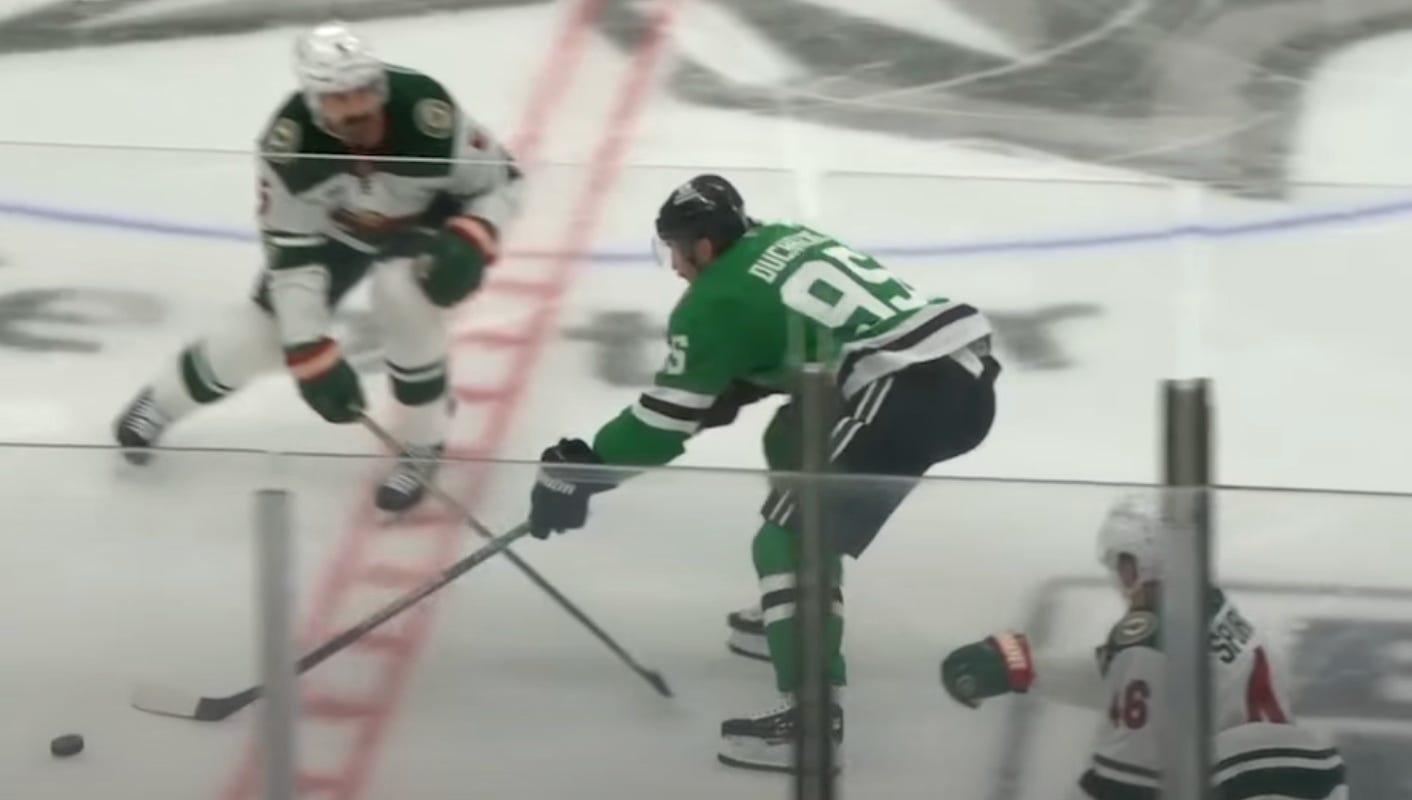
The latest news on Matt Duchene was surprisingly positive Wednesday afternoon, given how Duchene looked visibly shaken after taking a big hit from Jake Middleton the night before. Glen Gulutzan’s update before practice this afternoon allayed some of the worst concerns after Duchene left the ice early in the third period and did not return.
“I would call ‘Dutchy’ day-to-day,” Gulutzan said. “I wouldn’t rule him out for tomorrow. We’ll see how he is today, see how he feels. Tomorrow morning will be a better indicator.”
The tone of Gulutzan’s words was fairly upbeat, too. For Duchene to even be a possibility to play on Thursday suggests that no immediately major issues were identified after the hit last night, and that alone is a positive sign.
Still, “day-to-day” is a far cry from “good to go,” so there’s no guarantee that the Stars’ second-line center will be back in the lineup. And if he’s not ready, all indications are that Wyatt Johnston would move into that spot, as he did in the third period on Tuesday, when he primarily centered Seguin and Robertson.
Gulutzan went on to say that the Stars would probably be making some lineup changes for Thursday’s game against Vancouver regardless of whether Duchene plays or not, so perhaps that means Adam Erne could be making his Dallas Stars debut in the fourth game of the regular season.
With Jamie Benn on LTIR (and therefore out at least another seven games) and Oskar Bäck skating but not yet practicing with the group, the Stars were already down to 13 healthy forwards in the lineup before the hit on Duchene. So if Duchene can’t go on Thursday, the Stars would need every forward on the NHL roster to play, as they already have a full 23-man NHL group as it is. The only way they could call up someone from Texas would be if they were to send a player like Justin Hryckowian down in exchange. And given Hryckowian’s play so far, that would be a mild surprise.
When asked about how they might fill the center minutes if Duchene couldn’t go, Gulutzan said they would likely slide Radek Faksa up to more of a third-line center role from his usual fourth-line spot. That makes sense on the one hand, as Faksa is a veteran forward who plays responsible hockey, but it would also mean the Stars would be playing with a far less offensively threatening lineup—which is perhaps unavoidable with Duchene out, given how irreplaceable he is.
Anyway, we’ll see how it all shakes out. If Duchene is cleared to play tomorrow, this might all be moot.
Back to the hit itself, however. Any time a player gets hit high and looks wobbly afterward, you’re going to see Discourse, and we did. Glen Gulutzan agreed with those who thought the hit was a bit high as well, so let’s take another look:
Personally, I don’t have much more to say about this hit after sleeping on it. Duchene is stretched out, reaching ahead for the puck, and he’s nailed as he touches the puck and begins to straighten up. There isn’t much Middleton can do here to avoid catching Duchene in a painful way, but the result is pretty bad. Still, Middleton is already a bit hunched down, so he’s probably staying about as low as he can, given the size disparity between him and Duchene. And until the NHL says that open-ice hits like this should be flat-out banned, we’ll probably keep seeing them.
You can freeze the video above at different points to show just how much of Duchene’s chest/head/chin Middleton’s shoulder gets, but the sense I’ve gotten over last night and today is that the hit isn’t really resonating as a dirty one to most (though not all) people who saw it. Whatever group you fall into, that’s the lay of the land as I understand it.
The majority argument seems to be that Middleton isn’t extending his arm or exploding *up* into Duchene’s face, but rather driving *into* Duchene’s chest area with his arm tucked in the whole time. His shoulder then catches Duchene’s head about the same time his arm hits Duchene’s chest (though perhaps a tick before), which makes the head impact read more as a result than as an intentional “picking the head” sort of drive-by.
Compare it to the below, which were all ruled illegal checks to the head:
There’s a pretty stark difference in those three examples. And now is probably when you think I’m trying to point out how Middleton wasn’t clearly “headhunting” in this fashion, but rather hitting Duchene in the chest where his shoulder eventually follows through as well, so everyone should calm down, right?
But here’s the thing: officials aren’t always consistent with these calls (and understandably so, given the speed of the game). Because look at Max Comtois, who got tagged with an illegal check to the head for this hit:
That’s a pretty similar one to the Middleton hit on Duchene—and an even less dangerous one in my opinion—with perhaps the biggest difference being how Comtois does drive “up” a bit more in his hit, which might lead to some head contact (though still not as much as Middleton/Duchene).
Or, take John Carlson, who appeared to hit Brady Tkachuk completely below the head here, only to get penalized nonetheless:
Gulutzan said after the game that his experience has been that referees tend to err on the side of penalizing players for hits to the head area, even if it’s not explicitly a headhunting sort of shot. And those two examples above are just a couple instances that seem to back up his point.
His argument would be, I think, that the league has talked about getting rid of hits to the head, so why aren’t they penalizing a hit that resulted in heavy contact to Duchene’s head? Whether or not the hit on Duchene should have been penalized, I think Gulutzan’s argument for why it could have been penalized is pretty valid, given historical precedent.
I was also a bit surprised that the hit wasn’t even given the “safety check” major call like the Dumba hit on Pavelski back 2023 was, if only to allow the officials a chance to review it again before updating or rescinding their call.
Another factor perhaps was Middleton’s size advantage on Duchene, which I think gave an added appearance of “good hit, unfortunate result.” So my guess is that without any clear upward motion or extended arm, and with more comprehensive impact to the chest area as well as the head, the on-ice officials saw sufficiently clear reasons not to penalize the hit, rightly or wrongly.1
For now, the good news is that, as far as we know, Duchene hasn’t yet been entered into concussion protocol. That would be surprisingly sunny, given the violence of the hit and how fast Duchene’s head snaps back, but NHL players are a different breed, I suppose. Here’s hoping for his good health.
Instigator, Schminstigator
Speaking of inconsistent calls, though: Let’s talk about the other result of the hit on Duchene, by which I mean the subsequent fighting major and instigator call on Alex Petrovic.
In theory, this is exactly what the instigator call is for, right? Petrovic is coming over to start a fight in retaliation for an unpenalized hit, so he ends up getting tagged with not just the two-minute minor, but also the automatic ten-minute misconduct that goes along with it, taking him out of the entire third period.
Here’s what NHL Rule 46.11 says:
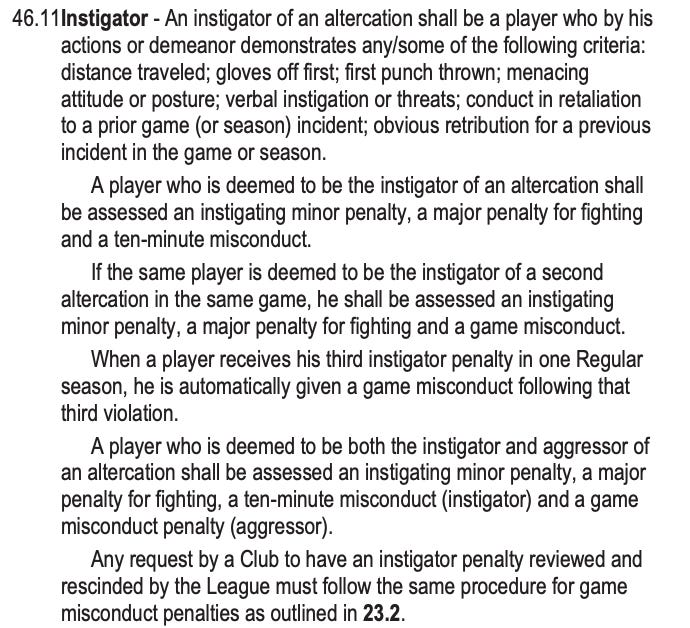
Petrovic’s penalty pretty clearly falls under the “obvious retribution for a previous incident in the game” part of the first paragraph there. So, nothing too surprising, right?
Well, in practice, the instigator penalty is wildly unpredictable. And for an example of how unpredictable, have a look at a certain fight just a couple of days ago between Justin Hryckowian and Ross Colton, narrated fairly and objectively by the good folks at Altitude Sports:
Heiskanen gets leveled by a big hit to his numbers (which probably should have been penalized), and Hryckowian skates over to grab Colton before the two start swinging. The situation here is nearly identical to the Petrovic fight, but no instigator call is made (which you may have picked up on during the enlightening dialogue among the broadcasters).
In talking with both Petrovic and Hryckowian about these fights, they didn’t really have any better guesses for why only Petrovic got the instigator than I did. Sometimes a player will be told that starting a fight after a clean hit is an automatic instigator penalty (and I believe that was what Petrovic was told), but that clearly isn’t always the case, given the Hryckowian/Colton altercation.
If fact, you could even argue that Hryckowian deserved the instigator call more, given that he jumped Colton from behind initially, whereas Petrovic actually asked Middleton to go before getting agreement, after which the two squared off and dropped their gloves simultaneously. The only “instigation” Petrovic did there was to make a polite request—or at least as polite as challenging someone to a fistfight can be in the NHL. But I suppose you could use the “verbal instigation” part of the rule to cover that, if you want.
Again, neither of the initial hits were penalized, and in both cases, a player skated a decent distance before the fight happened. And yet, only one of the bouts resulted in the additional instigator call. It’s a tough one to figure out, and has been for a while.
However, I do have one more theory here for why only one play drew the instigator call. I wonder if Hryckowian got off the hook because his fight began while play was still ongoing, whereas Petrovic’s fight came after a whistle had stopped play. Maybe a fight breaking out in the midst of play gives the officials enough of a reason to turn a blind eye to a pretty game-altering call, as opposed to one that starts after play has stopped, when it’s more undeniable.
However, that’s just a guess. In general, I find that talking with referees about calls always reveals a whole lot more being considered behind the scenes than I first realized, so I try to approach these things with a degree of humility. So on that note, if you’ve got any other theories for why it’s so tough to predict when the instigator call will get made (other than the fact that referees are just reticent in general to take a player out of the game for what amounts to 17 minutes of penalty time), please sound off in the comments.
Just try not to start any fights in the process.
Addendum: You could have a much bigger debate about whether the league as a whole should be discouraging anything like this contact at all, the same as other leagues have done. But as long as the NHL still wants to keep big hits in the game (which they clearly still do), hits like this are going to continue to happen—however they end up getting called.
As a hockey official (not nhl-level at all, done some youth AAA and college, but nothing pro) I thought id provide some ref-analysis here.
I think Hyrckowian was lucky to avoid an instigator by rule, as you mentioned. As for how he didn't, after the hit on Miro, the referee in the Colorado game is focused on the battle on the wall when Hyrckowian kind of sneaks below the goal line and starts the fight. Focusing on this peice of ice cuts off some of his field of view of the rest of the ice. Hyrckowian does cover some distance getting there, but its far from the point of focus of the referee. When the fight starts, that becomes that in-zone referee's world. The back referee is responsible for looking at the rest of the players making sure nothing else jumps off, while the two linesman become responsible for being ready to jump in as soon as the players fall to the ice, or the situation becomes unsafe for one of the participants. I would venture a guess that the referee had a feeling it was probably worthy of an instigator and didn't call it because he wasnt 100% sure how obvious it was that it wasnt an immediate response.
The referee for the Wild tilt is much more aware of everything at play. Hes in the far corner, so he has a MUCH wider field of vision on the play. So when the back referee blows the play dead for Duchene's safety, the front referee can clearly see both Middleton in the opposite corner, and Petrovic coming in hot from the neutral zone. A player skating 100 feet to start a fight while the play is dead is going to have a much harder time avoiding one than one blending in to live play.
Aren’t the altitude guys such a lovely, unbiased bunch?