


You may or may not believe, like Dostoevsky, that the world will be saved by beauty. Imagination and contemplation can sometimes seem like luxuries of privilege, something only those not stuck in the everyday fight for survival can enjoy.
One thing that I find becoming truer every year is how much I benefit from searching out things that will make me think more deeply than I did before encountering them. This is, I think, increasingly vital to our cultural survival, with so many people’s lives now being spent in the shallow pools of whatever videos or rage-baiting posts The Algorithm feeds us.
I recently spent half a decade in elementary education, and from what I saw, it is not getting better. Kids are being raised by screens inches from their faces with endless scrolling, and indiscriminate video consumption (almost exclusively of the micro variety found on TikTok or Reels) is withering our imaginations on the vine.
The good news is that there is hope.
Whether as parents, teachers, artists, friends, or co-workers, we are all of us individuals with imaginations of our own, and we can always make someone else’s life better just for being there. I can’t tell you the amount of times I’ve had a friend give me an eye-opening moment by cooking me something I’d never tasted before, showing me an incredible movie I hadn’t even heard of, or by recommending a book that blew my mind, or a hike I’d never taken before. These things all changed me because someone I cared about led me to something wonderful.
(I won’t pretend that I’m doing that today, though. I’m just recommending some books I liked.)
I remember at one of my first jobs, I would love to use my lunch break to read a few chapters of a book, or even to listen to part of a podcast. But now, there’s a far stronger urge to “check in” with my phone after being away from it for a while. Before I know it, I’ve gotten a bunch of tiny dopamine hits from scrolling without really learning anything new at all, and half an hour (or more) has gone by, and I reluctantly put my phone down, feeling vaguely unsatisfied.
This isn’t an anti-technology screed, or even an anti-escapist one. We need entertainment, after all, and not every book, or movie, or even TikTok needs philosophical justification. Sometimes, it’s perfectly fine to eat a metaphorical piece of candy or two. All I’m saying is, there’s probably a good reason that a whole lot of college students can’t read a full book anymore.
Besides, the dangers of mindless entertainment is a criticism I’ve heard of sports, too. How is some arbitrary game played by millionaires really good for us, as people? Shouldn’t we be taking all that money generated by pro sports and giving it to the poor,1 or something?
Where I land on this is that sports, at their best, can be as meaningful as a great book. They push us to think more deeply about what it means to be human, and they inspire and ennoble us in ways we never saw coming. Because sports, like all works of art, are made and played and refereed by people.
So today, I wanted to talk about a handful of good books I’m reading this summer, or have already read this year, and one I haven’t read yet. If you’ve read any of these and want to yell your disagreement or anything, please do so! Sometimes even I am wrong,2 and I always benefit from being corrected, unless I’m hungry.
A couple of these are hockey books, and a couple are not. Even if you have no interest in reading any of these, I’d love to hear what books you’re reading, especially if I’d benefit from them.
Let’s start off with an all-timer.
The Game, Ken Dryden
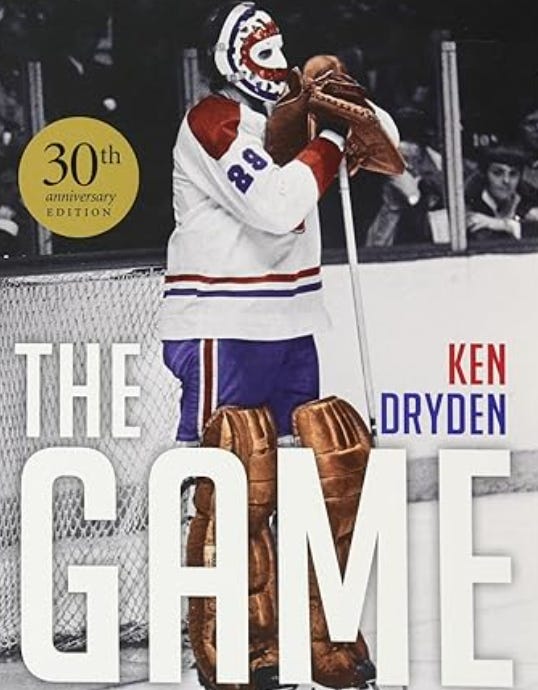
During the 2012-13 NHL lockout, I was starved for hockey. After the Stars had fallen just shy of a playoff spot in Glen Gulutzan’s first season as head coach, there was reason to be optimistic that the dark days of Dallas Stars hockey were ending, particularly with Tom Gaglardi having bought the team. New life was on the horizon, and hey, the Stars even signed the legendary Jaromír Jágr! It was going to be a fun season, however it ended.
Turns out, seasons need to start in order to end, though. With another CBA expiring, things took a slow-but-inevitable turn back to the hallmark of Gary Bettman’s tenure as NHL Commissioner: yet another lockout, just eight years after a whole season was lost in order to bring in a hard salary cap.
I’ll wax poetic about it for just a second: it sucked.
One redeeming part of that whole time, however, was that I was starved for hockey, so I expanded my horizons a bit. And that’s how I finally ran across The Game, by Ken Dryden, which I believe was a birthday gift from my parents in that summer of 2012.
This book is fantastic. Probably, it is the best hockey book ever written, but I haven’t read them all yet. If you have even a passing interest in hockey, you need to read it. This is a player who took a year off (and then retired shortly after) to study law. Oh, and he also happens to be one of the greatest goalies in NHL history.
Dryden’s writing is thoughtful and introspective, the rare combination of insight and resignation. He talks about his and his teammate’s superstitions with a sort of wry grin because yeah, he and you both know they’re bogus, but they make him feel better, so what are ya gonna do?
But I use superstition in another way. I don’t want…the first shot to be the reason I play well. It may be “better to be lucky than good,” as we’re often reminded (for a loser can be good, but only a winner is lucky), but I want to feel connected to what I do, I want the feelings a game gives unshared, undiminished by something separate from me. So, instead, I use it a focus for the fear I feel.
-Ken Dryden, The Game
The best stuff might be when Dryden talks about his experience before and after games just sitting in the dressing room, taking in the atmosphere. I don’t want to spoil anything, but this book is one the most immersive reads there is, written by one of the most brilliant hockey players ever to play, ahem, the game.
The Game is available on Amazon, but go into a used bookstore to buy it if you want to make a more pleasant afternoon of it.
Home Ice, Jack Falla
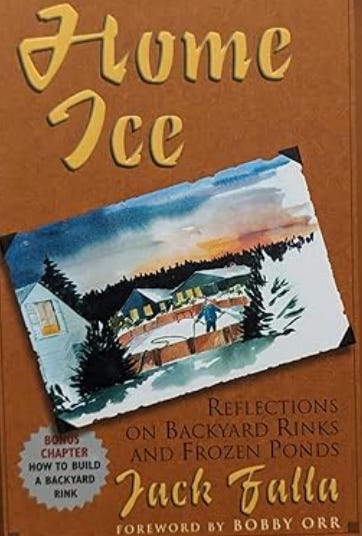
Something I meant to do this year was to thank John Buccigross.
I only rarely saw him on ESPN with Barry Melrose doing NHL 2Night, as we didn’t have cable TV in my house growing up for much the same motivations discussed in the introduction above.
But after I graduated college in 2008, I had a weird pastiche of part-time jobs for that first year attempting to use my journalism degree, and one of them was interning at a local chamber of commerce. Which meant that I mostly sat at a desk and didn’t get paid while my boss occasionally stopped by the office to play poker on his computer. Those days could drag, but one good thing that came out of them was reading Buccigross’s columns on ESPN.com.
That column is where I read his first “Alex Ovechkin will catch Gretzky” story 15 years before it happened. But more importantly, for me, it’s where I first heard about Jack Falla.
The sports journalism professor at Boston University was a beloved figure, but I never met him. I did, however, read a few of his books. And the best one, by far, is Home Ice.
What’s it about? Well, it’s mostly about skating on frozen ponds that you build yourself, but it’s also about what backyard ice rinks mean to a neighborhood, and to the people who have them. There’s a stirring scene in one chapter where Falla and his wife go for a skate late at night after the children have all left, and it’s stuck with me for coming up on two decades now.
It’s a book that is clearly written by a journalism professor, so you can see hooks and ledes and exactitude in every short chapter. It’s part journal, part memoir, and part history of going to watch the Bruins play at the Boston Garden—a 20-page chapter that will make you miss days you might never have experienced yourself.
Also, read Fluto Shinzawa’s story about the book if you don’t want to take my word for it.
Home Ice is on Amazon, but you’ll enjoy it more if you pick up a used copy somewhere for cheap. Okay, let’s finish up this list with a few shorter hits.
Mr. Hockey, Gordie Howe

This is one I haven’t read yet, even though I was given it years ago. But, I do own it, so that’s something, right?
If you’ve read it, how is it? Should I stop stalling and dig into this? I’m a little worried that it’s gonna be vaguely dissapointing, the way Bobby Orr’s autobiography was, but maybe that’s just paranoia.
I’m told it’s good, but I guess I’ll have to get back to you when I actually read it. Maybe I just wasted your time. Hey, sometimes you just don’t get around to reading things, right?
It’s on Amazon.
Letters to a Young Poet, Rainer Maria Rilke,
This was a gift from an old girlfriend years ago, and I only made it halfway through before we broke up. Then it sat untouched for a while, for obvious reasons. I’m reading it again this summer, but slowly.
It’s a collection of ten letters the esteemed Rilke wrote to Franz Kappus, the eponymous recipient, in the early 20th century. (Side note: The Greater Journey is a fantastic background read for something like this.)
You can tell the letters are the furthest thing from perfunctory. The German poet seems to be working out his own views on what it means to write while trying to be as practical as a poet is capable of being. Rilke goes into detail about how to navigate even some great writers (like Richard Dehmel) without falling prey to some of the pitfalls those artists failed to avoid themselves, and he also just gives painfully honest answers about what he thinks, feels, loves, and hates.
Each of the ten letters is dense in a protein-rich sort of way, and each deserves to be mulled over accordingly. You can’t breeze though the collection, even though it totals something like just 50 small pages. I think of this collection as a sort of fancy charcuterie, where each piece of meat and cheese is worth savoring, making you reflect on just what makes meat and cheese so delicious to begin with when presented in their ideal states. Maybe I’m just hungry, though.
It’s touching and sincere, and it will make you think about beautiful words in a tender sort of way that I won’t even try to describe further for fear of getting mawkish. It can border on the pretentious if you don’t approach it with a sincere desire, like Kappus, to write better. But like all great art, it transcends that risk because it accomplishes its goal. It’s a great book to own, sort of an Elements of Style for tortured poets. Read it.
It’s on Amazon.
Eager, Ben Goldfarb
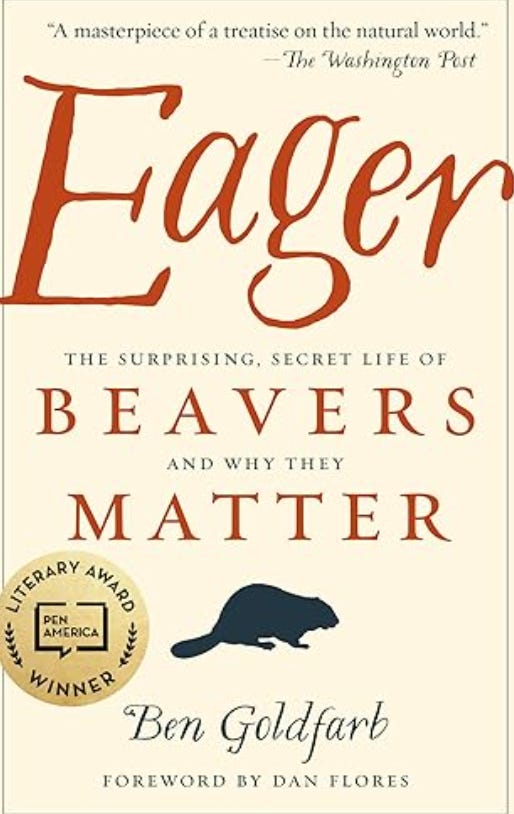
Everyone knows about the “bringing wolves back to Yellowstone” story, but what if I told you this book has a whole chapter arguing that beavers might be the unsung hero in that tale? Or that the tale is even a largely false one, so far as it’s commonly understood?
This is like Bill Bryson as a crunchy park ranger who had recently been converted to the hydrological reformation movement (real thing). This book made me want to go look at beaver dams. It was commended to be my Jeff Sullivan years ago, and he knew what he was talking about. I don’t know what else you need to hear, really.
It’s also well-researched enough (or at least, there are lots of citations and balanced arguments about complex issues—I haven’t read the research myself, becuase I’m not a nerd) for that not to matter. Thinking about nature is the point, not always coming up with easy answers.
It’s also really funny and delightful, written with merciful amounts of wit to make even a bunch of trees sound entertaining. Also, about beaver scent glands. A lot about beaver musk, oh man, there’s a bunch. Thankfully, it’s not a scratch-and-sniff.
It’s on Amazon.
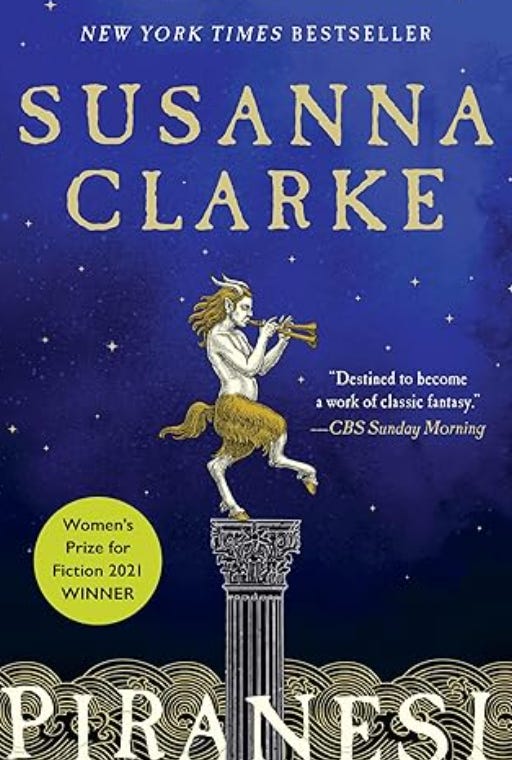
Piranesi, Susanna Clarke
Did you begrudgingly read Wind and Truth because you were so invested in the Stormlight Archives that you slogged through over a thousand pages of meandering young adult fiction pretending to be epic fantasy, only to be fantastically annoyed after all was said and done? I sure did, but this isn’t the place to talk about why that book was so disappointing (but mostly it’s because nothing happens for like 900 pages).
No, this is where I wanted to talk about one of the best new novels I’ve read in years: Piranesi, a sort of post-apocalyptic mystery that probably doesn’t merit the Fantasy label slapped on the cover. It’s a great, entertaining, and thoughtful little story that you’ll enjoy regardless of your predilection for or aversion to the genre.
Clarke takes the idea of an epistolary novel and spins the concept delightfully, but I won’t spoil it with anecdotes here. We get literary irony meted out in surgically precise doses, and it works. The first part takes a bit of patience, given the limited perspective of the protagonist, but the pace increases before long, and the payoff is more than worth it. You feel the pressure just before it hits the protagonist, and it has all the best elements of a suspense film with none of the schlock.
If you need a good beach read, this is great. If you want an excuse to spend two hours at a coffee shop with air conditioning, this will also serve. Just be careful not to start reading it right before bed, because you’ll have trouble putting it down and going to sleep. It’s that good.
It’s on Amazon. Everything seems to be, doesn’t it?
Jn. 12:4-6
For example: One time, I thought I was wrong about something, but I actually turned out to be right.
Ben Goldfarb's most recent book, "Crossings", is an excellent look at the roads around us and how they impact wildlife, so if you liked Eager, I'd pick up that too. In the animal vein, I'm currently reading "Jaws", which is a fun time (although I'm shocked to find out Spielberg cut out both the mafia and a wild romance plot from the movie, what a rookie)
Thank you for this column, for continuing the age-old tradition of one friend recommending a book to another. I've always meant to read The Game, and now you've given me that needed nudge in the right direction.
I do so love the way you write!