
Monday Rundown: Jim Nill on Gulutzan's Adjustments, Zone Time Zoom-in, Who's Filled in for Mikko Rantanen, and Crawfish Boils
It's been 70 games of Something Else

Welcome to the Monday Rundown. What with the unseasonable heat over the weekend, I found myself thinking back to the first crawfish boil I experienced a few years ago.
It was a scorching hot July 4th—aren’t they all?—and I was at a pool party way out near Weatherford. Immediately upon entry, it became clear that this wasn’t my scene, which you probably deduced the moment you saw a writer talking about being near a swimming pool. Still, it was one of those parties where you only know a handful of people, so you have a choice: Keep to yourself and your handful of acquaintances, or branch out and try to connect with the larger party.
That’s where the crawfish boil experience all began to make sense.
Look, I’m not a big shellfish guy. Sure, I’ll deign to eat the odd lobster. I’ll even condescend to consume the occasional shrimp or crab leg. But generally speaking, I prefer fish in almost any form to crustaceans, even those optimally prepared.
But the thing about a crawfish1 boil is that it’s designed for community. My theory is that any time food is served in troughs or their equivalent, it engenders a certain amount of friendly conversation. Whether it’s a company picnic, a church potluck, or a backyard boil, you can’t walk up to something like this for the first (or fiftieth time) without realizing that this is food meant to be enjoyed and embraced in a group.
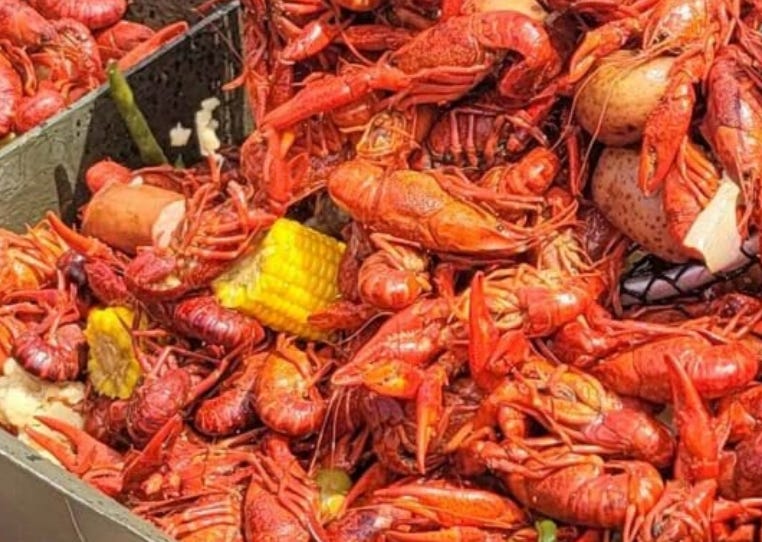
Cracking open one of those bad boys on Independence Day and extracting the (surprisingly good) meat was a veritable Experience, from the greasy hands and flimsy paper plate to the pool water puddles we were all creating as we stood still, simultaneously (and paradoxically) damp and dehydrated on a 100-degree day. The moment I walked up to fill my plate, I couldn’t help but start chatting with strangers, asking how they approached this whole deal. And every single one of the folks there was more than happy to share their approach.
It still wasn’t my favorite food as such—though the flavor-soaked potatoes were unlike any other I’d ever had—but the food wasn’t really the point. This wasn’t a dish meant to be eaten at a table in peace, with each bite slowly savored. A crawfish boil is meant to be enjoyed loudly and freely, with plates bending under the weight of pounds of food while someone’s kids run around screaming. Your neighbor might need an extra hand loading up his own plate, so you help them dish up, and you make an awkward joke that you will come back to at least once more tha day. The silly mess of the whole thing is what makes it beautiful.
Hopefully we’re still a few months from that sort of sustained Texas heat. But whenever it does set in for the season, I’m hoping I can get past my curmudgeonly weather side and embrace the deeper good that comes along with boiling hot weather.
All right, onto the hockey stuff.
Jim Nill on Puck Possession under Glen Gulutzan
Michael Dixon and Bruce LeVine had Jim Nill on the Stars Pregame Show on the Ticket yesterday. And in addition to the injury updates we discussed last night, one other thing jumped out at me that I wanted to touch on today.
Dixon asked Nill about the Stars’ improved underlying numbers, and Nill’s response was a bit more specific than I was expecting. After talking about the team’s pack mentality when it comes to sticking up for each other, Nill also talked about some tactical shifts under Gulutzan.
“I think our puck possession has changed a lot,” Nill said. “We used to be a real north-south team. Everybody wants to play fast. Get the puck up, get the puck up. That’s good. It can work for you. But we’ve implemented a little bit more of the puck control. Hold onto it, try to open up some areas, create some opportunities. Hold onto the puck more in the offensive zone, and I think we’ve had success because of that.”
Anecdotally, this tracks. Gulutzan has talked since last summer about creating more “in-zone offense,” and the Stars’ work off the cycle in the offensive zone has seen a notable uptick this season.
But it also tracks when you look at the numbers, or at least what NHL EDGE stats count as such. Because for most of their time under Pete DeBoer, the Stars led the league in an odd category: The most time spent in the neutral zone.
Here’s what it looked like in each of DeBoer’s three years.
(One note here: defensive zone time is ranked in reverse, with less time being better, thus receiving a higher rank.)
2022-23 Dallas Stars
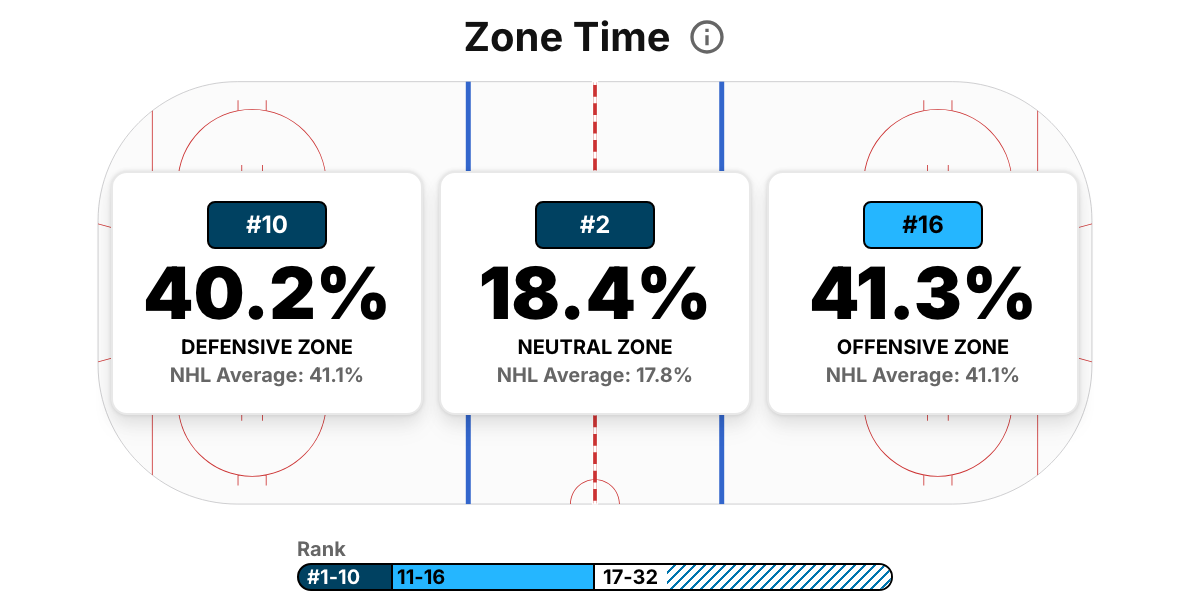
2023-24 Dallas Stars
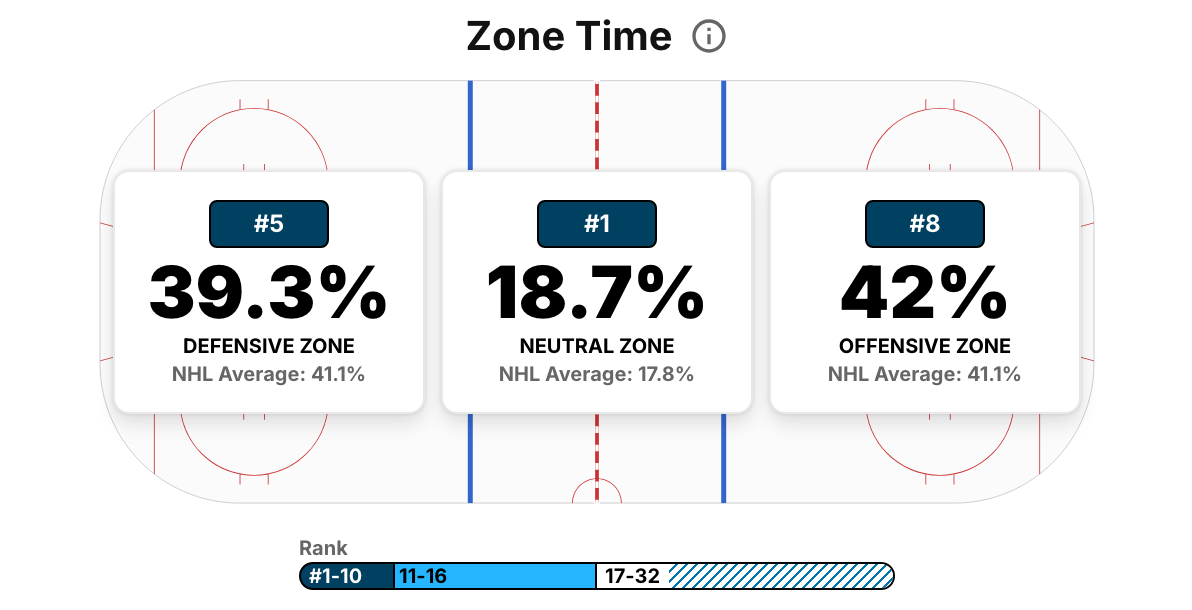
2024-25 Dallas Stars
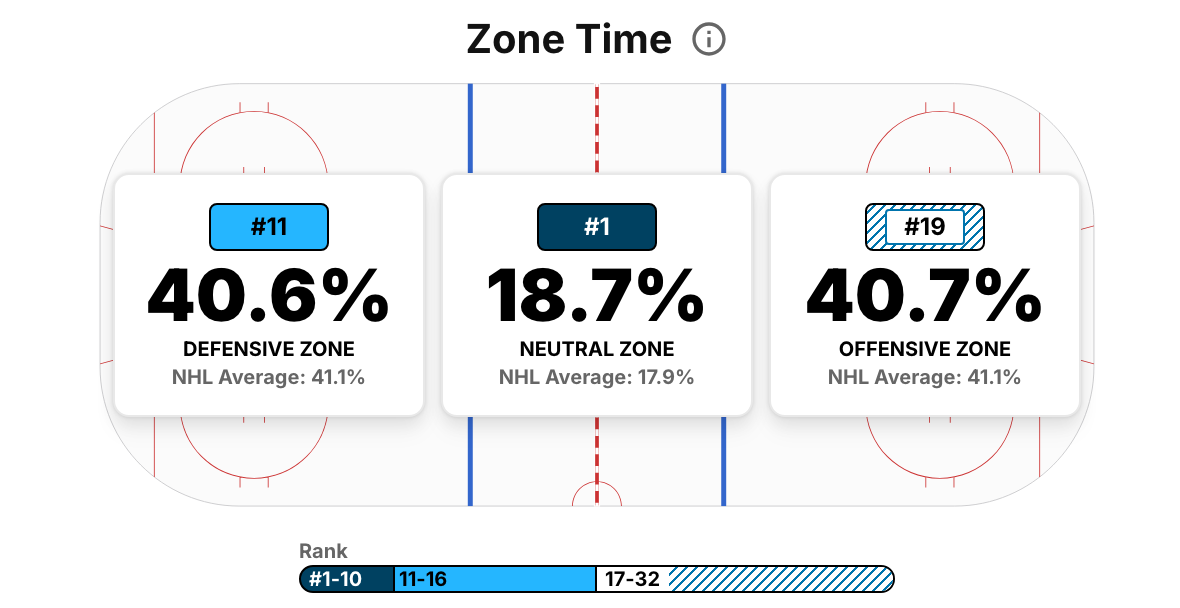
While the offensive-zone numbers changed pretty drastically from year to year, you can see in the DZ and NZ numbers what Nill was talking about: Under DeBoer, the Stars got the puck out of the defensive zone fast, attacking off the rush before the opposition could set up its full defensive structure. They didn’t always get into the offensive zone right away, but they at least got into neutral.
When it worked, it was deadly, with the ‘23-24 season being a prime example. However, there’s one other common element not listed on these graphs that we’ll get to in a moment. So let’s move on to this year’s team before we start drawing too many conclusions.
Okay, here’s what zone time has looked like this year under Glen Gulutzan:
2025-26 Dallas Stars
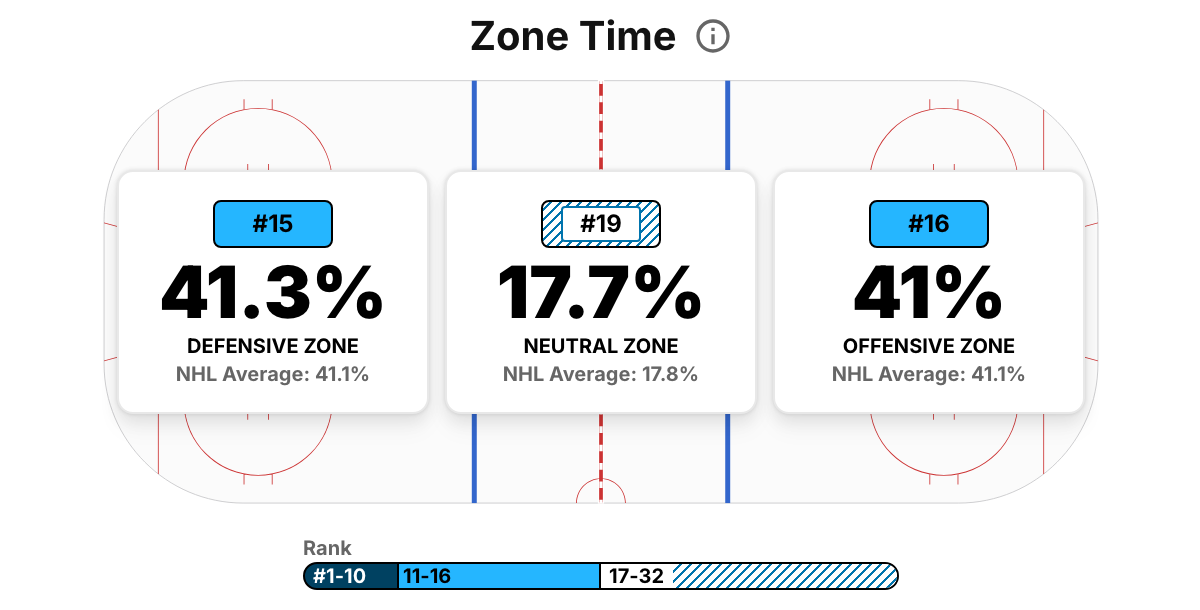
The result is pretty clear: they’re spending a little bit more time in both the defensive and offensive zones, and a whole lot less time in the neutral zone.
This is where it’s important to understand the limitations of a single chart. The time spent in either end might seem to balance out, but the way that time has been spent for either attacking team has been far from equal. NHL EDGE has the Stars as 6th-best in high-danger shots generated, while they give up far less quality in their own end. Defensive numbers aren’t as accessible as offensive ones through NHL EDGE data, but Natural Stat Trick has the Stars’ high-danger shot attempts allowed per game at the 6th-fewest in the league, which is likely a consequence of Gulutzan’s new defensive zone scheme.

The other common element I said we’d get to is the overall skating distance of the team, which you can find in EDGE data. And here are the Stars’ league ranks in each of the last four seasons in terms of Skating Distance:
‘22-23: 2nd
‘23-24: 1st
‘24-25: 9th
‘25-26: 24th
What the implications of this might be in a playoff series remain to be seen. But in theory, the Stars’ reduced skating load (particularly in their own end) could allow them to keep up their style of play for longer stretches, rather than risk getting worn down over the course of a long shift or heavy playoff overtimes. But that’s just a theory.
As for the shot numbers, we’ve done the whole quality vs. quantity thing ad infinitum, but through 70 games this year, the results are pretty clear: Dallas’s attack has changed in approach, but less so in efficacy. All the while, their defense has been shored up considerably. And that’s led to the 3rd-best goal-differential in the NHL this year at 5-on-5.
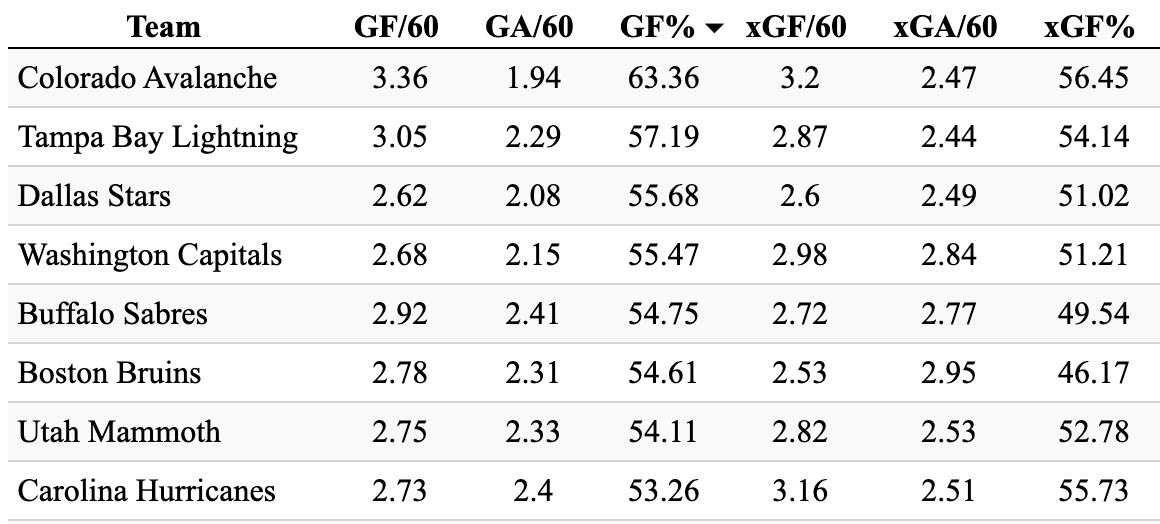
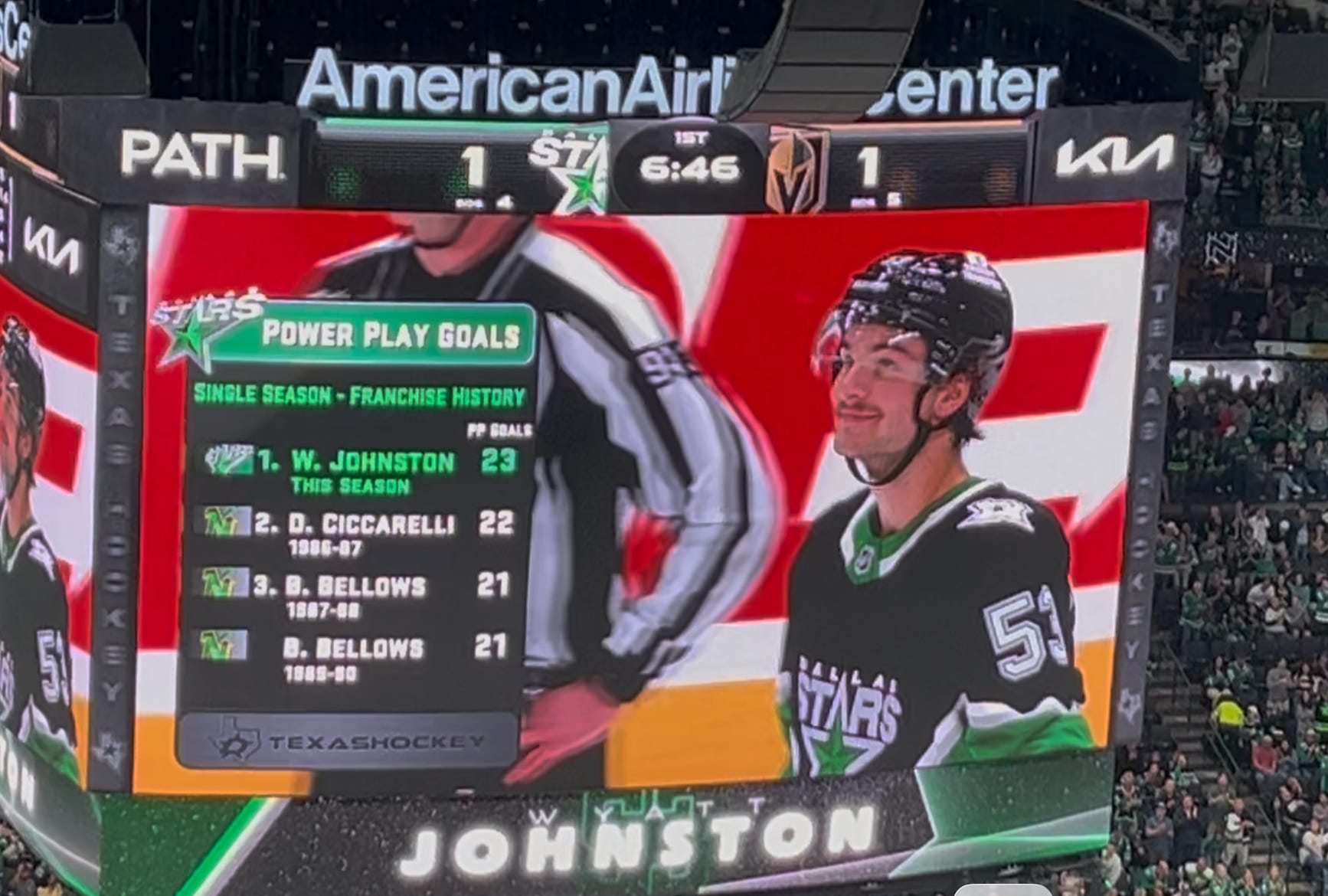
The big question here is not about the offense. Dallas’s actual 5v5 goals are right in line with their expected goals for. Rather, it’s fair to ask whether their defense can continue to allow markedly less than expected (2.08 actual to 2.49 expected) when the playoffs arrive. But if they can continue to win the battle for highest-danger chances from night to night, that will at the very least allow their special teams to be a very big factor in close games. And special teams have been a big strength for this club this year, as Wyatt Johnston knows better than anyone.
Team Leaders in Lieu of Mikko Rantanen
The Stars miss Roope Hintz, Radek Faksa, and Mikko Rantanen. That’s nothing revelatory, but it’s worth stating for the record before we zoom in on Rantanen specifically.
Miro Heiskanen’s assist on Johnston’s power play goal last night gave Heiskanen 50 assists for the season for the second time in his career. (Would you believe John Klingberg only hit that mark once?) That assist also moved Heiskanen ahead of Mikko Rantanen (49) for the team lead in assists this season. And it only took Heiskanen 14 more games to do it.
That got me wondering, though. The Stars’ 9-2-2 post-Olympics run has all happened without their superstar winger, when they’ve outscored teams 47-30. Aside from Jake Oettinger (who has been great lately), who else has helped fill the Rantanen gap?
The top answers won’t surprise you. In those 13 games without Rantanen over the last month, Wyatt Johnston (9) and Jason Robertson (6) have been first and second in goals during that time, with both being tied for the team lead in overall points (16 each) as well.
As for helpers, Matt Duchene and Miro Heiskanen each have 11 assists to pace the group, just one more than Robertson’s 10. Unsurprisingly, a lot of this production has happened on the power play, which has scored 12 times in those 13 games. Neil Graham and Glen Gultuzan have kept the Stars’ top unit absolutely rolling even without two of its key contributors, and they deserve a fair bit of credit alongside the players doing the executing.
That’s not the most fascinating part of this stretch, though. Because, would you like to hazard a guess at who leads the Dallas Stars in 5-on-5 points over those 13 games? You will not get this one right, I promise you.
Go ahead, guess. Throw out a name.
Three names, even. I dare you.
Oh, I’m sorry. That’s not correct. The name we were looking for—the Stars’ 5-on-5 scoring leader over the last 13 games? That would be one Sam Steel.
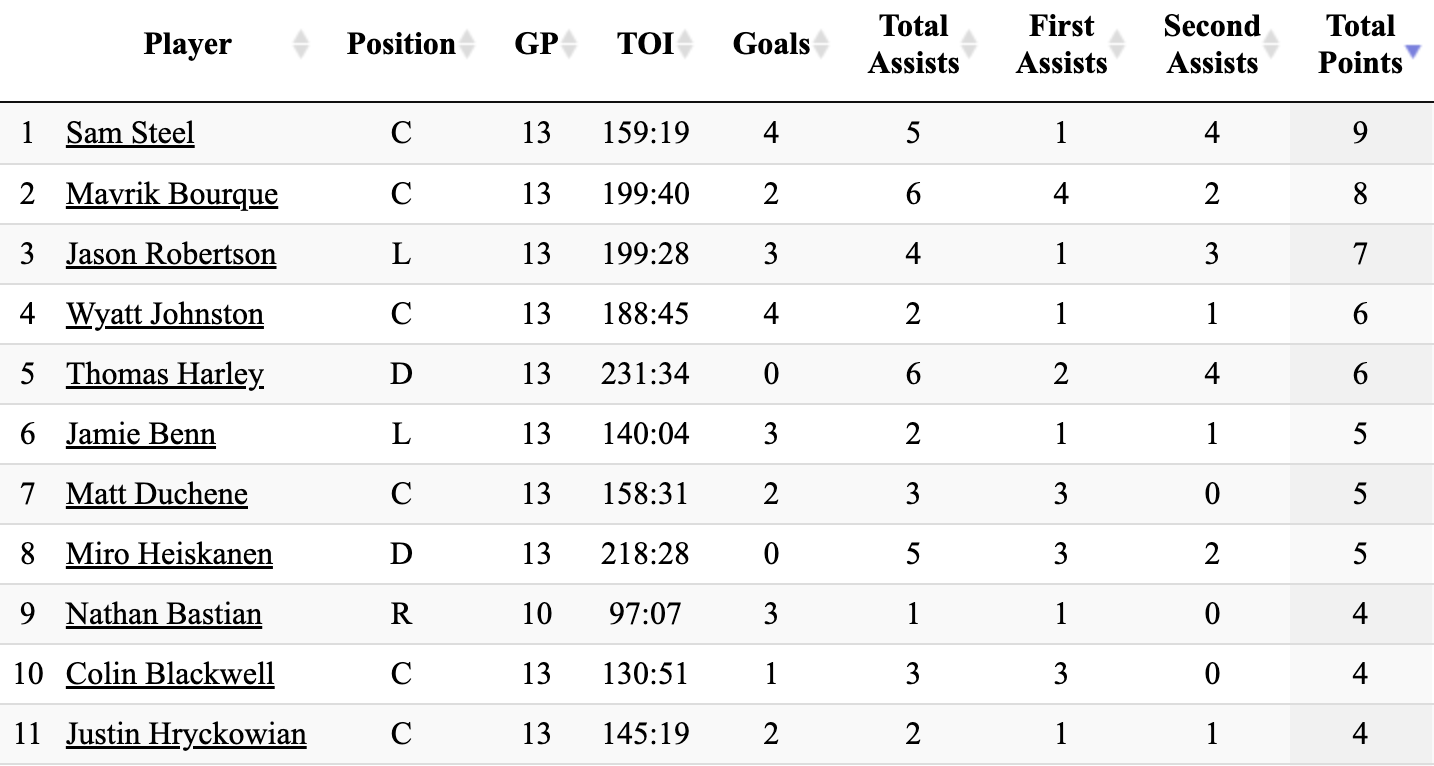
Sure, a chunk of those are secondary assists, but Steel also co-leads the team (alongside Johnston) in 5-on-5 goals during that time, too (with his pair of goals in Calgary making up half of them). He’s been far from a passenger, as the Stars have outscored opponents 11-4 during Steel’s ice time at 5-on-5 in those games.
Sam Steel isn’t likely to remain the main conduit through which the Stars’ even-strength offense travels, but it’s been nothing short of remarkable how he (and his linemates) have stepped up. Steel’s defensive responsibility and connective instincts have been instrumental to the Stars’ attack over the last month, and he’s finished a fair few chances along the way.
I’ll end today with this crazy comparison between two scoring lines Steel has played on this year:
In 217 minutes together, the Steel-Johnston-Rantanen line scored 11 goals and allowed 7.
In 146 minutes together, the Steel-Duchene-Benn trio has scored 10 goals and allowed just 4.
While the expected goals numbers are similarly strong on both lines (54-55%), the results have been much better recently than they were early in the year with the top duo. As a result, Steel has already set career-highs in goals, assists, and points this year.
Lately, Steel has been moved down to a third line with Hryckowian and Blackwell, and that’s been one of many lines whose underlying numbers have suffered during the Stars’ last three games against top-tier opponents. But even at 41% xGF, that line has still managed to be +1, not allowing a single 5-on-5 goal against.
That low mark, much like the lofty highs preceding it, may not be sustainable. But then, it doesn’t have to be. Mikko Rantanen is returning very soon, and when he does, Sam Steel will still be wherever he needs to be.
Also known as crayfish, crawdad, mudbugs, or even rock lobsters depending on regional terminology. The “yabbies” term in Australia is, of course, the most absurd/best one.
Robert, when I read the stuff about the boil, I skipped the hockey (I'll go back!) and came straight to the comments - **there is nothing better than a good crawfish boil**! It IS a party, with great food!
For those that want to try, I recommend the two-pot method - https://youtube.com/shorts/8F0GCdx-sBc?si=WCdGCbuH39I3jdub.
Cook the crawfish by themselves, in CLEAN water, with all the spices, veggies, sausage, etc. in a separate pot. After the veggies cook (10 min or so), bring that pot down to 140 degrees, than add the cooked crawfish for the soak (the longer you soak, the spicier they'll be. I recommend 30+ min.)
No matter how much you purge and wash the crawfish, you'll be surprised at how muddy the first pot will be. Soak separate from the mud!
Anyway... Go STARS!
I have only been following the Stars (and by extension, hockey) for a few years, and I can't believe this is the first mention I've seen of Skating Distance. I should have trusted my gut and asked the question even as a newbie. It was SO obvious to me that the Stars were skating a LOT more than the other teams. Fans on social media saying the Stars were out of gas and I was like, "Yeah, duh!" I wouldn't have known how or where to check for stats/comparisons, though I did Google it once and got nowhere.
I'd say that adjusting play to reduce the amount of skating required has had a big impact already. I hope it's going to pay off big in the playoffs.
The other stuff is good news too - I just got excited to see something confirmed that I've suspected all along.