
Miro Heiskanen's Familiar and Unfamiliar Season
It took a while, but Heiskanen finally found the full-season defense partner who was there all along. It worked quite well.

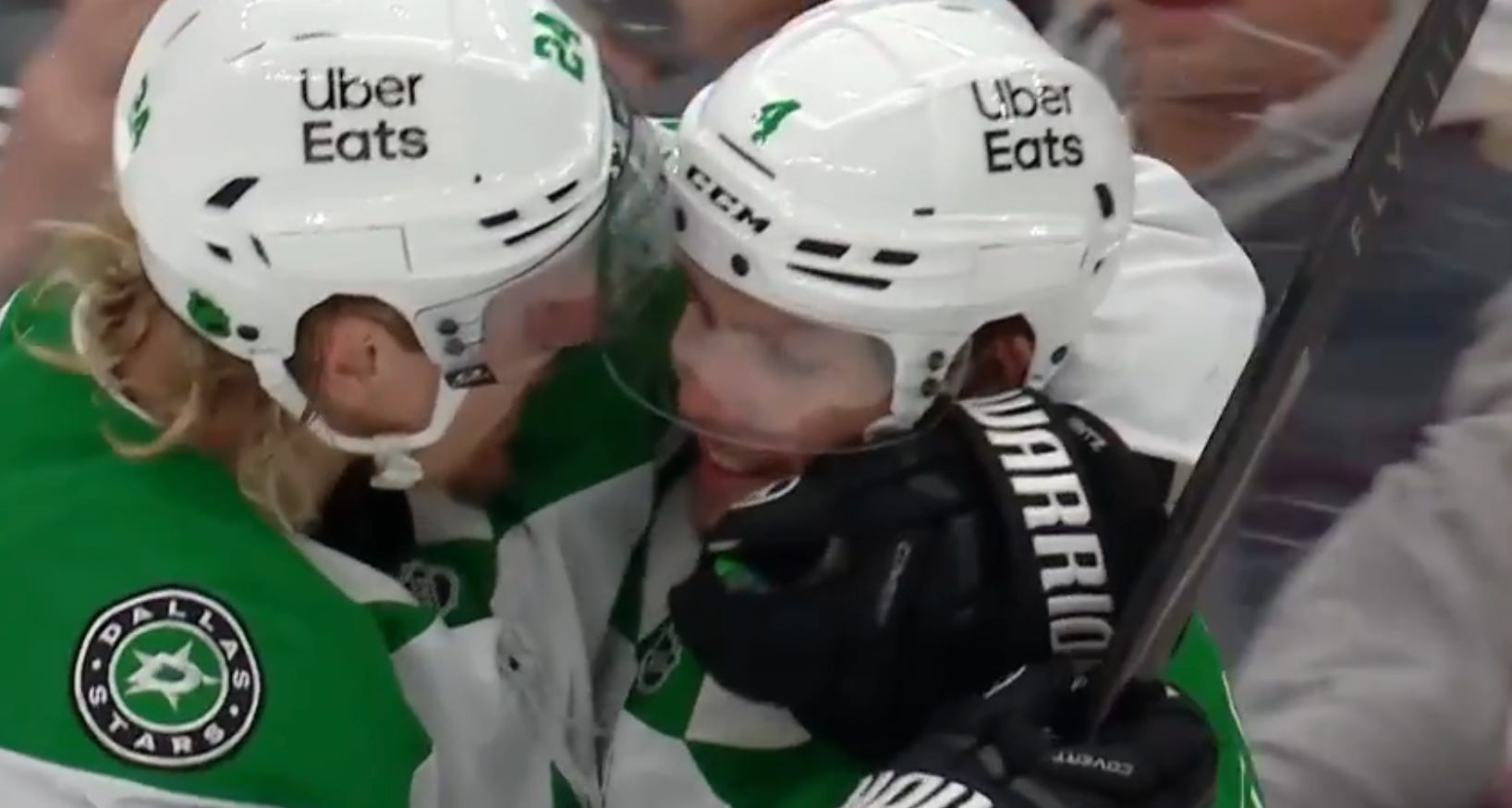
A little spoiler alert, first: the Stars’ defense corps didn’t have a great postseason. Getting outscored 14-4 at five-on-five in a first-round loss means that’s the case for a lot of players, but defensemen tend to be the ones in-frame when goals are being actively created, so that means you probably have a few bad memories from this spring.
That’s fine, but we’re not here to let a six-game sample size overshadow the broader picture of what defensemen do in the NHL. Instead, we are here to talk about Miro Heiskanen in today’s episode of Very Real and Important Player Grades.
But before we dig into what Heiskanen did for the Stars this year, it’s important to point out that Heiskanen played the entire season alongside Esa Lindell. It was the Finnish duo’s first season-long run together in the NHL, and it could well be some of the most viable long-term partnership Heiskanen has ever had in Dallas.
Miro Heiskanen and a Defensive Partner Digression
The Lindell-Heiskanen duo played around a dozen games together in 2024-25, after the team gave up on trying to get Heiskanen back onto his left side following the failed Matt Dumba/Ilya Lyubushkin experiments. (Yes, you may have forgotten, but Heiskanen played around a dozen games next to Lyubushkin last year before Mark Stone Happened.)
Heiskanen even got a ten-game stretch with Lindell in his rookie year, when injuries across the Stars’ defense corps in the fall of 2018 forced their hand. Heiskanen began the year with Marc Methot and Connor Carrick, but injuries meant he even played a game with Julius Honka and a few with Joel Hanley (because of course Joel Hanley). That month alongside Lindell was actually the most stability Heiskanen had in his rookie season under Jim Montgomery, before right-handers Roman Polák and John Klingberg wound up being the go-to options alongside the breakout rookie star, with Polák being the go-to option in the postseason.
That rotation of defense partners has been a theme of Heiskanen’s time in Dallas. So often, he’d start the season with one partner, then that experiment would be abandoned early on in favor of another option, and we’d generally see option C by the end of the year.
In 2019, it was Andrej Sekera who began with Heiskanen, but that likewise didn’t last long before Klingberg was tried out briefly. But Klingberg and Lindell were always the most reliable partners, and that meant Jamie Oleksiak got the longest run with Heiskanen that year…until Stephen Johns gave us a couple of months of what might have been, when Johns was paired with Heiskanen for the final weeks leading up to March 2020, when the season appears to have abruptly stopped for some reason. (Weird, right? Remind me to look into what happened.) Johns would sadly finish his Stars career in Game 1 against Calgary, and it would be Heiskanen and Oleksiak who were paired together for the rest of that Stanley Cup Final playoff run.
That chemistry with Oleksiak stuck with Bowness, as he ran Heiskanen with Oleksiak for every game of the (weird, realigned, and shortened) 2021-21 season. But alas, the Seattle expansion draft arrived the following summer, and the Stars lost Oleksiak1 as a result.
With the departure of Oleksiak and John Klingberg one year away from free agency himself, the Stars had limited options for supplementing their defensive depth. Thus, Jim Nill signed Ryan Suter fresh off his Minnesota buyout to a four-year contract in July of 2021. So while Heiskanen began that ‘21-22 year with Lindell for 25 games or so, Suter would wind up being Heiskanen’s go-to partner for the back half of the season, as well as that famous Calgary playoff series.
Heiskanen’s rotating defense partners were not going unnoticed even back in 2022, when Saad took a look at what the Stars were doing and could do differently when it came to Heiskanen’s minutes. Saad even mentioned Alex Petrovic way back then, clearly foreseeing his 2024 Dallas playoff arrival, but it was pretty clear even then that the Stars needed to make a move to get more right-handed blueline talent, and they would trade for Nils Lundkvist just a couple of months later, in September of 2022.
Pete DeBoer arrived ahead of 2022-23 as well, and we saw yet another version of the same tune: a low-cost RHD was acquired and paired with Heiskanen to start the season, but the experiment was abandoned before its end. This time, it was Colin Miller, who got around 50 full games in which to prove he could handle himself next to one of the best defensemen in the world, and failed to do so. Instead, Suter and the newly acquired Nils Lundkvist displaced Miller for a chunk of time in the middle of that season, and DeBoer would go back to Suter with Heiskanen late in the season and throughout the playoffs.
Finishing our tour of Heiskanen’s defensive counterparts is the 2023-24 season, and it was a straightforward one: Heiskanen played the first half of the year with Ryan Suter and the second half with Thomas Harley, as well as the vast majority of the playoffs.
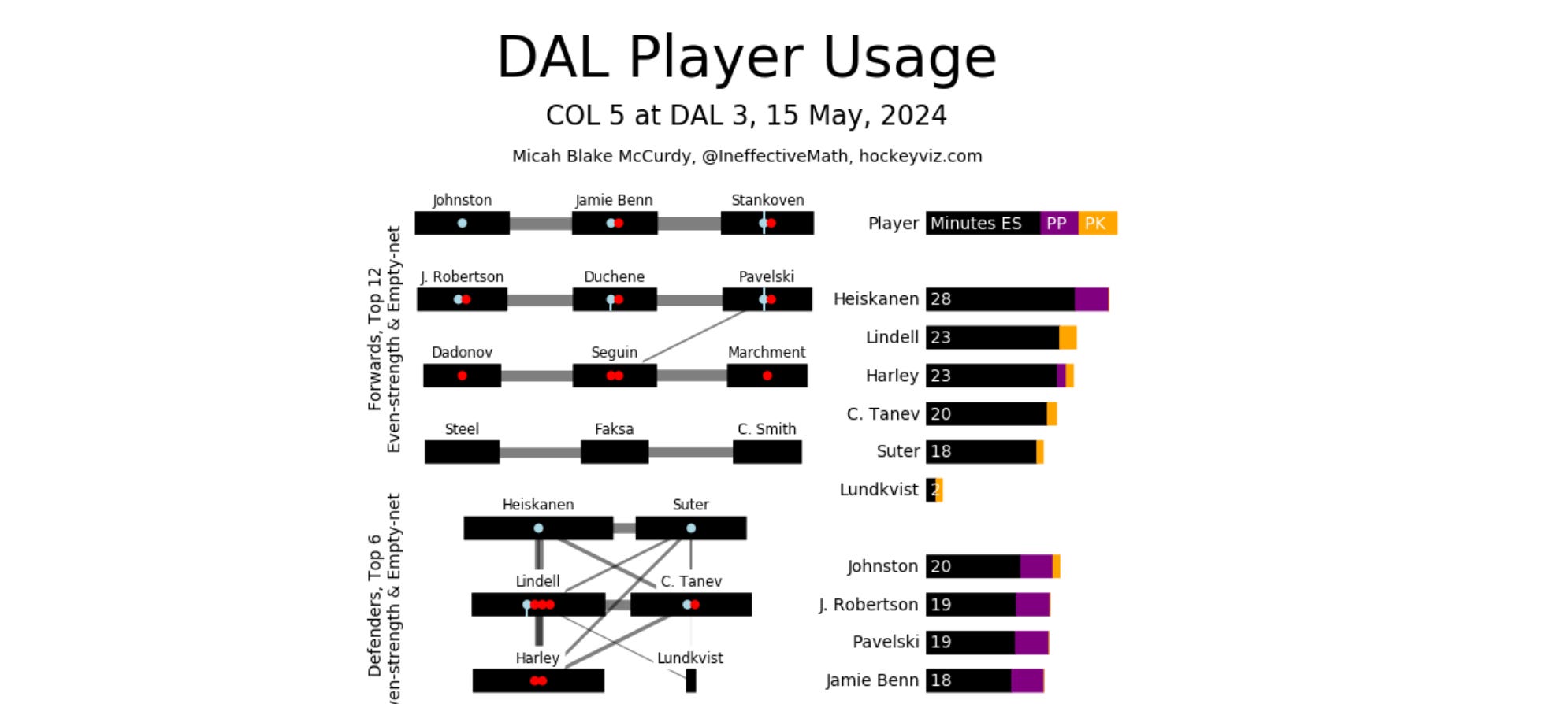
There were two times when DeBoer chose to alter the Harley-Heiskanen pairing, not counting the loss of Chris Tanev in Game 3 vs. Edmonton, which mixed things up out of necessity. The first time was when DeBoer pretty plainly sent a message to his GM that he was not going to use Nils Lundkvist in the playoffs, by doing this in Game 5 vs. Colorado, with Heiskanen next to Suter again:
And the second time we saw Heiskanen next to someone other than Harley by choice was in that fateful Game 6 defeat to Edmonton, which is as far as the Stars have gotten in the postseason since 2020. Here’s what Pete DeBoer ran out in that moment of desperation:
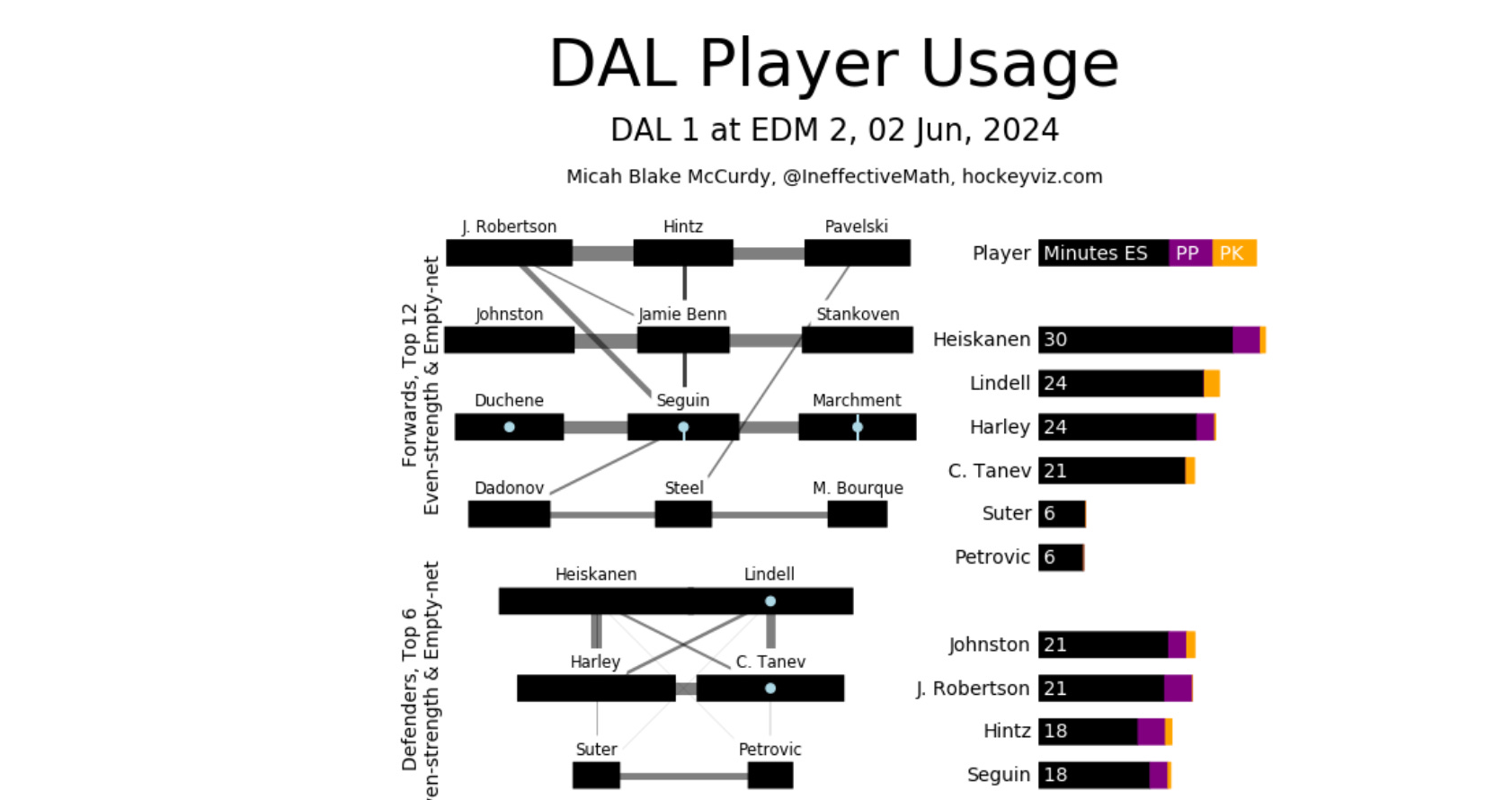
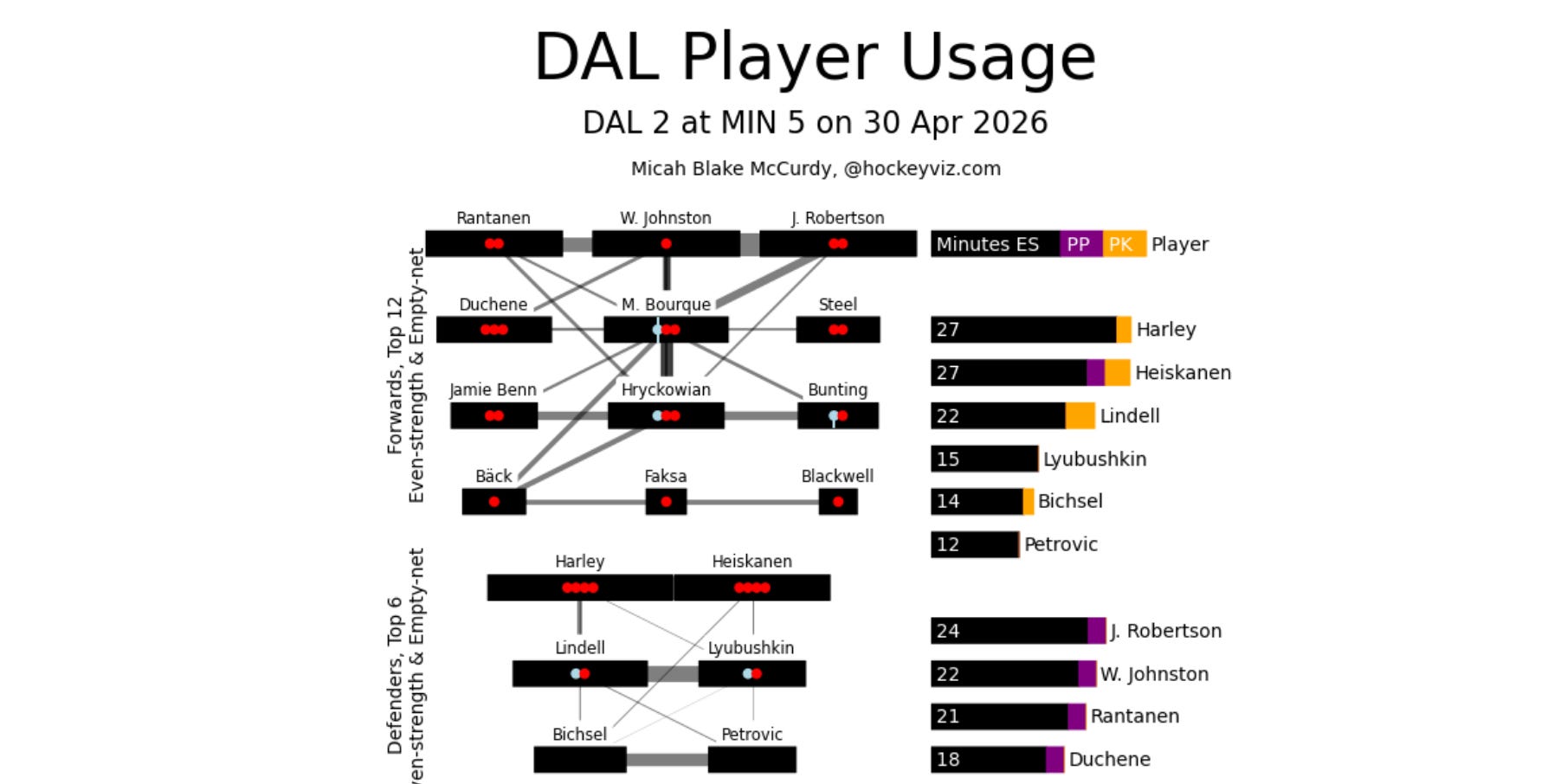
Indeed, it was Lindell-Heiskanen back together with the Stars on the brink of elimination, in a poetic foreshadowing of what we saw in this year’s Game 6 elimination, when Glen Gulutzan split up Lindell-Heiskanen in favor of Harley-Heiskanen for Game 6 vs. Minnesota, when the reunited duo saw four of Minnesota’s five goals go into the Stars’ net during their time on the ice together:
Whether playing with Marc Methot, Connor Carrick, Roman Polák, Andrej Sekera, Matt Dumba, Stephen Johns, Ilya Lyubushkin, Ryan Suter, Jamie Oleksiak, Colin Miller, Thomas Harley, or Esa Lindell, Miro Heiskanen has consistently been the best defenseman on the ice for Dallas when he’s been out there. But man, you’d love to see him find a stable defense partner for more than one season, and Esa Lindell certainly looks like he could be that guy.
In their 77 games together this regular season, Lindell-Heiskanen were outstanding. Of the 28 defense pairings to amass at least 700 minutes together at 5v5, the pairing holds up well. In fact, the Stars’ duo had an xGF% that was a tiny bit better than Cale Makar and Devon Toews put up for Colorado, if you can believe it.

Despite being asked to do more defensive-zone work than most of the other pairings on this list, that Lindell-Heiskanen duo ranked fourth-best in xGA/60, actual GA/60, and high-danger shot attempts allowed among those same 28 pairings. Little wonder that they stayed together all year, I suppose.
My sense is that even after the Game 6 reunion of Harley-Heiskanen, the Stars still see Lindell-Heiskanen as the better of their current options as things stand now. So it wouldn’t surprise me to see that pairing in Game 1 this September, when the Stars begin an 84-game regular season.
Now, let’s get into the pretend grade.
For this year, Heiskanen earned an A rating. That “A” stands for a few things, so let’s hit each of them in turn.
Heiskanen Almost played a full regular season slate of games for the first time2 since his rookie year. And I would've happily given him credit for doing despite his January absences, as those were family-related. But alas, Heiskanen got Foligno’d in Game 77, and while the final regular season games he missed didn’t end up mattering for the standings, he carried a torn oblique muscle into the playoffs, which mattered much more.
The playoffs, yes. That’s where the “A” might stand for Arduous, because every bit of offense the Stars tried to generate felt like it required heroics from Heiskanen and all of his teammates. Heiskanen tallied six points in six playoff games, with his four assists supplemented by two big power play goals. But your memories of those goals are probably tainted by the fact that both came in Games 4 and 5, which Dallas lost.
You also couldn’t help but contrast Heiskanen’s dogged work (again, done with a torn oblique muscle) with that of Quinn Hughes and Brock Faber, whose easier offensive production was stark in this series. When Heiskanen and Hughes/Faber were on the ice together, goals at 5v5 were 5-0 for Minnesota, with the Wild also holding a nearly 60% share in expected goals.
That isn’t intended to put all the blame on Heiskanen, particularly with key absences up front. It is a trope in sports fandom to blame the best players when a team falls short, and that’s very often wrongheaded. After all, Heiskanen was asked to do the heaviest lifting of anyone, and he averaged a ridiculous 31:30 per game in the postseason, on account of logging 43 and 33 minutes in the extended overtime contests of Games 3 and 4. He also scored a point per game. Sure, the 5v5 minutes were tough, but Heiskanen was far from the problem.
Anyway, the playoffs were the playoffs, but they shouldn’t overshadow what Heiskanen did over the course of the regular season, which was quite Above Average. Racking up 63 points in 77 games, Heiskanen was 13th in points-per-game among NHL defensemen this year. His nine goals might strike you as modest, but that total was two more than a certain Quinn Hughes amassed in 74 games, and it was also the third-highest in Heiskanen’s career. Coupled with his 54 assists—the second-highest total of his career—Heiskanen wound up with a quite prolific offensive season, at even-strength as well as on the power play.
The final “A” for Heiskanen is All-Around, which also happens to be a phrase directly from the verbiage that spells out Norris Trophy criteria. In addition to quarterbacking a top power play unit that really ran more through Mikko Rantanen, Heiskanen was also asked to be a top penalty-killer under Gulutzan, and his 3:06 in shorthanded ice time per game was the highest in his career.
It was a decision Gulutzan made going into the season, and he stuck with it throughout the year. My opinion is far less-informed than that of those who matter, but if I’m being honest, I do still have trouble agreeing with that call, particularly given that the public numbers with Heiskanen don’t exactly indicate that he elevated the penalty kill relative to other Stars defensemen.
Yes, Heiskanen’s skating and stick work are as good as it gets in the NHL, and he certainly had some heroic moments shorthanded. But for my money, Heiskanen’s elite skills are best leveraged in minutes where they can shine the brightest, and while he can close down pucks quickly when the opportunity arises, I generally think the cost of him being “less involved” in the game while shorthanded would be more than made up for by being able to roll a fresh Heiskanen out right after the penalty kill.
Sure, the penalty kill dipped a bit from the prior few years under Alain Nasreddine, but it was still solidly above-average relative to the rest of the league. I also harbor a (completely unsupported) belief that forward pressure has a bit bigger impact on PK success3 than defensemen’s duties usually do. If you can survive shorthanded minutes while saving your top offensive forces for minutes with higher offensive potential, that seems logical to me. I just didn’t see enough from Heiskanen shorthanded to warrant his taking those minutes this year, but again, my opinion only counts for what opinions usually count for, which is to say not that much.
Still, I can’t help but notice that Heiskanen played just 17:14 at 5v5 per night, by far the lowest in his career. And despite scoring quite well in the 5v5 minutes he did play, Heiskanen’s overall 5v5 impact was down by his standards. While shots on goal numbers were skewed this year for league reasons, Heiskanen had some of the lowest totals in his career in individual shot attempts, scoring chances, and high-danger shot attempts. But despite all that, Heiskanen’s results were a different thing than the process, as Dallas scored 55.77% of the goals during his 5v5 ice time, which was the third-highest share of his career. It was a weird feature of this Gulutzan team to defy some common proxies in the results it achieved, so how you feel about Heiskanen’s process vs. results is probably going to be a deeper reflection of the team’s approach as a whole.
To wrap up special teams, if you’re going to be critical about Heiskanen’s usage on the PK, then you also have to be laudatory of his work on the league’s second-best power play unit, which Heiskanen featured on all year. Even if his shot wasn’t the focus of the unit, his work in transition, zone entries, and puck rotation was clearly a boon to a terrifying power play unit.
Oddly enough, Heiskanen’s two power play goals in the playoffs equaled his total of PPGs from the entire regular season, so it’s probably time to admit that he’s just not the sort of defenseman who’s likely to pile up 20 goals one of these years. That might put a damper on hopes for Heiskanen’s winning a Norris Trophy, but that’s not to say that his overall body of work wasn’t still very good. I had him as a top-ten defenseman in the league this year, easily.
After logging the most ice time of any player at the Olympics, Heiskanen returned to wind up logging the fourth-most TOI per game in the NHL over 77 contests. He played a ton, he scored a bunch, and he did it while being asked to do everything. And once again, the pillar of the Stars’ defense showed why he’s one of the best there is.
You can’t help but wonder what might have been, had the Stars gotten a bit better injury luck in the playoffs, but Heiskanen’s season really was outstanding. Maybe the “A” should really just stand for Awesome, because that’s what Miro Heiskanen is, fundamentally.
Technically Oleksiak was signed by Seattle as a free agent, but that still counted as Seattle’s Dallas pick in the expansion draft.
Heiskanen also missed a single game in each of the shortened 19-20 and 21-21 seasons, lest you think I’m penalizing him unfairly.
Another digression, briefly: Further to that point about forwards, it’s worth pointing out that the Stars’ most-used penalty-killing forward was Radek Faksa, about whom we wrote this last August:
If I have any big reservations about Faksa, it’s that his work on the penalty kill might not measure up to the rest of his defensive reputation. Alain Nasreddine has been pretty shrewd in deploying Stars’ skaters on the 4-on-5, however, so perhaps the Stars will continue to lean on the strong PK work from players like Steel, Johnston, Hintz, Blackwell, Bäck, and Bourque while saving Faksa for defensive matchups at 5-on-5, where he’s shown much more ability to bring positive results.
As it turned out, Faksa was on the ice for the second-most PK time of any forward per night for Dallas, and the highest rate of goals-allowed of any regular PK forward. Again, I’m loath to link PK percentages to any one player (even the goaltender), but I don’t know that you can really look at the Stars’ approach to the penalty kill this year and call it a recipe for success going forward. I’d expect to see some changes.
Great article. Hopefully after Robo and Borque contracts are finalized there is enough change remaining to sign a reasonably priced RHD for depth. Otherwise we can always count on Petro! BTW, what are the important calendar dates related to getting something done with Robo? Thanks.
I’m biased because I’m a Miro fan to the core but- this was a great piece lol
I think your point about the forward usage/style on the PK is incredibly important and like… truly, my kingdom to get Faksa off the PK and Johnston back on it.
But I ALSO… this ties into my Harley concerns (which are not “Harley is bad” but “what is the point of a 10.5875mil #3 defender?)- I think as much as we all admire Harley’s offensive prowess and the threat of his shot, Miro as the PP QB was awesome this year. And I’m sure Miro wants all the minutes and all the responsibility but it feels like it might be good to let Harley take over the bulk of those PK minutes or SOMETHING.
I think Harley had more 5v5 avg TOI this season than Miro? And like, sure, but part of that is because Miro’s PP usage and how much more effective would the team be at even strength if that 3:06 avg time on the PK was instead added to even strength?
I like Lindell a lot, I think he is undervalued outside of Dallas (I also think if he could be convinced to waive his protection he would be a great trade chip) but.
Not to add to the carousel of Heiskanen partners but… I dunno.
They were very very very very good together.
I still kind of think Miro could be better with a different partner.
Awesome work as always!