
Making Sense of the Jason Robertson Situation Right Now
Personally, I would be open to being paid $120 million to live in Seattle

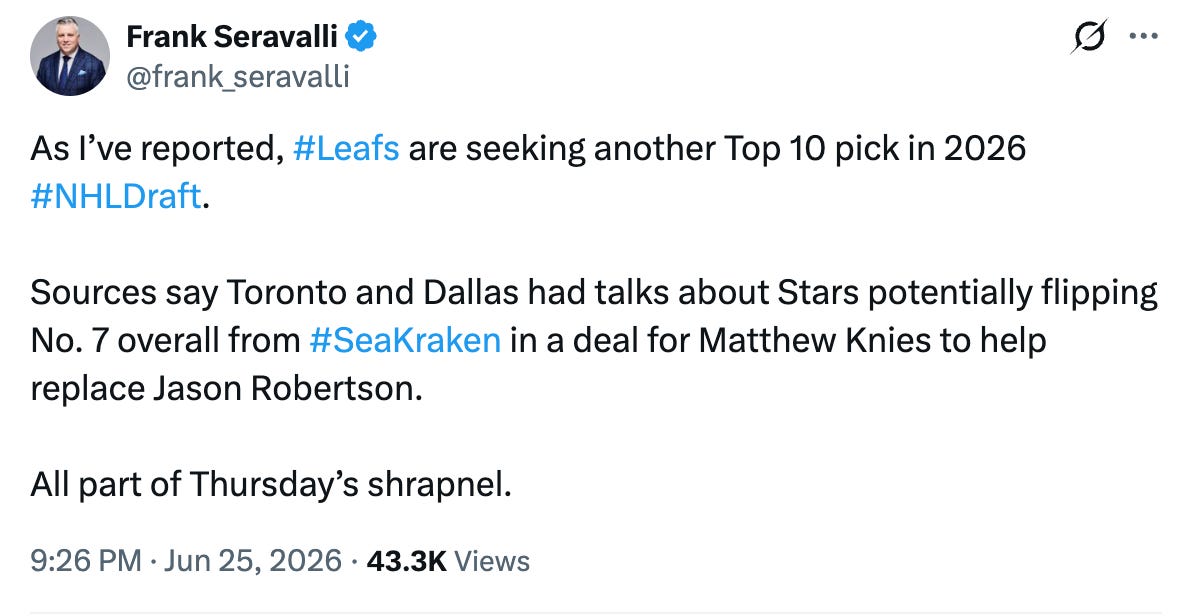
According to SportsNet’s Elliotte Friedman, Jason Robertson has turned down a $15 million x 8-year offer from the Seattle Kraken as part of a trade with Dallas. We also just heard from Victory+ personality Frank Seravalli that Matthew Knies was a part of that potential trade.
That’s a lot to process, and there’s much to be said about it. So let’s dig into what we know about the Robertson situation as it stands Thursday night, and what this all means right now.
First, let’s talk about the two reports in tandem. If we’re connecting dots here, then the Stars were looking at trading Robertson to Seattle, then making a separate trade flipping a pick from Seattle to Toronto in order to acquire Matthew Knies.
Knies is a 6-foot-3, 230-lb winger who’s signed for the next five years at $7.75 million—coincidentally, the same cap hit as Robertson’s from the last four seasons. Knies has scored 29 and 23 goals in his last two seasons (though five of those 23 were empty-netters), and he profiles as something like a Brady Tkachuk starter kit, however you feel about that. Clearly, Dallas feels pretty good about such a prospect, at least as part of any trade package.
Knies doesn’t drive play, but he does bring size and tenacity along with netfront work, and he’s shown himself to be very much worth the extension Toronto gave him. He is also a very different player from Jason Robertson.
On the Dallas side of this, surely they would have been getting more than just the 7th-overall pick from Seattle in the now-nixed deal, so it’s possible Dallas might have wound up with Knies and multiple extra assets in exchange for moving Robertson. Without knowing all the details of what those other assets would be, I don’t think it’s worth doing much deeper analysis right now, particularly with Robertson having already declined the Seattle offer.
Also notable is the fact that Robertson and Dallas are still reportedly engaged in talks, which means that there is still at least some kind of chance that Dallas re-signs him. Personally, I think that would be their preference, but if Robertson’s camp stands firm on their $14 million (or more) ask, all indications are that such a number would be a no-go for the Stars. As we’ve said many times before, the Stars don’t sound likely to go much higher than $12 million. They might consider $13 million flat at their absolute best, but who knows if that’s actually been said.
It’s also a big deal that Dallas was willing to give Seattle permission to extend that offer to Robertson in the first place. That tells you a lot about the likelihood of any Stars extension as things stood earlier on Thursday. If Dallas thought they were close to signing Robertson, they wouldn’t have gotten all the pieces in place for a potential trade, let alone gotten to the point where Robertson actually had a deal to consider from another team. That’s typicaly one of the final steps in any such process.
So, what happens now? Well, as I see it, there are three big questions the loom over everything:
What teams would Robertson be willing to sign a long-term extension with? So far, it sounds like Ottawa, Seattle, and St. Louis are not desired destinations for him, but we really don’t know what other teams Robertson would be willing to sign with, were Dallas able to work out a trade with them. Speculate if you like, but I won’t go there for now.
Does Toronto stay engaged with the Knies idea if Dallas could move Robertson in a three-team deal for a different package that includes another first-round pick from a team in the top ten, like San Jose?
Most crucially, is Robertson ultimately just going through this whole thing in order to get the best possible deal out of Dallas? If so, letting things go this late is certainly a bold way to go about that strategy for him and new agent Andy Scott, as Dallas has shown today that they’re absolutely willing to move him if he’s not willing to reduce his current ask. Of course, Robertson’s needing to approve an extension to consummate any major deal gives him a lot of say in the matter, so it’s not quite as much of a risk as it could be, from the player’s perspective.
Now, let’s be real: even a Knies package that comes with another first-round pick or two for Dallas is not going to make them better next year. Dallas is understandably rumored to be looking for a Rantanen-type trade package, but any package looks like one that probably would make the Stars at least a bit worse next season, at the very least.
Remember, Jason Robertson has scored at least 41 goals in three of the last five seasons, and he also drives play, defends well (check the numbers—it’s true), and facilitates breakouts and transition play with smart passes and calculated movement. And of course, in terms of production, Robertson’s has been as good as it gets in terms of NHL wingers. Oh, and he’s not even 27 years old yet.
This is why the Stars’ preference all along was to re-sign Robertson, and their reported offer of the Mikko Rantanen $12 million x 8-year deal demonstrated that. If you’re Dallas, it’s not exactly ridiculous to ask Robertson to take the same deal a superstar teammate like Rantanen just took to stay with a team in the middle of their Stanley Cup window. In fact, it’s perfectly reasonable, given what players with Florida and Tampa—and even Marner in Vegas—have done in recent years.
But Robertson’s camp appears to be operating under another very reasonable presumption, which is the fact that the salary cap is shooting up quickly, and Robertson is the most desirable player any team could hope to acquire this summer, barring a Zach Werenski or Connor Hellebuyck trade.
Given all that, I also don’t think it’s ridiculous of Robertson’s camp to peg $14 million (or thereabouts) as their minimum asking price. Sure, they’re leaning a bit more into the “FA” of “RFA” than other players have done, but if you’re Robertson, now is the time to make your move in terms of deciding where you’re going to play for the better part of the next decade. I know that for us normal folk, the difference between $100 million and $112 million may not seem like much, but twelve million bucks is hardly chump change. I suppose twelve percent of your possible generational wealth is always an amount worth factoring into the choices you make during the prime earning years of your short NHL career.
Further to that point, Robertson is reportedly unlikely to sign an offer sheet for less than a $15-million AAV, as any offer sheet would be for only seven years. Thus, any such deal would need a higher AAV to net out to the sort of earnings Robertson’s camp is looking for over an eight-year extension.
I wonder if this has given some teams around the league pause. Does it mean Dallas would actually be willing to extend Robertson a qualifying offer on Monday, thereby inviting a team to come at him with an offer sheet that would require surrendering four unprotected first-round picks? For Dallas, it depends on the teams involved, and where their picks would fall. For Robertson, it depends on what teams he actually wants to go to—and again, we have no idea what teams those are, right now.
I’d imagine this has all been part of Jim Nill’s due diligence over the past few weeks, and it will certainly become even more crucial in the next 20 hours or so before the draft kicks off.
So, as I see it, the questions the Stars have to answer include the following:
Is there a number that Dallas dislikes, but that they could stomach in order to still get Robertson to re-sign?
If they’re certain Robertson’s camp isn’t willing to come down to a range the Stars can countenance, can you maximize his value without making the team markedly worse in 2026-27?
Is Matthew Knies the best-case scenario in terms of getting immediate help in return, or is there another player Dallas could pry out of a different suitor, even via a three-team trade?
Is it imperative to get this Robertson deal done before the draft, or are you willing to qualify him on Monday and deal with any offer sheets when they come—even if it means flipping two (or more) of the picks you get for immediate help?
One ancillary benefit of trading Robertson, of course, is the ability to sign Mavrik Bourque before Monday, which the Stars would obviously very much like to do. There is no world in which the Stars want to expose Bourque to offer sheets, and that means getting him signed, however they end up having to do it.
There’s much more to be said about Robertson and Dallas from a big-picture perspective, but we’ll save that piece for when things actually happen. For now, all we know is that the Stars are listening to offers, and that Robertson hasn’t heard about one that winds up with him on a team where he’s willing to sign a long-term extension—yet.
I’m in this limbo where I feel equal parts ready to name Robo my favorite player and also to take my Robertson Reverse Retro 1 jersey to Blakes to get stripped.
Great piece on that continuous saga.
It would be very interesting to know what was part of the package we could have had from Seattle.
As far as offer sheet goes, what are the teams that can actually do it? In other words, which teams have tha Cap space AND their own 1st round picks to do it? And, off of these teams, which ones are actually "good" destination for Robertson? By good, I mean already good or upcoming teams and geographical destinations where Robertson would like to go.
Right now, we "know" that Ottawa, Detroit, St-Louis and Seattle are not it.
In doing this analysis, it would be easier to see the level of bargaining power Robertson's camp truly have.
As far as I am concern, I would truly like it better for him to stay in Dallas. 45-50 goals scorers do not grow on trees. But if we trade him, I would like it to be in the eastern conference. It would be asking a lot to see him play against us more than 2 times per year.