
How the Stars Beat the Hurricanes Last Year, and Whether They Can Do It Again
As with most things, it isn't as simple as we'd prefer

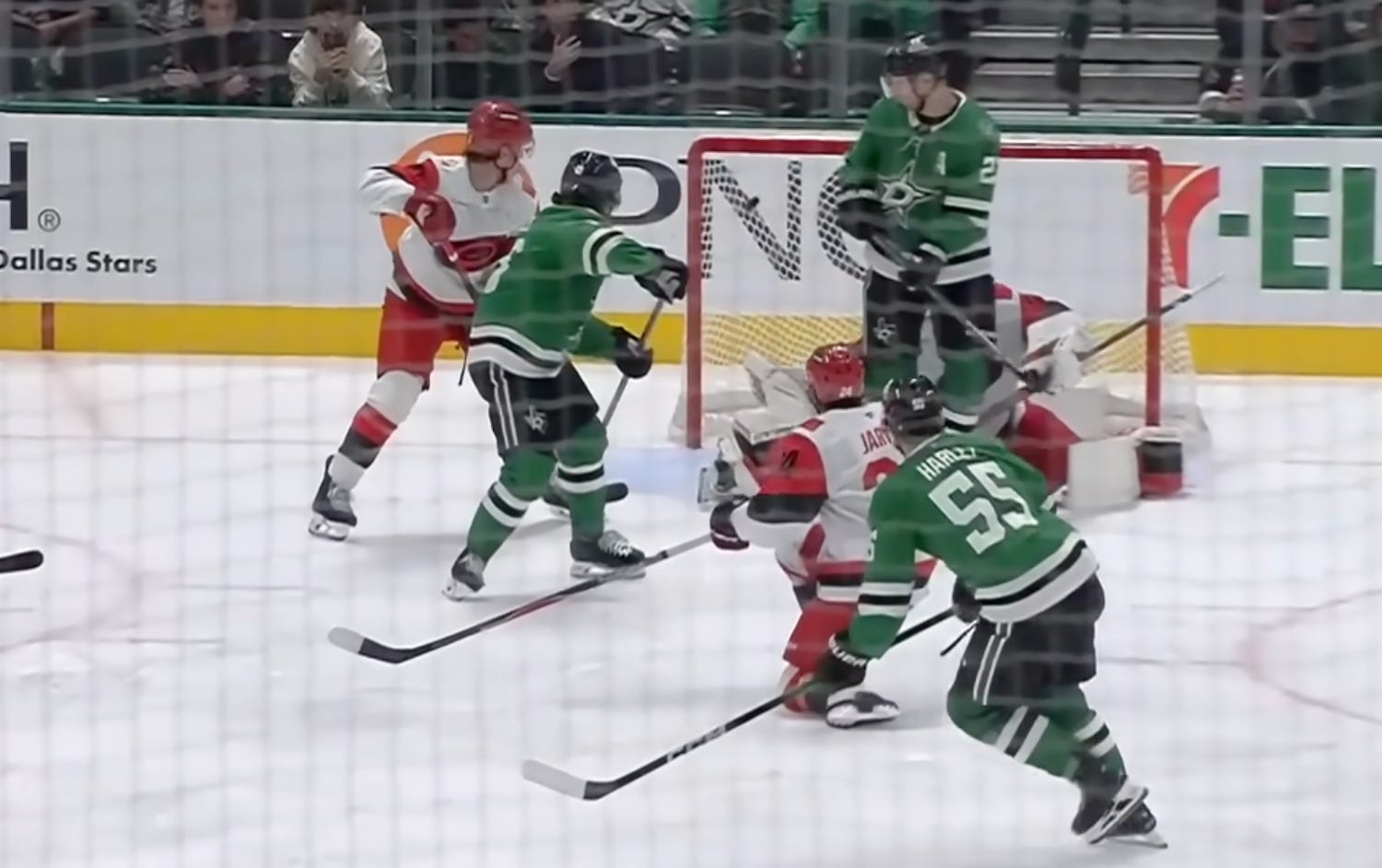
After spending some time last week moping under thunderclouds and gazing through rose-colored glasses, I’ve come to the conclusion that we won’t know how the Stars will actually finish this season until they play the games. This is called Analysis, and it’s something that requires the kind of insight you can only find at great websites like this one.1
What’s less unique to Dallas than that chestnut is the fact that the Stars will have both advantages and disadvantages when it comes to each of those 84+ games they play this season. There will be the odd game where Minnesota waxes them 6-1 to open the playoffs, but there will also be nights like October 25 last year, when an already depleted Stars lineup out-shot the eventual Stanley Cup champions en route to a strong 3-2 victory.
Did you forget about that game? If you need your memory jogged, it was the one where Miro Heiskanen scored 22% of his total goals for the season (neither of which he actually shot into the net), while Sam Steel scored the second power play goal of his career (after a six-year hiatus following his first). You know, normal Dallas Stars stuff.
Putting the goal-scorers aside for the moment, it’s worth reflecting on that game in a tad more detail. Because here’s the lineup Dallas deployed that night:
Steel-Hintz-Rantanen
Robertson-Johnston-Bourque
Erne-Seguin-Blackwell
Hryckowian-Faksa-Bastian
Lindell-Heiskanen
Harley-Lyubushkin
Bichsel-Petrovic
Oettinger
The Stars were still without Jamie Benn and Matt Duchene, so that meant Adam Erne and Colin Blackwell were third-liners for the night. And while neither of those lines was terribly strong, they did serve up a pretty representative shot chart from last year. Because while the Stars did put 34 shots on goal to Carolina’s 28, the Hurricane Hailstorm was in full effect, with pucks being flung toward the net from all over the ice, heedless of whether they had a prayer of going in.
On the other side, the Stars were, as ever, a bit pickier about their shot selection, particularly at even-strength:
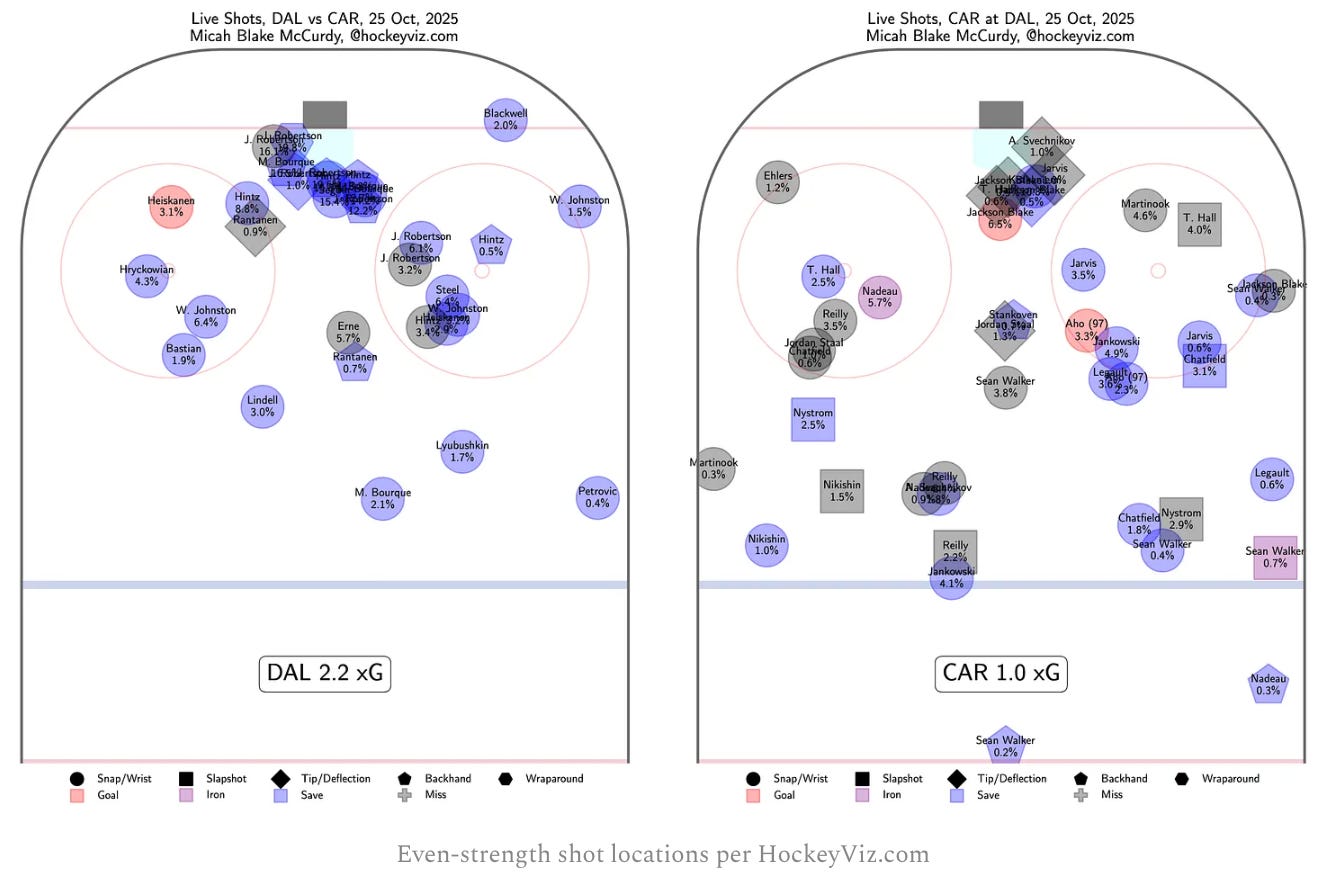
If you take away those three point shots from Lyubushkin, Bourque, and Petrovic, the Stars would have adhered to what in some respects was their ideal gameplan: shooting only from the tops of the circles on in, where one can theoretically put pucks on net with greater certainty (and thus, give them the best possible chance of sneaking in). Keep in mind that the grey shapes up there are missed shots, and you’ll realize just how accurate Dallas was compared to Carolina in this one.
The Stars’ accuracy was not a fluke, or at least it wasn’t a one-game fluke. As a team, Dallas led the league in shooting percentage last year at 13.15%. This wasn’t just a power-play skill either, as the Stars were also near the top of the league in five-on-five shooting accuracy (and tops in the West). Dallas leveraged the shooting talent of its players as well as any team in the league, and they wound up with 112 points at season’s end.
This was kind of a reversal of the playoffs against Minnesota, when an even more banged-up Stars team wound up out-shooting Minnesota, only to find their accuracy to have abandoned them at even-strength. Dallas shot only 3% in that series against Minnesota despite out-shooting the Wild in five of six games, as Minnesota was able to cash in on their truly premium chances to the extent that Dallas never could, as we looked at in detail a couple months ago.

Some of Dallas’s playoff defeat was simply a result of Minnesota’s better execution (and health). That series wasn’t one with a Stars team hanging on for dear life and hoping to get lucky with one of the few shots they had, but rather one where the top guys from one side forced more mistakes from opponents than the top guys on the other. Anyway, we’ll not do another postmortem, but I know everyone tends to point to the playoffs any time regular season discussions get going, so consider the playoffs Talked About for now, and let’s get back to our point.
In that Carolina game back on October 25, I really do think you can see some of the principles of Glen Gulutzan’s team beginning to take shape (even if it would take another couple of months and a tidal wave of injuries for its best version to show up). Dallas blocked a lot of blockable shots, capitalized on a couple power plays, and Carolina couldn’t consistently penetrate the inner slot.
Yes, Heiskanen got a couple of fortunate bounces after the Stars failed to score on a couple of their own Grade-A looks (including a Robertson breakaway), but it was still a pretty good example of how a team missing some key pieces (including Roope Hintz after he was knocked out of the game by Taylor Hall) could beat That Carolina Team without getting overwhelmed. On balance, it was an impressive win, even if it was far from a clean one. Heiskanen also made a rare mistake late in the first that led to a goal, and the Stars really did have to dig their way out of a first-period hole.
Putting this in perspective for a moment, let’s remember that these same Hurricanes went 12-1 in the first three rounds of the playoffs. Carolina absolutely rolled through the East before dropping two against Vegas, so winning a game with as many breakdowns as Dallas’s October contest had is no small thing. The Stars stumbled, corrected, and came away with a victory the team deserved.
In a lot of ways, this is the sort of game that should feed your optimism about next year’s Stars. Sure, they’ll be thinner up front than anyone would like, but their most dangerous weapons are still going to be present and accounted for. And just as the Stars were able to fix some first-period issues in this game, so also were the playoff Stars able to address their Game 1 struggles against Minnesota en route to a much more even Games 2-6. Gulutzan and his team deserve the criticism they received for how they began the playoffs, but they also deserve credit for how they addressed those early issues and came within an eyelash of going up 3-1. Whatever this Stars’ team’s faults, their ability to regroup and rebound is not one of them.
They’ll have to do perhaps more regrouping than ever this season, as the Western Conference only looks to have gotten more difficult over the summer. Colorado and Minnesota should make getting out of the Central as labyrinthian an achievement as ever, and the inevitable lineup adjustments necessitated by an 84-game schedule will be formidable indeed. This would not profile as the sort of season where you would choose to have less depth than more, given the option.
This year, the Stars are pretty much out of options for the time being. This Stars group will have to show what it can be at its best, and how it can bounce back from its worst nights. This is the challenge of sports, and I can’t imagine it’s made more pleasant by fans and media members asking about it directly after things have gone wrong. That’s just the price of making millions of dollars being a world-class athlete, I suppose.
When I try to place the pessimism and the optimism over one another like National Treasure magic glasses in order to see the Real Dallas Stars, I keep coming back to what we saw in that Carolina game. This was a Stars team capable of breakdowns and odd-man rushes allowed, but it was also one that could assess their opponent and turn even the eventual best team in the NHL into a fairly fruitless offense for the final 40 minutes.
At their worst, the Stars were a team that struggled to drive possession and relied on their power play to bail them out, but this was much truer in the first half of the season than it was afterward, (though the final 15 or so games of the year are ones I’m inclined to de-emphasize, given all the injuries after the Olympics along with how different the league gets once teams start selling and the playoff picture starts solidifying).
At their best (say games 45-70), the Stars were a team who could drive possession, whose physicality only accentuated their foundational strengths, and whose lethal finishing ability and special teams prowess were complementary abilities rather than fundamental ones.
The floor feels like it could be a bit lower for this year’s Stars team than it was last year, if only because of the loss of Bourque along with the statistical reality that any team would probably be unlikely to repeat all of the good fortune and power play perfection Dallas got when they weren’t playing their best hockey earlier in the year.
But at the same time, I don’t think I’m willing to say the Stars’ ceiling has definitively lowered, or at least not all that much. Because in the playoffs, hockey tends to be a strong-link game, and this is still a Stars team with a host of very strong links. And when he’s been given time to analyze and adjust (even if he hasn’t always opted to do so), Gulutzan has demonstrated some pretty strong acumen in terms of getting the most out of his team thus far.
Maybe that’s just a long-winded way of saying that, when taking all the upsides and downsides into account, I can’t help but think that this year’s longer summer could end up bringing an equally extended spring. That “could” doesn’t mean “should,” but insofar as we’re capable of anticipating how any given hockey season might play out, I still tend to find myself falling slightly more on the side of the sunshine than the rain when it comes to these Stars. Ask me again in October, though.
Clearly, we are still working on our marketing strategy.