
Contemplating the Best-Case Scenarios for the Dallas Stars This Year
Let's skip to the felicitous

Over the past four NHL seasons, two teams are tied with a league-leading total of 439 points.
One of those two teams is the Colorado Avalanche, whose place atop that list shows that winning a championship in 2022 could have been just the start of a multi-year run. Instead, they won only one playoff series in the next three seasons before getting swept out of the third round this past spring. We hardly need reminding that regular season success does not guarantee a win in any given playoff series.
The other team to have led the league in points over the past four seasons is the same one to have eliminated the Avalanche in two of those four postseasons: the Dallas Stars, whose six playoff series wins over the past four seasons doubles what the mighty Avalanche have been able to do in the same span.
Obviously the Stars were not coming off a Cup championship like Colorado after 2022, and that makes all the difference in the world if you’re a fan. But there’s no arguing the fact that in the four years since, Dallas has been the better playoff team of the two, to the tune of 11 more wins.
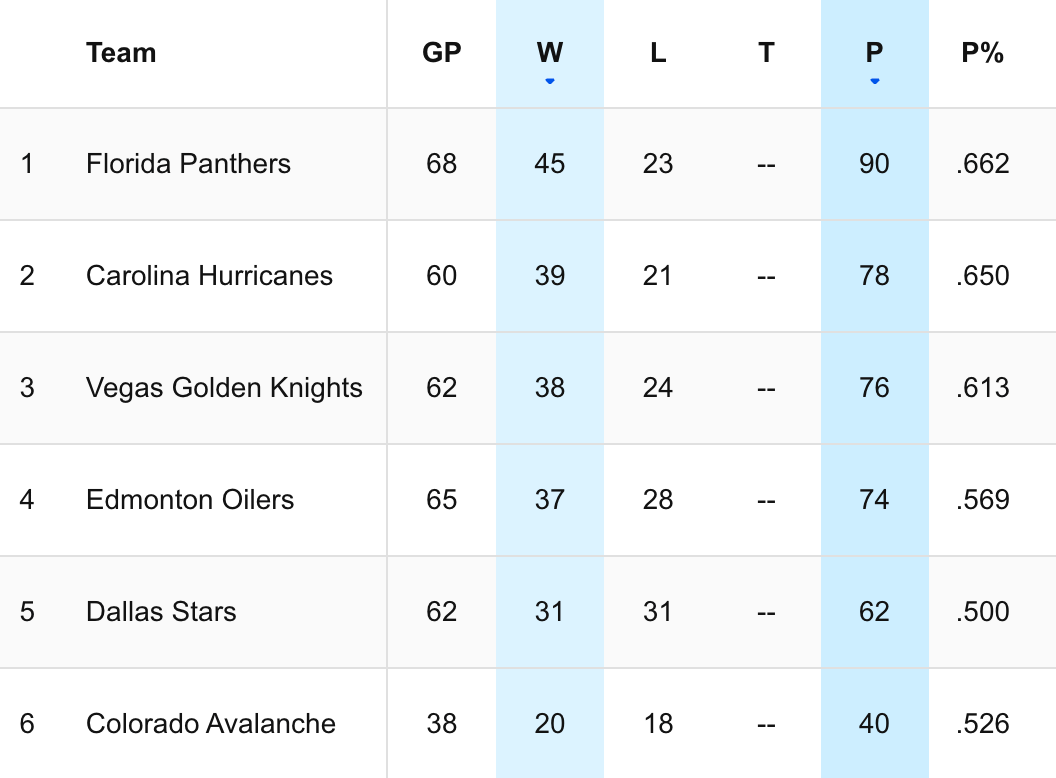
Given all that, I think it’s entirely fair to say that even a slightly thinner Stars team this year could easily do some serious damage in the playoffs, should they have something close to a healthy roster in April. This group has done a lot against some very good teams, so the optimistic tone we’re about to take today shouldn’t feel like that much of a stretch, even if your inner skeptic prefers not to indulge such a view. The Stars may not have won a championship recently, but they are much closer than a whole lot of other teams. To win 67% of the available points over four years requires you to be the better team two out of three times, and they’ve been that.
As far as the makeup of the team, it’s worth pointing out that despite all of the roster attrition caused by the salary cap over the last couple of years, the Stars really don’t have any egregious overpays clogging up their roster, unless you want to complain about the final year of Seguin’s eight-year deal which was signed in a difference hockey universe. Of that deal, I’ll simply note that Tyler Seguin is going to be as motivated as he’s ever been to remind people why he got that deal, and I’d bet against him at your own peril.
By and large, Jim Nill has built a team that provides surplus value relative to its cap hit with a lot of high-end talent, and that’s why the Stars have been one of the best teams in the league for the last four years and counting. True, they don’t have much in the way of up-and-comers to bridge any gaps that might emerge, as we discussed earlier this week, but that’s only an issue if the current group starts to flag, and that has yet to happen for any meaningful stretch of time thus far. There are not many holes in the most important parts of this roster.
If these Stars wind up having a terrific season, it shouldn’t be too surprising. They’ve got three centers who all qualify as top-six talents in Johnston, Duchene, and Hintz. Roope Hintz and Wyatt Johnston combine for a smaller cap hit than either of Leo Carlsson or Macklin Celebrini. And on the fourth line, Radek Faksa isn’t going to blow the doors off the place offensively, but that’s never been his role anyway. Besides, the Stars also have multiple bottom-six centers who can also flex out to wing in Arttu Hyry, Sam Steel, and Oskar Bäck, so they have options if injuries strike again. Up the middle, the Stars are in excellent shape, as they have been for a few years now, and that’s the position that most teams find hardest to solidify.
The blue line is also as good as anyone could ask. Anyone who watched Thomas Harley at the Olympics last year can rest assured that Thomas Harley is still the player Dallas locked up long-term, and a return to form this year would go a long way toward jogging everyone’s memory. Here’s a fun fact for you: the pairing of Thomas Harley and Nils Lundkvist accounts for nearly the same $12 million cap hit as the Devon Toews-Sam Malinski pairing Colorado had to roll out for much of the spring. With 32+ year-olds like Josh Manson and Brett Kulak also signed for at least a couple more years at $4-4.5 million apiece, the Stars look positively lean by comparison when you compare their own bottom four, even if you aren’t thrilled about what Tyler Myers did last April.
Lian Bichsel is still full of upside as well, and that’s a much more preferable way to operate your blue line depth than to be hoping to stave off decline. Round that group off with Miro Heiskanen and Esa Lindell on one of the best defense pairings in the league, and you have a team with a blue line that is not only efficient, but still quite promising, too. Harley and Bichsel are both under 25 years old, for goodness’ sake. This group is a long, long way from the years when they were hoping that Andrej Sekera or Sergei Gonchar still had something left in the tank. If one year of Tyler Myers as your sixth defenseman at $1.5 million is the most the average fan can find to complain about, it’s fair to say the group is pretty darn solid.
The biggest area of need for the Stars is, as it was last year, the winger depth. We covered this earlier in the week, but the other side of that coin is the fact that quality wingers are easier (and generally cheaper) to acquire than top defensemen or quality centers. Right now, the Stars winger depth looks something this, presuming everyone comes into camp healthy:
Hryckowian-Johnston-Rantanen
Robertson-Hintz-Seguin
Steel-Duchene-Benn
Bäck-Faksa-Blackwell/Kiviranta
You can also plug in Arttu Hyry if you like, though he may have to begin the year in Texas for cap reasons. The point is, the Stars’ winger depth may require some optimism, but it’s a far cry from the disaster that teams like Edmonton were rolling out last year, with Kasperi Kapanen playing next to McDavid and Draisaitl in 2026. And again, Dallas can always look to go get another middle-sixer if they decide that they need to without having to sell the farm. (I seem to recall that they did so last trade deadline, but my memory gets fuzzy about which winger they acquired and how he did in the playoffs. Ah well, I’m sure it’ll come back to me.)
The metrics liked that top-nine group last year (though Seguin wasn’t playing there, of course), and if the power play continues to do what Neil Graham showed it capable of, the goals should not be in short supply. That means that even if the Stars don’t get all the production they would ideally receive from players like Steel, Benn, or Hryckowian, they still have other ways of manufacturing offense. And remember, we’re talking about complementary offense rather than core contributors, a mere rounding out of key production from Johnston, Rantanen, Robertson, and Duchene. That’s still critical, but it’s also easier to find in multiple ways.
Sure, Dallas would ideally have a deeper group on the wing, but it doesn’t require a huge leap to project someone like Tyler Seguin to be able to match the departed Bourque’s 20/20 season. Remember, last year’s team had to roll out players like Bäck and Adam Erne on the third line more than a few times last year, and they still wound up scoring the ninth-most goals in the league. When you have the top-end talents the Stars do with Rantanen and Robertson, you can afford a little patience with your other six wingers—especially if they’re doing a lot of other things well (like Sam Steel did, for example).
We’ve been pretty candid about how far short Jake Oettinger fell of his and his team’s standards last year in terms of netminding, but let’s zoom out for just a second here and remember that at 27 years old, Jake Oettinger is still well-within the established prime of goalie aging curves. He’s also put up a .909 save percentage over the last four seasons, which is better than Jeremy Swayman (.907) and Sergei Bobrovsky (.901), and only slightly behind Igor Shesterkin (.911). Even after last year’s down season, Oettinger is still solidly above-average, and he’s shown the ability to steal a playoff series against a President’s Trophy team as recently as 2025, when he outdueled Hellebuyck.
When accounting for his workload, Oettinger is still in a relatively small group of go-to number-one goalies who are still on the right side of 30 years old. Over the last three years, Oettinger has saved 0.16 goals above average per game, and while that’s not quite up to the elite standards of Shesterkin (0.36) or Hellebuyck (0.35), it’s light years away from being anything like a problem. And as we’ve discussed, the Stars also have Rémi Poirier looking ready to dip his toes into NHL action this year or next, while they also have the luxury of the perennially solid Casey DeSmith1 for one more season. Goaltending isn’t their biggest weapon, but it’s nowhere close to a position of need. Many otherwise talented teams cannot say the same thing. If the team is going well in the spring, all they need is for Jake Oettinger to regress back to his 2025 self, and they should be in for another deep run (and even better, if the offense doesn’t evaporate in the third round).
As for coaching, I keep coming back to just how underappreciated Glen Gulutzan was last year. Navigating the unyielding string of injuries the Stars endured last year was a daunting task, but Gulutzan found ways to spackle and paper over the team’s holes en route to the third-best record in the league. Doing that without a goaltender stealing games every night is something I tend to find more impressive than even what Winnipeg did in 2024-25.
Some people will still express skepticism about Gulutzan’s playoff record, but I’m not sure what more you could really have expected out of the roster he had to work with against a loaded-up Minnesota. Dallas was without Hintz and Seguin for the series, then lost Hyry and Nils Lundkvist during it. Rantanen (knee) and Heiskanen (oblique & ankle) were playing with significant injuries, while Faksa wound up requiring a second foot surgery after the season finally ended. This was not a fresh group, or anything close to it.
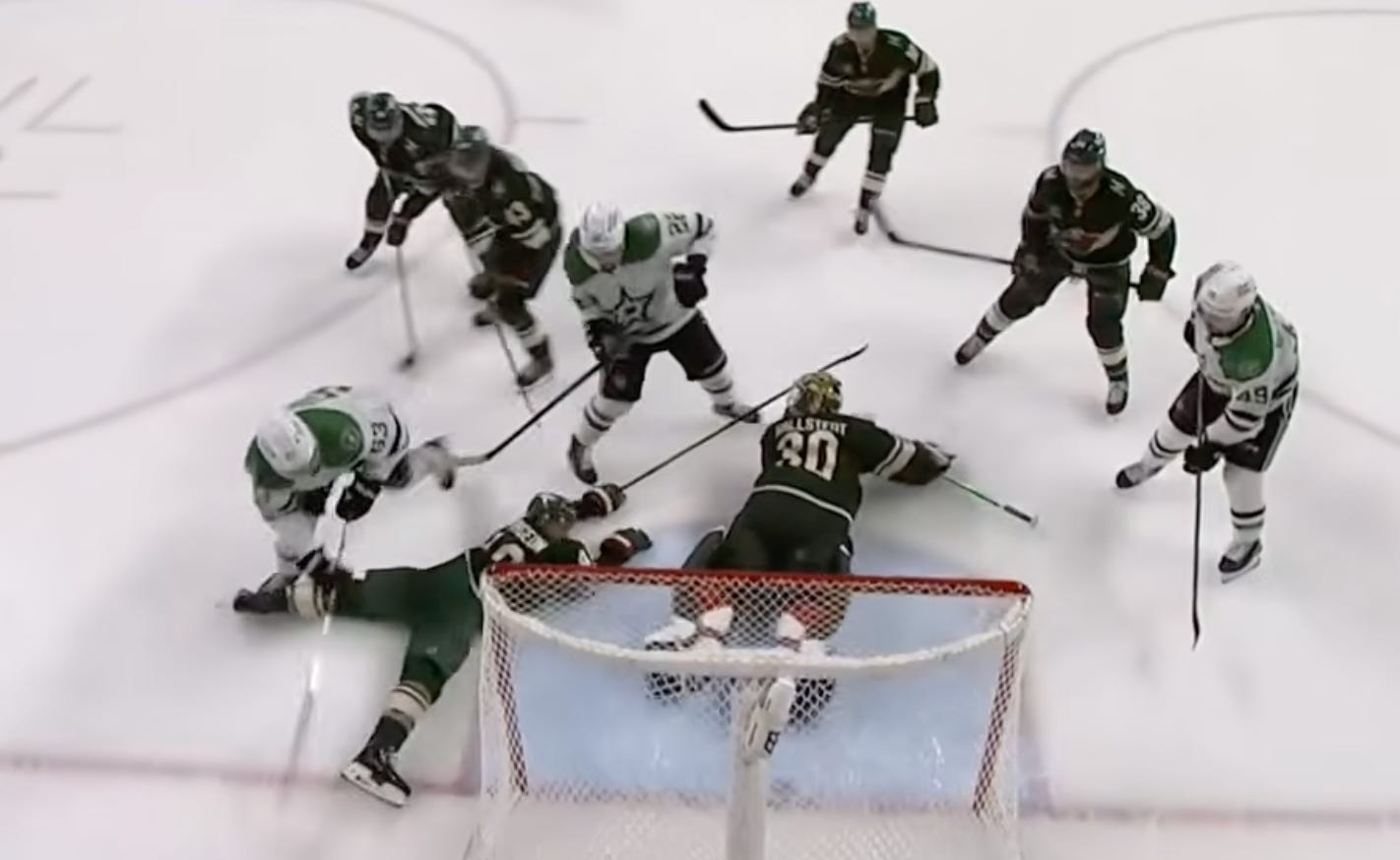
And despite all that, Dallas still came within mere minutes of going up 3-1 in Game 4, and thus, up 3-1 in the series. You may remember when Johnston tucked this puck behind Wallstedt in the third period, sending it along the goal line and off the far post, keeping the Stars’ lead at 2-1 with eight minutes to play rather than giving them an insurance tally. What a fun memory that is.
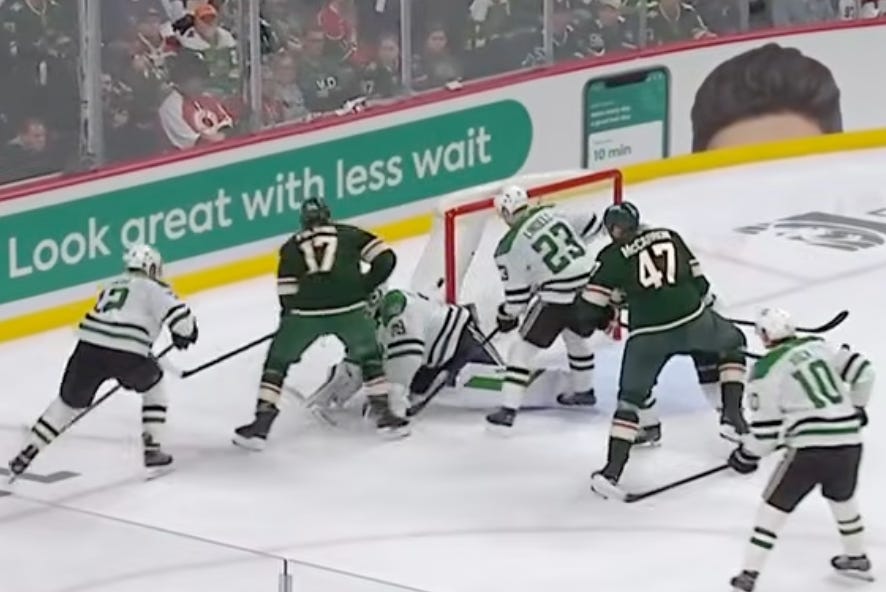
And just two minutes later, you will also remember that Marcus Foligno scored on this shot, somehow, to tie the game. Minnesota wound up leveling the series in overtime.
We’re not here to re-litigate that series, but simply to point out what a hollowed-out version of the Stars still almost did. It’s cruel to ask you to imagine what that series could have looked like with a healthier Rantanen or Heiskanen, let alone an active Roope Hintz or Tyler Seguin, so I won’t ask you to do that. Probably, you’ve been down that road far too many times already.
The best-case scenario for the Dallas Stars isn’t that they get all the breaks in terms of health and a relatively easy playoff path, like Carolina kinda did last year or Colorado certainly did in 2022. (Well, I mean, I guess that is a best-case scenario, but it’s not the most reasonable one.)
If we’re being realistic, then the Stars could have an outstanding season and postseason by simply experiencing the benefits of their established strengths and their latent potential. This is a well-built team, even if they aren’t perfect, and Gulutzan has demonstrated that he understands how to maximize the team’s strengths while mitigating their weaknesses. That’s as good a definition of a coach’s job as any other, I’d say.
Oh, and if Jason Robertson stays in Dallas after the trade deadline and Dallas have another good playoff run, then suddenly you’re looking at a Stars team that would be extremely attractive to some of the elite players who could be looking to change teams in the summer of 2027. Heck, Dallas would probably still be an attractive destination even if they did have to trade Robertson, and that’s as much to do with what Jim Nill has done off the ice as it is with what the team has done on it.
Yes, the window isn’t as wide-open as it was two or three years ago, and things could always go awry. I’m quite aware that in late July, most fans would prefer to face their fears more than indulge their hopes, but this is how competitive windows always tend to work. The Stars’ own band of Cup-worthiness might have narrowed a tad over the summer, but they’ve still shown themselves capable of doing excellent things for quite a few years now, and it’s not like they’re the 2008 Stars or anything. One more great year in 2026-27 is not only possible, but wind up leading to even more good years after this one without too much fairy dust needing to be sprinkled.
Success is never guaranteed, but good teams have better odds of climbing the mountain than bad ones. This season is fully capable of demonstrating why that has been true for Dallas, and why it could still remain so for years to come. All the players have to do now is go out and prove it, again.
If one more person asks whether the Stars should trade Casey DeSmith “for a big return,” I’m going to go into conniptions.