

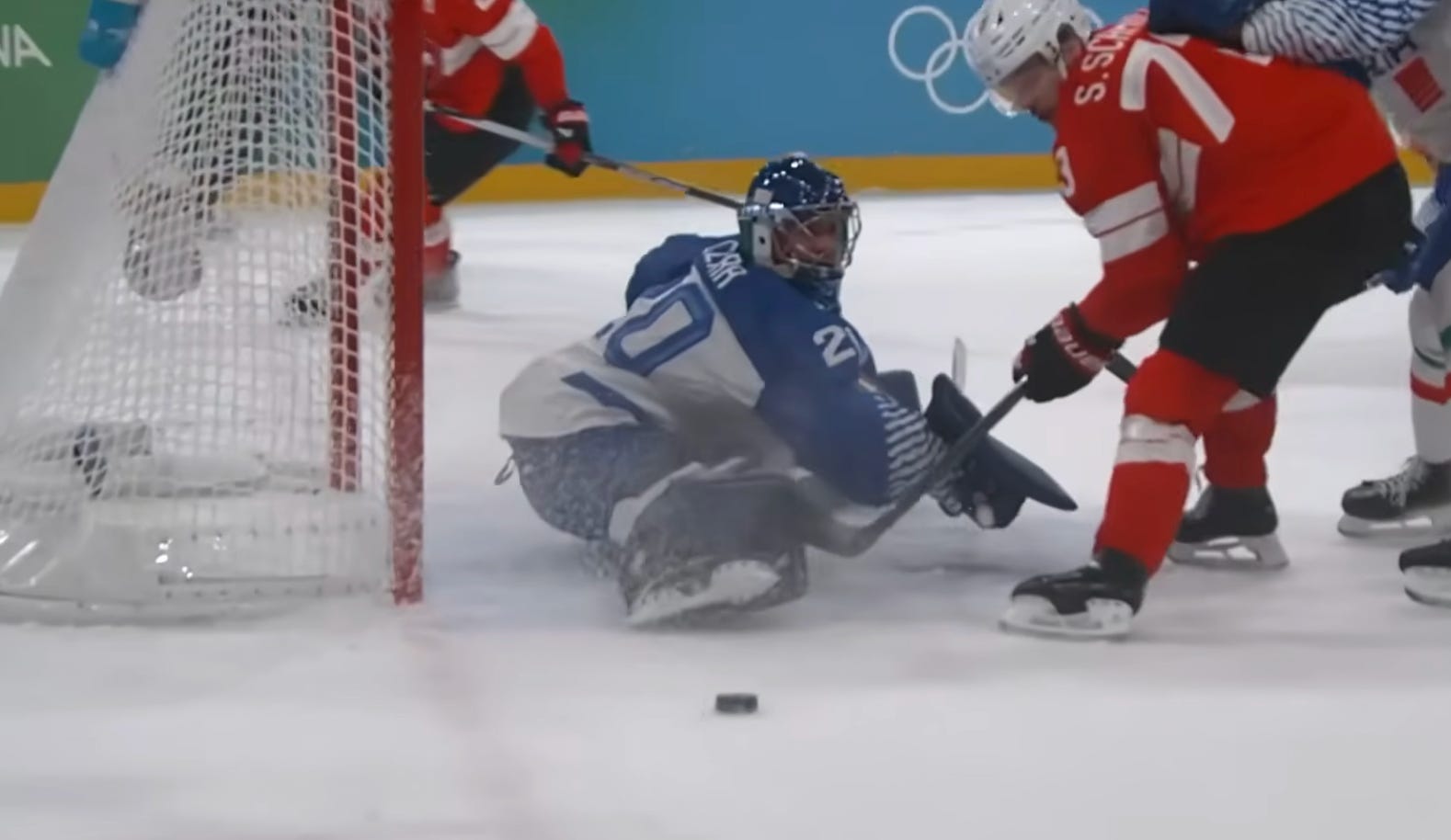
Olympic hockey is not a level playing field. That’s especially obvious on the women’s side, where the USA has posted a 31-1 goal-differential in its six games thus far. But it’s also clear on the men’s side, in a different way.
Italy and France are not dominant hockey forces, yet. They aren’t without their strengths—read Sean’s excellent piece on Pierre-Édouard Bellemare for proof—but there are reasons that those two countries both suffered humbling defeats in which they allowed double-digit goal totals.
But if you’re watching these games for parity, you’re watching for the wrong reasons.
What I’ve come to love about Olympic hockey in 2026 in particular has little to do with balance. If anything, it’s the opposite: how utterly unhinged these games, fans, and storylines have been.
That was clear from the first game of the tournament, when Damian Clara dragged Italy to the third period of a shockingly close game against Sweden before suffering an injury. But still, take a look at this scoreline with under five minutes left in that game:
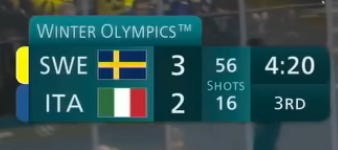
Remember, this was the same Sweden side (more or less) that defeated the USA just a year ago at Four Nations. And yet here they were, kicking off the tournament against a team without a single NHL player and hanging on to a one-goal lead despite having put 40 (forty!) more shots on net than their opponents.
From that point, this tournament had me. And not because of the illusion of parity (for that is indeed what Italy’s scoreline was), like some distant cousin to the NHL’s overtime loser point. It transfixed me because it was and has remained clear even through Germany’s elimination this morning that these games mean the world to, well, the world. (Or at least the 12 countries in the tournament.)
Part of that is who’s behind the scenes. Take Slovakia, for instance. Their general manager is a certain Miroslav Šatan. And if you remember Stars/Sabres in 1999, then you remember that he faced off against Finland’s current GM, Jere Lehtinen, in the Stars’ only Stanley Cup victory in franchise history.1
Here’s a quick clip of Šatan (#81 in black) celebrating Jason Woolley’s overtime winner in Game 1, if you don’t remember:
Now, 27 years later, Šatan is overseeing the renaissance of Slovakian hockey, which seemed impossible just 12 short years ago, the last time NHLers were at the Olympics. That’s when Jaroslav Halák famously broke down after his team’s elimination, despairing at the lack of a next wave of Slovak players to carry on the torch.
But in the last few years, players like Juraj Slafkovský and (now) Dalibor Dvorský have brought hope and joy to a hockey program that seemed bereft of it. They kicked off this tournament by humbling Finland, and not they’ll have a chance to humble another one of the top nations on Friday in the semi-finals—possibly even the USA.
You can find stories like that in a lot of countries in this tournament. Finland and a new coach are trying to find their stride without Aleksander Barkov, but beating Sweden did a lot to wash away the memory of that loss to the Slovaks. And today, they’ll face Switzerland, who are riding a surprising wave of hockey that reminds me a whole lot of their soccer (football) program: Built on stingy defense, with a handful of offensive focal points.
In their first playoff game, Switzerland beat Italy 3-0. That would be the same Italian group that Finland rinsed 11-0 a couple days before that. As a result of that and the deeper bench for the Finns, I can’t imagine there will be too many people picking Switzerland to win this one today. But as we saw with Italy and Sweden, the longer the game stays tight, the nervier (and more compelling) it gets. Don’t be shocked if the Swiss make a game out of it.
Sure, Canada has the best group overall, and the USA have have the deepest roster they’ve ever brought to these games. There’s a reason all the highest-quality hockey jerseys are made in Canada, after all. Since 2002, a best-on-best tournament has always been theirs to lose. But sometimes a sport is better when there isn’t total parity, when there are giants to slay. And boy howdy, don’t you be shocked if Czechia or Sweden find a way to galvanize as a result of their opportunities to take down their own personal El Guapos.
The narratives around the various teams aren’t the main things that have kept me watching, though. Because I realized this morning that what got me out of bed at 5am to watch a disappointing Germany team lose to Slovakia was far less about Leon Draisaitl vs. Juraj Slafkovský than about the experience of just watching hockey.
Take the boards, for instance. You’ve surely heard about how they changed the boards from a darker pattern to a lighter one pretty much exclusively because of the embarrassing goal Jeremy Swayman allowed a few days ago.
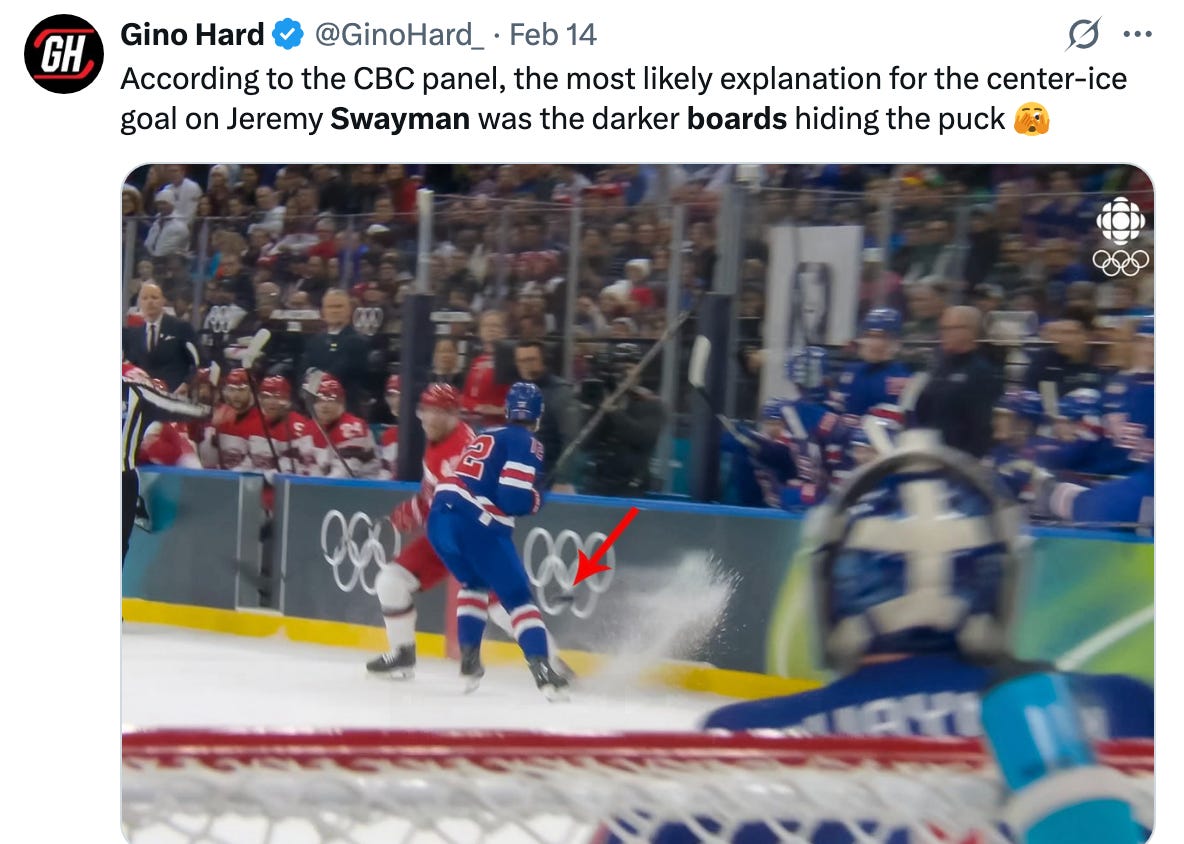
Compare that Olympic Rings background to the new sky-blue one, and you notice two things.
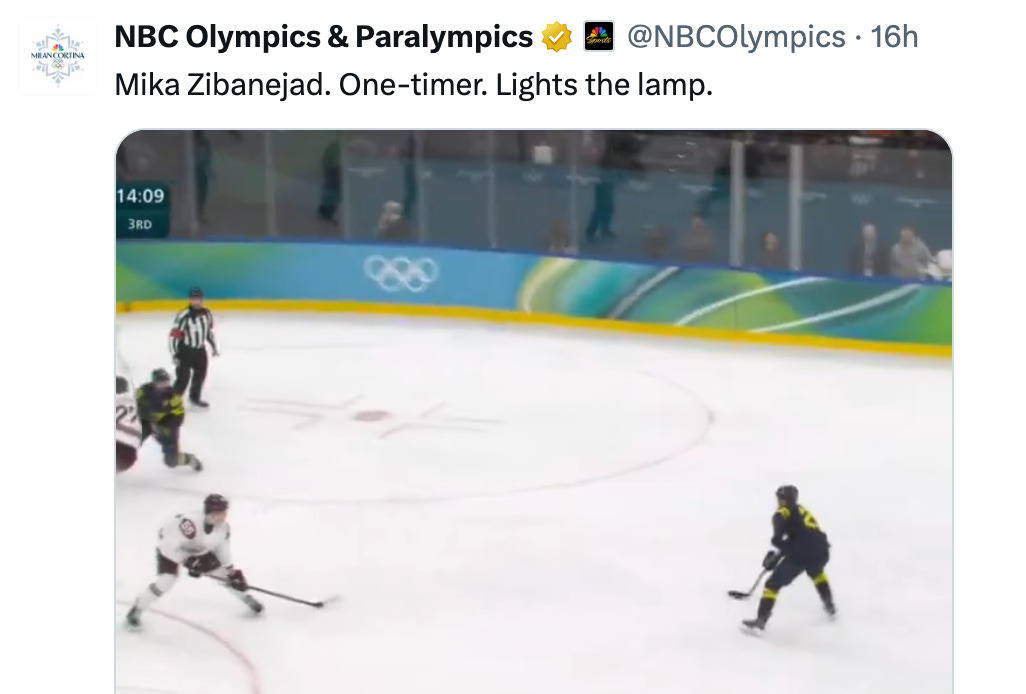
First, you notice that the boards are lighter. (At least, I hope you noticed that.) But second, you notice that the boards are, gloriously, just boards. No ads, digital or otherwise. Just a playing field, meant to make the sport look a tiny bit cooler. That’s it.
It’s also been a delight not to have every power play “brought to you by Fan Duel” or whatever. Sure, year-round sports need money to come from somewhere, but it’s really lovely to have the highest level of hockey happening without most of the worst parts of it being shoveled in front of us at every opportunity.
The more you step back and look at these Olympic hockey games, the more you appreciate these sorts of things, even up to and including some of the less-familiar broadcasters. After all, if you’re gonna wake up in wee hours to watch meaningful hockey, it’s only fitting that the soundtrack be equally surreal.
The uncluttered nature of the hockey-watching experience only gets more winsome the more places you notice it, too. In my case, I’ve had a Peacock subscription for a couple of years in order to watch Premier League games, so the ability to watch literally every Olympic hockey game from any device has been a refreshingly delightful experience.
I have, many times, woken up in a fog, mashed two buttons on the remote, and boom: Hockey plays while I make coffee. It’s like my updated version of the peaceful giddiness of eating leftovers in the grey hours of New Year’s Day while the Rose Parade played on my grandmother’s television.
As for the presentation of the games, I have little doubt that the Canadian broadcasts of these games are a bit slicker than the ones we’ve gotten in the States. Still, I have come to love the givenness of a small pool of broadcasters for each game. You know what to expect, and for the most part, they don’t get in the way of enjoying the game, which is the baseline expectation. And in most cases, they genuinely enhance it.
The jerseys do the same thing, possibly even more effectively. Without the ugly ads that most sweaters now bear, ever reminding us of the craven undercurrent of professional sports, these sweaters allow you to just bask in their aesthetics. These jerseys (even the bad ones) actually reflect the old cliché about the thing on the front being more important than the name on the back.
All that makes it far easier for you to get to the place the Olympic Games work so hard to take you: What it means to represent a country, both as an individual and as a member of a team. Without all of the commercial interests integral to professional sports, Olympic hockey finally feels like a mixture of the best things about the 2020 Bubble and the passion of the World Juniors. And that’s a pretty addictive thing, it turns out.
I just love the idea that every team plays on the same surfaces, takes the same long walks (or golf cart rides) to the ice sheet, and wanders around the same beautiful Italian downtown areas.
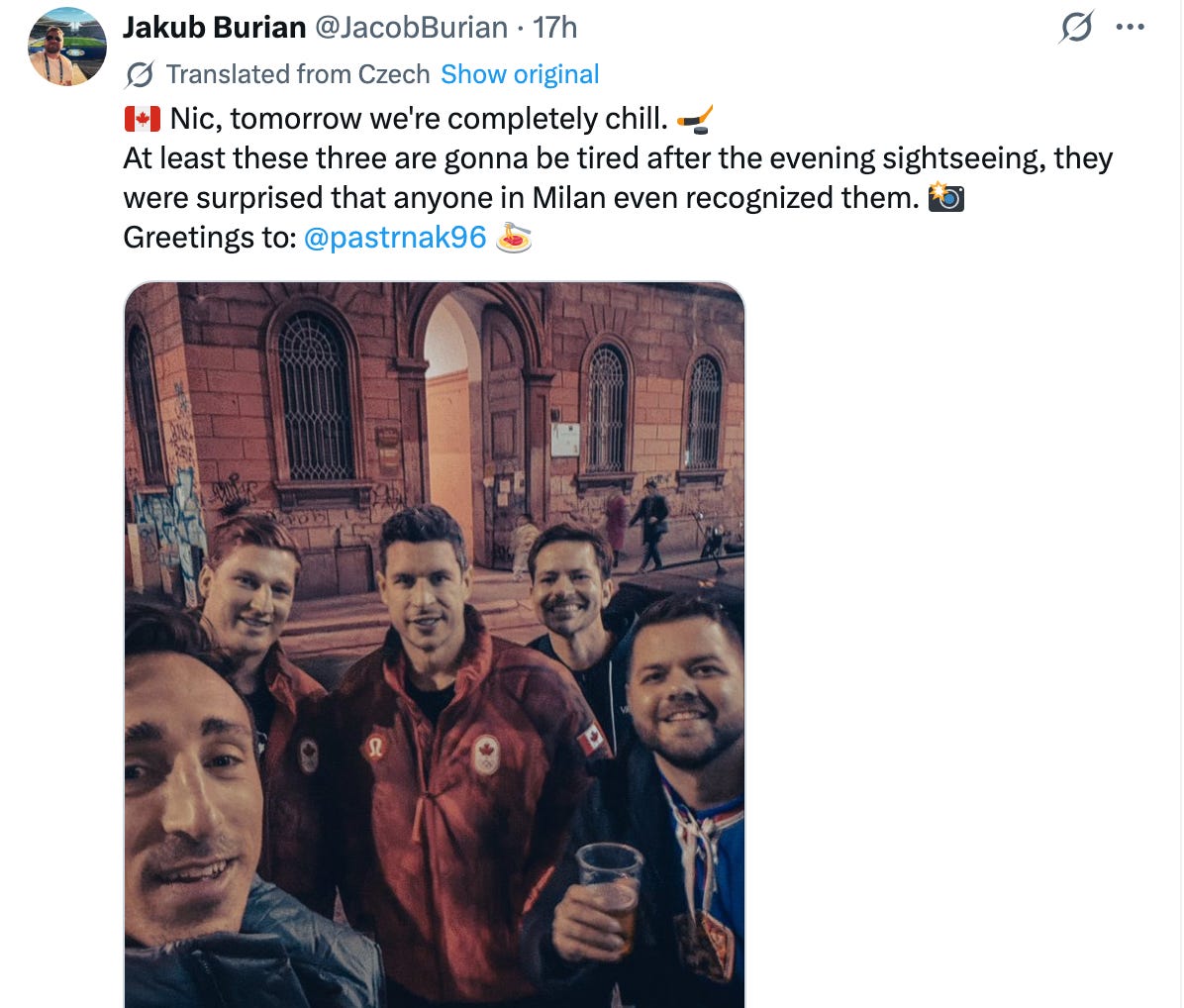
I got to experience a Global Series in Finland, and even with just two teams in the mix, the atmosphere was intoxicating. So these two weeks in Milan with twelve countries in the mix are basically hockey Disneyland, right?
And the reason it’s felt that way, even to me here in Texas, is because of the excellent journalists on the ground bringing us the corporate experience of it all. It’s been a downright thrill to follow coverage from Czech, Finnish, and Slovak writers (as best I can with the help of translations, of course), but it’s been just as fun to read stories like this one from Mark Lazerus in which he describes each country’s goal song, along with how it actually lands in the arena.
That sort of coverage is especially necessary due to the frustrating restrictions on in-arena photo and video. Those obstacles would, without that coverage, have kept us from knowing about the eerie insanity of the unhappy whistling and incessant singing2 that are so common in European hockey rinks. Thankfully, we at least get to hear some cool stories.
I’ve watched almost every single one of the men’s games, because the experience of just watching it is genuinely pleasant. The hockey is good, even when the competition is unbalanced, and the level of effort is unquestionably high, as you’d expect from a group of players most (if not all) of whom are living out a lifelong dream.
Watching Nikolaj Ehlers, Lars Eller, and Frederik Andersen do their best to throw on Superman capes and drag Denmark as far as they could was fantastic stuff, even if you knew it was probably a doomed effort. I can’t imagine Slovakia’s next game will be any less compelling than that, and probably even more so. For all but a handful of elite NHLers at these games, winning a medal is the top of the mountain, full stop. And you see it in nearly every shift.
That’s what makes for great hockey: A shared experience of watching people pursue glory.
For those of us not lucky enough to be in Italy right now, the corporate experience of crazy broadcasts or odd commercial cuts is just part of the great hockey casserole we’re all consuming. And the more shared that experience is, the better it becomes.
At the risk of alienating some folks, I’ll finish with a short diatribe: This is also why the excessive marketing of gambling is ultimately bad for sports. When different people have different stakes, suddenly you’re not all quite sharing the same experience. A win or a goal starts to mean different things to different people. And while that can add a little extra juice in some cases, the rapid rise of gambling ultimately serves to separate people rather than bring them together.
And at their very best, sports unite people, whether in sorrow, or joy, or the shared awe of witnessing both of those. Anyone who’s ever watched a game in person and found themselves screaming along with thousands of other people knows the visceral joy that comes with that experience. Being able to say “I was there” isn’t just a brag: it’s a way to re-live the thrill of that shared joy, every time you bask in that memory.
This is also, incidentally, why I don’t think silly things like AI-broadcasts that are tailored to individual people’s preferences will ultimately work: Sports are always better when they’re shared, rather than consumed.
The nature of their presentation will continue to evolve, and surely broadcasts and ads and technology will be a part of that. But those things don’t have to continue to separate us, to distill the sports-watching experience into a bit of pleasure that exists only in order to be shaped to our individual consumption preferences, like some kind of TV version of a Chipotle burrito.
What I’ve really fallen in love with when it comes to the Olympic hockey this year is that the closer we get to the action, the more magical it becomes. Because at its core, hockey is an incredible game to play, and thus to watch.
No matter how much money there is to be made in adding layers on top of and around that core, the most wonderful thing of all will be to experience the raw, unfiltered thing itself. And even today in 2026, it’s been an absolute joy to find that you can still do that, if only for a couple of weeks.
Team Canada GM Doug Armstrong was also a Stars’ assistant general manager in 1999. So if/when we get Canada, Slovakia, and Finland in the semi-finals, it’ll be a beautiful mess of a reunion, of sorts.
As an aside: USA and Canada just can’t compare to the energy and atmosphere that fans from other countries bring. This is also true in the soccer world, where even beyond the loathsome “USA! USA” chant, you have tired old anthems like “I believe that we will win!” that I have heard so many times more than I ever wanted to. And if you don’t think it’s quite as bad as all that, here is a screenshot of the top Spotify playlist for USA soccer songs and chants from ten years ago:

Now, it’s gotten a little better since then, as the Outlaws have compiled something of a hymnal. But not by all that much. Mostly, you could just shout “USA” every other word, and you’ll be right more often than not.
Yes yes yes. We love the thing itself, and we love experiencing it together. Anything that gets in the way of that needs to go.
The NHL can be plenty profitable without shoving FanDuel down our throats. Perhaps they might consider not alienating certain groups of fans ? Just a thought.
Not to mention the lives ruined by gambling (especially the lives of women and children who were not the ones doing the betting).
Great article! And dead on about gambling separating sports fans rather than bringing them together. I can't count how many times I've seen a small number of people celebrating despite their team losing. You seen 100 people in an orange jersey and most are distraught bc their season ended but half a dozen are cheering bc they won some money.
I ABHOR the way gabling has already infected so much of sports. From promotions, to ads, to coverage, to how the game is presented. The gambling aspect is often given more attention than the sporting aspect and for someone who doesn't gamble that's all just worthless noise to me.