
How a Resurgent Dallas Stars Penalty Kill Prevented Any Shots on Goal from New Jersey's Power Play Last Night
Colin Blackwell and Sam Steel are really, really good at this

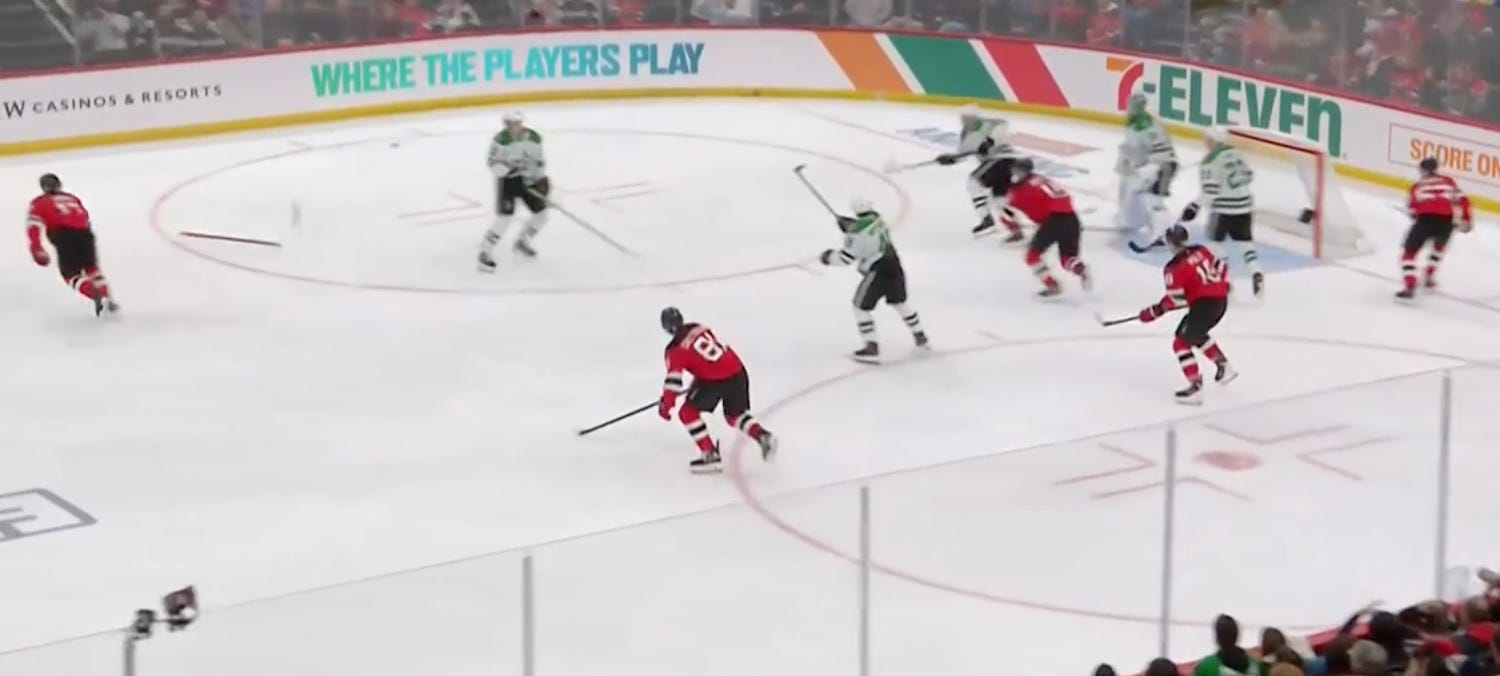
The Dallas Stars penalty kill is back. Has been for a while, in fact.
So today, we’re going to look at just how remarkable that comeback has been on a statistical level, a few of the people who have been driving it on a player level, and break down a few clips illustrating how Alain Nasreddine’s group have gotten the Stars’ PK back into its elegant, effective form.
What They’ve Done
Over their last 13 games, the Dallas Stars penalty kill has held opponents to just three power play goals in 41 opportunities: a conversion rate of 7%. Alain Nasreddine’s group went a perfect 11-for-11 in five games in mid-November before falling into a slump (by their standards) against Vancouver and Calgary, when they allowed three power play goals on 11 chances.
But they apparently took those two games personally. Because since that Calgary game (which featured a major penalty, as Mikko Rantanen may recall), they’ve gone six more games without conceding across 19 penalties taken.
That’s led to a remarkable jump in the rankings, as the Stars PK jumped from 70% on November 8 to 80% today, less than a month later.
To put that in perspective, it’s as though the Stars’ penalty kill over their last 13 games has turned whatever opposing power play it faces on a given night into something even worse than the 2020-21 Anaheim Ducks’ power play, which was the worst power play in NHL history. That’s a pretty nice magic wand to be able to wave, when the need arises.
The goaltending has certainly improved on the penalty kill in that span, but the Stars’ kill has also been allowing fewer shots, going from allowing the 10th-most shorthanded shots on goals in their first 15 games to allowing the 10th-fewest shorthanded shots on goal over their dynamite last 13 games.
If you want the skinny, here’s a comparison in the interest of transparency—but I’ll summarize after these screenshots if you don’t care to click on them.


It’s been a remakable tightening up, to say the least. The Stars have executed a 20% reduction in the shot attempts and shots on goal they allow while shorthanded since November 8, a number reflected in a similar drops in scoring chances and high-danger shots allowed.
Unsurprisingly, that’s also led to a surge in the shorthanded goaltending as well:
Games 1-15 Shorthanded Save percentage: 79.7%
Games 16-28 Shorthanded Save percentage: 94.2%
All due credit to Oettinger and DeSmith, certainly. But there’s no getting around the fact that the penalty kill as a whole has thoroughly cleansed itself of the issues early on, and everyone is benefiting as a result.
But let’s drill down further than that, because I wanted to call out the work of a couple specific players not named Esa Lindell, with a few video clips to boot. Because how the Stars have effected this transformation (or return to form) is even more interesting than a bunch of tiny numbers in eye charts, if you can believe that.
How They’ve Done It
Well, at least I was going to talk about those other players, but then I realized it’s basically sacrilege to mention the PK without talking about the obelisk in the center of every Stars kill, the constant presence who plays 80% or more or every kill. Folks, we’re talking about the breaker of power play hearts and shorthanded charts: Let’s talk about Esa Lindell.
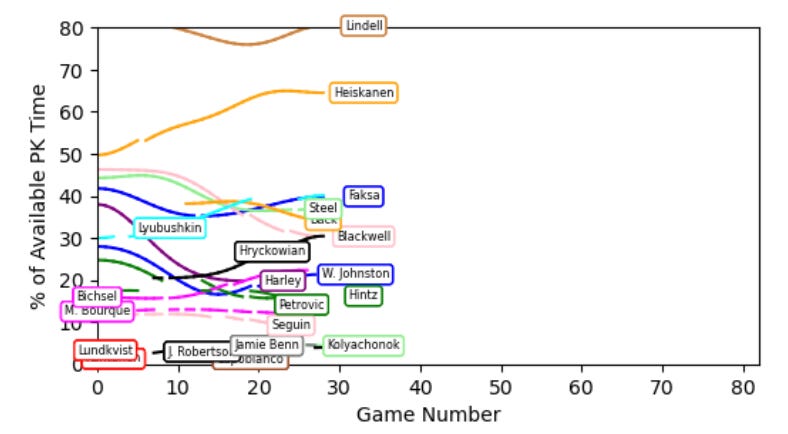
Lindell has led the league1 in PK time per night so far this season, being one of only two defensemen to top 100 minutes on the kill so far this year. But despite the PK’s dreadful start to the season, Lindell is still in the top half of all defensemen to play at least 50 PK minutes this year in terms of goals against per hour, ranking 36th of 77. (And Miro Heiskanen is even higher, at 26.) To play that heavy of a workload during the red-hot streak the Stars have been on lately is nothing short of terrific. (And as we’ve said, Heiskanen has been a very big boost to the PK himself.)
I didn’t mention this moment in AfterThoughts last night, but check out how Lindell and Oskar Bäck worked this play down low to clear a puck on the kill. Bäck makes a smart play here to fake the hard clear around the boards, because he knows there’s at least a 50/50 chance the New Jersey defenseman is stapled to the wall up high, ready to knock even a hard clearance down and keep the play alive.
So instead, Bäck fakes the clear and takes a step to maintain his positioning to protect the puck. That allows him to bump it along to Lindell (who positions himself to beat another forward, Meier). Then Lindell uses the time and space he has to make sure the clearance is there, moving his feet and sending the puck out deep. It’s simple, but it’s efficient and effective. It’s entirely Esa Lindell.
When I had a chance to talk to Jere Lehtinen at the Stars Hall of Fame event a couple weeks back, I asked him about Lindell, who ended up becoming the de facto number one defenseman for Finland at the Four Nations Face-Off last February, playing 30 minutes a night a running power plays, penalty kills, and everything else.
And Team Finland’s general manager just smiled and shook his head before answering.
“Underrated,” Lehtinen said of Lindell. “If there would be a second trophy2 for D-men, he’s the one who should have that. What else can you tell? He’s doing everything, playing against top lines, playing the most penalty minutes in the league, plus/minus, everything. People don’t maybe see that as much, but it’s crucial to winning games.”
I think it’s safe to say Esa Lindell has a good shot at keeping his spot on Team Finland for the Olympics, folks.
But yes, back to the other guys for a moment: Colin Blackwell and Sam Steel are quietly two of the best penalty-killing forwards in the league, both ranking in the top-15 in goals-allowed among all forwards to play at least 50 minutes on the kill this year.
And how have they done it? I think their first shift from the PK last night against a top-five New Jersey power play is pretty instructive:
Steel’s containment up top draws your focus, since the puck is there. And he does a great job!
But look at Colin Blackwell, on the far left (#15 in white). Can you count how many shoulder-checks he does on this shift? I have him giving at least six, and there are probably more we miss when he’s out of frame. He is constantly making sure he’s in position, more concerned (as he should be) with passing lanes than where the puck-carrier is.
Blackwell’s biggest moment early is when he smartly gets to the back post of the net to prevent the deadly back-door pass to Jesper Bratt (#63 in red), properly rotating down low to the crease as the defensemen push to the strong side when Lindell telescopes out to the faceoff circle (another smart, aggressive play by Lindell at just the right moment).
And Blackwell’s energy doesn’t sag after that, because he recovers up high enough to explode when the puck does get fed to his side of the ice, after Bratt has drifted back up to the point, clearly tired of being so tightly covered. But the pass has to come quickly with Steel pressuring the puck-carrier closely and Blackwell lurking up high as well, and that forces a bad pass, which Blackwell jumps all over and clears down the ice.
I’m not sure you can find even a small mistake for any of the four penalty-killers on that entire sequence. Blackwell and Steel are aggressive without getting out of position, and their rotation syncs up perfectly with the defensemen, leading to frustration that would carry over into the rest of the power play.
Speaking of frustration, let’s fast forward to the second Devils’ power play in this game, and guess who subverts things right off the bat? Steel and Blackwell, once again:
Again, look at how Steel and Blackwell combine to suffocate the space up high here. Yes, Meier probably needs to work harder rather than gliding here to find some open ice, but it’s brilliant awareness by the Stars’ forwards to funnel him into a suboptimal space, and Blackwell uses every bit of his 5-foot-8 frame to anticipate and shut down the passing lane, leading to an early clearance, and continued frustration.
In fact, the duo’s work isn’t just excellent in-zone on the PK. They also sense something about the Devils’ zone-entry strategy here, and they both pounce up-ice in what might look like careless aggression, but is clearly a well-informed attack that kills the entry before it even begins:
With three other New Jersey players all up ice, both forwards know they don’t have a drop pass to worry about. And that’s why, I think, Blackwell decides to push up and execute a low-risk stick check here, which ends up causing the turnover:
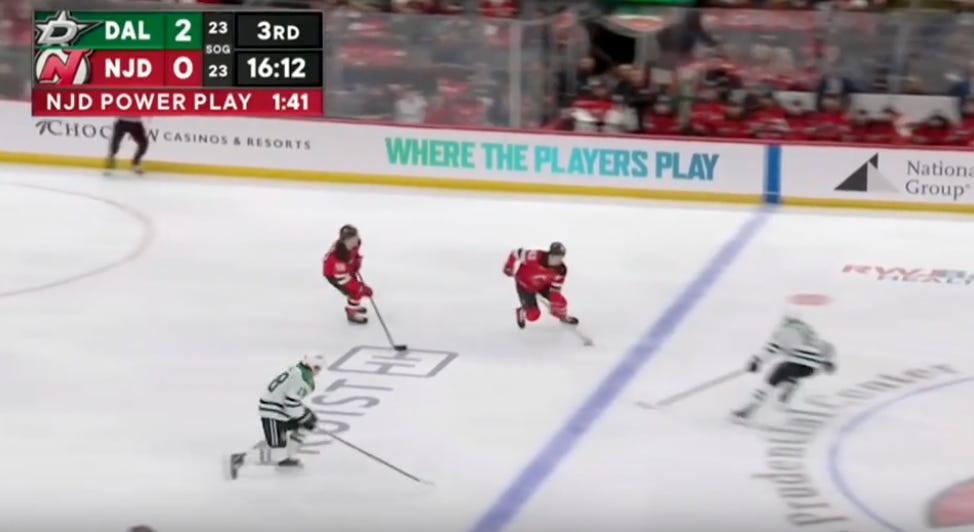
It’s smart and aggressive, pressuring at the power play’s weakest moments without risking all that much. But it only happens with hard work, trust, and cohesion.
And, one strongly suspects, some extremely smart preparation and communication by Alain Nasreddine before each game.
And perhaps the most noteworthy part of that first New Jersey penalty kill was the last part, when the Stars had Justin Hryckowian, Radek Faksa, and Ilya Lyubushkin on the ice (along with the omnipresent Lindell). Because this was when the crowd started booing most loudly, as the Devils hadn’t gotten a single puck on net—and they never would, on this or the second power play New Jersey got later in the game.
Note how Hryckowian (#49 in white) executes top-down pressure six seconds into this clip, skating first to the middle of the point before angling toward the puck-carrier. He does not take a straight line path to the puck, and that’s a staple of the Stars’ PK, where they essentially concede quick flings at the net if teams want them in order to restrict quick crosses, which change the angle of attack and make it harder for goalies to track pucks and position themselves.
The boos really intensified with about 15 seconds left in the power play, when Nico Hischier had this look, which is probably not ideal for the Stars to give up, coming after somewhat overexuberant pressure by Lyubushkin below the goal line.
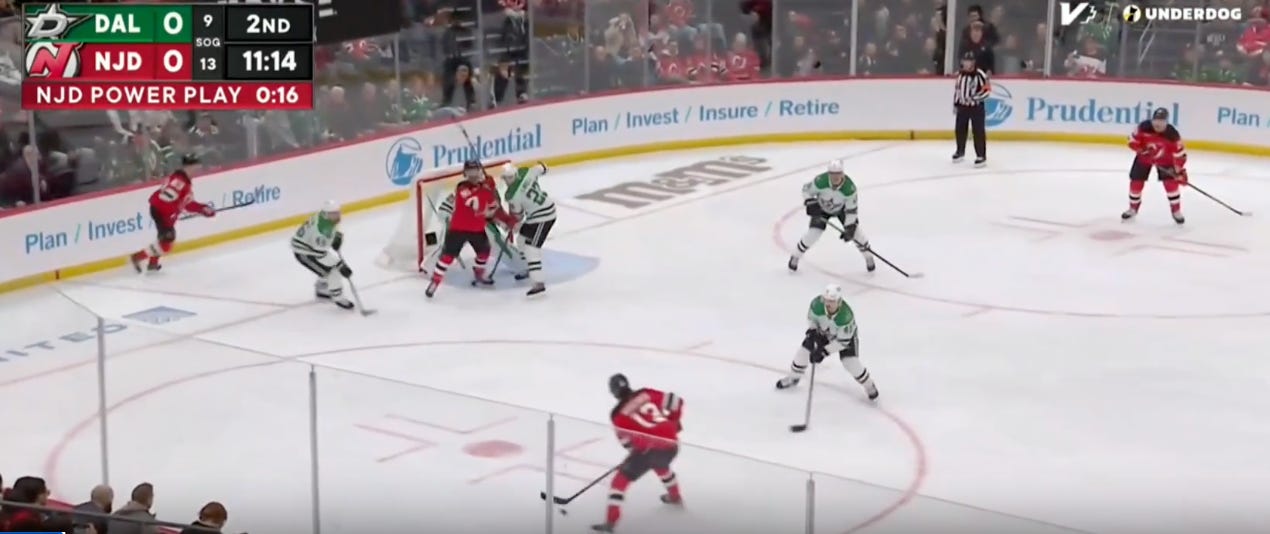
Hischier could take a chance at finding a way to beat a screened Oettinger, but there is not a lot of daylight there to shoot at, so he clearly doesn’t like his chances, much to the home crowd’s chagrin.
And with Hyrckowian once again shutting down any cross-slot passing, Hischier opts to regroup and reset rather than shoot, a choice which results in a low-danger wrister from the center of the slot—which gets blocked to the corner by (shocker) Esa Lindell, who is still winning his battle for net-front positioning despite having never left the ice for the entire power play.
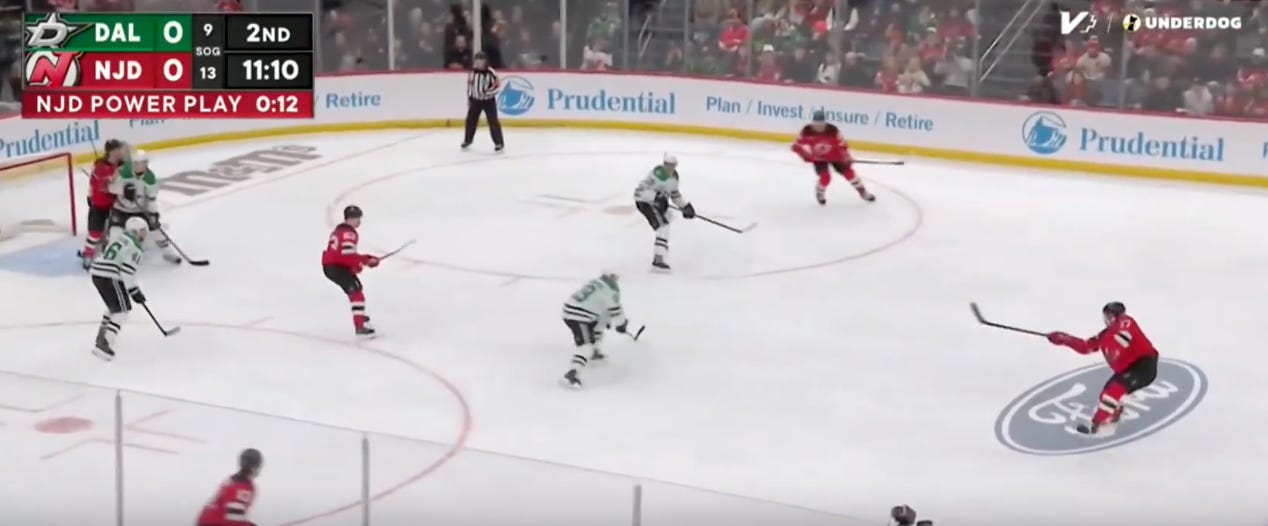
Lyubushkin collects and clears, and the Stars would take a 1-0 lead just a couple minutes later on Miro Heiskanen’s goal. And from there, the game would tilt in Dallas’s favor for the rest of the night.
Is it too much to call that first penalty kill the most pivotal point of the game? Well, it’s my narrative, so I’m gonna say “absolutely not.” This was the Stars staking their claim on special teams halfway into the second game of a back-to-back. They faced down a dangerous power play, and they turned them into a pumpkin both times.
Let’s end on a couiple more Esa Lindell plays, because who else could possibly deserve the final word on shorthanded excellence more than he?
An initial shot goes off (I think) Heiskanen’s skate but not out. And then, we see another of our common themes: both defensemen pressuring the strong side, with a forward rotating down low to add net-front coverage. And Lindell is easily able to intercept the pass with a hard little chop at the puck that wins the battle cleanly.
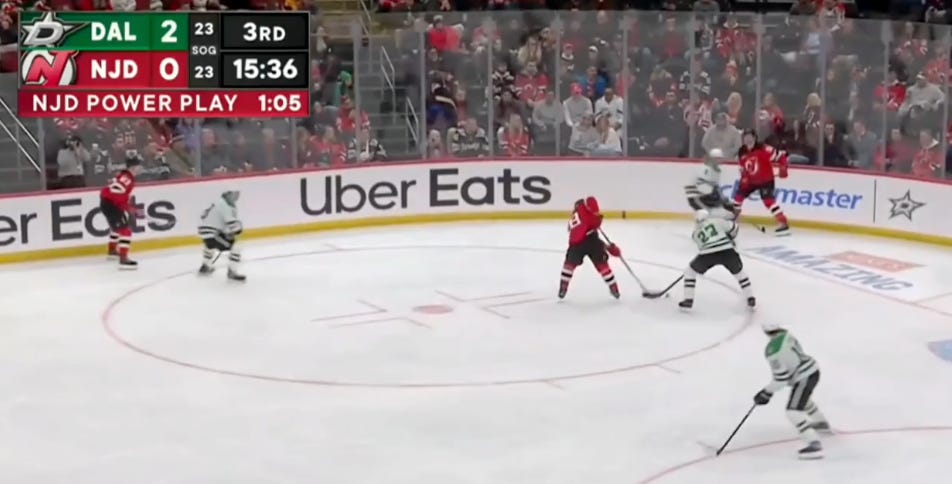
Notice how Lindell doesn’t just fling the puck from there as soon as he gets it. Instead, he immediately take a few quick steps back around his net to get the lay of the land before sending it down the ice for another clear. He knows exactly where the space is, and he uses it to make sure he finds the right play.
It’s not just positioning, rotation, stick work, or awareness—it’s all of them together, combined with hard work and moving his feet, something hockey coaches at every level preach incessantly.
Genuinely, I don’t think you can teach the perfect synthesis of these skills that Lindell demonstrates night after night. He’s a special, special player.
So space that, even when you think you have Lindell out of position, his long reach will inform you that, no, you do not have him out of position, because he is never out of position:
I can’t prove this, but I have a theory that when Esa Lindell is on a plane flying over the Midwest, the Kansas City Mavericks find their power plays becoming weirdly lifeless, with passes not connecting and sticks blowing up inexplicably. Again, just a theory, but can you disprove it? I didn’t think so.
Esa Lindell, as Stars fans know by now, is a pretty darn good player to build a penalty kill around. In fact, the more you watch him, the more you come to agree with Jere Lehtinen that he may be one of the very best such defenders there is.
And when you combine Lindell’s excellence with the effervescent brilliance of Miro Heiskanen, the hard work of forwards like Blackwell and Steel, and the widespread adherence to the stratagems of Alain Nasreddine throughought the rest of the group? Well, perhaps it’s little wonder that the Stars’ penalty kill is once again looking like its familiar, dominant self.
Erik Gudbrandson technically has an edge on Lindell in shorthanded ice time per game, but he’s only played a handful of games this year due to injuries, so it’s not relevant for this discussion.
I later clarified with Lehtinen in our conversation that he was indeed referring to a Selke Trophy equivalent for defensemen, or a “best defensive defenseman” award.
No doubt that Esa is a PK wizard but I wonder if any other defense man comes close to combined PK and PP TOI that Miro does so efficiently? Norris voter should take notice.
Awesome read as always! Enjoyed it👍