
Esa Lindell Found Yet Another Way to be Underappreciated
Got a problem? He'll solve it.


Esa Lindell will make $5.25 million for four more seasons. Technically, his full no-trade clause only covers the first two years of that term before changing to a 20-team no-trade list in the summer of 2028, but I doubt it’s going to matter. Because Esa Lindell might be among the last players Dallas would ever look to move, and the 2025-26 season showed precisely why that is.
Let’s start with the most obvious thing: Esa Lindell once again sported an “A” on his sweater this year as an alternate captain for nearly every game (and he played all 82). The only times Lindell wasn’t wearing a visible badge of leadership was during the eight games in the fall when both Jamie Benn and Tyler Seguin were in the lineup. Other than that, Lindell wore a letter all year.
In terms of how the sweater letters were rotated this year, the priority list appeared to go like this, unless I’m missing someone:
Benn - C (duh)
Seguin - A
Heiskanen - A
Lindell - A
Hintz - A1
Duchene -A2
Lindell is the longest-tenured Stars defenseman on the roster, and he trails only Seguin and Benn in unbroken3 longevity with the team overall, having completed his 11th season in Dallas this past year. He’s a clear leader in the room, and he extends that leadership to his mesmerizing consistency on the ice, too.
What did Lindell do in the 2025-26 regular season? Here are some raw stats for you:
Average time on ice: 23:14 per game (25:18 in playoffs)
One of just four players4 to play in all 82 games in the regular season (and all six in the postseason)
Shorthanded time on ice: 322:28 (Led the NHL)
Plus/minus: +30 (Led the team)
Penalty minutes: 20
Tied career-high in points (32) and set career high in assists (26)
Lindell was leaned on heavily this year, and he once again proved why he’s been a go-to resource for coaches during nearly all of his decade in Dallas. Lindell embraced a more slot-focused defensive system in his own zone while playing top-pairing minutes alongside Miro Heiskanen.
And if you think Lindell was just sitting back in a rocking chair, playing safety to Heiskanen’s aggressive cornerback work, I would submit this goal from November as evidence to the contrary:
With the Stars’ fourth line on the ice, Lindell sees Kirby Dach (#77 in red) slide out of the play after blocking a shot. With Faksa covering for Heiskanen at the point, Lindell doesn’t hesitate, jumping up into the suddenly soft ice between the circles and burying a puck from a dangerous shooting area.
It was an example of the shot tool that Lindell has always had, even if he’s made his NHL career more on what he prevents other players from doing with the puck. Lindell was asked to be Heiskanen’s full-time partner this season, and he rose to the occasion. We talked about the Lindell-Heiskanen partnership in detail previously, so I’ll not rehash that here, but feel free to check it out if you want:

For Lindell’s part, it’s funny how this most recent season kind of mirror Lindell’s Dallas debut back in 2015-16: an outstanding regular season that ended in playoff disappointment. Lindell’s first four NHL games barely got a mention when I wrote up that season a lifetime ago, but Lindell began by playing with Patrik Nemeth and Jyrki Jokipakka, so it wasn’t as though he was asked to light the world on fire. Rather, Lindell was asked to play next to a Swede and then a fellow Finn—something that would become a theme in his Stars career (Lundkvist/Klingberg and Honka/Hakanpää/Heiskanen).
Lindell didn’t hit the 30-minute mark in the regular season like he did a year ago, but he would surpass that mark in the postseason, playing over half an hour in both overtime games against Minnesota. The other four games of that series tell an interesting story, though. With the Stars’ scoring struggles on full display, Lindell wasn’t asked to do quite as much: he played just 20:29 in Game 5 and 22:14 in Game 6 (which he played largely next to Ilya Lyubushkin).
That’s kind of the story for Lindell, too. Lindell scored at prodigious (for him) amounts this year, but his offense has never really had to be the hallmark of his game, so it tends to fly under the radar. Instead, the focus more often tends to be on his partner’s offense, whether that’s been John Klingberg or Miro Heiskanen or even Nils Lundkvist.
Lindell shot less than ever this year (6.7 CF/60, a career-low) at 5-on-5, but he had the highest shooting percentage of his career at evens. If you didn’t already know the Stars were a pickier team in the shot department this year, Lindell’s season would be undeniable proof of that approach, both in practice and in its effectiveness.
As far as his overall impact, Lindell had arguably the best season of his career. He put up a 54% expected goals share that undersells Lindell’s 60% actual goals share (that plus-30 came from somewhere, after all). Despite the Stars’ rougher shot metrics overall, the high-danger areas were also dominated by Dallas during Lindell’s ice time, with Dallas controlling an excellent 55% share of high-danger shot attempts with Lindell on the ice as well as an absolutely absurd 68% of the high-danger goals when number 23 was patrolling the blue line.
The Stars’ house was quite simply brick and mortar when Lindell was at home this year.
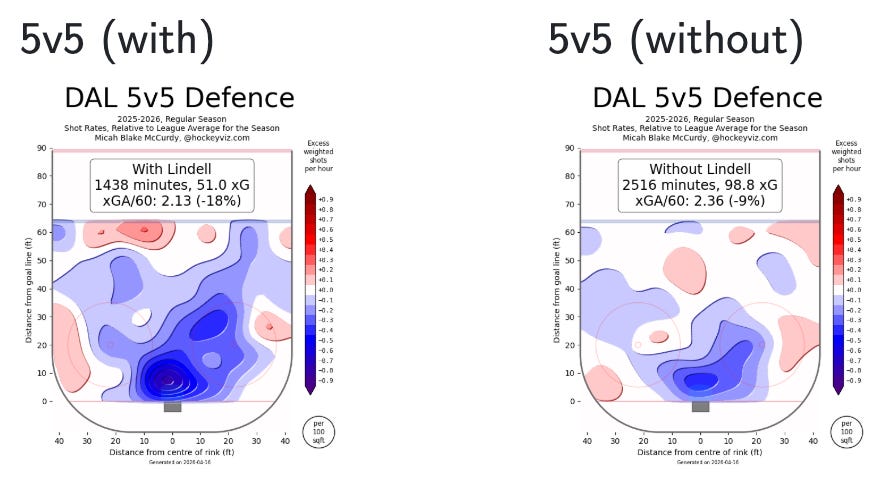
It should be said that Lindell was not buried in the defensive zone quite as much as he was in the Pete DeBoer years, which didn’t hurt these numbers. Playing with Miro Heiskanen means you are going to get a bit of time up the ice here and there, certainly. But not being buried doesn’t mean being sheltered, and Lindell was still starting more shifts and taking more faceoffs in the defensive zone than he did in the offensive end. It hardly need be said, but he was doing so against top-tier competition, too.
All up, Lindell was asked to anchor the top defense pairing in a new defensive system, and he did so as well as anyone could have possibly hoped. It was the only Stars defense pairing that didn’t see major injury-related absences at some point during the year (until the Folingo hit tore Heiskanen’s oblique on April 9, at least), and that consistency was the pillar of the Stars’ defense.
We’ve been pretty flowery so far, but two negatives bear mentioning from Lindell’s campaign, so let’s touch on those before we wrap up here.
First, Lindell’s yeoman’s work on the penalty kill was less effective this year, and he did so alongside Heiskanen for the first time in a while. In fact, Lindell and Heiskanen logged the most penalty kill ice time of any NHL defense pairing this regular season, playing over 218 minutes on the kill this season, but how did those minutes go? Not as well as you might expect.
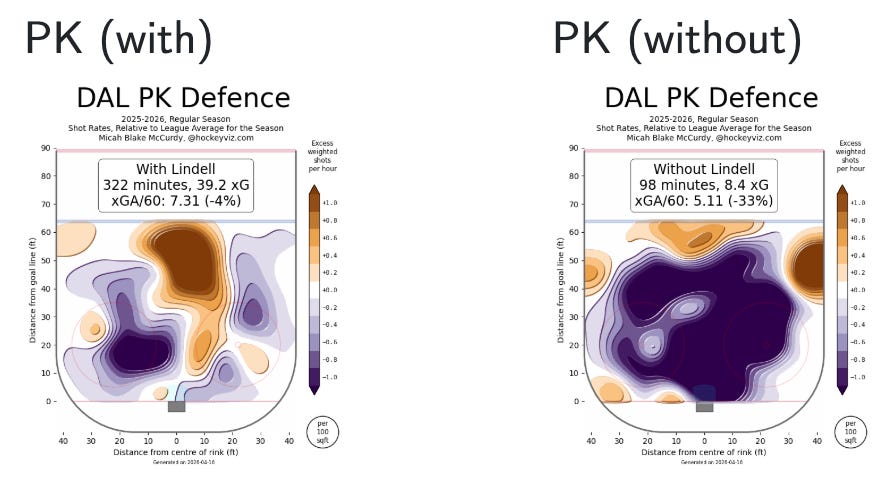
In terms of goals allowed per minute, the Lindell-Heiskanen PK defense pairing was average, ranking 17th-best among 38 defense pairings to log at least 80 minutes together on the PK. They outperformed their expected goals numbers (if you put stock in such things), but they were a fair tick away from the most dominant PK pairings in the league, with pairings like Erik Karlsson/Parker Wotherspoon or Cale Makar/Devon Toews outperforming them in both actual goals and underlying metrics.
Jake Oettinger didn’t have a great year on the PK, but he also wasn’t a disaster outright. Pretty much across the board, it’s just a fact that the Stars’ PK was worse this year than it was last season, even if the Stars did dominate Minnesota at special teams in the postseason. And given that their most-used players on said PK were Heiskanen and Lindell, it’s fair to ask the biggest questions of the two.
Lindell doesn’t get a free pass or anything, but I do think it’s worth considering what changed this year. Because when you look at Lindell’s career work on the PK, this year really does look like a bit of an outlier. His 9.1 xGA/60 was a career-worst, as was his high-danger shots allowed while on the ice.
Lindell’s results and some of his key metrics (xGA, HDCA, HDGA) were all much better in the 40+ PK minutes alongside Lyubushkin than they were with Heiskanen, and if I’m being honest, I still kinda think the Stars would be better off pairing Lindell with more of a right-handed specialist like Lyubushkin on the kill. I just don’t see the upside in rolling Heiskanen out there to do heavy PK work for 82 games. Lindell’s numbers certainly didn’t see an upside, either. (Of course, this is all moot if the Stars do as expected and move on from Lyubushkin’s cap number.)
The second area that Lindell bears some criticism for is the playoffs, where he and Heiskanen got handily outplayed by Quinn Hughes and Brock Faber. Lindell and Heiskanen were both on the ice for six goals against at 5v5, while Lindell managed to be present for just a single goal scored by Dallas. That’s not all on the defense, of course, but the net effect was undeniably disappointing. (And again, Heiskanen’s torn oblique muscle probably is something of a contributing factor here.)
It would have been one thing if Lindell had been the one simply taking on water while other pairings thrived in easier usage, but with Tyler Myers and Thomas Harley also getting fairly steamrolled at 5v5, Dallas needed their top defense pairing to keep the ice at least level, and they couldn’t do it. Even the Stars’ dynamite power play couldn’t dig them out of the hole that was dug for them, which is pretty damning.
Overall, it was a postseason to forget for Lindell and many of the Dallas Stars, as Lindell took more penalties and delivered fewer hits per game than he had in any of his prior playoff runs. Throughout his career, Lindell has been asked to absorb heavy defensive minutes in the postseason. But this time, for whatever reason, Lindell and Heiskanen both bent and broke, and the Stars’ first-round exit leaves questions that we’ll have to wait a year to answer.
As Glen Gulutzan said after the season, the Stars overachieved in the regular season and underachieved in the playoffs. Lindell is as good an example for this as anyone, and I’m awarding him a “B” grade for this year that stands, as always, for Better than you realize.
For my part, I’m inclined to put more emphasis on his first 82 games than his final six. Because for the vast majority of the year, Lindell did what he’s always done, and often better than ever. He isn’t a number one franchise defenseman, but his workload might fool you into thinking he’s every bit as important as one. But if you didn’t notice him for much of this season, then it probably means he was doing something right. He almost always is.
Hintz wore a letter during Heiskanen’s two-game absence for family reasons in mid-January.
Duchene wore a letter at the end of the regular season, when both Hintz and Heiskanen were out with injuries for the final three games of the year.
Though it must be said that Radek Faksa debuted three months earlier in 2015-16 than Lindell did. Faksa’s trade to St. Louis in 2024 broke his own consecutive streak, though.
Can you guess the other three without looking?
I think Ash has it right, that's my guess also for the other 3 Stars to play all 82 games last season.
Lindell is awesome and I agree that the Stars should look to reduce Miro's PK time next season.
Guessing the other three were Johnston, Robertson and Bourque?
Great piece!
I do think splitting Lindell and Heiskanen is the way to go next season and definitely easing Heiskanen’s PK minutes.
Hopefully Lindell will be as productive or uh, good at not letting the other team be productive and the aging curve won’t creep in too fast for someone playing those heavy minutes.