
Dallas Stars President and CEO Brad Alberts on Watching Logan Stankoven Win the Stanley Cup, Two Years of Victory+, and the Economic Realities that Could Necessitate a Move to Plano
The Stars' CEO talks about his vision for a potential arena in Plano, Logan Stankoven's Stanley Cup win, the evolving future of Victory+, and more

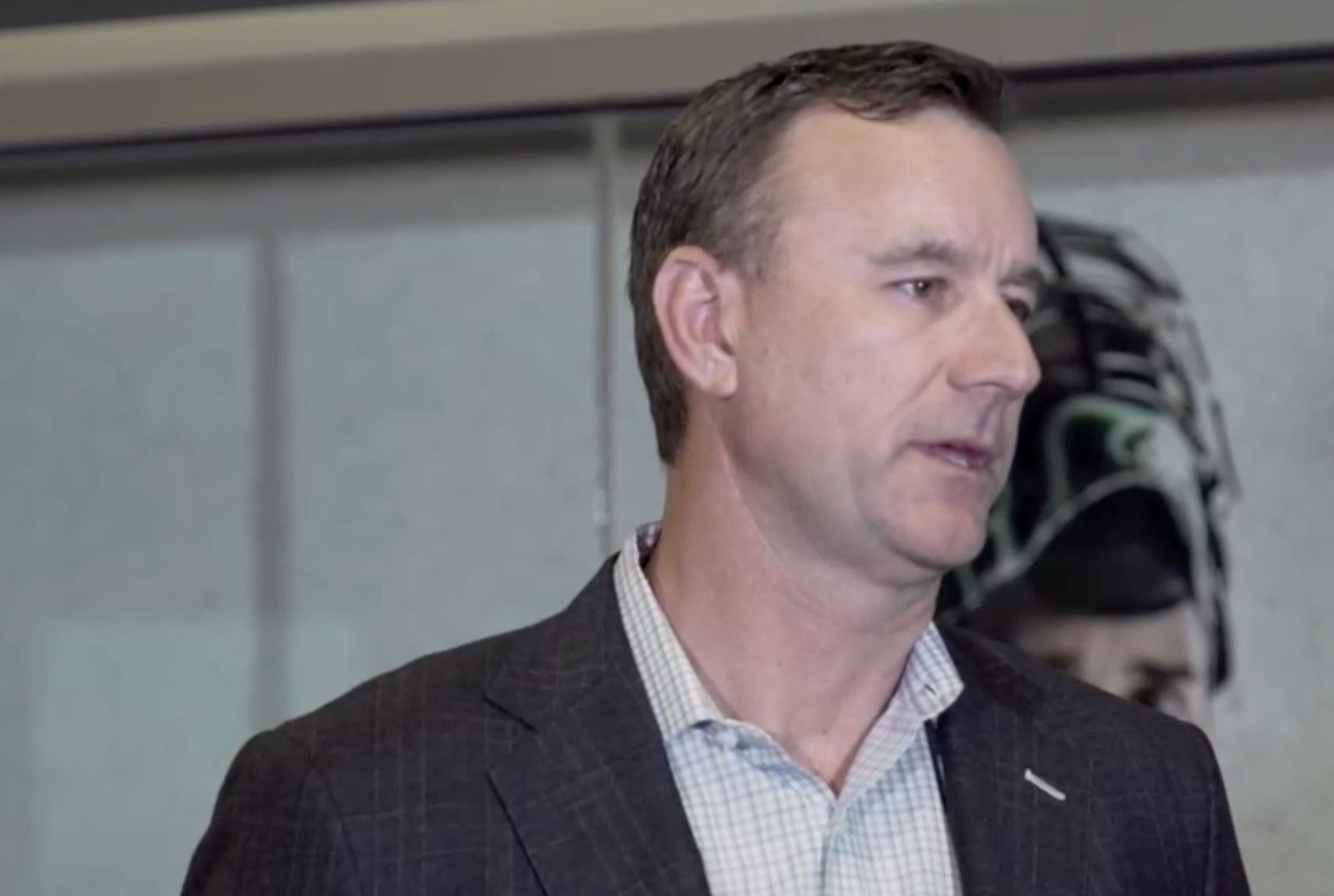
As you surely know by now, Dallas Stars President and CEO Brad Alberts has been a particularly busy man over the last two years.
After things began to fall apart with the City of Dallas, Alberts and the Stars began speaking with the City of Plano in the fall of 2024. All that work finally started to come to fruition last week, when the Plano City Council voted 8-0 in favor of multiple considerations related to a Dallas Stars move up the Tollway in 2031 to what projects to be a $3 billion1 entertainment complex and brand-new hockey arena.
Alberts has been clear that things are not quite finalized with Plano just yet, but all signs point to a Plano move happening once the Stars’ lease at American Airlines Center expires in 2031.
Amidst all that activity, I had a chance to speak with Alberts today, and he discussed a few topics related to the move to Plano, how Victory+ is going two years in, and how the Stars will be able to continue to spend to a rising salary cap over the next five years.
Before getting to all that, however, the first thing I had to ask Alberts was just what it was like to watch Logan Stankoven lifting a Stanley Cup in Carolina after being traded away just over a year ago.
“Happy for him,” Alberts said of Stankoven. “Great kid, great hockey player. It was painful having to give him up, but in order to get, you gotta give. We got a great player [in Mikko Rantanen], and we had to give a great player to Carolina. And we’re all happy for Stanky. He’s a wonderful kid, and well-deserving of a Stanley Cup. Great for him.”
That trade is in the past now, however, so we move to talking about the future. When asked about his vision for the new arena, Alberts reiterates something he’s said before: it’s going to be better.
“I think I’ve probably said it a couple times,” Alberts said. “The fan experience, both getting to and leaving, and inside a building has to be better than what it is currently at the American Airlines Center, or I won’t feel fulfilled, that’s for sure. We’re gonna set out to create a fantastic experience.”
As far as what that experience will be, Alberts went on to point out some of the key advantages to the Stars’ having their own place.
“I think the one thing that this allows us to do that we can’t do at the AAC because of the shared situation with another team, is to really create a Stars-themed building that the fans are going to love,” Alberts said.
“It’s going to be our colors, our history, all those things—a testament to the Dallas Stars and hockey, similar to what the Wild have in Minnesota where it’s a hockey-only building, or the Canadiens. This gives us the opportunity to be able to do that. So, yeah, I’m absolutely dead-set on making sure that the fan experience of getting there, leaving, and in the arena is going to be better than it is currently.”
In the meantime, the Stars will have five more years left on their lease in downtown Dallas in a building they share with the Mavericks and their new ownership group. The Stars, of course, can’t comment on a lot of the things that are still being worked out legally between the two teams right now, but as far as the Stars’ revenue for the next five years, Alberts said the Stars are in a good place, though the challenges are real.
“Our business is what I would describe as maxing,” Alberts said. “Our business is in a really good place. It’s in a place where it’s never been better, to be honest. The concern, for me, is the ability to continue to create new and different ways to generate revenue to keep up with the expense growth.”
As Alberts went on to say, costs are only going up, across the board.
“The costs of doing business in the NHL continue to increase,” Alberts said. “General managers aren’t taking less. Coaches aren’t taking less. Certainly players aren’t. There’s never been a better era than right now to be an athlete. I mean, we have seven, eight guys that are generationally wealthy from playing in the NHL and playing on our team.”
That rise in salaries is a result of a healthy league, of course. But it also means teams have to figure out ways to prepare for that rise accordingly.
“You think about what’s going on in college, and you now have guys making seven figures playing quarterback at SMU,” Alberts said. “The pressure is on the institutions or teams like ours to continue to find revenue from new and different ways to continue to keep pace. Nobody can sustain operating losses. I don’t care how wealthy you are, whether it’s an institution, a university, or a team.”
This is where the Stars’ (and Alberts’) past emphasis on year-round revenue comes into play. For Tom Gaglardi to continue to run a profitable franchise in the decades to come, the Stars want to ensure that significant revenue is coming from places other than just tickets.
“No owner wants to fund 30, 40, 50-million dollar operating losses,” Alberts said. “We’re not in that position now, and we don’t intend to be, but that’s why it’s really important to me to be able, long-term, to create new and different revenue, 365 days of revenue, and use real estate to do that.”
I asked Alberts if the Stars’ lack of such year-round revenue over the next five years could potentially impact the team in the meantime, or at least lead to temporary operating losses that would be recouped in a new location. But Alberts said right now, the outlook is still positive in the short term.
“No, I don’t anticipate [operating losses],” Alberts replied. “Our team is playing at a high level. Our business continues to max, and I don’t see that changing in the next five years.”
I did ask whether Alberts expects the Stars to be able to continue to spend up to the rapidly rising NHL salary cap over the next five years, and he responded confidently.
“One hundred percent,” Alberts said. “A hundred percent.”
The Future of Watching Games on Victory+
Alberts’ assurance of the Stars’ being able to spend to the cap is particularly noteworthy given the Stars’ lack of a traditional regional sports network model (like they used to have on FOX Sports or Bally). Selling those rights historically generated tens of millions of dollars in money for teams, but as you know by now, the Stars have gone a different route since 2024.
For the last two seasons, the Stars have kept those rights and broadcasted their games free on Victory+ for fans to stream. So I asked Alberts: How has the Victory+ experiment gone, both in general and with regard to generating projected revenue?
“I think the distribution, viewership, and the fan experience of what we’ve done with Victory+ and streaming has been fantastic,” Alberts said. “I think the fans have really embraced it. It’s easy to watch. Everybody now knows where to go. The quality of the broadcast is as good as anything that we had on cable. So I think from that perspective, it’s been great.”
However, Alberts cautioned that the revenue side of Victory+ isn’t making up the big gap left by the collapse of the RSN model across most major sports (not that anything is, these days). And that means the Stars are still looking at what exactly they can do to make Victory+ as profitable as it needs to be.
“The economics around it are still concerning to me,” Alberts said. “I still don’t know. Is it sustainable financially the way we need it to [be]? Maybe it is, but we’re still figuring that out. It’s still, I would say, TBD. We’ll just continue to monitor it. APMC [A Parent Media Company] is out trying to enhance their position to be able to handle more properties, and we’ll see how successful they are at it.”
This led the conversation to a key question: will the free model for watching Dallas Stars games on Victory+ be going away in favor of a paid subscription, like the Texas Rangers use for their games on the platform?
“I don’t want to say that,” Alberts said carefully. “I don’t know. Again, this is still such an evolving space. I don’t want to say that right today, but I also don’t want to say no. I think we’ve got to continue to just keep ourselves nimble here, as this whole local television situation continues to evolve. Nobody still, to this day, knows where this is all going. Nobody. Not baseball, not the NBA, not the NHL. So it’s still going to need more time to figure out what the long-term sustainable solution is.”
Alberts did clarify that this discussion includes the upcoming Stars season, and that it is still underway. As of now, nothing has yet been decided in terms of moving away from the free model, but Alberts also didn’t rule anything out entirely.
“Right now, we have no plans to change,” Alberts said.
On Rising Costs for Fans
The final thing Alberts and I discussed was the reality of rising costs for people to attend games. When asked what he would say to fans who are concerned that it might be less affordable to attend a game in, say, a new arena in Plano, Alberts had this to say.
“Well, I’m always concerned about that [affordability],” Alberts said. “And then there’s the reality, you know, everything in Dallas seems to be getting more expensive. Golf in this city is more expensive than it was ten years ago. So you have inflationary realities that we all have to deal with. We certainly respect our fan base. We do not want to price out our fan base.”
Alberts went on to say, however, that rising costs are something teams and fans have to reckon with in order for clubs to stay competitive in the growing economic realities of the NHL—and that might include higher ticket prices.
“We’re right now middle-of-the-pack on average ticket price,” Alberts said. “So for anyone that complains about our ticket prices, half of the league is higher than us. Think about that. So, I’m not trying to make us number one. In order to be competitive and to stay competitive long-term, to provide the resources necessary to continue to be a cap team in 2032-33, we need to stay competitive. We need to keep up. Being in the middle of the pack can’t turn into 22nd in the league in ATP [Average Ticket Price].”
In pursuit of ensuring the Stars don’t lag behind the pack in average ticket pricing, Alberts has repeatedly said the Stars’ need to have more premium seating available than American Airlines Center currently offers. But Alberts is well-aware of how statements like that can sound to the average fan.
“When I talk about ‘Premium,’” Alberts said, “Everybody’s like, ‘Oh, the tickets are gonna be more expensive.’ And they are. But that’s where sports is headed. I can’t change that. We’re not going to go back to have an arena like Reunion Arena. I think we all know those days are gone, and we need to keep pace.”
This level of candor might not be fun for the average fan to hear, but Alberts isn’t wrong. Rising ticket costs across sports have been happening for a while now. From the Stars’ perspective, the possibility of adding more premium seats with higher ticket prices could simply be a way to keep up with the market rather than find themselves lagging behind it.
“We’ll certainly be sensitive to our fan base,” Alberts said. “We understand it. We get it. But at the same time, we’ve got to balance the realities and the competitiveness of our sport.”
An earlier version of this piece had “million” instead of “billion” here, which is a laughable mistake by the author.
Props on the footnote / error acknowledgement. To paraphrase the old chestnut, the only difference between three million dollars and three billion dollars is about $3 billion.
Since the move became evident, I’ve resigned myself to hoping we can win a cup before we relocate.
I’ll absolutely be priced out of my season seats.