
Where Wyatt Johnston Plays Might Be the Biggest Question of 2025-26 for the Dallas Stars
And we're not just talking about with whom

Last summer, lots of folks in Stars Land had a conversation about where Wyatt Johnston would play in 2024-25. Joe Pavelski had just retired, leaving an open spot on the right wing next to Roope Hintz, and it seemed eminently logical for Johnston to move up and take that spot.
Or at least it did, until Mavrik Bourque pulled a groin muscle late in the preseason, and suddenly the Stars needed a center on the third line. Johnston was also dealing with a lower-body injury for much of preseason, and with Jason Robertson’s summer cyst removal surgery, Dallas had some holes to fill, and some less-than-100% players with which to fill them.
So that’s when Pete DeBoer went back to ol’ reliable: Johnston began the year centering Jamie Benn and Evgenii Dadonov once again, while Logan Stankoven got a chance to kick things off in style with Hintz and Jason Robertson on the…third line.

Really, this was the moment when the phrase “top line” should have been excised from our collective vocabulary, at least until Mikko Rantanen’s arrival months later. Johnston led the forwards in ice time that game, and he was second at even-strength to only one forward: Dadonov. Johnston may not have played with Hintz and Robertson, but he was otherwise deployed like a top-line guy, as he’s been for a while now.
Let’s go back, then, and look at just how Johnston was deployed last year, both in the regular season and the playoffs. With a new head coach in town, that deployment was always likely to change, but it’s always helpful to know where you’ve been in order to start guessing where you ought to go.
DeBoer began his first of three Dallas seasons back in 2022 by keeping Johnston in the NHL as a teenager right out of juniors, putting him with Jamie Benn most every night, and to great effect. Under DeBoer, Johnston continued getting every opportunity on every stage for three years, largely carpe-ing the diem out of each and every one, including 56 playoff games (his less-impressive 2025 postseason notwithstanding).
So even though Johnston was briefly sent to play on what looked like a third line last season, he got the minutes and opportunities befitting what DeBoer has always kind of seen Johnston to be: one of the best forwards on the Stars, who was used accordingly.
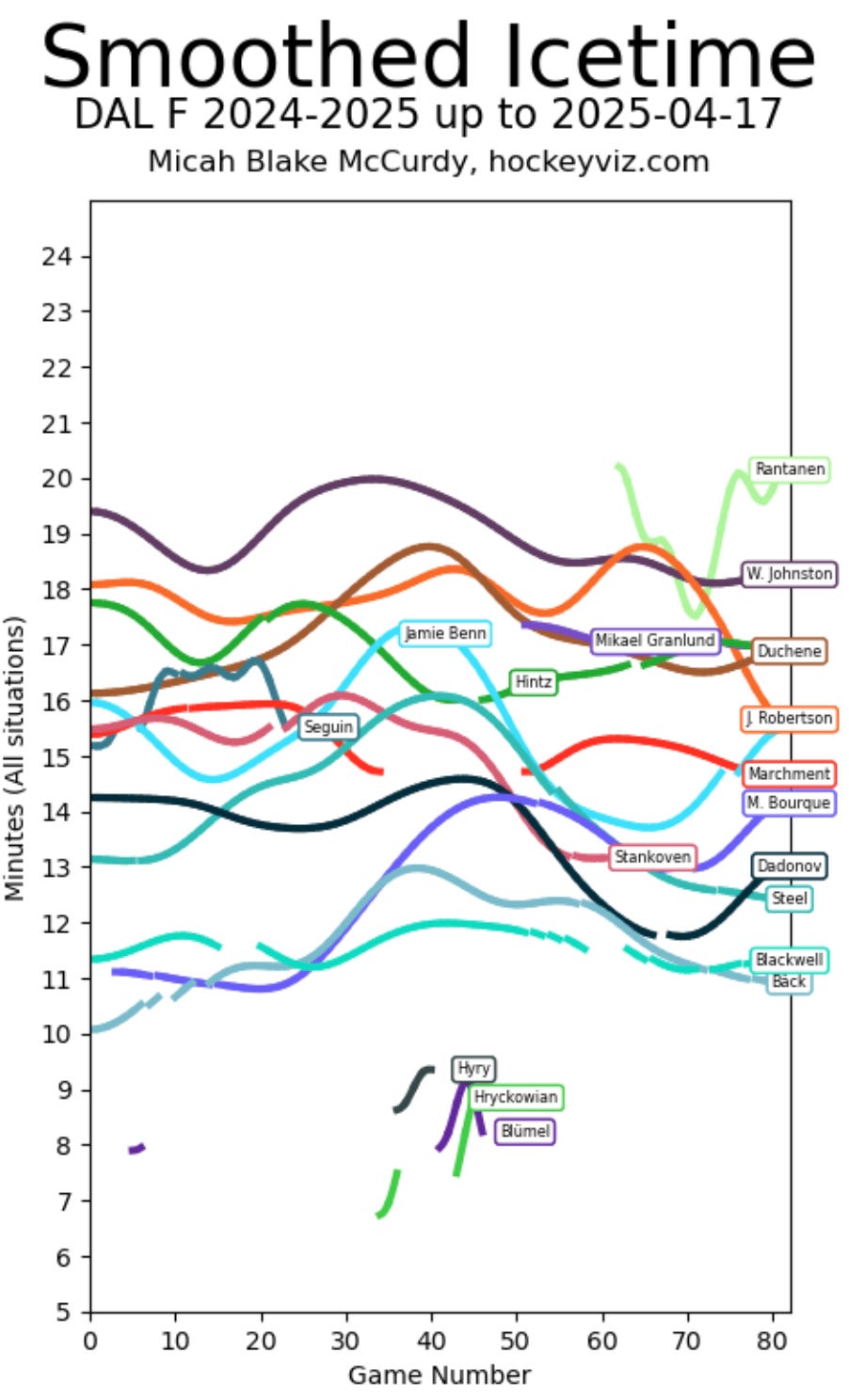
After two games with Benn and Dadonov to start 2024-25, Johnston got a couple of games up with Hintz and Robertson after all. Then he went back with Benn and Dadonov for a few more games before Logan Stankoven’s slow start saw him moved down with Johnston and Benn, while Dadonov got a chance to flash the top-line skill that has made him such an NHL mainstay for so long.
(Side note: it’s kind of wild that two of the Stars’ top-line right-wingers are gone from last year, and yet it’s the left wing that seems so thin. Mikko Rantanen makes up for a lot of shortfalls, I suppose.)
But after that early back-and-forth, Johnston got a stretch of about a dozen games where he played with Hintz and Robertson on what we had assumed would be the top line for opening night. And if you’ll recall, this was following a cold snap for Johnston and a few other players to start the year, as the young forward had only scored two goals through his first 17 games—a ten-goal pace for the season.
Johnston would heat up like Robertson and many others after the slow start, but he never really found a stable long-term line last season. With Tyler Seguin’s injury opening up another right-wing spot early in December, Bourque and Stankoven both struggled to grab and hold bigger roles, while Mason Marchment also dealt with injuries to further disassemble the second line Dallas had begun the season with.
Johnston would end up playing eight games with Duchene and Robertson around the turn of the calendar, and to some success. But eventually, Mikael Granlund arrived a few weeks before Mikko Rantanen. And with the arrival of one of the best right wingers in the NHL, the opportunity for Johnston to jump on next to Hintz and Robertson was no longer available, and for good reason. Thus, Johnston’s role became that of a rotating pillar rather than a situational wing weapon. Also, he played with Jamie Benn a lot.

That question lingered into the playoffs, where Johnston started off Game 1 against Colorado by playing with Jamie Benn and…Mikko Rantanen (remember that?) before the Finnish Line became inviolable quickly afterward. After the early scuffling against Colorado (despite taking a 2-1 series lead), Johnston wound up back with Dadonov and Benn for that series (during which Robertson was unavailable after his Game 82 knee injury).
Against Winnipeg, Johnston began the series centering a recovering-from-knee-injury Robertson and Mason Marchment, with Benn getting a trial run up with Duchene and Seguin for two games before the captain swapped back with Marchement to re-join Johnston and Robertson for Game 3.
For the second half of the Jets series, the Stars went the 11F/7D route to accomodate Miro Heiskanen’s return, and Johnston and Robertson were paired with a rotating winger that was mostly a double-shifting Mikko Rantanen, though Hintz and Granlund also took some turns with the duo.
In the third round against Edmonton, DeBoer tried everything. Most of it didn’t work, as you surely know by now on account of DeBoer said so.
Here’s what Johnston’s linemates against Edmonton looked like:
Game 1: Johnston plays right wing with Duchene and Robertson, finishing -2 with no points. Tyler Seguin scores two goals playing right wing with Steel and Marchment.
Game 2: Johnston goes back with Benn and Dadonov. No points, no goals against.
Game 3: Back with 14 & 63 for the second game in a row, Johnston is a -2 with no points.
Game 4: The Finnish line is broken up, and Johnston plays with Granlund and Benn. He goes scoreless for the fourth straight game in the series, along with a -1.
Game 5: Johnston plays with Robertson and Bourque early, and he assists on goals from Robertson and Hintz (PP) to finish +2! There endeth the good news, as Rantanen double shifted with Robertson and Johnston in the third period as the Stars’ season came to its ignominious end. There is some discussion about the goaltender afterward, but who can recall how that all shook out?
This year, Johnston will be playing for an NHL head coach who is not Pete DeBoer for the first time in his career. NHL coaches will surely see things I won’t think of in July, because they are paid millions of dollars to do that, but the most likely thing in a vacuum seems like Johnston would be viewed as one of the Stars’ best three centers along with Duchene and Hintz. That means you have to decide on who gets the offensive-zone starts, and who is going to be tasked with the tougher defensive work.
Mikko Rantanen is the first player in Dallas who should be given those premium scoring opportunities, since he’s one of the best scorers in the entire league and all. And if you start with that assumption, then putting a familiar center like Roope Hintz next to him is a pretty clear logical continuation. It’s what DeBoer wound up doing for most of the postseason, after all, as Hintz got the most offensive deployment of those three centers.
Duchene, for all his virtues last year, also seems a good candidate to give slightly more offensive deployment, as his defensive game isn’t how he earns his keep. It’s logical to shelter Duchene from too much defensive duty, but that logic means you have Johnston as a center who, regardless of the number of minutes he gets, is likely going to have the most work to do in order to create scoring opportunities after starting in his own end of the ice.
This is where the Radek Faksa addition begins to make a bit more sense. Because as defensively stout as Sam Steel is, Faksa has been even better in recent years. So, if Faksa can lead a fourth line that needs less-sheltered deployment than traditional bottom-line groups, he could absorb significant defensive duty, which could at least get Johnston closer to neutral when it comes to his zone usage.
This isn’t too far off what happened last year in the regular season, when Johnston got a ton of offensive-zone starts, but also led the team in defensive zone starts, too. He was asked to do everything, because DeBoer trusted him to do so. Note how far down and to the right Johnston’s name is on the below chart showing which zones players were deployed in.
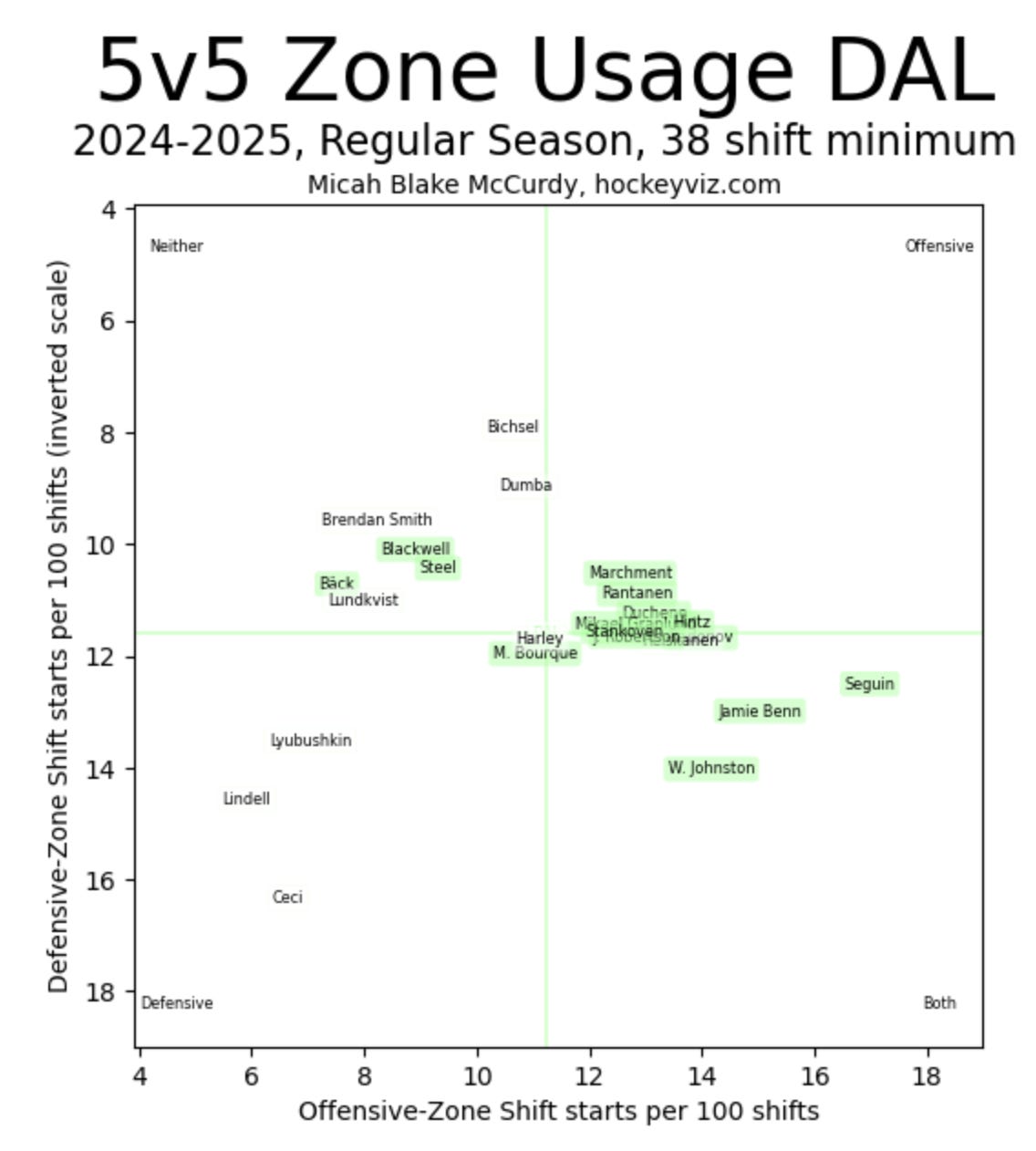
It’s worth noting that Johnston still had 33 goals and 71 points in 82 games last season, so it’s not like his game got crushed or anything—at least in the regular season. But when you dig into the numbers, you see that Johnston’s even-strength scoring really did suffer last year in both the regular season and the playoffs.
Still, someone has to take those less-tender minutes in the defensive zone, and the job of a roster isn’t to get your favorite player the most points possible, but to win games. Clearly DeBoer thought Johnston could handle the heaviest deployment of his career, though. Compare the above usage to the year before (below), when Hintz was given a bit more defensively heavy duty than his fellow centermen.
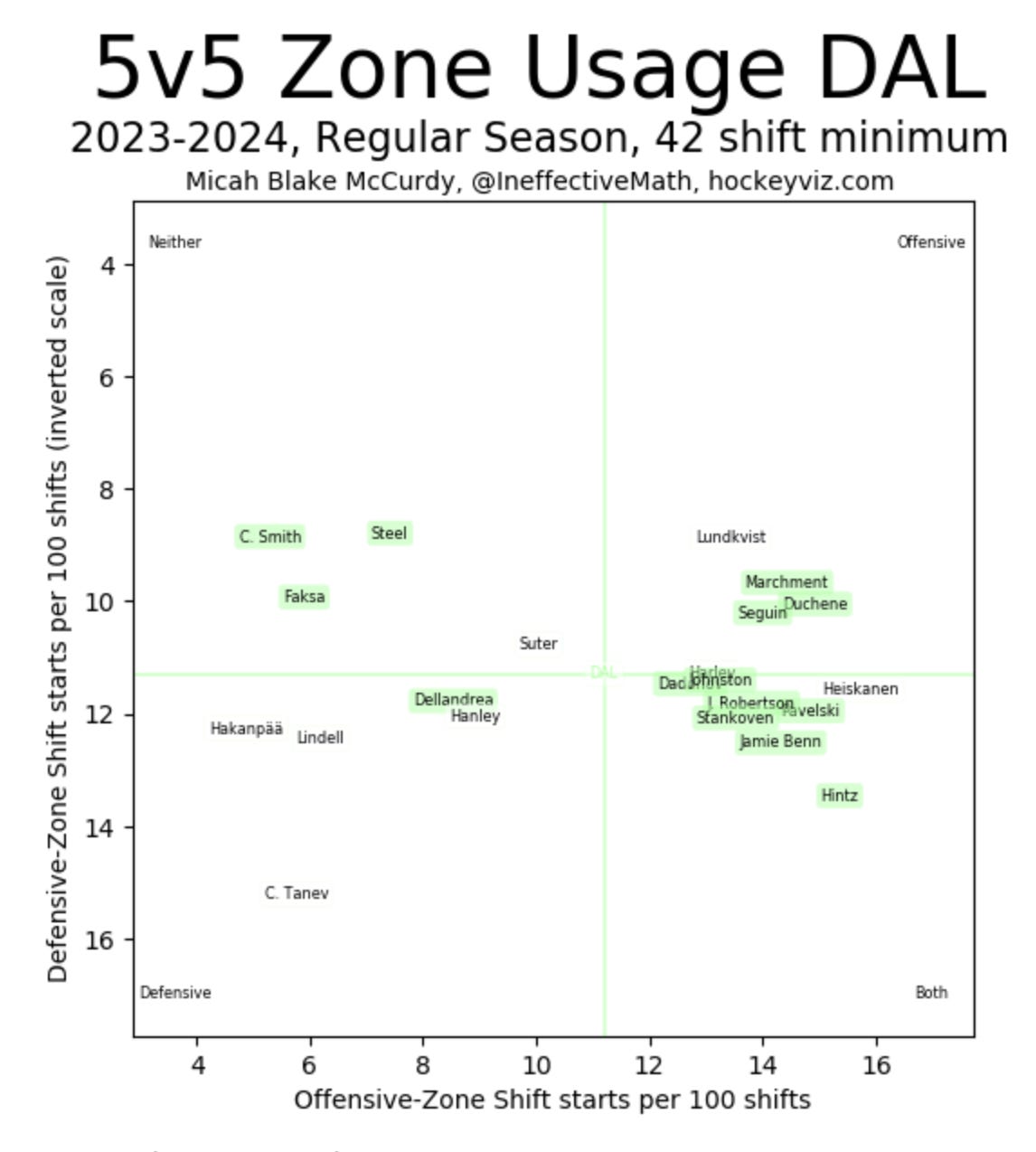
All this talk about zone deployment is something to be careful about, though. You should want your team’s best players to play the most minutes, and that includes defensive zone starts, too. It’s not a bad thing for great players like Hintz or Johnston to be on the ice, no matter what part of it they’re on.
All the same, I do wonder if Johnston’s even-strength scoring dip last season was partly due to his heavier defensive-zone deployment. Here are Johnston’s last three seasons from Natural Stat Trick, along with an ugly table if you don’t wanna click through:
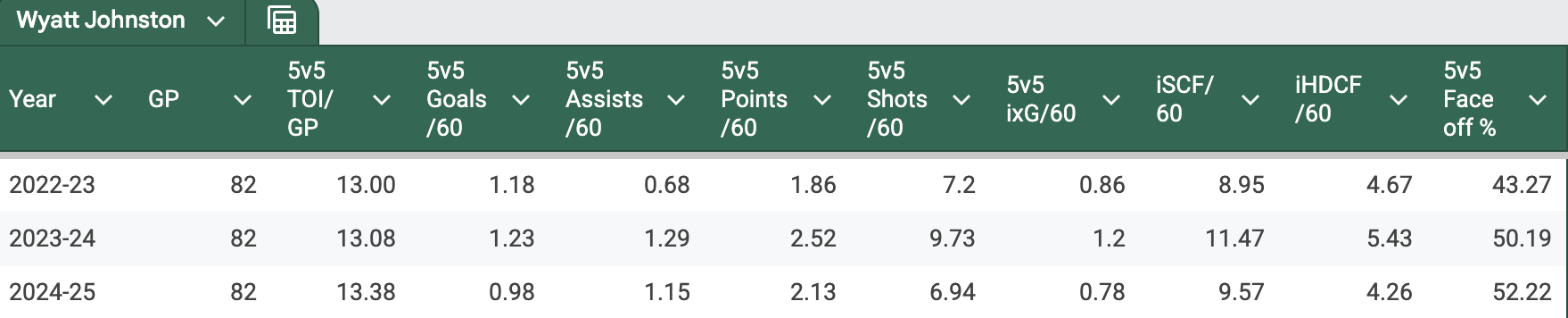
Click on the image to zoom in if you like, but here’s the gist: at even-strength, Johnston’s scoring and scoring chance creation rates dipped significantly from last year. His defensive numbers were similarly affected, with everything getting worse this year from on-ice xGA/60 to scoring chances and goals against (though nothing looking dire, to his credit).
Some of that could be related to Johnston’s preseason injury, but I haven’t found a way to confidently parse that out yet, and I’m not going to guess. The point is, Johnston’s scoring was bolstered by power play production—a very good thing!—but his overall effectiveness at 5-on-5 looked very much like the same player being asked to do heavier lifting than ever before.
If you want a glimmer of hope, then you can look at some of his underlying playoff numbers, where Johnston’s results were far worse than his metrics. While he was significantly out-shot on the ice (just a 45% CF rate), Johnston’s line (whatever it was on any given night) did tend to prevent the most dangerous chances while creating pretty good ones. That wasn’t much consolation though, as Johnston’s on-ice save percentage was just 89%, coupled with an on-ice shooting percentage of a similarly miserable 7.4%.
Anyway, enough numbers. The point is, Johnston last year was asked to do more defensive work than ever before, and while he showed he could do that, the consequences of said deployment look pretty stark. You can dig a hole with a sword, but don’t expect the edge to stay quite as sharp after you’re done.
For Glen Gulutzan, he’s going to have to decide exactly what Johnston is, and how to use him. That question is linked to how Duchene and Hintz will be used, too. With the addition of Faksa, it seems likely that one of the left-hand shots named Steel or Duchene will be asked to supplement the Stars’ thin left-wing depth at some point, but unlike last summer, Johnston seems much less likely to play up on the top line as a right winger, because, well, because Mikko Rantanen.
But just like last summer, the Stars’ coach will have to decide whether Johnston is a player whose best skills were being dampened by his deployment and linemates, or whether asking him to shoulder a heavier portion of the load is the best thing for the team as a whole, even if it costs Johnston a few points.
Johnston and Hintz both played top power play and second-tier penalty killing minutes for Dallas last year, often being put out later in a penalty kill to take advantage of tired and/or secondary power play units. That sort of tactical approach was a hallmark of DeBoer’s time as head coach, and one would bet that Gulutzan will bring a similar sort of approach, given how Connor McDavid and Leon Draisaitl were often put on the ice at the end of a penalty kill for similar reasons.
But when it comes to even-strength usage, Johnston is a tool whose many virtues can almost be a curse. Any time you save him for one situation, you’re missing out on using him for the current one. That’s how Johnston started just 39% of his playoff shifts in the offensive zone this past spring—significantly lower than Duchene (45%) and Hintz (54%). I think it’s not too crazy to suggest that his dip in scoring reflects that usage, but the question of who should take those minutes instead is a complex one, indeed.
When the dust settled on last year, I walked away feeling like Johnston had been asked to do a lot of what Mike Modano was asked to do in 1999. That Cup year ended with Joe Nieuwendyk winning the Conn Smythe Trophy after scoring 11 playoff goals to Modano’s five. Nobody on that team cared too much about who won that trophy, given the more important trophy they took turns hoisting. But it is a fact that a coach’s job is, at times, to choose who is going to get more glorious opportunities than others, and Johnston was asked to show a lot of humility last year.
Maybe that was the best thing for the team as a whole, as the coaches seemed to decide. But from my far less-informed perspective, I can’t help but wonder if the Stars, and Johnston, could be even better off with Faksa or Hintz shouldering just a little bit more of the defensive load than they did last year.
You’ll notice I’ve talked much more about usage than about linemates, and that’s because I really loathe putting together mock lineups in the summer, because so much can change before opening night. But if you just can’t wait, and you’re eager to start drawing line combos in your Moleskine notebook, the biggest question you’ll need to answer before doing so is where to put Wyatt Johnston.
He’s shown himself to be one of the Stars’ best players in every situation. Now Glen Gulutzan needs to decide what’s best for everyone. That seems to be, as ever, a very tough job indeed.
Maybe, Hyry can make the roster out of camp.
Good point.