
The Complex Improvements of Lian Bichsel's Sophomore Season

The Dallas Stars had three defensemen who played at least 70 games this season: Thomas Harley (70), Miro Heiskanen (77), and Esa Lindell (82). The next-highest total on the blue line? that would be Alex Petrovic, who played in 54 games during the regular season before returning to the lineup at the end of the Minnesota series.
In other words, the Stars had a lot of rotation happening on the back end, and it was largely out of necessity. Three defensemen sustained fractures to the leg/ankle/feet area, Tyler Myers tweaked his groin, and Miro Heiskanen tore an oblique muscle before spraining his ankle in the playoffs. And that’s just the stuff we know about.
I say all that to put Lian Bichsel’s 50 games this season in proper context. A lot of defensemen (and forwards, come to that) missed time this year with injuries, so that meant a frequently rotating cast of partners for everyone but the top pairing. Very little was stable this season, other than the Stars’ ability to keep piling up points.
Bichsel’s own 32-game absence began after he suffered a nasty fracture on this play against Ottawa on November 30:
Bichsel would remain out until after the Olympic break, when he returned to play 14:30 against Seattle on February 25. He wouldn’t miss another game all year, including the playoffs.
It’s easy to forget that Bichsel was only 21 years old this season. Once again the youngest player on the roster, Bichsel nevertheless had a regular roster spot locked down every night he was able to play. While he was the third-youngest defenseman in the Stanley Cup Playoffs, Bichsel’s responsibilities didn’t diminish in crunch time. In fact, they increased.
Last year, Bichsel averaged 11:47 per playoff game. This year, Bichsel played nearly 17 minutes per night against Minnesota (16:54), with that total only marginally affected by the overtimes in Games 3 & 4. Under a second NHL coaching staff in two years (albeit with Alain Nasreddine still there), Bichsel once again earned and kept the trust of his head coach, no matter how high the stakes got.
Little wonder that he did, too. While Bichsel’s size and skating are obvious selling points, he turns those assets into real results on the ice without crossing the line nearly as much. In a new defensive system that kept defensemen a bit closer to home, Bichsel’s penalty minutes trended the right way, as he took fewer penalties in 50 games this year than he took in 38 games last year—while also drawing more.
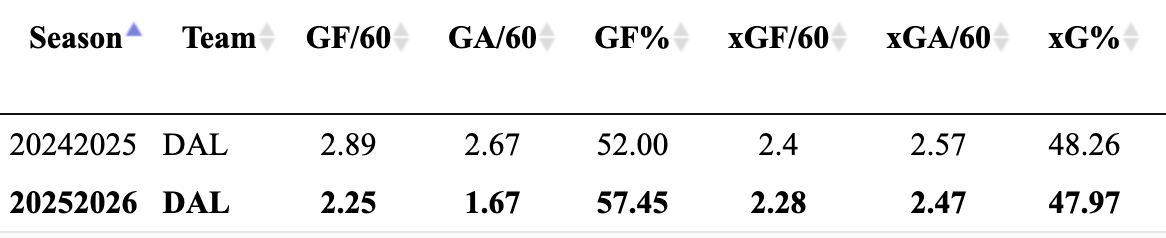
After scoring four goals and adding four assists in his 38 games as a rookie, Bichsel put up another four goals in 50 games this year along with five assists. Like a lot of the team, Bichsel’s shot metrics weren’t impressive, but he still matched his 48% xGF percentage from last year while improving some even more important categories, like actual goal-differential, where Bichsel went from being on the ice for a 52% share of the 5v5 goals last year to 57% of them this campaign.
That improvement was driven by a big decrease in goals Dallas allowed while Bichsel was on the ice, as he dropped a full digit from his 2.67 GA/60 last year, to 1.67 this time.
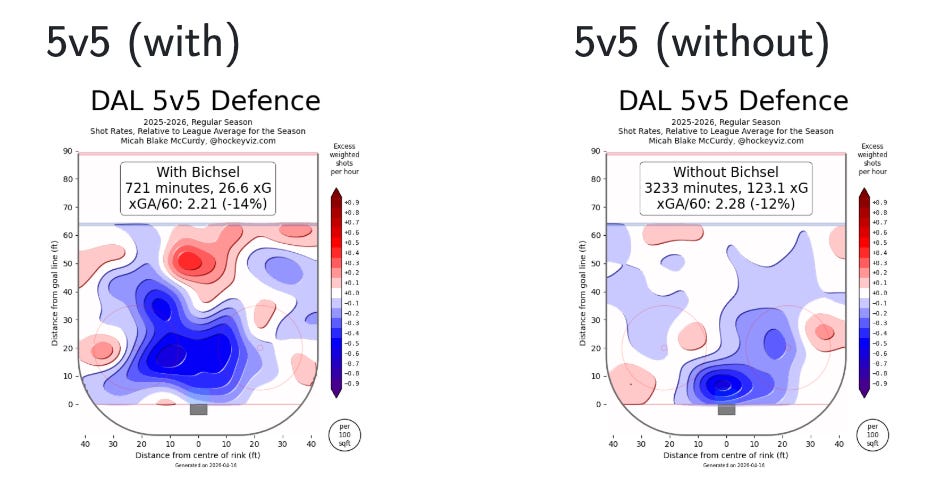
The more you drill down, the more you see that Bichsel was fairly representative of the Stars’ defensive approach as a whole. Xg numbers and raw shot attempts might have seemed ugly, but the Stars were largely allowing the sort of shots they were comfortable with this year, which is to say those away from the low slot. And when the third defense pairing was out there, they protected the house even more intensely than usual:
In the other direction, Bichsel’s offensive work seemed as confident as ever, particularly right after his return in late February. This goal against Vancouver was emblematic of Bichsel at his most confident, when he saw an activation opportunity and seized it without hesitation to great effect after the return pass from Lyubushkin:
(It was the first of two goals Bichsel would score that night, but we’ll save the second for further down the page.)
Among his three most regular partners, Lyubushkin made Bichsel the most dynamic, with all the shots-for numbers going up when 6 and 46 were paired together, albeit with more given up defensively, too.

That eye chart gives you some idea of what the journey was like this year. Bichsel-Lyubushkin had the best results: an 83%(!) share of the goals at 5v5. But Bichsel-Myers had the best expected goals, as well as the fewest high-danger shots allowed. Do you trust the process or the results, when it comes to third-pairing defensemen?
Well, we know how the playoffs shook out. While Bichsel was only on the ice for one goal against all postseason, it was not a pretty one for him or anyone else on the Stars, as he overcommitted to the right side in Game 3 on this initial rush by Matt Boldy, putting himself out of position to defend the subsequent chance:
But putting that goal on any single player is probably a fool’s errand. Some mistakes are a team effort, and this certainly qualifies.
In any case, Bichsel otherwise kept the Wild off the board during his ice time in the postseason, whether playing with Myers in Games 1 through 4 (though his and Myers’ marathon shift in their own zone during the overtime of Game 4 was not exactly a masterpiece, to be fair), with Lyubushkin in Game 5, or with Petrovic in Game 6.
Thus, Bichsel gets an “S” grade this year for his Steady improvement this season. It’s tough for even enormous 21-year-olds to keep hold of spots on the blue line, but Bichsel’s play absolutely merited the run-out he kept getting. With three lefties above him in the pecking order, Bichsel was always going to be given the chance to take another measured step, and he did that, even if some opportunity to do more might have been missed by the nasty injury he suffered.
In terms of watching him from game to game, that “S” might also stand for Shrewd. Bichsel’s game looked a bit “smarter” this year to my eye, with a year of NHL experience clearly having helped his reads and breakouts, even as he and the entire team went through an adjustment period early in the year in the new system.
Confidence is the thing everyone talks about when young players finally take that big step in their careers, but in Bichsel’s case, that confidence is very much already there. He knows how good he can be, and when the results reflect that reality, you can see his game get even more out on the front foot, in all the best ways. The trick for next year will be for Bichsel to use his abilities even more effectively as both threat and reality, keeping opponents honest while not being afraid to test them even they appear to be doing so. Sometimes,you just need to prove that you can dominate even the most prepared opponent.
In all likelihood, Bichsel will get another run with Myers to start next season, but he’s proven himself more than capable of playing with others, should the need arise. And for a player who just turned 22, he has a lot of runway still in front of him. Here’s hoping the good things we saw this season proved just a glimpse of what Bichsel’s ultimate potential winds up being.
Robert- good analysis of his performance and thanks for the reminder about his age. He carries himself so well on the ice it’s hard to remember how young he is.
Regardless of what contacts get moved to sign Robertson, having (at least) 5 legitimate defensemen on the roster seems like it will give Nill more leeway in who he moves.