
Some Thoughts on What We Learned about Jason Robertson and the Dallas Stars This Week
A little, but maybe a lot

I moved to a new place on the other side of Dallas this week. All things considered, choosing what wound up being the hottest week of the year for a move probably wasn’t great foresight, but that’s what I get for buying a crystal ball from that guy in the Torchy’s parking lot.
My old place in Valley Ranch was great, but it was time for a change. I’d moved there back in 2019 when the world and I were very different, so a spot in 2026 that didn’t entail hour-long drives on game days was long overdue.
Today, I’m surrounded by unpacked boxes, but there’s excitement, too.1 Change is inevitable, but there’s something invigorating about seizing it before your hand gets forced, like diving underneath a big wave just before it crashes on top of you.
Now, would I have stayed in my old place if someone had paid me $12 million to do so? Sure I would have, at least for a year. This is what we in the writing world call a “syllogism,”2 which is just one of the many words I can use to demonstrate why I would be worth $12 million, should someone discover within themselves a strange desire to so compensate me.
Jason Robertson did not move this week, as we discussed when his own one-year extension happened Tuesday evening. Why that extension happened when it did is not entirely clear, even if there are a few things we can deduce.
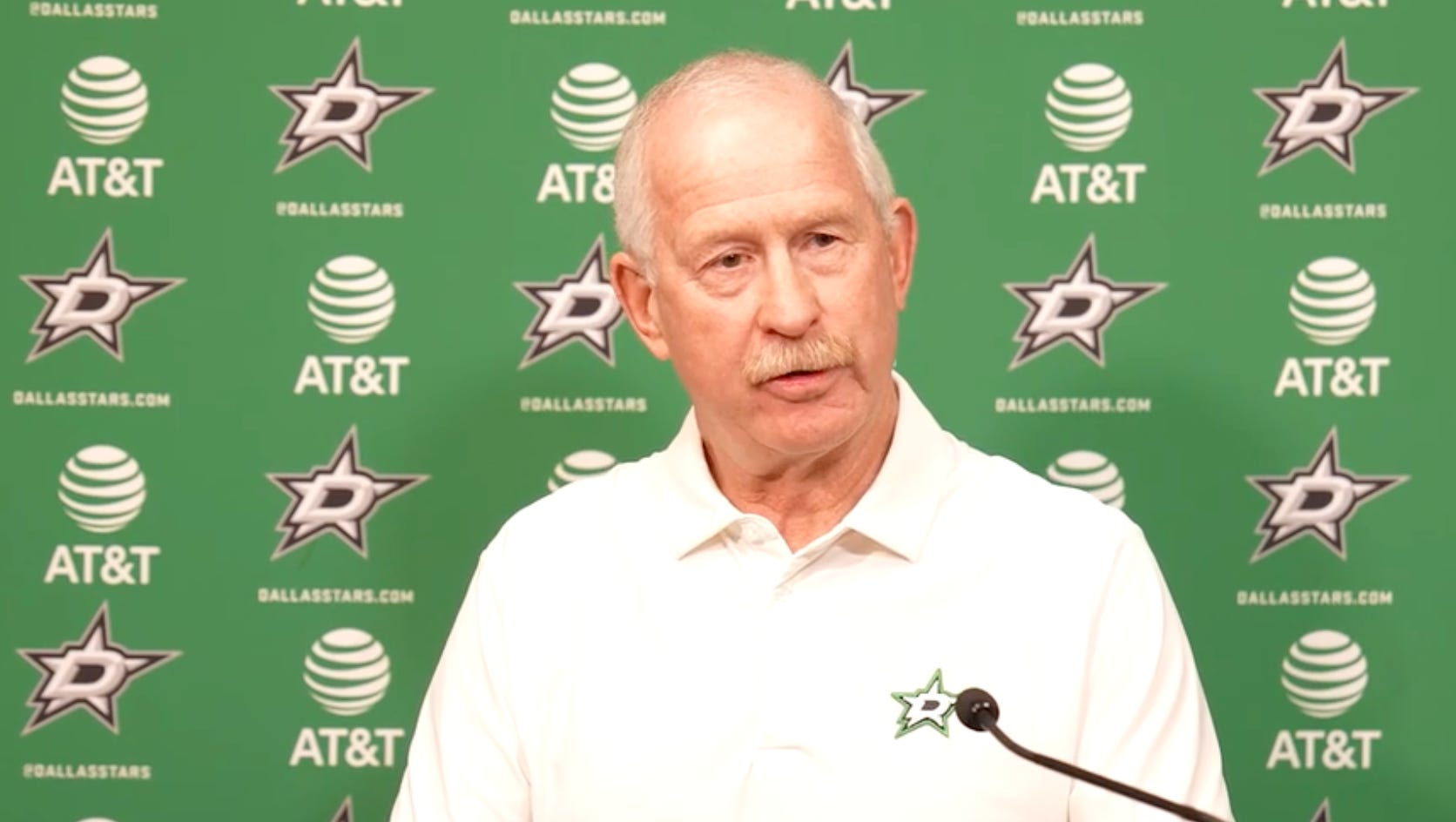
When we in the media (you might think of us as “a collection of syllogisms”) were asking both Jim Nill and Jason Robertson about why the deal got done when it did, they didn’t appear terribly eager to reveal who bent first.
Here’s part of Jim Nill’s response when asked about the timing:
“They had to go through their process. We had to go through our process. And in the end, you know, they filed. Deadlines always help to get things finished, which is important. This could have gone, I think I mentioned the last time we met here at the end of the summer, that I don’t know where this is gonna go. But deadlines help, which is, I think, good for both parties. I talked to Jason this morning. We had a good talk, and he’s up in Detroit. He just wants to continue his training and get excited about this year. He loves hockey, and he just wants to be training and know where he’s gonna be at for this season. So that’s a long story short.”
Clear enough for you? Okay then, let’s try for Jason Robertson. Here was his answer:
“Well, I mean, kind of knew where I was going. Saturday being that deadline and those meetings and everything. I think it was in our best interest to try to avoid that and figure out something before that and do something we’d both be content and happy with.”
If I might be so bold as to summarize those answers, I’d say that the prospect of arbitration was unpleasant enough to both sides that $12 million at one year began to feel not only acceptable, but even appealing, giving the alternatives. Anyone who’s ever tried to take frontage roads during rush hour knows just how tolerable it can be the next time to head up the on-ramp, joining the thousands of others who fork over their change rather than stagger through a series of jammed intersections.
You can listen to both of the above pressers in full by clicking on the linked names above. If you do, you might just come away with the same impression I did: there are clouds on the horizon, and everyone knows it.
To be clear, Jim Nill was adamant that Jason Robertson wants to be a Dallas Star. Take this answer to the question about whether January/February is another deadline for re-signing Robertson, given the NHL trade deadline shortly thereafter:
“Well, [January 1] is when we can do a new agreement. But I think we’ll be talking before that. And, you know, things happen. It’s a long ways away. A lot of things happen in this game. You know, you look back over the last two, three years, things that happen in the business. You don’t know, but that’s our plan. Let’s get the season going. He knows where he’s at. We’re happy where he’s at. We’re happy he wants to be Dallas Star. We want him to be a Dallas Star. I’ve had those discussions. Like I said, we want to make this work, and so does he.”
And then here was Robertson, when asked by Greg Wyshynski how he reconciles the fact that Dallas says they want him to retire a Star but were only able to sign him to a one-year deal:
“At the end of the day, it’s a business for them, for me, everything. I don’t know their future plans. They don’t know their future plans either. It’s too soon, so raw. It just happened yesterday. We’re both so content on getting it done and having time to re-evaluate both our futures.”
Robertson in particular was very careful with his answers, and understandably so. But if you really want to do the Big Media Market thing and overanalyze every word he used, you might take note of the fact that Robertson used a couple of “theys” when referring to the Stars during the presser. Now, given that he has been involved in tough negotiations with the team for months now, that’s a completely understandable way to phrase things. He and his camp were on one side (and will be again in a few months), while Jim Nill and the Stars are on the other. Personally, I’m not reading into things any more than that at present, but it’s just something to file away. When a player says “they were in a little crunch,” when referring to the Stars’ cap situation, my ears perk up.
I moved to a new place on the other side of Dallas this week. All things considered, choosing what wound up being the hottest week of the year for a move probably wasn’t great foresight, but that’s what I get for buying a crystal ball from that guy in the Torchy’s parking lot.
My old place in Valley Ranch was great, but it was time for a change. I’d moved there back in 2019 when the world and I were very different, so a spot in 2026 that didn’t entail hour-long drives on game days was long overdue.
Today, I’m surrounded by unpacked boxes, but there’s excitement, too.1 Change is inevitable, but there’s something invigorating about seizing it before your hand gets forced, like diving underneath a big wave just before it crashes on top of you.
Now, would I have stayed in my old place if someone had paid me $12 million to do so? Sure I would have, at least for a year. This is what we in the writing world call a “syllogism,”2 which is just one of the many words I can use to demonstrate why I would be worth $12 million, should someone discover within themselves a strange desire to so compensate me.
Jason Robertson did not move this week, as we discussed when his own one-year extension happened Tuesday evening. Why that extension happened when it did is not entirely clear, even if there are a few things we can deduce.
When we in the media (you might think of us as “a collection of syllogisms”) were asking both Jim Nill and Jason Robertson about why the deal got done when it did, they didn’t appear terribly eager to reveal who bent first.
Here’s part of Jim Nill’s response when asked about the timing:
“They had to go through their process. We had to go through our process. And in the end, you know, they filed. Deadlines always help to get things finished, which is important. This could have gone, I think I mentioned the last time we met here at the end of the summer, that I don’t know where this is gonna go. But deadlines help, which is, I think, good for both parties. I talked to Jason this morning. We had a good talk, and he’s up in Detroit. He just wants to continue his training and get excited about this year. He loves hockey, and he just wants to be training and know where he’s gonna be at for this season. So that’s a long story short.”
Clear enough for you? Okay then, let’s try for Jason Robertson. Here was his answer:
“Well, I mean, kind of knew where I was going. Saturday being that deadline and those meetings and everything. I think it was in our best interest to try to avoid that and figure out something before that and do something we’d both be content and happy with.”
If I might be so bold as to summarize those answers, I’d say that the prospect of arbitration was unpleasant enough to both sides that $12 million at one year began to feel not only acceptable, but even appealing, giving the alternatives. Anyone who’s ever tried to take frontage roads during rush hour knows just how tolerable it can be the next time to head up the on-ramp, joining the thousands of others who fork over their change rather than stagger through a series of jammed intersections.
You can listen to both of the above pressers in full by clicking on the linked names above. If you do, you might just come away with the same impression I did: there are clouds on the horizon, and everyone knows it.
To be clear, Jim Nill was adamant that Jason Robertson wants to be a Dallas Star. Take this answer to the question about whether January/February is another deadline for re-signing Robertson, given the NHL trade deadline shortly thereafter:
“Well, [January 1] is when we can do a new agreement. But I think we’ll be talking before that. And, you know, things happen. It’s a long ways away. A lot of things happen in this game. You know, you look back over the last two, three years, things that happen in the business. You don’t know, but that’s our plan. Let’s get the season going. He knows where he’s at. We’re happy where he’s at. We’re happy he wants to be Dallas Star. We want him to be a Dallas Star. I’ve had those discussions. Like I said, we want to make this work, and so does he.”
And then here was Robertson, when asked by Greg Wyshynski how he reconciles the fact that Dallas says they want him to retire a Star but were only able to sign him to a one-year deal:
“At the end of the day, it’s a business for them, for me, everything. I don’t know their future plans. They don’t know their future plans either. It’s too soon, so raw. It just happened yesterday. We’re both so content on getting it done and having time to re-evaluate both our futures.”
Robertson in particular was very careful with his answers, and understandably so. But if you really want to do the Big Media Market thing and overanalyze every word he used, you might take note of the fact that Robertson used a couple of “theys” when referring to the Stars during the presser. Now, given that he has been involved in tough negotiations with the team for months now, that’s a completely understandable way to phrase things. He and his camp were on one side (and will be again in a few months), while Jim Nill and the Stars are on the other. Personally, I’m not reading into things any more than that at present, but it’s just something to file away. When a player says “they were in a little crunch,” when referring to the Stars’ cap situation, my ears perk up.
If you’re looking for optimism, you can find it pretty simply by looking at the Stars’ cap situation starting next summer. If the Stars and Robertson really do want him to spend the next seven years in Dallas, the salary cap won’t be the reason, or at least not directly. The Stars only have seven NHL forwards signed beyond this season: Rantanen, Johnston, Hintz, Duchene, Hryckowian, Hyry, and Faksa. If the Stars want to rebuild their forward depth with Robertson as the centerpiece, they can spend a big chunk of the $40 million+ in cap space they’ll have to make it happen.
But to paraphrase some of Bob just wrote this morning, the ability to pay Robertson millions more than Rantanen and the inclination to do so might be very different things. Sean and I talked on Wednesday about what the Stars will have to decide before the trade deadline, and while Sean was more inclined to say that the Stars might be willing to do what they did with Klingberg in 2022 and keep Robertson as their own rental after the deadline even if they can’t agree to extension terms, I remain skeptical that they’ll let themselves lose him for nothing after being close on at least one big trade this summer (and possibly more than one).
If you’re Dallas, do you want to pay $14-15 million for a winger who will be 28 to start that deal? Rantanen was also 28 when Dallas got him, and I think it’s still fair to wonder what exactly the final seven years of a deal whose bulk is spent on the other side of 30 will look like. How many premium seasons does Rantanen have left, and how well would those align with the premium years of Robertson, should the Stars pony up to keep him? These are, I would think, questions that the Stars have been seriously pondering for a while now, from the top down.
If you’re Robertson, I’d imagine your thought process is something closer to this: you just had a great year, both by the league’s standards and (more importantly) by your own. You are absolutely worth being paid like one of the top forwards in the league, and it’s not your problem if one team doesn’t see things the same way.
We don’t have to rely on imagination, however, because Robertson told us what he thinks. When I asked a bad, rambling question about whether Robertson felt like he had proven something with his First Team All-Star performance this year, he gave a much better answer than the question deserved, and one that I think tells you a lot about who Jason Robertson is. I’m going to embed it for the fullest possible context.
(The below should start at 14:36, but skip to that timestamp below if it doesn’t.)
Jason Robertson is a player who holds himself to a very high standard. Those standards don’t always match the criteria of other Hockey People (as Bill Guerin made abundantly clear), but you can’t argue with the fact that Robertson started his career by showing extraordinary promise as a young player. He then experienced some obstacles in the following years (while performing pretty consistently nonetheless), but he weathered all of them and continued to grow. As a result, he had the most complete season of his career last year.
I believe Jim Nill when he says the Stars love Jason Robertson and want to keep him. I think his actions this summer support that fact, insofar as current cap constraints have allowed him to do so. This is not a player the Stars have been trying to unload at any cost.
But when Nill found himself in a position where he could turn Jason Robertson into a lucrative, Rantanen-esque package of first-round picks and Matthew Knies he tried to make it happen, because he believed it would have been the best thing for the team. That is Nill’s job, after all.
If the two sides can’t find middle ground after January 1, I’m skeptical whether the Stars would be offered a similarly rich trade package for Robertson ahead of this year’s deadline, particularly if Robertson doesn’t want to extend with anyone in order to make the trade more appealing. (Which is absolutely Robertson’s right, and I wouldn’t begrudge his doing so one bit, even if fans will probably view it differently.)
In such an event, Jim Nill (and Tom Gaglardi) would have to decide what to do: compromise on cap structure and negotiating position in order to keep a great player, or else try to get the best return they can in order to help the team. The Stars are approaching a really critical juncture where their Cup window could shorten considerably if a few things go wrong, and I am sure the decision-makers are quite aware of the worst-case scenarios. (Today isn’t the day to lay out the darkest timelines, but stay tuned for next week.)
The players have to do what they can in a labor market that offers fairly narrow windows for maximum earning power and opportunity to build a legacy. Most players value the details of their contracts differently at different stages of their career, but good agents help players account for all of the factors that matter to them in pursuit of a contract that will make the player happy.
Let’s end with this thought: Tyler Seguin’s eight-year, $9.85 million extension signed in 2018 accounted for 12% of the salary cap in its first three seasons. Rantanen and Robertson’s $12 million hits this season, by contrast, are a bit less than that, at just 11.5%. But put them together, and you have two wingers accounting for over 20% of your cap space this year and next. It is not fair that Robertson’s cap hit is judged in tandem with Rantanen’s, but it is something Dallas has to take into account when building a team. It’s always tougher being the second guy to the table after the first guy has gotten his bag.
When a team and a player can find their way to overlapping zones of contentment, it can make for a really wonderful story. Thus far, the Stars and Robertson have not found the long-term overlap that will allow that story to continue beyond this year. The biggest question at this point is whether they’re getting closer to such a convergence or getting farther from it by the day.
As usual, we probably won’t really know until the season begins. Winning tends to help, I’ve noticed.
Also, an annoying hiss from what I think is the air conditioner, so if you wouldn’t mind breaking into my place’s A/C cabinet and fixing it for me, that would be great. Thank you.
It is not a syllogism at all, but you’re probably content to assume that’s what a syllogism is, because who can be bothered to look these things up when most of the internet is just half-dead AI-pastiche, where web traffic is driven by bots, analyzed by the same, and monetized by, from what I can tell, AI-voiceovers and so-bad-we-don’t-even-care advertisements for aphrodisiacs?