
Some Thoughts on Accountability and Hockey Media
And on taking nothing for granted

Update: The NHL has fined John Tortorella $100,000 for his actions last night, and the Golden Knights will forfeit a second-round pick in this summer’s NHL draft.
Per the NHL’s release today: “The imposition of these penalties comes after previous warnings were issued to the Club regarding their compliance with the Media Regulations and other associated policies.”
John Tortorella made some waves last night for opting not to fulfill his media duties as the head coach of the Vegas Golden Knights following their victory over Anaheim in Game 6. There’s much to be said about how much that decision does or doesn’t matter, but I think it’s important to have the full context: this was clearly a team-wide thing, not just one head coach’s decision, as player availability was also more limited than usual.
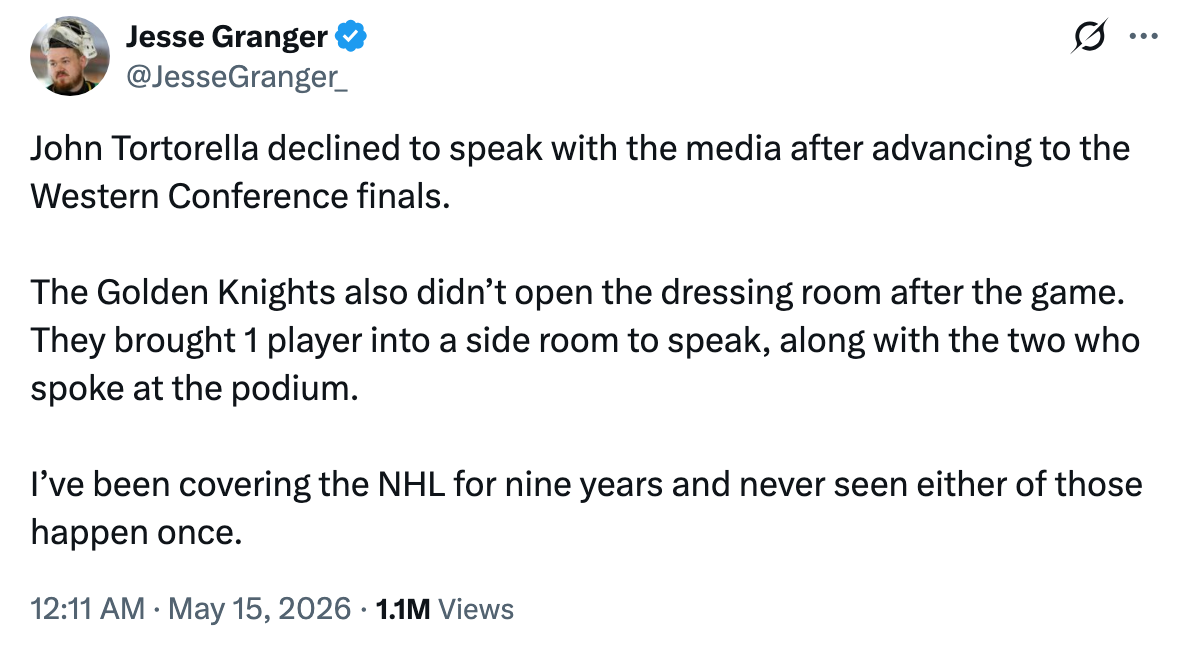
I’m sure the easiest excuse for Vegas to make will be that the team’s bus was leaving Anaheim in order to get to the airport for the return flight home. Mitch Marner even began his and Brett Howden’s postgame presser by saying “Bus in ten minutes.”
But to be blunt, those are all just excuses. The team plane could easily have departed a bit later, if need be. Likewise, the game could easily have gone into overtime. Nothing here was unforeseen or unavoidable. Vegas’s coach (and by extension, the organization) simply decided they didn’t want to bother with meeting their obligations last night.
And remember, this is the same Golden Knights club that revoked longtime NHL writer Mark Lazerus’s credential after he asked Noah Hanifin questions about Carter Hart during the preseason. This is the same organization that routinely treats its coaches and even beloved team icons with utter disregard the moment they decide they no longer have any use for them. When it comes to doing right by people, Vegas has not exactly earned the benefit of the doubt.
In hockey, players and coaches are always quick to talk about accountability on the ice. Every player and coach has to be careful to add the caveat “and it starts with me” to any criticism of the team. Rookies are routinely taught to keep their heads down until they’ve learned all the taboos and unwritten rules that allow them to mesh with the rest of the group seamlessly.
But the thing about accountability is that you have to demonstrate it. And like it or not, doing postgame press conferences is part of the job for which a head coach is accountable. It’s the one time fans actually get to hear players and coaches answer questions from independent reporters about the game they just played, and even if some of the questions will be less than revelatory than you’d hope for reasons Sean discussed well the other day, it’s still a vital part of the transparency of professional sports.
You don’t have to go back further than last spring to remember how big this can be, as Pete DeBoer’s own postgame presser following the Stars’ loss to Edmonton led to his pointing the finger at Jake Oettinger. That media availability gave everyone a deeper insight into what DeBoer was feeling and thinking, and obviously a whole lot transpired after those comments. The whole point of the media is to be the media, that connective tissue that brings the wider hockey world as close as possible to the players and coaches and executives of the teams they spend their money and time to follow.
For John Tortorella of all people to decide it simply wasn’t worth his time—whatever the reason—is just flat-out disappointing, albeit not surprising. Tortorella certainly had time to play the media game when ESPN was paying him to do so, but he’s been known for decades as someone who treats press conferences with scorn, despite the fact that he clearly has thoughts and feelings about the game that are worth sharing and discussing, whether or not you agree with them.
I mean, look: Joel Quenneville had no issue doing his postgame media after his team was eliminated last night, and he knows about press conferences better than a lot of people, considering that he and his GM recently went through a tough press conference of their own. Of course, that was a tough presser because of reasons much bigger than hockey: Quenneville’s admitted failure to protect his players and respond adequately to Brad Aldrich’s abusive behavior under his watch in Chicago.
(Aside #1: If you haven’t read the Jenner & Block independent report following their investigation, I’d recommend starting on Page 38, which details what exactly the Blackhawks staff had been told, and how they did (or didn’t) respond to that knowledge. Quenneville’s particularly hazy memories on pages 50-51 about a meeting and a phone call regarding Aldrich’s behavior are notable when compared to those of people like Stan Bowman’s.)
(Aside #2: Before last year’s Western Conference final series, I even asked Bowman about Joel Quenneville after the latter’s reinstatement had become public in recent days. And to the Edmonton Oilers’ credit, Bowman gave a thorough response, and nobody with the team said or intimated a single thing about such questions being off-limits.)
What I’m saying here is that if someone like Quenneville can take his medicine in press conferences, then so can Tortorella or anyone else in far less serious circumstances. It’s part of the game, and it’s part of the job for which coaches are paid millions of dollars a year. I’d love to assume best intent and say that Tortorella was feeling ill or something after the game, but all accounts thus far suggest that one of the most veteran coaches in the NHL simply declined to participate in the most routine of postgame NHL procedures because, as he’s made clear over the years, he didn’t think it was worth his time.
We should certainly hold the media accountable, too. It’s our job to ask relevant questions and to make press conferences more worth everyone’s while, as much as it’s within our control. But after the clinching game of a second-round series, I can pretty much guarantee that at least one or two salient questions would have been posed by the larger-than-normal media contingent in Anaheim last night. This wasn’t some mid-December blowout in front of a small local contingent. It was Game 6 of the second round of the Stanley Cup Playoffs.
But again, it’s about accountability more than quality of content. All the money that professional sports creates is ultimately there because of the fans’ interest in the team. And for a team like Vegas to repeatedly treat the media (who are paid far less than the coaches and players they cover) with indifference or even hostility is disappointing—particularly after the expansion franchise just advanced to the Western Conference finals for the fifth time in nine seasons.
Las Vegas and Dallas aren’t all that different in some ways. Both are cities filled with transplants, both qualify as “non-traditional hockey markets,” and both see summer temperatures well in excess of 100 degrees. In many ways, the ever-growing (if occasionally fraught) Dallas hockey landscape 33 years after the Stars’ arrival is what the nine-year-old NHL franchise in Las Vegas can aspire to match one day.
But Vegas has gone about their business very differently from Dallas since their inception. An expansion franchise like Vegas kind of has to do things differently compared to a transplanted one like Minnesota/Dallas, as the job of building a team from scratch is generally the toughest one in sports. Just ask the Seattle Kraken1 (or the Minnesota Wild) how tough it can be to go from Day 1 to being a perennial contender.
When Pete DeBoer ill-advisedly joked about how an optional practice on December 26 was not optional for younger players, he ended up incurring a $100,000 fine for the Dallas Stars as a result of violating the CBA. And I can tell you that when I was first looking into that story, the team didn’t push people away or make excuses to try to cover anything up. They answered questions and continued to make everyone available, and DeBoer had to answer questions about the violation multiple times. Fans knew what was going on, why it happened, and how everything was ultimately resolved.
At no point over the past couple of years have I ever been told that something is “off-limits” to ask about with regard to Dallas. Sure, common sense and good taste dictate the way you might ask about certain things, but ultimately, my obligation is to report the truth as responsibly, clearly, and (hopefully) entertainingly as I can. And the Stars, at least for as long as I’ve been doing this, have consistently opted to project transparency and accountability more than defensiveness and indifference.
Heck, even that USA Today piece by Kenny Jacoby acknowledged that the Stars gave both a 35-minute interview as well as some statements via e-mail, despite how critical that piece was of them as an organization. Given what we’ve seen from Vegas, would they even have picked up the phone in a similar situation?
If Vegas wants to be ruthless in how they approach personnel management, that’s absolutely their choice. And given all the success they’ve had in their first decade—including, like Dallas, a Stanley Cup in their sixth year in town—you’d be hard-pressed to argue with that approach.
But it’s one thing to be tough internally in pursuit of a Stanley Cup; it’s a whole other thing to spurn the very people who fly to Anaheim in order to provide fans the very best coverage they can. To treat with contempt the reporters who are there to hold the team accountable for how they honor those fans’ investment is just extremely difficult to defend, from where I’m sitting.
Don’t take my word for it, though. Here’s a member of perhaps the most veteran Vegas media outlet there is saying it even more clearly after he was at that would-be presser:
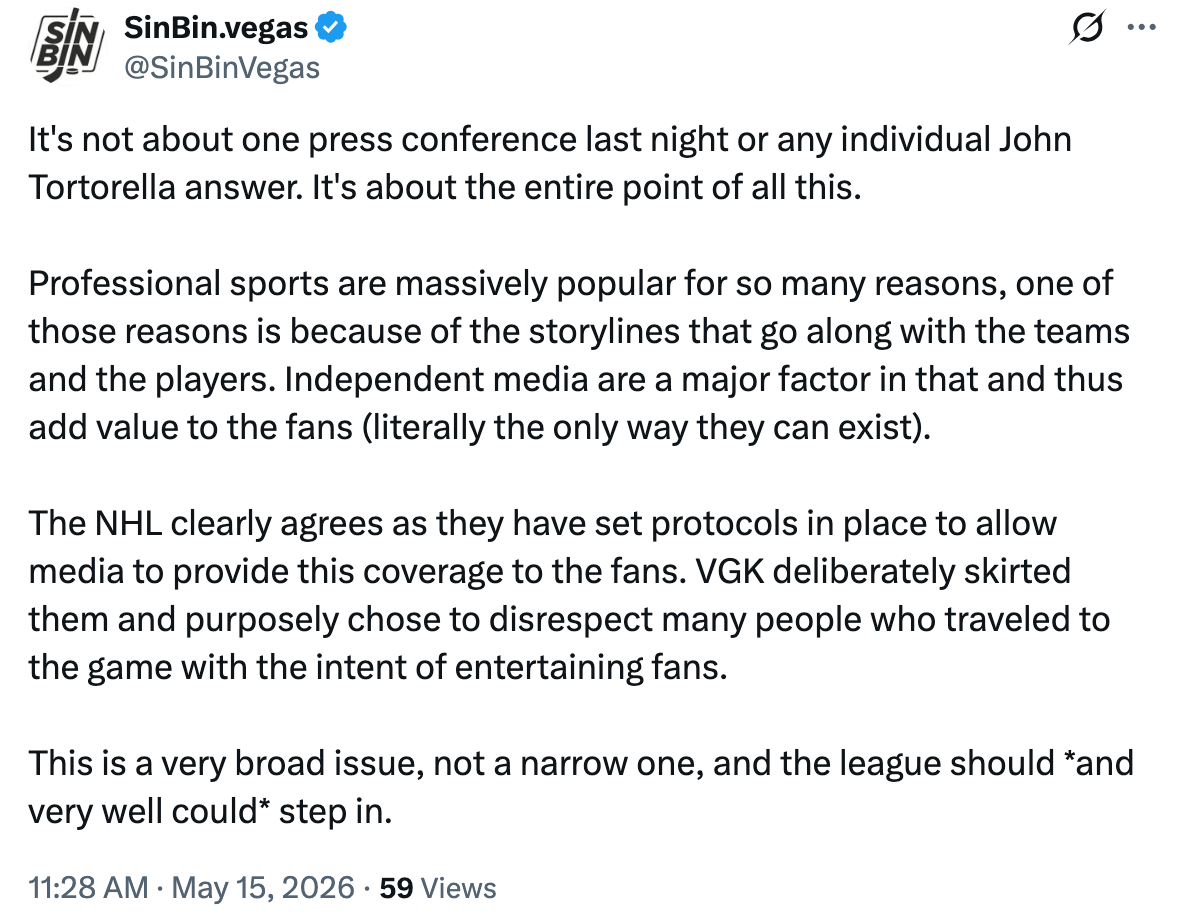
It’s about doing the right thing, even when it’s not pleasant or convenient. Everyone knows the rules in the NHL, and for a team to flout media responsibilities is a pretty wild stance to take. It’s also hypocritical, considering that every single player knows they will get healthy-scratched if they show up late to a practice or meeting during the season—even when the cause of their tardiness might have been out of their control. Accountability isn’t a real part of your culture if it only matters for some of the people, some of the time.
Again, the media should be held accountable to make press conferences more than sycophantic dog-and-pony shows. As someone in the independent space, I’m particularly aware of this. There’s a real tension between the business/entertainment side of media and the integrity that has to undergird it, if we’re to do the thing properly. But I decided a long time ago that there’s no point Doing The Journalism if you’re not going to try to do the thing honestly. And just as fans expect media coverage to be fair and honest, so also should they expect a similar level of accountability from the teams they root for.
Vegas has bet that their fans’ trust will be vindicated by the organization’s demonstrated willingness to do whatever it takes to win. That can be a very appealing part of their brand when it comes with success, as it largely has for nine years now. It’s certainly possible that players coming from places like Toronto or Buffalo might see the high degree of media “protection” a place like Vegas offers as part of its appeal, too.
Ultimately though, teams live and die because of the fans that pay their bills. And when a team chooses to limit their obligations to those fans depending on the circumstances, they might end up finding out that the cost of those choices is only fully reckoned with when they stop winning and the money stops rolling in. A team in Las Vegas should know better than anyone that you can’t keep beating the house forever.
And don’t forget that Seattle had its own screw-the-media misstep earlier this year, too.
Really good Robert. Thanks for calling them out.
Congrats to John Tortorella & the VGK - win or lose, your next press conference will be about this. 🙄