
Playoff Poise and the Space Between
Every loss a calamity, every win a vindication

For hockey fans, the worst part of a playoff series is the day after a loss. Sure, you knew going in that playoff sweeps are rare, particularly when the two teams are evenly matched. Six-game series are common, and even likely in a lot of cases. That doesn’t stop you from questioning everything about a team the morning after their best proved not quite good enough.
Nearly all of a fan’s experience of a playoff series is dictated by the path to the elimination games. Unless it’s a sweep, every series will have that morning after, that 24 hours of listless discontent. The Stars’ five-game Western Conference final win over Vegas in the 2020 bubble is a prime example: the Stars scored nine goals in those five games to the Knights’ eight, and two of those wins came in overtime. A gentleman’s sweep? Perhaps, but those who watched it will remember how Vegas evened the series with a 3-0 shutout in Game 2, while Dallas never won a game by more than one goal.
Stars fans likewise know that winning the Cup in 1999 took six games, but a lot of stories since then suggest that it was basically a Game 7 when Brett Hull scored, because the team had been so depleted and banged-up by that point that they would, in all likelihood, not have been able to beat Dominik Hašek in a Game 7.
Right now, Dallas and Minnesota are tied 2-2 in their series. Nothing else matters except the wins you bank, and both teams have taken half the pie so far. You can try to squeeze meaning out of stats from those four games, and certainly that’s the best data we have to analyze.
Jesper Wallstedt has been fantastic, and the Wild’s top defense pairing and the Boldy/Eriksson Ek duo have looked nigh unstoppable. Likewise, Jake Oettinger has gotten stronger as the series has gone on, and Jason Robertson leads both teams with four goals in four games. Concerns about Miro Heiskanen’s health appear to be firmly in the past as well. Goals in the series are 14-11, and since Minnesota’s big win in Game 1, it’s been nothing but nail-biters.
Last year, the Stars were also tied 2-2 after four games in the first round. And for all the hand-wringing going on this week about Dallas’s even-strength scoring, I can tell you that it was even worse last year. After four games, Colorado had a 9-4 edge in even-strength scoring, and Dallas’s special teams edge looked precarious at best. Without Heiskanen or Robertson, the Stars had eked out two overtime wins, but Colorado had pounded them in Games 1 & 4 by a combined score of 9-1, including a 4-0 shutout in Game 4.
After four games, Gabriel Landeskog had just made an almost miraculous comeback after a years-long absence, and Mackenzie Blackwood had thoroughly outdueled Oettinger to that point. Any reasonable person would have concluded from the goal totals, the rosters, and most certainly the underlying metrics that Dallas had gotten lucky to still be in the series at all.
Then Dallas came back home for Game 5 and did this:
Wyatt Johnston scored a fluky goal from the side of the net—sound familiar?—and Thomas Harley doubled the lead in the final minute of the first period with a shot that bounced high and, well, flukily over Blackwood. Mikko Rantanen would also score for the first time in the series to make it 3-0.
But then Colorado woke up, and it was 3-2 midway through the second period after Nathan MacKinnon decided to be Nathan MacKinnon. All the momentum was going back to Colorado, and the Stars looked like a team that would have to hang on for dear life against an offensive powerhouse. You know how that usually goes.
Just two minutes after that MacKinnon goal, however, Wyatt Johnston scored a power play goal off a pass from Matt Duchene that exploited something in Blackwood’s game that we later found out Jeff Reese deserved credit for. A Mason Marchment tip of an Alex Petrovic shot two minutes after that restored the three-goal lead, and the Stars ended up coasting to a 6-2 win.
Rantanen would stay hot for the rest of the series, including a four-point second period in Game 6 and some notable accomplishment in Game 7 you may have heard of. By the time hats were covering the ice in celebration, Game 4 was a distant memory.
The lesson here isn’t that the Colorado series was a template for success. If the Stars play that kind of series with that roster ten times, I’m not sure they win it even twice. But they did win it once, and that does something for a team. As Glen Gulutzan has said, it’s best to stay neutral in the heat of a playoff series, and Jamie Benn’s Dallas Stars have learned this firsthand, again and again. The ride is never over until it stops.
Fans want to cling to hope, some numbers beyond 2-2 that will promise security and happiness. There is no such thing in the playoffs. Underlying numbers are great, but can you score that goal, or get that save? Sometimes, doing one allows for the other; not doing so can preclude the possibility entirely.
When pressed to predict this series a week or two ago, I responded that it felt like the sort of series where whoever wins Game 5 would win the whole thing. That’s patently speculative, because loads of teams win Game 5 and lose a series, including the same Colorado Avalanche in 1999, who racked up seven goals on Eddie Belfour and the Stars before a pair of 4-1 Stars defeats sent Colorado packing for what would not be the last time in a Stars/Avs playoff series.
The Wild are not the Avalanche. They’re not as deep, not as proven, and without absolutely any of Colorado’s recent or historical success in the postseason. But the lack of things to take for granted can also make a team more dangerous, and the Wild have looked the part. Where Dallas has struck in moments of greatest leverage, the Wild have found ways to make their own leverage, whether with a rookie goaltender, a depth forward, or an elite defenseman. A team without any real skins on the wall looks like they’re salivating for what, in Dallas, would be their biggest and sweetest trophy in recent memory. If this team beats Dallas, the city will never forget it. Don’t think this hasn’t crossed the mind of every player in that room.
For now, however, you’re stuck waiting for Game 5 in which absolutely anything could happen, just like anything could in what is now a necssary Game 6. But the team that walks out of this series alive will almost surely have very little to do with the teams we saw in these first four games. Great playoff series simply refuse to adhere to linear curves.
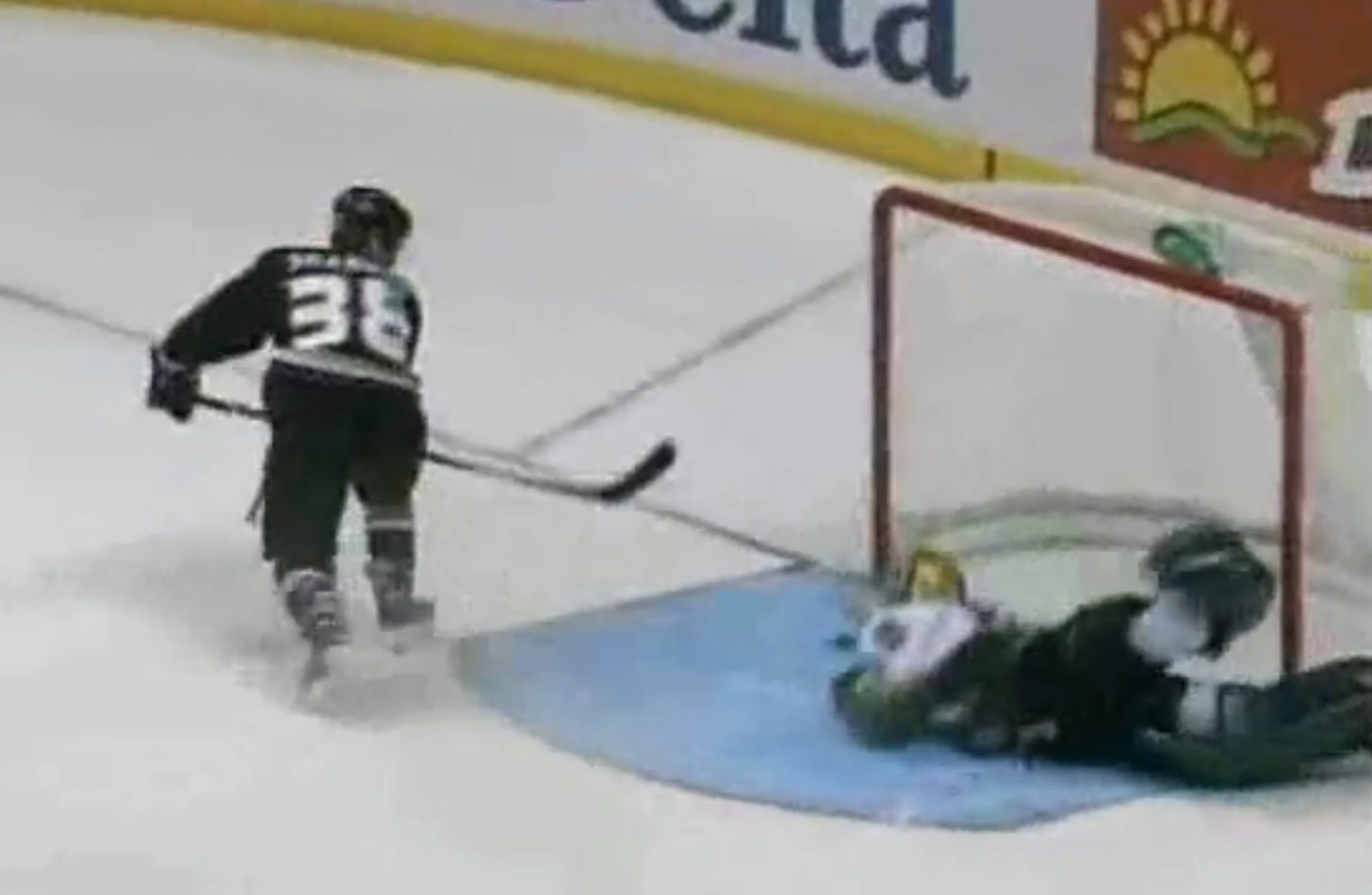
It’s kind of like that moment at the start of a shootout, you know? Whichever team you’re rooting for, you’re both excited and anxious, able to envision both success and failure as the shooter scoops up the puck at center ice and bears down on the goalie. There’s something romantic, I think, about that skate between the red line and the faceoff circles, those handful of seconds when both players are working through every combination of possibilities in their mind, while the rest of us can do nothing but sit and wait. Sometimes, a beautiful deke will draw a shout of joy, only for the goaltender to recover with a miraculous save. Until it’s all over with, nothing has been done at all, but we agonize regardless, because what else is there to do?
One of these teams will go out and win Game 5, and I genuinely have no clue which one that will be. It’s the best and the worst part of sports, that uncertainty. Liminal spaces aren’t mean for long stays, but thankfully there’s just one more day to go.
“Adventure” begins when you don’t know the outcome… everything else is Disneyland!
Poetry.