
One More Thing about that Minnesota Wild Playoff Series, Radek Faksa, and Thomas Harley
And also some free stuff for subscribers at BoomerJack's tomorrow!

Note to paid subscribers who are showing up to BoomerJack’s tomorrow: I’ll have a few random items to give away.

If you’d like one, all you have to do is walk up to me and say the name of the hockey player I’ll send out to y’all tomorrow (Tuesday) morning in the subscriber chat. You might get something cool! You might also get something less cool. Or if there are a ton of people there, I might run out of stuff altogether, because I don’t have a magic bag of holding or whatever. Also, Gavin tells me that there will be a whole bunch of other giveaways there for all attendees, so I’m sure most folks will leave with something more than just memories, even though memories are the most priceless thing of all, according to credit card commercials that have no ulterior motives whatsoever. See you there!
Just about any time a team loses in the first round, uncomfortable questions get asked. That’s true whether you’re the 2023 Colorado Avalanche, fresh off a Stanley Cup championship, and it was true for the (also) 2023 Boston Bruins, whose 135(!) points in the regular season didn’t help them in a seven-game loss to Florida.
If teams of that caliber are subject to criticism when they fail to advance, then most certainly it is true of a Stars team that is 27 years and counting from its last and only championship season. The loss hurt even more, coming as it did against the notorious playoff underperformers in Minnesota.
The nature of sports is for some things to matter more than others, and that’s especially true of Stanley Cup Playoff games vs. regular season tilts. Many players find that their games struggle to translate entirely to the intensity of the postseason, where checking is tighter, puck battles are even fiercer, and the crowd is absolutely juiced so long as the game is even marginally within reach.
Predictably, fans over this summer have been beset with (very understandable) pessimism primarily about two things: Dallas’s premature playoff exit, and the somewhat thinner roster after the departure of Mavrik Bourque. These are very reasonable and valid concerns, and it is up to the Stars to show that they can overcome those challenges to keep the window as wide-open as it’s been for the last few years.
But I was watching a shift from Game 3 over the weekend because I am a total party animal, and something about it struck me. A few somethings, really. Here’s the full clip before we touch on a couple specific points.
So the top line has just finished a shift, and you can see Wyatt Johnston heading off. Mikko Rantanen hangs out despite being a minute into his shift, on account of it’s his first shift of the game, he’s feeling fresh, and he’s Mikko Rantanen. He bolsters the weak side as the Stars change, and that’s how you get Oskar Bäck and Radek Faksa playing alongside a superstar in the offensive zone. As you’d expect, the puck finds Rantanen after he and Bäck gain the zone, and two Minnesota players converge on the Stars’ winger. This should be a turnover of some kind, by rights.
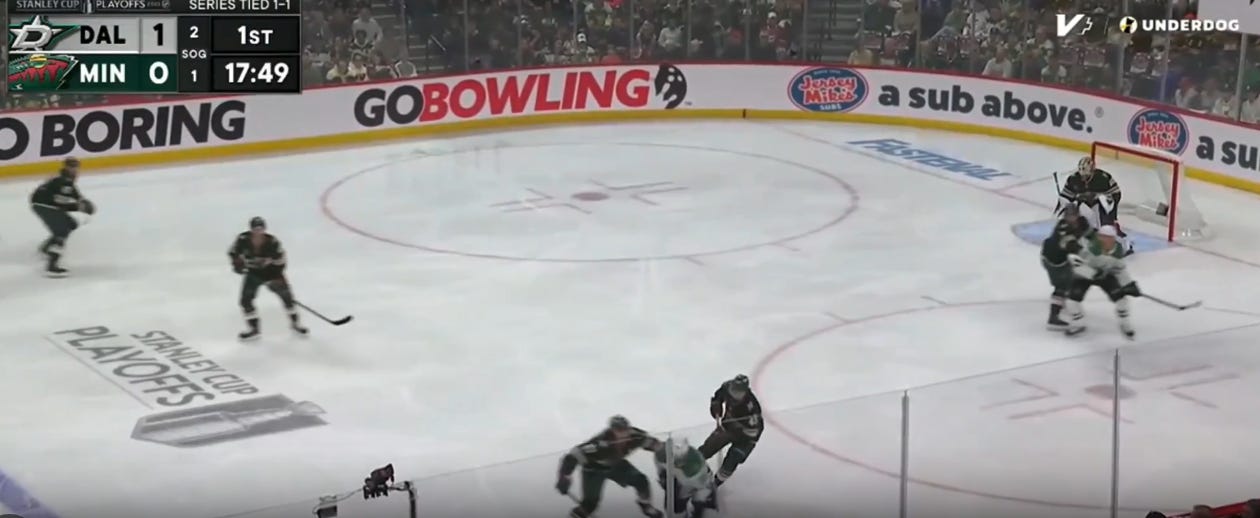
It is not a turnover. Instead, the trio of hulking forwards (all of whom are at least 6-foot-3 and easily over 200lbs) and the Stars’ third defense pairing hold off the Wild’s top defense pairing in Hughes and Faber, as well as a M. Foligno-Boldy-McCarron trio (Boldy having been on the ice for the entire time Rantanen has been out there), and the puck is fed to Faksa as he skates toward the corner.
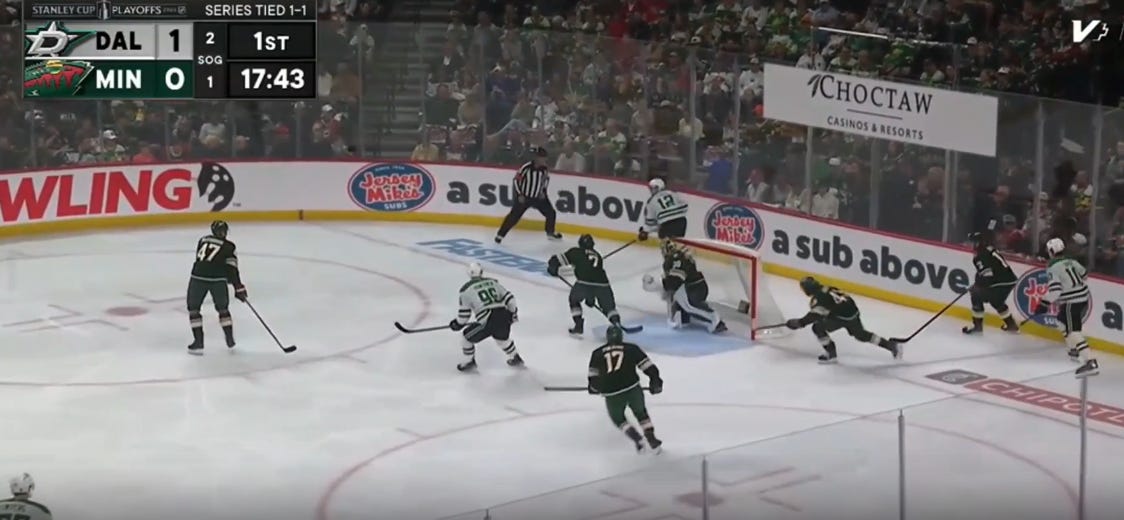
Faksa will send it to the point, where Bichsel and Myers will connect and put the puck right back in deep. Faber will catch the top of Faksa’s pants with a one-minute cross check, sending him down to the ice (with no penalty call, which is probably correct after Steel drew a marginal power play a minute earlier, on which the Stars scored the opening goal). Dallas will continue to possess the puck.
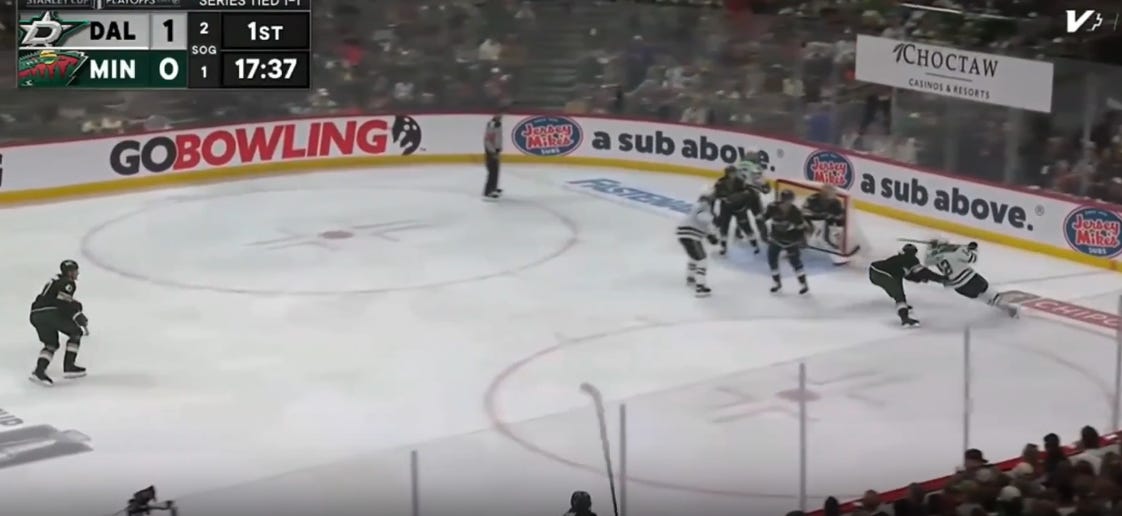
For a fourth-line shift (or at least two-third of one), spending this much time in the offensive zone is a treat. To do so against the Wild’s top D pair is even more so, and perhaps that’s why Bäck finds some extra juice as Quinn Hughes wheels behind his net to finally gain possession and relieve some pressure. One would generally expect Quinn Hughes to escape the forecheck of Oskar Bäck in such a situation, but that is not what happens.
Because the Stars’ fourth-line pressure means that Hughes has been out there for a while now, and Bäck’s reach is annoyingly effective at closing him down, preventing anything like a controlled exit. Here’s the clip:
As you saw, Hughes was not able to escape, and the puck was just bumped up the wall and eventually sent out by McCarron to neutral for a turnover, after which Dallas sends it right back in, and the lines keep rolling.
Now, Hughes would end up playing almost 44 minutes in the eventual double-overtime game (which the Stars won), and Boldy just shy of 35. One early shift in the defensive zone didn’t make or break the entire game for Dallas. But what I do think it did was establish the Stars’ fourth line as a viable option in the first road game of the series, where matchups weren’t in their favor. Colin Blackwell took most of their other shifts on that line’s right-hand side, but even without Rantanen’s magnetism, that Stars’ fourth line was absurdly dominant in Game 3 of the series.
How dominant? Well, here’s how Radek Faksa (he of the stitched-up, punctured foot) controlled play in his 13 minutes of 5v5 time in that Game 3 marathon of the playoffs. All of the below numbers are events in the Stars’ favor during Faksa’s 5v5 ice time:
Shots on goal: 4-0
Scoring chances: 5-0
High-danger shot attempts: 4-0
Unblocked shot attempts: 7-1
Expected goals: 0.81-0.03, which equates to a 97% xGF share.
Combine that with Faksa and Bäck’s perfect penalty-killing in Game 3, and you can see why that duo was trusted in every game. Fourth-liners don’t have to change the game, but they do need to do their job, and those two did that and then some in a crazy (and memorable) Game 3.
One more chart, really quickly: outside of a crazy second period where Minnesota got a double-deflection goal and two ugly (for Dallas) rush tallies, the Stars’ in-zone defense was incredible.
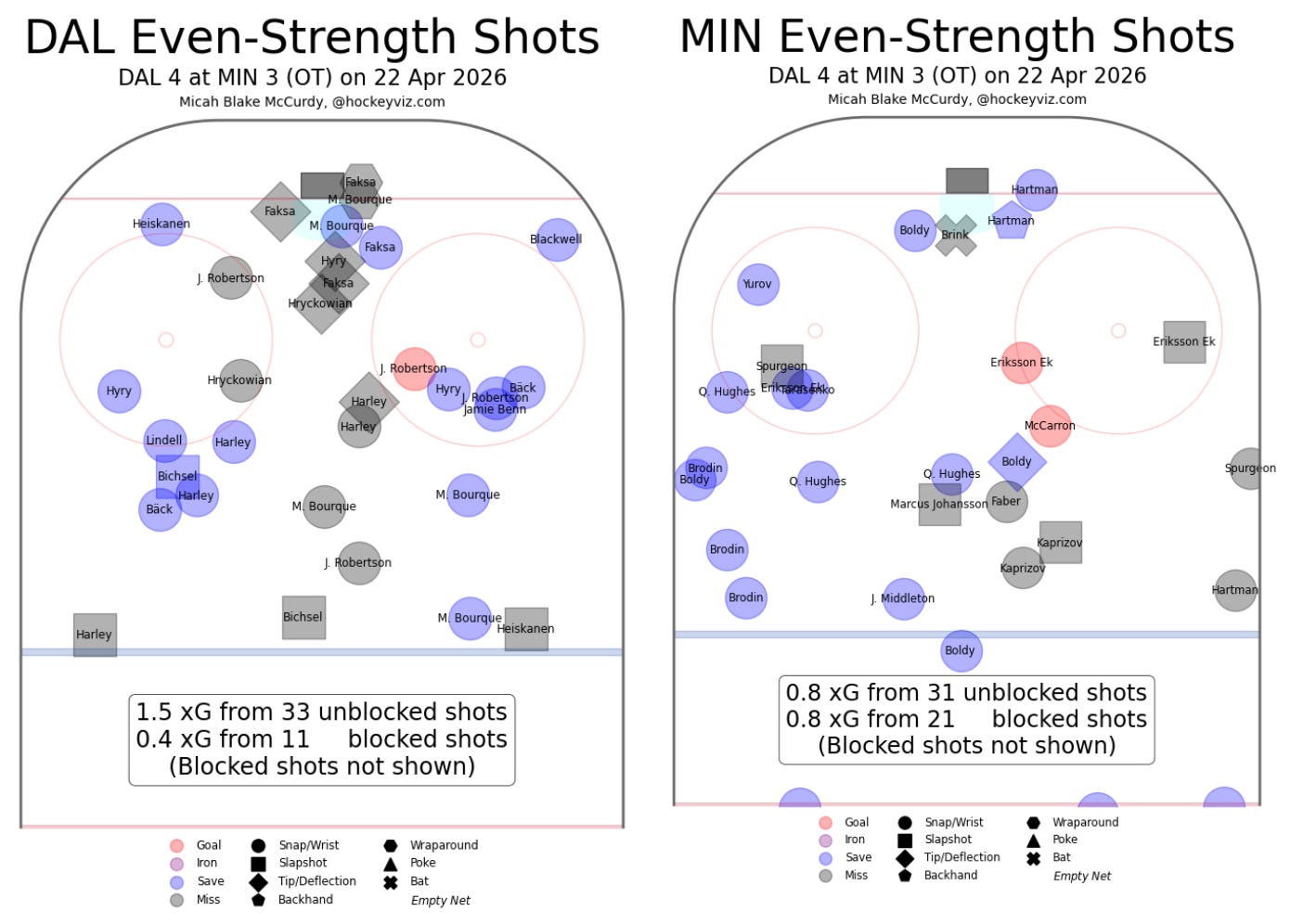
(Don’t forget about Matt Duchene’s goal-saving play after Oettinger’s stop on that 2-on-1, either.)
There’s one other thing about Game 3 that I wanted to mention, and it involves the only other player to have an expected goals share of over 90% in Game 3: Thomas Harley. Some players started the night like Faksa, showing their best even in a crazy building hungry to stomp their opponents into dust.
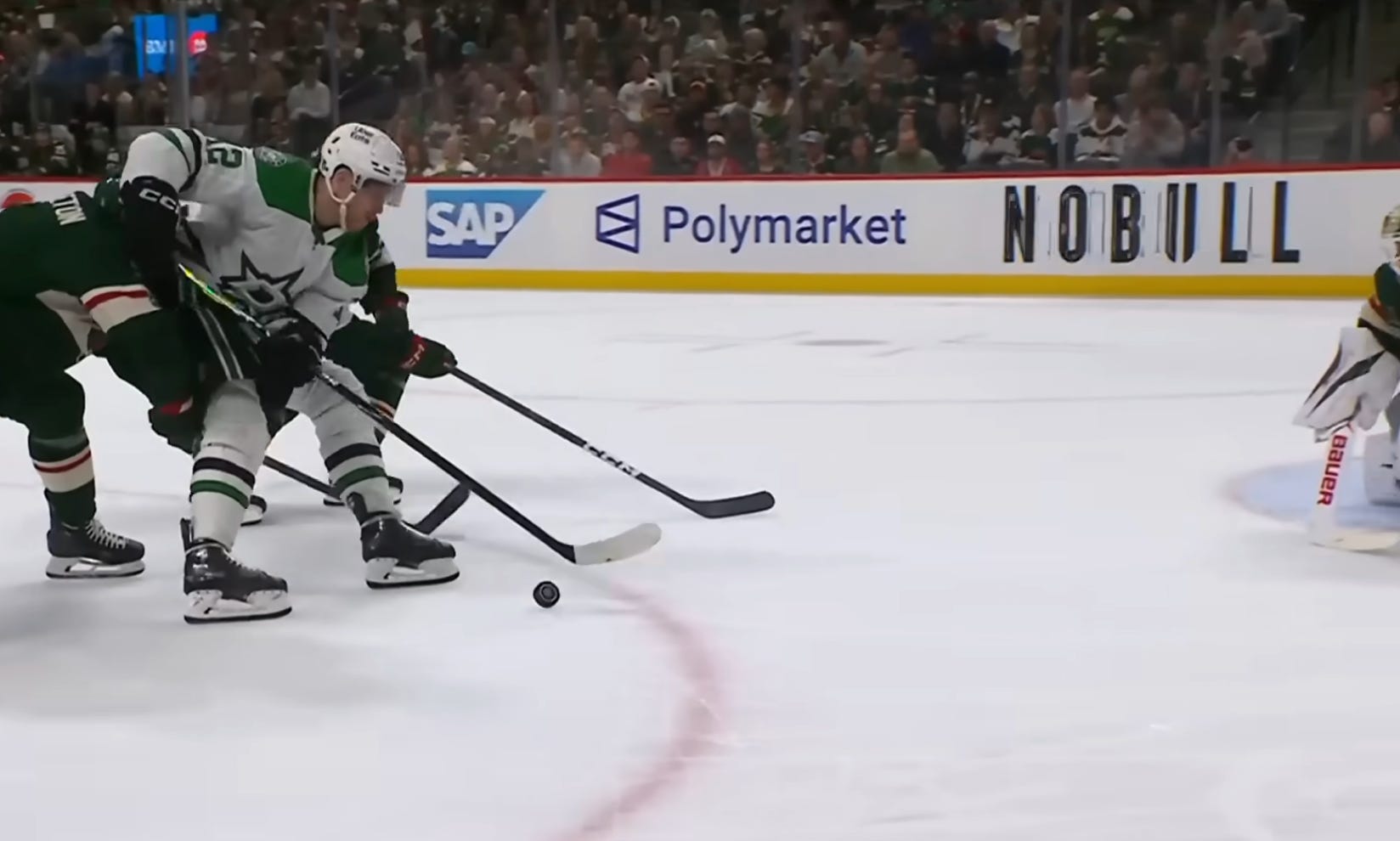
Other players needed a minute to adjust, as you can see from Harley’s opening shift, where this happened:
There’s a world where things go even worse on that play, and it becomes a microcosm of all the weird hiccups of Harley’s 2025-26 season. Instead, Harley showed the same ice water that ran through his veins for Team Canada, and he rebounded from that moment of terror to do this during his 23 minutes of 5v5 ice time:
Shots on goal: 12-4
Scoring chances: 14-3
High-danger shot attempts: 6-0
Unblocked shot attempts: 20-6
Expected goals: 1.38-0.11 (a 92% xGF share).
Harley was still good after game 3, but not nearly as dominant in the final three games of the series. Losing his defense partner in Game 4 and playing 29 minutes in back-to-back games probably had something to do with that, as the reality was that Dallas’s right-side defense became a liability in the final two games, between Myers’s struggles and Lundkvist’s absence.
There’s a reason that even purported top-four RHDs command insane salaries in this league, and with Nill’s attempt to acquire Zach Werenski, you can’t say he wasn’t willing to swing big in order to solve that issue, even if it would have cost the Stars Harley to do so. (Yes, Werenski is a left-hand shot, but he has played on his off-hand side, because it turns out elite defensemen can do that.) Time will tell how that all works out in the long run, but there’s no denying that Harley will be coming into this season with just a little bit more to prove.
In Game 6, Myers was finally scratched (and I’m sure he would be the first to admit that his play through the previous five games merited it), and Harley was paired with Heiskanen. It wouldn’t matter, and the Wild got past Dallas to earn the privilege of losing 4-1 to Colorado in the next round.
I do think there’s an argument to be made that a more stable top-four defense group in Games 5 and 6 could’ve swung things the other way for Dallas, even if the underlying injuries and absences in the forward group (and to Heiskanen) probably had sunk the Stars’ Cup chances before the playoffs even began. Obviously results are all that matter, and there’s no redeeming a first-round exit, particularly one with such meager 5v5 goal-scoring as Dallas managed.
Even so, the more you look at this series, the more you can understand why the Stars aren’t exactly punting on a season by largely running things back. Sure, Jim Nill did try to make a couple of seismic shifts over the summer, neither of which panned out. But it’s not like Dallas isn’t still a really good hockey team. They are that, in fact!
As for Game 3, the Wild had no business pushing it as far as they did, but the second period of the third game of the series showed what that Wild team was capable of: with one good bounce to get the crowd back into the game, they were able to punch Dallas in the mouth and capitalize on a couple of Grade-A chances (one of which Oettinger needed to stop). They almost stole the game right there, until Matt Duchene was able to tie things back up on the power play, and Johnston would win it two periods after that.
It was a crazy game, as you may recall, but the Stars got the win they deserved in the end. Unfortunately, it wound up being their last victory of the season. But if I might Columbo you all for a moment, this game almost didn’t require overtime, because of one other play in the third period that involved both Thomas Harley and Radek Faksa. Here it is:
Harley makes a wicked stretch pass off the boards, and it finds Faksa in behind Jake Middleton. Faksa uses his size to protect the puck, and he drives to the net, where Wallstedt manages to get something on the shot. But Wallstedt pretty clearly had no clue where the rebound was until a microsecond before Mavrik Bourque’s stick arrived.
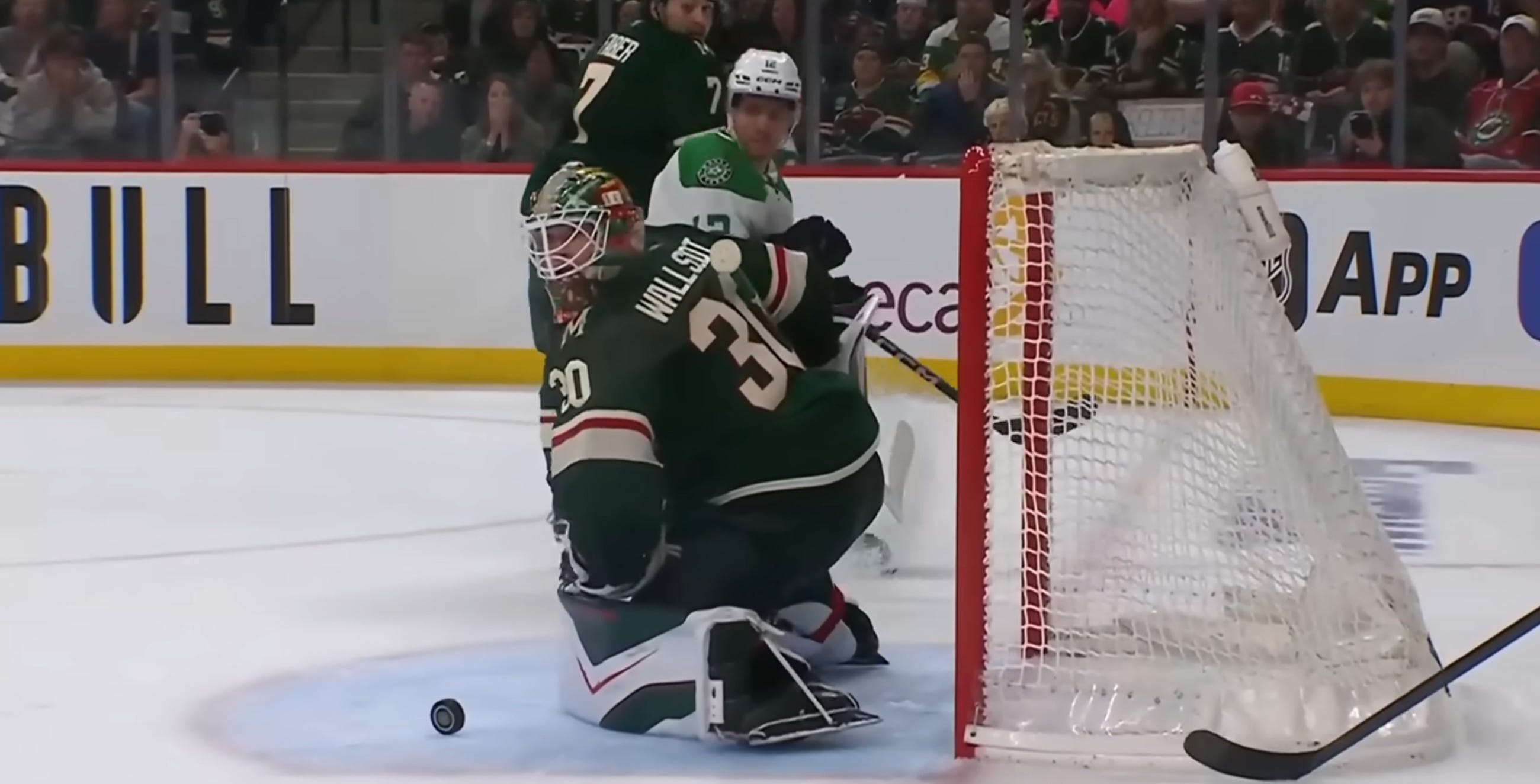
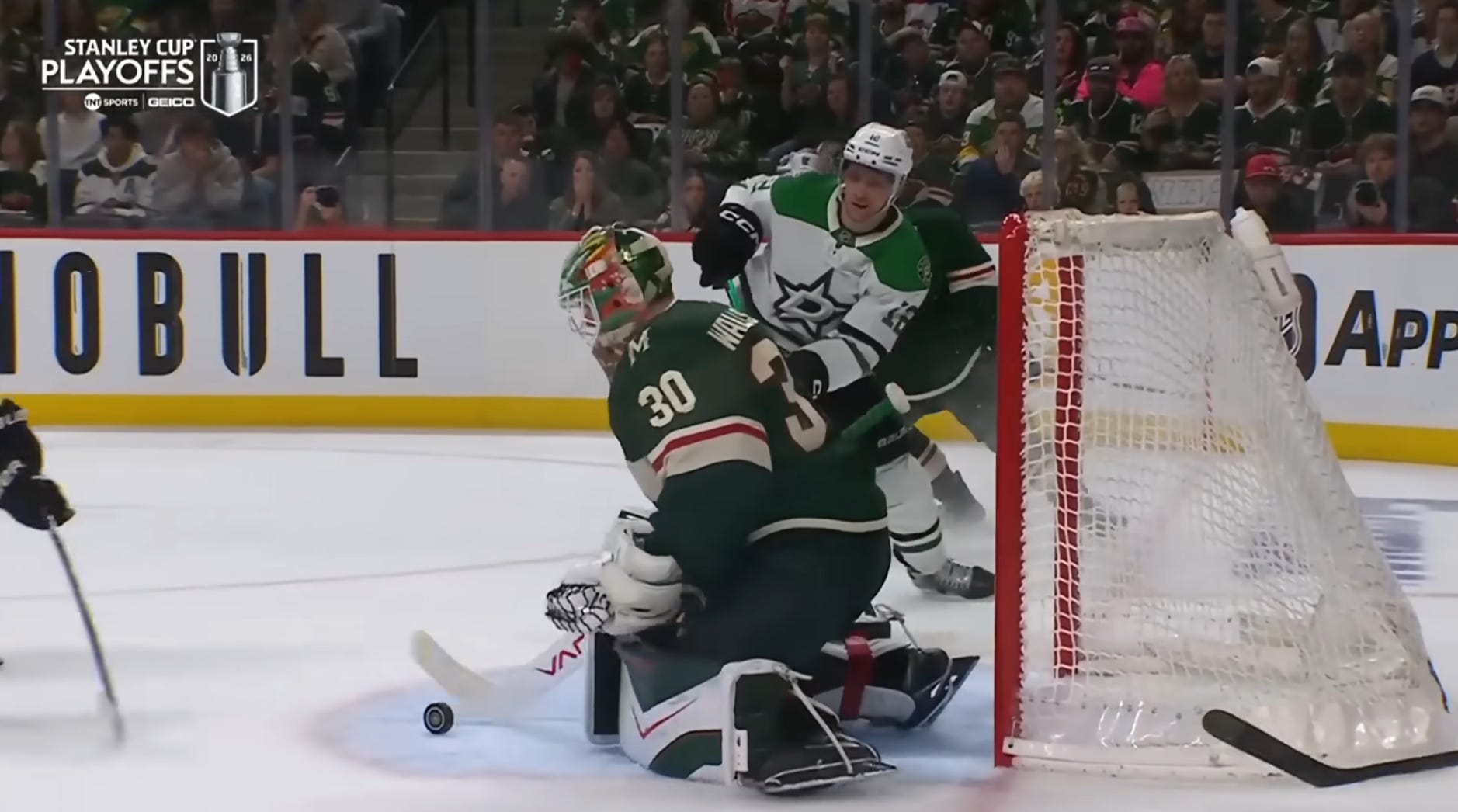
These are the moments that change games, and sometimes more than that. If Dallas wins this one in regulation rather than requiring double overtime, does anything change in the series? I have no idea, but it’s probably not outlandish to suggest that playing less hockey would have benefited the more banged-up team. Of course, Dallas didn’t win in regulation, and they didn’t win any of the next three games. For that, they can blame nobody but themselves.
(Also, how about Joel Eriksson Ek grabbing Bourque’s arm and taking a dive here in overtime to try to buy a call? I’d have to think he’d have been fined if this had drawn a penalty.)
Game 3 was a reminder that, for all of the talk about Dallas needing more from their forward depth and more from Thomas Harley in general, they actually got precisely that, for a little bit. It turns out that this is a good team!
That doesn’t guarantee anything at all, and better teams than Dallas have lost in the first round before. Such teams surely will again, but sports would be a lot less fun with more guarantees. All we can really do is ride the wave, whatever it brings. After it crashes, you just have to wait for the next one, and hope it takes you farther. Maybe that’s masochism, or maybe it’s just good old-fashioned fanaticism. Sports are healthy, right?