
Nils Lundkvist Has Finally Found His Place in Dallas
Another season was marred by injury, but Lundkvist finally showed what he's capable of

Brief note: Don’t miss the bonus episode of AIH that Sean and I recorded with former Stars player Jason Demers1 which just went up today. It’s a really entertaining chat, so give it a look.
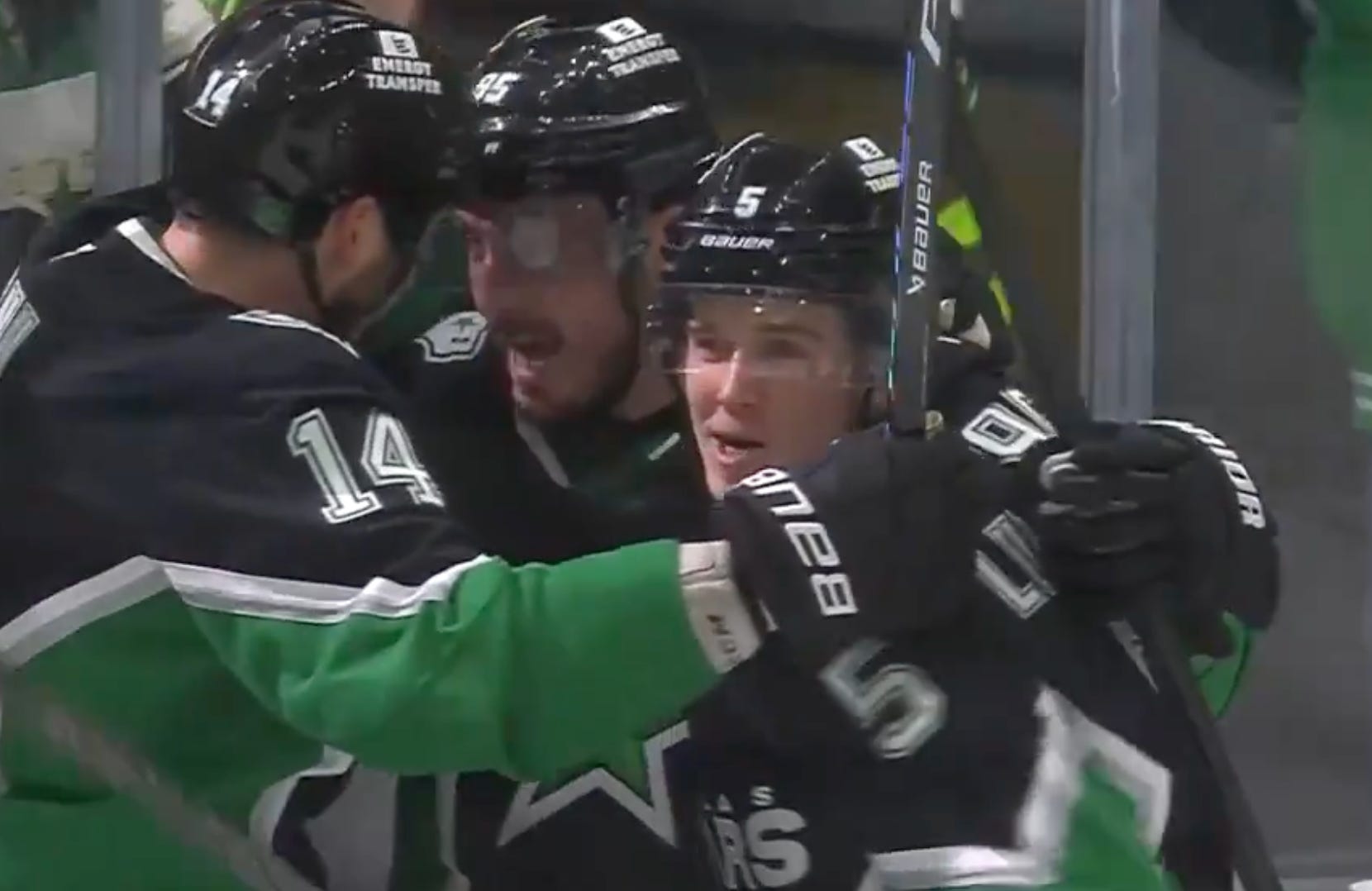
The season couldn’t have started better for Nils Lundkvist. After missing the second half of last year and the entire Dallas playoff run, Lundkvist opened the 2025-26 season with a two-point night in Winnipeg, including this goal past the reigning Hart and Vezina Trophy winner Connor Hellebuyck:
For me, Lundkvist’s moment in the next game was just as impressive, if not more so, as he confidently led a rush chance against Colorado and bulled his way to net, starting a scoring chance that Mikko Rantanen and Thomas Harley finished in style:
Unfortunately, things got derailed shortly after that. Those three points in two game would be followed by only eight more in the rest of the regular season, because Lundkvist had the unenviable distinction of starting a trend of literal bad breaks in Dallas.
Lundkvist would miss six weeks after suffering a fracture to his lower leg/ankle area in the fourth game of the season, against Vancouver. The play happened off-camera and wasn’t shown on replays—yes, I checked both broadcasts—but to my recollection from way up in the press box, Aatu Räty finished a check on Lundkvist along the boards in the second period on October 16, and Lundkvist immediately went down the tunnel with what we later found out was a fractured lower leg/ankle.
We would end up learning that Lundkvist and Bichsel suffered oddly identical injuries, but I won’t show a replay of Bichsel’s injury for reasons of good taste. Still, if you remember how Bichsel’s skate got wedged into the boards, you might have some idea of what may have happened on Lundkvist’s injury.
In any case, Lundkvist had to use a knee scooter for a bit, and by the time he returned in early December, the Stars were well into the depth of their blue line with Harley and Bichsel both on shelf. But despite a smattering of time with Lindell and Kyle Capobianco, Lundkvist spent the bulk of the year paired with Harley, to great effect.
In over 540 minutes together at five-on-five, Lundkvist and Harley were very good, though we’ll discuss Harley’s more volatile season as a whole in the coming weeks. Here’s an eye chart with the Stars’ three most common pairings in the regular season, just so you have a relative idea of where the Harley-Lundkvist pairing’s numbers lie. The most important number, of course, is their 27 goals for, and just 17 goals against while on the ice:

That 60% share in 5v5 goals is either inflated or a more telling representation of the work that pairing did in the most important areas of the ice, depending on how you approach it. Lundkvist’s strongest stretch came when the team’s as a whole did: from late January to early March, when his confidence and mobility meshed seamlessly with the entire team’s work rate and aggression to create goals like this one—again, scored on the unfortunate Connor Hellebuyck.
If you watched the playoffs, you already know how good Lundkvist was then, too. He and Harley put up 60% or better in all their pertinent 5v5 metrics against Minnesota, and after being on the ice for two goals2 in Game 1, Lundkvist didn’t see another Wild goal go in while he was on the ice, while Dallas scored three of their own (including a pair of Lundkvist primary assists in Game 2).
Sure, Lundkvist and Harley faced the second defense pairing a bit more than the Hughes-Faber combo, but one second defense pairing won their minutes against the other, and that’s the job, generally speaking. When Lundkvist was concussed out of the playoffs by a vicious (and accidental) skate to the face, the Stars’ blue line was never the same.
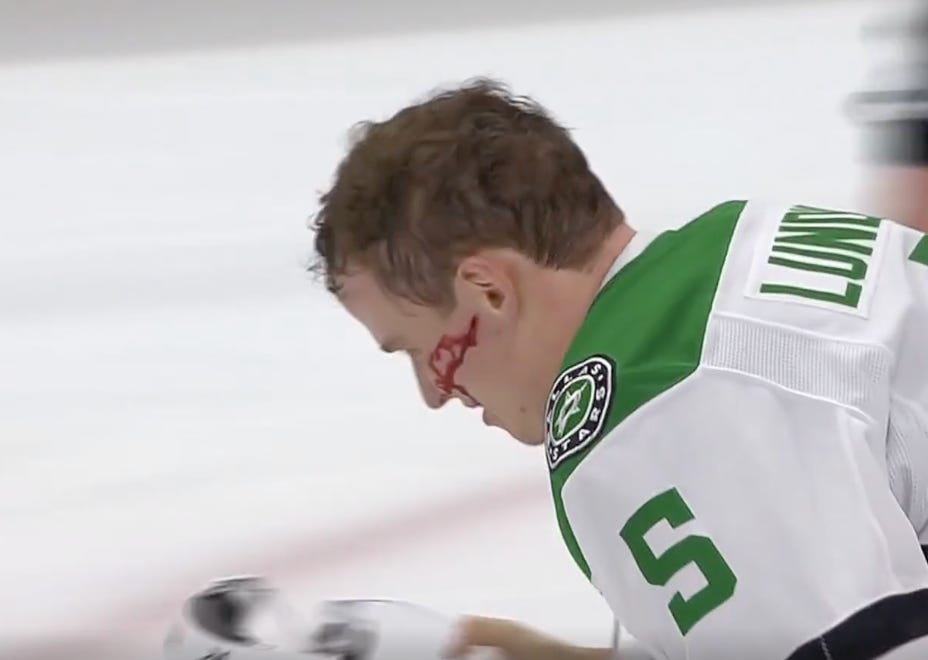
And when you consider that this was really Lundkvist’s first run-out as a full-time blueliner in the postseason—he averaged an absurdly low 4:28 per game in his 12 playoff games under Pete DeBoer—the job he did playing 16+ minutes a night before his concussion was a very satisfactory one indeed.
Overall, Lundkvist earned a “T” grade for this season, for his tantalizing show of just how much he’s grown since his arrival in Dallas four(!) years ago. This is no longer a player with the mere potential to grow into a mobile right-shot defenseman, but such a player already. It was telling that after acquiring Tyler Myers in March, Glen Gulutzan still opted to keep Lundkvist paired with Harley, rather than elevating the much larger and much veteran-er Myers. (And given what wound up happening when Myers was elevated out of necessity after Lundkvist’s Game 4 injury against Minnesota, Gulutzan knew what he was doing.)
In Gulutzan’s defensive system, Lundkvist seemed to thrive on knowing where he needed to be defensively, and likewise when he could activate the other way. In the old man-on-man coverage under DeBoer, Lundkvist appeared to grow a little more gunshy with each passing year, perhaps more worried about being out of position than driving play when opportunities presented themselves. In more conventional D-zone coverage, Lundkvist performed well in transition, perhaps benefiting from clearer delineations and more assurance of coverage when he chose to go forward.
Teasing causes and effects from the usual shot metrics was trickier than ever this season, both because of the changes Gulutzan made and because of how much of a roller coaster the 112-point season could be, at times. In one sense, Lundkvist’s peak with Dallas still appears to be his 2023-24 stretch alongside Ryan Suter, though that pairing was so heavily sheltered in the offensive zone that I’m inclined to say his tougher minutes alongside Harley this year are a stronger proof of concept than anything we’ve yet seen.
You can reach for a lot of different players as hopeful comparables for Lundkvist, whether someone like Gustav Forsling or Sam Girard, but perhaps the best way to understand Lundkvist is to recognize his tools for what they are. He’s capable of excellent defensive stickwork, and his skating is a genuinely great asset. Pairing smooth skating and speed with outstanding fitness allows him to cover a lot of ground, and that’s just as valuable in gapping up on attackers and closing down puck-carriers as it can be in transition.
Furthermore, Lundkvist still has an underrated release which is capable of things like the 95 MPH bomb he stepped into against the Islanders in late March (which was blockered away by Ilya Sorokin). Lundkvist isn’t likely to return to the power play in Dallas any time soon, however, so smarter wristers are probably where he can make his shot shine most brightly, as he did in the first game of the season in Winnipeg, or in the playoffs against Minnesota, on the shot Robertson tipped in:
I think there’s a lot to like about Lundkvist’s game, and even more one you separate yourself from the journey he’s had. So often we bemoan how traditional NHL thinking gravitates towards the Greg Pateryns of the world when it comes to bottom-four defensemen, but if the Lundkvists of the world are being trusted for second pairing minutes, I don’t have much issue with a Pateryn3 or a Hakanpää or a Myers being deployed on the third.
Nils Lundkvist is four years removed from being acquired from New York for Jim Nill’s first of many first-round pick trades. The emergence of Thomas Harley during that time has lessened the Stars’ need for Lundkvist to channel his inner John Klingberg, but this season was the first time you really began to see how that could still be a good thing. Combining an irrepressibly positive disposition with a high work-rate and a deep skillset could make Lundkvist as valuable as his coach wants him to be. And it sure seems like the Stars have a coach who is excited to explore that ceiling, for once.
Yes, Lundkvist could really use a fully healthy season to ensconce himself in Dallas’s top-four, but this year’s injuries were more of the freakish variety than anything else, so I’d still bet on him carpe-ing the diem out of 2026-27. When Jim Nill signed Lundkvist to a very reasonable two-year extension at $1.75 million per season back in April, it looked like a bargain. By this time next year, it could well end up being a steal.
The parallels between Demers and Lundkvist are interesting, if you’re inclined to draw them. Both RHDs who could skate well, both of whom tended to play on the second or third pairings, and both of whom were acquired by Jim Nill to address Dallas’s dearth of right-handed defensemen. One main difference is that Demers, of course, was a seventh-round pick who worked his way into the league, while Lundkvist was a first-rounder for New York.
Neither of which Lundkvist bore much responsibility for, in my opinion: the first was the Kaprizov goal from the sharp angle on the left side, and the second was the Faber bank shot that went in off Hartman at the back post.
We are big fans of him.in our house. He was SO awesome to my kid at a practice in Frisco. Glad he is one of ours, and looking forward to a fully healthy year for him and Harley both next season.
Here’s hoping that contract becomes a steal. It was great to see him given opportunities this season and what he did with them.
I kind of wonder what he would be like with Heiskanen, but I also kind of think there are a half dozen reasons for that pairing to never get more than five minutes of intentional time together.