
Monday Rundown: Looking at Glen Gulutzan's Jack Adams Case
When your team is 42-14-10, you're probably doing something right

Welcome to the Monday Rundown. The Minnesota Wild lost to the Toronto Maple Leafs last night, because nothing makes sense in the NHL these days. This is the weird time in the schedule where the Give-Up and the Try-Hard can blend together for teams on the margins (or further out) the playoffs, and it can make for wacky outcomes all over the place.
That, as much as anything, is what has made the Stars’ 14-0-1 run so ridiculous. There have been some close calls—particularly against St. Louis—but generally speaking, Dallas is playing great hockey, and they’re getting the results they’ve deserved. That almost never happens this often at this point in the season. Hockey is normally just way too random for that level of consistency.
As of Monday morning, Stars are just three points back of the Colorado Avalanche, which shouldn’t be possible considering those same Avalanche posted two different stretches of 14-0-2 and 12-0-1 in the first half of the year. Catching a team like that in the second half shouldn’t be remotely possible, unless you steal their skates right before each game.
To be clear, chasing down Colorado is still a long shot. All the oddsmakers still have Dallas at well over 90% to finish second and face Minnesota in the first round. That’s the smart money when all factors are taken into account, though any money you decide to bet on NHL games right now is the furthest thing from smart.
With that said, let’s move away from standings talk and get into some specifics. Because today, we’re going to focus on one key topic that will involve touching on a host of other ones. And in case you have a conscientious objection to reading headlines or something, I’ll go ahead and tell you what that focus will be: Glen Gulutzan.
Per NHL.com, the Jack Adams Award is presented annually “to the coach adjudged to have contributed the most to his team’s success.”
Here’s a list of the last dozen winners of that award:
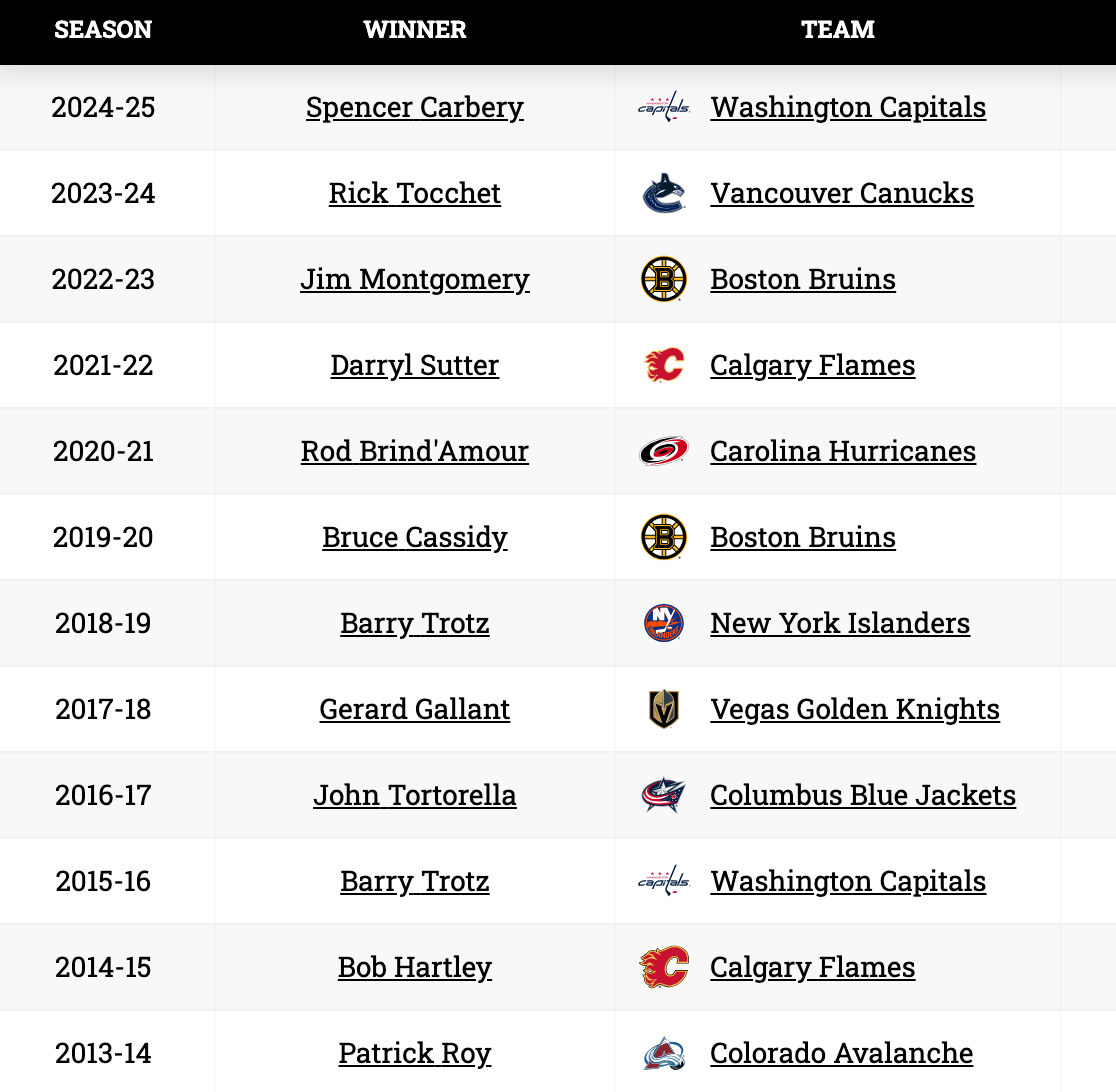
You may recall some amusement a year or two ago about the fact that all three finalists from 2023 were fired not long after being voted as such. And indeed, the same is true of (most) of the winners: they didn’t last long at all, with the exception of Rod Brind’Amour. The volatile nature of coaching in the NHL means that almost any hiccup (or even a Western Conference finals run…) can end with a coach losing his job.
Look down the list, and you’ll see Ken Hitchcock was a finalist for three straight years in Dallas from 1997 to 1999, but never the winner. No, Hitch had to wait over a decade for his Jack Adams, finally winning it in his first year with St. Louis in 2011-12, when he suffocated opposing offenses with typical Hitchcockian excellence.
[Quick aside: Those ‘11-12 Blues only gave up 165 goals in 82 games, or just over 2 goals per game. But it gets even crazier: Hitch didn’t get hired until Davis Payne was fired after a 6-7-0 start. And in the next 69 games under Hitchcock, the Blues held teams to just 130 goals—a terrifying 1.9 goals per game.]
Anyway, it’s a weird award, and if you’re someone like Glen Gulutzan, maybe this is the last one you want to win, given its recent history. But putting the future aside, let’s talk about how Gulutzan compares to other NHL coaches that are being talked about this year when it comes to having “contributed to [their] team’s success.”
Jon Cooper
Cooper is the leader in the clubhouse right now, because things are shaping up to make this year’s Jack Adams a lifetime achievement award for Cooper, who absolutely ought to have won this award long before now.
Cooper is a charismatic personality who sticks out among the swath of ex-players behind other benches, but it still blows my mind how overlooked he’s been for so long. This piece from a decade ago notes all the things that are still true about Cooper today: He’s careful with his words, unique in his approach, and effective with his tactics.
Here’s what Brandon Hagel told NHL.com about Cooper:
“He's the best coach in this league, and the way he handles himself, especially in those ups and downs, that's not easy. To come around and still put a smile on his face after everything he's been through is pretty impressive. He treats us like his kids. We're one big family in here and it starts with him."
But that’s all been true about Cooper for a long time now. So why is the hockey world only now deciding that the coach who won back-to-back Stanley Cups five years ago might actually be, like, good at his job? Well, here’s one anonymous voter from this ESPN piece:
"Jon Cooper has continued to guide his team through nonstop injuries up and down the lineup. His ability to motivate different personalities is an art," another voter noted.
Okay, let’s talk about the personality thing first. Because Gulutzan has come into a Dallas locker room with a host of different temperaments, voices, and age groups, and found a way to make it all coalesce.
Sometimes, it’s involved one-on-one conversations and problem-solving with players like Matt Duchene, whose remarkable recovery and turnaround deserve way more widespread attention. At other times, Gulutzan has been clear that he’s opted to take a lighter touch, trusting players to sort things out without his getting too much into their business. It’s been the furthest thing from a one-size-fits-all approach. And while that surely requires countless hours of work we never see, it’s also reaped rewards we never would have expected.
Gulutzan said from his first day on the job that he was looking to implement things that fit the talent Dallas had, not to box players into Gulutzan’s Way before he even knew what he had.
He’s been true to his word on that account, and the Stars’ underlying numbers and overarching performance have borne it out.
Now, the injuries. Tampa Bay has certainly had their share of injuries, including a big one to Victor Hedman earlier in the year. But NHL Injury Viz actually has Tampa and Dallas right next to each other when it comes to the true impact of their respective injuries:
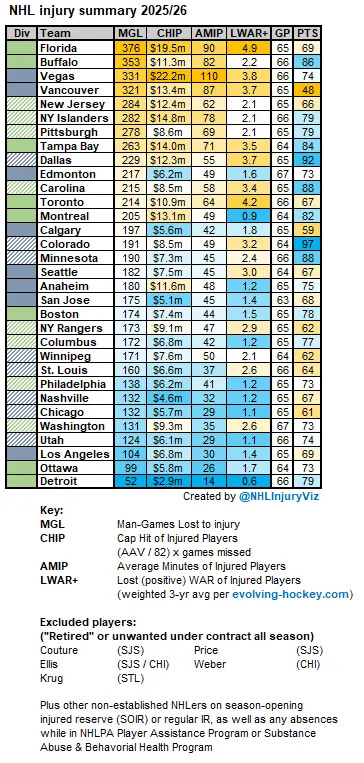
And with Dallas continuing to rack up man-games lost for key players like Rantanen and Hintz, I’d expect Dallas to creep past Tampa Bay before too much longer.
Gulutzan has faced every bit of the injury adversity that Tampa Bay has, and is still doing so. But try this on for size: Here is how the Dallas Stars have done when they’ve been without three of their most important players:
Without Mikko Rantanen: 10-1-1
Without Thomas Harley: 9-1-2
Without Roope Hintz: 11-0-2
Oh, and by the way, they’ve done this all with Jake Oettinger having a fairly humdrum season by his standards. Meanwhile, Andrei Vasilevskiy has put up Vezina-caliber numbers, and looks as likely as anyone to win the award as things stand now.
Head coaches being praised (or vilified) for their goaltender’s performance is nothing new in the NHL, of course. But with both Tampa and Dallas boasting similarly stingy defenses—they’re literally right next to each other in xGA/60—I find it hard to believe Jon Cooper deserves that much extra credit for a future Hall of Famer having himself a fantastic season.
So, let’s talk about a coach who’s benefiting from the other half of the PDO combination.
Lindy Ruff
Ruff has been a finalist twice in the last decade: with New Jersey in 2023, and with Dallas in 2016. But we’re talking about Lindy Ruff here, so one decade isn’t nearly enough to talk about his history with this award.
In fact, Ruff did win a Jack Adams, doing so way back in 2005-06, when the Sabres put up 110 points in the crazy, post-lockout season. The even crazier thing, though, is that Ruff was also a runner-up the next season, in 2006-07, when Buffalo won the Presidents Trophy with 113 points. Ruff lost out that year to new challenger Alain Vigneault, who—shocker—got rewarded for coaching a world-class goaltender in Roberto Luongo, as Stars fans will unfortunately remember.1
Anyway, Ruff and the Sabres have been the best story in the NHL this year, so it wouldn’t surprise me at all to see him get rewarded for breaking that city’s Stanley Cup Playoffs drought. Anyone who’s had to coach in Buffalo as much as Ruff has probably deserves some recognition.
Ruff would be a runaway candidate in almost any other “normal” Jack Adams year. But the buzz for Cooper started early, and from some of the big names in hockey media, so it’s going to be legitimately interesting to see what route NHL broadcasters (who vote on the award) take after 82 games.
I do think it’s worth pointing out that Gultuzan and the Stars had their own taste of adversity this year, including their four-game losing streak right after Matt Duchene’s concussion in their home opener, not to mention dropping ten of twelve at the turn of the year. To rebound from both of those stretches without panicking or overcorrecting has been impressive, even if it can’t really compare (because nothing really can) to the feel-good turnaround we’ve seen in Buffalo.
With that said, how much of Buffalo’s success has really been a result of improved play? They began 11-14-4, and they’ve gone 30-6-2 since, but only in the last bit of March have they really began to get their underlying numbers looking like that of a team deserving of those incredible results.
In fact, do you know who the second-half Sabres resemble a bit, to my eyes? That would be the first-half Dallas Stars, whose players and coach alike have all consistently said that they were getting good results that belied the flawed nature of their play earlier in the year. A top-five penalty kill and shockingly great goaltending from Alex Lyon have been hallmarks of their success, but their recent uptick in overall play will be the real foundation of any noise they make after Game 82.
Fair play to them and all that, because it’s the sort of extended run recent Buffalo teams have never gotten when they’ve needed it. But Lindy Ruff knows better than almost anyone just how ephemeral this sort of success can be. Because the Buffalo Sabres have the fourth-best shooting percentage of any team in the league. Maybe they deserve to be atop that list, alongside teams like Tampa Bay and Dallas and (at 5v5, at least) Colorado. But if the offense were to dry up suddenly on any of those teams, Buffalo would be the most likely victim, you’d think.
Colorado is an offensive juggernaut in a class by itself. They’re getting to the best areas by sheer, inevitable force, while Dallas is doing so with a more patient, selective approach. But when you have the elite talent those teams do, both approaches can work. Whether Buffalo’s roster can keep up their sniping is anyone’s guess, though.
Now, let’s bring up the third and final coach mentioned in ESPN’s recent poll.
Jared Bednar
Bednar’s case is the same as Ruff’s was 20 years ago: He’s leading a really good team to what looked like an historic season for most of the year. Colorado is a monster, defending with excellence while attacking with ferocity.
Here’s one stat that should blow you away: Colorado have scored an outlandish 65% of the 5v5 goals in their games this year, while the second-best NHL team (Tampa) is at a mere 57%, with Dallas right behind at 56%.
The most recent team to even approach that 65% mark was the Boston Bruins of 2022-23—the same team to have perhaps the best regular season in modern history. Those Bruins racked up a preposterous 135 points with a 65-12-52 record. And those Bruins had just a 64% share of the 5v5 goals scored in that historic season. That’s how absurd this year’s Colorado team has been.
Suffice it to say that if Dallas miraculously manages to track down this Colorado team without Rantanen, Hintz, or Faksa down the stretch, they will have done something truly incredible.
But if they can, it will almost certainly be because of one key difference between these two teams: the power play.
In a chaotic sport like hockey, there’s only so much a coach really has control over. It couldn’t be more different from NFL coaching, where the head coach and the coordinators are calling for specific things before every single snap. Sure, players have to make reads and improvise, but coaches have a massive, massive effect on the environment in which those reads and improvisation are happening. In hockey, once a player hops over the boards, he’s immediately thrown into some measure of chaos without radio backup. Possession will likely change hands multiple times per shift, and it’s up to a player to read off everyone else at high speed, and do what needs to be done.
Special teams and faceoffs are the exception, though. In these situations, coaches have a much bigger effect, I think. Because as much as Gulutzan is being honest when he preaches Road Hockey, teams also have special teams meetings just about every day, and before every game. After all, these are the high-leverage environments where plans and preparation can win (or lose) you a game. Getting that one goal at that one time can mean everything.
So, for me, Dallas’s power play under Neil Graham and Glen Gulutzan is perhaps the biggest testament to just how well Gulutzan and his staff have been able to problem-solve this year.
Here’s the deal: people love to say that Gulutzan’s power play in Edmonton was so good because he had McDavid and Draisaitl, two of the honest-to-goodness best players of their generation. Edmonton’s power play is still leading the league without Gulutzan this year, after all. He clearly wasn’t the linchpin there…right?
Well, look at Colorado, where two more hardware-carrying players in MacKinnon and Makar have simply been unable to sort out their issues on a 29th-ranked power play. True, it’s looked better in recent weeks as they’ve made changes, but isn’t getting the most out of your best players one of the clearest signs of good coaching, in any sport?
And that’s where I come back to the Stars under Glen Gulutzan, where so many players are thriving. Jamie Benn and Duchene have rebounded from big injuries earlier this year to make up two-thirds of a critical scoring line whose third member recently set a new career-high in goals: Sam Steel.
Wyatt Johnston also has a career-high in goals. Jason Robertson’s 36 are already more than he had either of DeBoer’s last two years. Young players like Mavrik Bourque and Justin Hryckowian have also justified every iota of their coach’s trust, with double-digit goal totals.
Players have been hitting their ceilings particularly in high-leverage situations. The penalty kill has steadily climbed up to 10th in the league under Alain Nasreddine despite losing a ton of its personnel from last year, while the power play has continued its torrid stretch, scoring in twelve straight games3 despite losing half its top players in Rantanen and Hintz. The second unit has also been performing, with Michael Bunting getting the latest 5-on-4 tally on Saturday night against Detroit. Wyatt Johnston’s power play prowess, of course, needs no elaboration.
These are just the most obviously remarkable things the coaching staff has accomplished under Gulutzan, but as ever, your definition of Best Coach will depend on what you think a coach actually does. Maybe you look especially at how coaches do on the road, where they don’t have last change. Maybe you look more closely at home performance, for the converse reason.
Heck, maybe you simply want to see players be all mean and nasty like the Panthers. If lack of culture can get a coach fired (as Toronto has been discussing so loudly in recent days), then the clear presence of it ought to count for something, too.
Anyway, I’m not voting on the award. I’m just looking at how people are talking about the debate this year and holding each name up next to that of the new bench boss in Dallas. And each time I compare the two, I can’t help but see some pretty good reasons why Gulutzan deserves to be in the same conversations those other folks are. Who am I to argue with Kris Knoblauch, after all?
I had completely forgotten that I spent much of August 2017 writing like 40,000 words about that series. Talk about a cry for help, man.
The 2025-26 Avalanche, by the way, already have 12 regulation losses this season.
I’ve used a lot of italics today, and I hate it. Sloppy stuff, not trusting the reader and so forth. Forgive me, please.
Enjoyed this a lot
I know it’s one of those things not talked about but… with the broadcasters voting on this award, there is a not insignificant influence of whom they “like” best- not even personally but in the professional sense of as a broadcaster, does this coach make your job easier/better and I kind of suspect that’s one of the reasons Bednar has never won it despite having multiple individual seasons AND a body of work that would earn that award.
I ALSO think the Stars, like the Lightning, are cursed with diverse and elite talent. And while you could argue that means coaching is MORE important than say, get the puck to Mack or feed Ovi- I think the inherent strengths of those rosters (and Florida- I still think Maurice should have won in 24) mean that it would be difficult for those coaches to win.
I wish, like the Ted Lindsey, there was a coaching award voted on by the players.
Also wish more awards period were voted on by the players.
Great stuff!
Wonder if anything interesting will come out of the GM meetings this week
Great article! Seriously thought after PDB… what are the chances they’ll find someone better???
Well, they did!
Ps… can’t read anything about Hutch’s depressed opponent scoring … without adding his own team’s depressing scoring and the increased sleep I got while watching his teams.