
Matt Duchene's Remarkable Resurgence and Playoff Performance
The Stars needed him in crunch time, and he was there

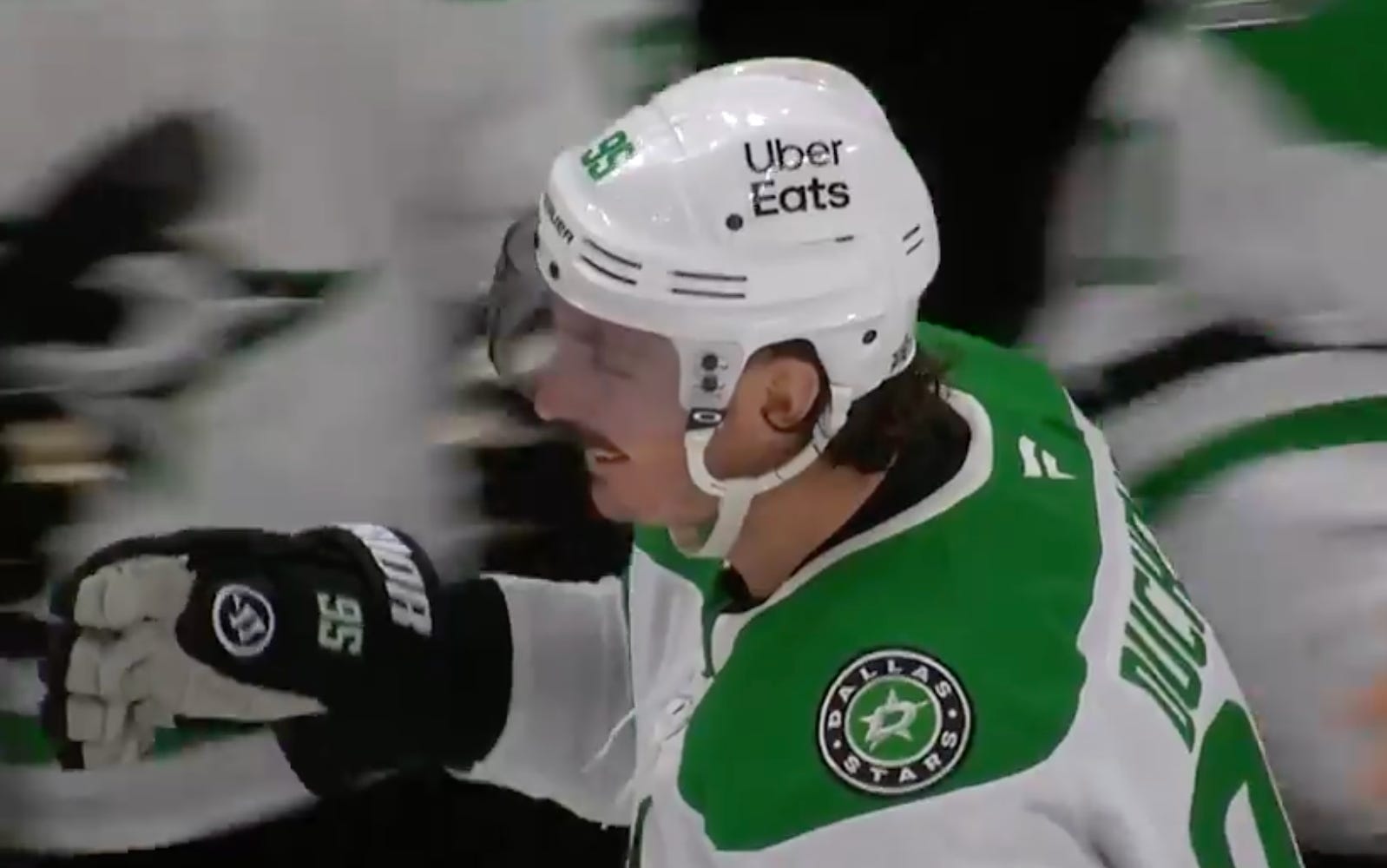
Matt Duchene has always prided himself on being honest. Whether the story is good or bad, he’s not going to mince words when answering questions. At 35 years old, the former 3rd-overall draft pick has seen it all, and he’s chosen to approach life in Dallas with a candor that you don’t often see in professional sports.

This season made you wonder if that would change, at times. After suffering a vestibular concussion that Duchene called the hardest injury he had to return from in his 17-year career, many would have understood if Duchene had chosen to withdraw a bit. That’s not who Duchene is, though. Time and time again, he faced the cameras and reporters, talking about success or failure, glory or frustration.
After starting the first season of his newly signed four-year extension with a devastating injury that kept his scoring to a meager 4 goals and 7 assists through his first 26 games, Duchene kept going back to who he is. And it finally worked, as he caught fire right when the team did. Duchene put up a scorching-hot 9 goals and 12 assists during the team’s record-tying 14-0-1 stretch before and after the Olympic break, with 12 of those 21 points coming afterwards, when the Stars were largely without Roope Hintz and Mikko Rantanen.
In a season that could have been defined by injury and frustration, Duchene instead wrenched the narrative back into his favor. When Dallas needed him most, he stepped into Hintz’s vacant center spot like it had been made for him all along. And when the dust had settled, Duchene had piled up 34 points in the final 31 games of the season. Despite his new tinted visor, Duchene’s playmaking vision was as clear as ever.
And this year, Duchene carried that vision into the playoffs. In just six games against Minnesota, Duchene topped his playoff scoring totals from each of the prior two three-round runs in Dallas. The veteran led the entire Dallas roster with nine playoff points, and he did so while centering the only consistent forward trio Glen Gulutzan had to work with in the postseason.
That’s how a season that began with a devatasting hit ended with Duchene scoring one of the biggest goals of the year, tying Game 3 in the third period before Johnston eventually won it in double overtime.
Duchene’s grade for the season is a V. Perhaps that could stand for vocal, with Duchene being one of the more outspoken leaders on a bench that was without Jamie Benn early on, without Tyler Seguin after December, and without Mikko Rantanen and Roope Hintz for some or all of the final months. Dallas needed people steadying the ship in multiple ways, and Duchene very clearly did that.
Earlier in the year, there was some hope for versatility, but in a way, Duchene’s lack of success when moved around the lineup wound up demonstrating why he was able to take over for Roope Hintz to the degree that he did. Some centers can play more freely when moved to the wing, while others tend to thrive when in the middle of the ice, and Duchene showed himself to be the latter sort, this year.
This is where the coaching staff deserves a fair bit of credit, I think.. It would have been easy to move Duchene lower and lower down the lineup as he struggled in returning from his concussion. Instead, the Stars got creative.
Initially, that meant taking some of the responsibility off Duchene’s shoulders with a move to left wing. In his first game back in early December, Duchene played opposite Mikko Rantanen on the left of Wyatt Johnston, on the Stars’ top line. You could see the thought process for th emove, as Duchene had the potential to address the Stars’ lack of top-six winger depth while also being required to do less defensively. In theory, it was a good idea, and you can’t imagine too many players who wouldn’t jump at the chance to play with Johnston and Rantanen.
To say it didn’t work would be an understatement. The trio never look comfortable together, and they got outscored 8-4 during their 5v5 ice time together. All the underlying numbers were similarly disastrous. The line, for whatever reason, ended up being far less than the sum of its parts, and the experiment was abandoned after a half-dozen games or so.
This is where frustration could have taken over Duchene’s game, and perhaps some did, here and there. But rather than getting pushed to the side and asked to fix it himself, Duchene’s subsequent line combinations indicate a real commitment by the coaching staff to figure out how to get him going. Duchene got time centering Jamie Benn and Justin Hryckowian, until Benn’s concussion on January 4, when Blackwell was moved into that spot out of sheer necessity for a game or two.
But after seeing Duchene moved up to the right wing with Hintz and Robertson when Dallas was trailing in the third period against Anaheim, it was clear everything was truly on the table. That Robertson-Hintz-Duchene line got two more games, and although they weren’t scoring, they looked a lot more in sync than Duchene had in his previous wing assignment.
The next game was where you really saw the lengths Glen Gulutzan was willing to go to in order to get Duchene going, though. When Mikko Rantanen caught the flu bug that was going around, Gulutzan shocked all of us by moving Wyatt Johnston to right wing for essentially the first time all year. Duchene was asked to be the team’s top-line center, with Steel on the left side of him and Johnston in what turned out to be a much-needed 6-2 win over Boston back at home. The turnaround was just about to happen.
Duchene got two more games in that top center spot before Rantanen was back to full health. From there, things standardized: Duchene went back to centering Benn and Steel on the third line, and the Stars were off and running on that points streak.
Duchene got a few games with Benn and Michael Bunting later on, but the most important deployment down the stretch came after Sam Steel’s injury on Long Island (and Bunting’s in Philadelphia right after that), when Duchene was asked to move up and center Bourque and Robertson, as he would end up doing in the playoffs. And in less time together than Duchene had gotten with Johnston and Rantanen way back when, that trio would outscore the opposition by the converse margin of 8-4, foreshadowing what Minnesota would encounter in mid-April.
While much of the mix-and-match approach was out of necessity, I really do go back to that stretch with Duchene getting to center Wyatt Johnston after Johnston had been Duchene’s center earlier on. How many coaches would be willing to displace a young player like that? It didn’t wind up being the best solution in the long term, but I really believe that Gulutzan’s willingness to give Duchene a chance at all three forward positions spoke volumes. The goal was the make the team better in the long run, even if it meant trying some unconventional things in the short term.
When the Stars signed Duchene to that four-year extension last summer, the term raised some eyebrows. It wasn’t quite Brad Marchand-ian, but given Duchene’s inconsistent work in the playoffs and general aging curves, there were some questions lingering over the deal. Those questions only became more prominent after Duchene’s concussion and subsequent scoring struggles. Was a decline already here?
As it turned out, one of Duchene’s best runs with the Stars was right around the corner. A healthy Stars team probably has Hintz and Johnston in those top-six center spots going forward, but it’s a credit to Duchene, the training staff, and his coaches that he was able to fill that role so well during his time this year. Even without Seguin and Marchment, he still found a way to be the center depth Dallas needed.
The margins of Duchene’s game got better this year, too. In a very different system, Duchene’s defensive game got some of its corners rounded off. He’s still a player far more comfortable in the offensive zone than in his own, but he found a way to make that work, whether playing with Benn and Steel or Bourque and Robertson.
Going forward, Duchene will have to bring that same creativity and play-driving with whatever wingers Dallas has to match with him. Perhaps that will be Bourque and Robertson, when the need arises. It could well be Benn and Steel again to start next season, with whom Duchene outscored the opposition 10-5 on top of a 54% expected goals advantage. Or perhaps it will be someone we don’t even know about yet.
Regardless, Matt Duchene will never be the two-way force that Roope Hintz is, but he doesn’t have to be. This year, he found a way to match his game to the important moments, despite all the struggles early on. Duchene finished the regular season with 16 goals and 45 points in 57 games, good for fifth on the team despite missing a full third of the season, and I suspect it is no coincidence that the team’s surge largely coincided with his own.
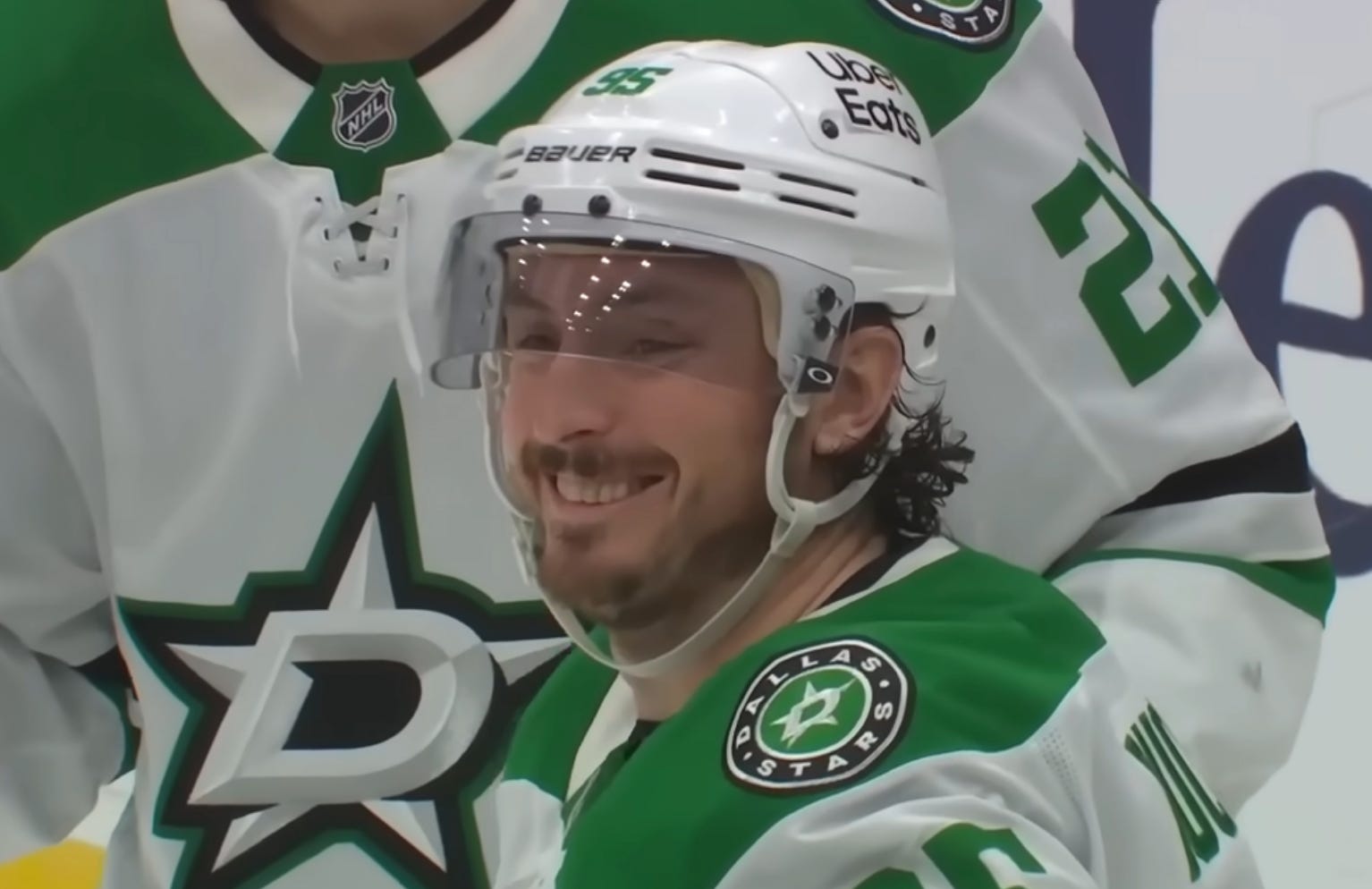
Perhaps that “V” is really for Validated, because after a long recovery with more symptoms on and off the ice than we might ever hear about, Duchene wound up being exactly what the Stars hoped he would be once the calendar flipped to 2026. All of the work, experimentation, and dedication coalesced into the veteran center finding some of his best hockey at the most critical time.
It was a disappointing end to the season for the team, but for Matt Duchene, there’s good reason to think that the next three years could end up being much better than expected.
I call him the Magician and that is what he is , so underrated . If you look back at some of his goals and passing I think the name fits
If you’re expecting Hintz and Johnston to center the top two lines, would Duchene possibly center the third? Or are you thinking Seguin as center of the third line? Or will he be a winger?