
Jason Robertson, Team USA, and Defining Defense in the Modern Game
Team USA certainly has a type

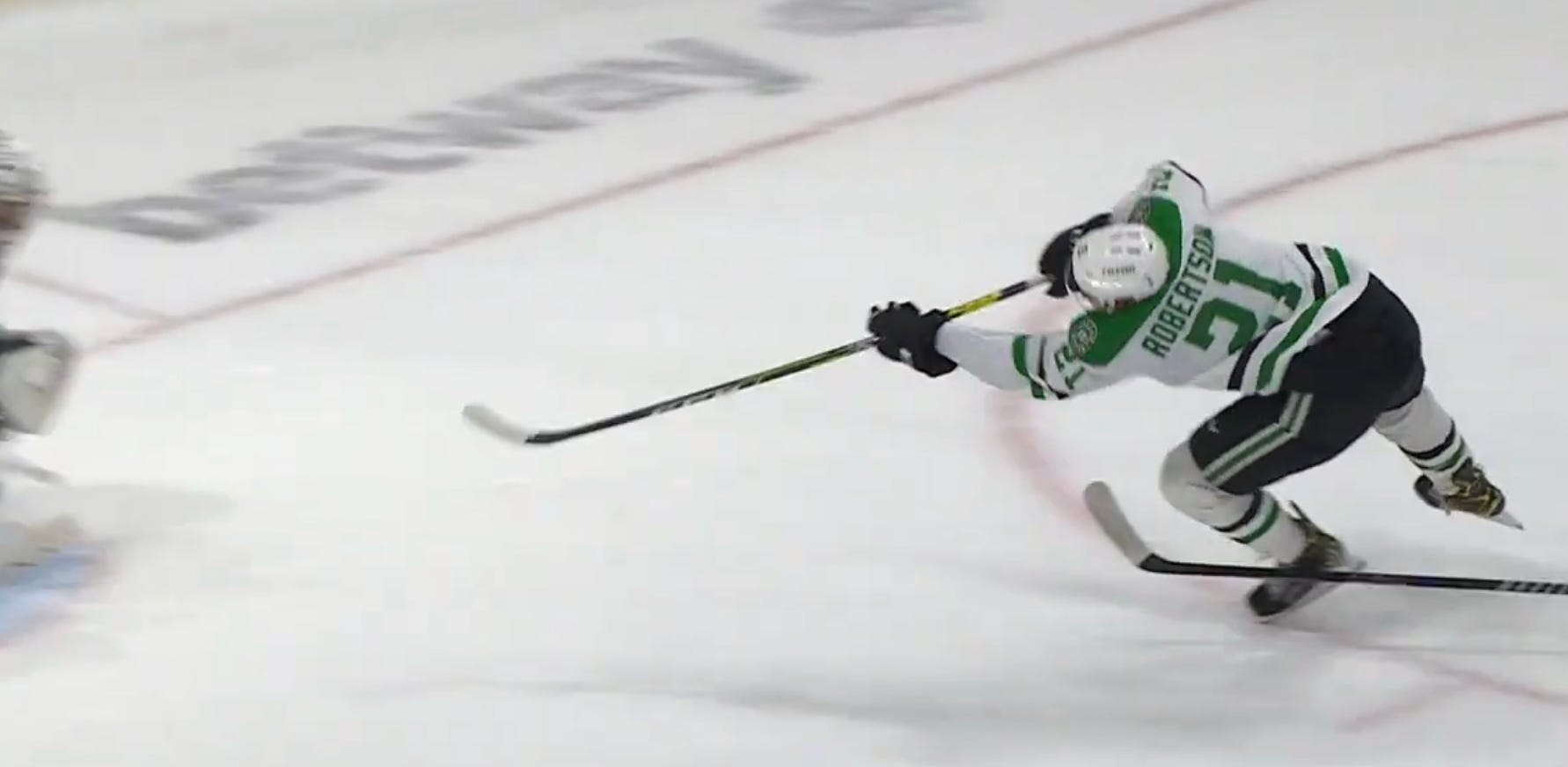
As we discussed last night, Thomas Harley has made Team Canada, making him the first Dallas Stars player to officially punch their ticket to the 2026 Winter Olympic Games.
More Stars players are likely to receive similar news from other squads. Team Finland players will start getting phone calls in the next day or so, and the players on Team Czechia should be announced within a similar timeframe (which is to say Radek Faksa will also be going, barring a major surprise).
Jake Oettinger’s teammates on Team USA will be announced tomorrow morning, but as tends to happen with these things, word has already begun to leak out.

In that linked piece by Michael Russo, Jason Robertson is not projected to be on Team USA. Nor are Cole Caufield, Alex DeBrincat or Chris Kreider, but Robertson’s omission is particularly striking.
Russo acknowledges as much in his story (which, again, you should read), saying that it’s the decision likely to draw the most scrutiny. It’s not hard to see why, either: Robertson is an elite goal-scorer for a nation that hasn’t won a best-on-best gold medal in 30 years.
It’s a bold strategy, to say the least.
How elite is Jason Robertson? Well, we’ve made the comparison before to Brett Hull’s role on the 1996 USA team that won the World Cup of Hockey, so let’s start there: Robertson’s scoring ability right now is actually better than Hull’s was in 1996, when he played a crucial role in USA’s last best-on-best championship.
In the 1995-96 season, offense hadn’t yet been killed by the dead puck era. Eight players had over 50 goals, and 18 had over 40. Today, even with a bit of offensive resurgence, the NHL still hasn’t gotten close to those totals, with only one 50-goal scorer last season and just eight players hitting 40.
Hull was well-known for his, ah, “offensively inclined” playing style. His legendary one-timer and goal-scoring instincts were what made Bob Gainey go out and acquire him as the final piece of the Stars’ only Stanley Cup roster in 1998-99, and he will remain a beloved figure in Dallas because of the goal reviewed ‘round the world.
Yet, Hull was only 14th in goals and 27th in points in the ‘95-96 season. He was past his peak goal-scoring form, on the wrong side of 30, and with only one 40-goal season remaining in his career, and far from a defensively stout player.
Nonetheless, that version of Brett Hull was an essential—perhaps the essential—ingredient in Team USA’s victory over a stacked Canadian roster. Hull went on to post a four-point game in the rubber match against Canada, and he would lead the entire tournament in scoring.
How did Hull keep scoring, no matter how tough the environment? Former Stars executive Craig Button points to one thing: Hockey IQ.
"Brett was one of the smartest hockey players I've ever been around," Button told NHL.com. "He understood what teams were trying to do to him. He understood where the openings would be and how to get to those openings. I'm going to say his hockey IQ was second to no one. He was that smart."
Jason Robertson, right now, is a more elite scorer than Hull was in 1996, relative to the league. He’s tied for 5th in goals and 10th in points, and every metric you can find suggests that Robertson creates offense at a world-class level, both at even-strength and on the power play. He’s got one of the best shots in the game, and he’s also the best shootout performer in the NHL. These are things that matter even more than usual, given Olympic rules and shootout tiebreakers.
Like Hull, Robertson also has an extremely high Hockey IQ. But by all accounts, Team USA doesn’t think that’s enough to warrant Robertson as one of the 14 forward selections—a reality the team’s GM has been kind of hinting at for a while.
“He’s doing all he can,” Guerin said when asked specifically about Robertson. “And again, these are situations where I know guys want to make this team and guys want to be in this situation. There’s a number of players that we could take that we won’t end up taking because we won’t have the room. And when you look at it, there’s so many guys that are close in the way that they’re performing, in their statistics, in their body of work. It could come down to the fit. What do we need?’’
-Team USA GM Bill Guerin, from Pierre LeBrun’s story in The Athletic, 11/26/25
Bill Guerin went on to answer his own question in the same piece, before the leaked roster selections all but confirmed it this week. Guerin wants a roster with a good chunk of players who play a certain brand of hockey. Or to put it succinctly: He’s not interested in making room for players like Robertson or Caufield.
“Honestly, I just don’t think you can put into words how tight those games were (at 4 Nations), how little room there was to operate. And how well these elite players can check. In NHL games, they’re not always counted on to do that, but when they are, they can. And not everybody can play in those situations. No matter what their offensive gifts are, if you can’t check, it’s probably not the tournament for you. … There’s just no room out there.’’
-Team USA GM Bill Guerin, from Pierre LeBrun’s story in The Athletic, 11/26/25
The million-dollar question (or the gold medal question) is this: What does “checking” mean to Guerin and Team USA?
Look, let’s be clear here: Guerin was on Hull’s 1996 World Cup of Hockey team, so I have no doubt that he is acutely aware of the nearly 30-year gold medal drought for Team USA, and takes great pride in potentially being the GM to end it. Guerin was a vicious, hard-nosed NHLer who could also score quite well, and he never backed down from a fight (including dropping the gloves in that final series in 1996).
And yet, it appears that the way the USA lost their most recent tournament is being viewed as a template for success, not failure. Surprisingly (or unsurprisingly), Team USA sounds entirely content with their loss to Canada at the Four Nations Face-Off, where the rules, limited opponents, game locations, and timing were all set up to be as advantageous for the USA as any best-on-best tournament is ever likely to be.
Unlike the Olympics, fighting was allowed and celebrated. But the change in tournaments doesn’t appear to resulting in big changes to the roster, other than dropping Chris Kreider and adding Tage Thompson and Clayton Keller—both of whom played for the USA in the IIHF World Championships this summer (while Dallas was still in the Stanley Cup Playoffs), and whose inclusion appears to be at least in part a reward for their performance at a tournament players like Robertson never had the opportunity to play in.
To touch on the Brett Hull comparison once more, Jason Robertson separates himself from Hull in another sense: He’s a good defensive player. At least, as far as all the numbers tell it.
Look at the rawest of stats, for starters. Hull scored 70 goals in 73 games in 1992-93, posting 109 points in an incredible scoring season. And he finished that season with an (objectively hilarious) -2 plus/minus rating.
Robertson, this year, has got the second-best plus/minus on his team, trailing only Esa Lindell. When Robertson scored 109 points himself back in 2022-23, his plus/minus was a sterling +37. Across his NHL career, Robertson is a +109, and he’s been playing top-three forward minutes on his team for the past four seasons now.
Remember, this isn’t someone playing third-pairing defensemen minutes and juicing their numbers, or even a Patrik Laine or Alex Ovechkin, who is only ever asked to hop over the boards for power play duties and offensive-zone faceoffs. Robertson plays heavy, important minutes against top competition, and he consistently comes out ahead while doing so.
But you can even forget plus/minus, because we don’t have to settle for rough, team-wide correlation to buttress Robertson’s defensive results. All the deeper defensive metrics you can find likewise indicate Robertson is not just poaching goals while flaoting around in the defensive zone like, ahem, J.T. Miller, but in fact helping his team defensively.
Robertson is a big, smart player who knows how to score, but he does so while also helping his team in all three zones.
Nevertheless, it seems clear from Guerin’s comments that the way Robertson goes about getting those results is perceived as a liability, not an asset.
Guerin’s comments would suggest that they believe Robertson doesn’t “check” in the way Team USA thinks is crucial to best-on-best tournament success. They perceive such a giant, latent flaw in his game, in fact, that they’re willing to sacrifice Robertson’s best-in-the-country goal-creating abilities.
That scoring isn’t just decent, either. Among USA players in the NHL since 2021, Jason Robertson ranks 2nd in points and 3rd in goals in regular season games. Ah, you may be interjecting now, but what about the playoffs, where players like Robertson can get pushed out of the game?
Well, among USA players in NHL playoff games since 2021, Jason Robertson ranks…2nd in points, and 3rd in goals, just shy of a point per playoff game. Just as he does in the regular season.
(And that’s including the 2022 Rick Bowness-coached Calgary series that started the whole narrative around Robertson’s playoff scoring, as well as the Winnipeg series last spring when Robertson’s recently-injured knee still wasn’t right.)
Robertson is, objectively and demonstrably, one of the best scorers the USA has available. Yet, because of his perceived lack of “checking” ability, Robertson won’t even get a depth role on the team.
Whatever Guerin and company’s definition of “checking” is, it obviously doesn’t include what Robertson does well. The more you dig into the numbers, the more mind-boggling the exclusion of Robertson becomes.
So this week, I decided to stop poring over numbers and start talking to NHL players themselves. What is the nature of defense for forwards (or “checking” if you prefer) in the NHL, and how does Robertson measure up?
“Playing wing, you gotta be in lanes. You gotta get pucks out, and you wanna play with the puck. If you’re playing with the puck, you don’t have to defend,” said Matt Duchene. “Wingers have a very minimal role in the D-zone, for the most part, but it’s important.”
Duchene compared centers to midfielders in soccer, as centers generally are covering more ground and going lower in the defensive zone than wingers, who conversely tend to stay higher along the wall, providing outlets for breaking the puck out with possession.
When asked specifically how Robertson’s defensive game looks, Duchene pointed out that a player’s position sometimes dictates the opportunity you have to demonstrate your checking abilities in the defensive zone.
“Wing, you’re not playing as much low, playing one-on-one,” Duchene said. “You’re not covering as much ice, but he’s positionally sound. He’s in lanes. If you don’t have to block a shot, it’s usually because you’re in the [shooting] lane.”
This has been a common theme in a lot of conversations I’ve had this year: Centers simply have to do more by virtue of modern systems, so they also tend to be perceived as more diligent defensively.
Incidentally, I also believe that’s a big factor in the Selke Trophy being pretty much exclusively a center’s award to win nowadays, despite its being created to recognize Bob Gainey (a winger) and being won multiple times by one Jere Lehtinen (also a winger). Perception is so frustratingly often the reality when it comes to top-level decisions for awards or national team selections.
But in Duchene’s eyes, at least, Robertson is both responsible and trustworthy when it comes to his checking in the defensive zone.
“I don’t think we have anyone on this team who’s a liability, and that’s rare,” Duchene said. “I think on [most] teams, there’s usually guys that are all offense, and you can’t really trust them. I think you can trust every single forward on this team, and he’s no different.”
That’s one veteran center’s perspective. For another, how about a certain longtime linemate of Jason Robertson’s named Roope Hintz?
Hintz and Robertson have played together the vast majority of the time since 2021. Thus, Hintz has most often been the center who has to do all that aforementioned work lower in the defensive zone, and he’s also gotten Selke votes for four straight years.
So, does Hintz think makes Robertson such an effective linemate for him, defensively? Absolutely, he says.
“It’s just the smart decisions,” Hintz said. “Sometimes with the puck, and positioning. Be in the right spot at the right time. I think those are the biggest ones.”
Hintz also said he’s seen Robertson get stronger in battling along the boards over their years playing together, too—a key part of winger responsibilities in the defensive zone.
One other thing Hintz added is that when one player on a line works harder going up and down defensively (which is usually the center), it also conserves more energy for another forward (usually a winger) to use on offense. That doesn’t make one player less or more selfish than the other; it’s just the nature of what it takes in today’s NHL to get the puck up the ice.
I believe this reality—the strategic conservation of energy—is what current and former players often view through the most critical lens. Until recent years, all bottom-six players were scrutinized heavily for work-rate, always expected to keep their feet moving, to constantly be fighting for every puck and finishing checks at any point in their zone. There wasn’t much hope of them generating too many chances down the ice, so their just finishing a shift without causing a problem was often seen as a win.
In other words, the results of their work were sometimes viewed as less important than the aesthetics of the process: Coaches love “grinders” on those lower lines, because they can deploy them with known effect.
When scorers are viewed through that old bottom-six lens, it can result in an incomplete (or incorrect) picture of who they are. And I wonder if the strategic conservation of energy often employed by scoring wingers (watch Leon Draisaitl when he plays with Connor McDavid) is why scoring forwards like Robertson are perceived by some as less than adequate “checkers.”
Robertson knows full well that if he goes down low to fight for every puck, the opportunity to help the team get the puck out and go to work at the other end of the ice will be lessened, and the system under Glen Gulutzan reflects that reality. Because as much as you might want to see all three forwards battling for their life along the wall, it’s often the freshest players who are the most dangerous in transition—as Hintz and Robertson demonstrated against Chicago, when Hintz sent Robertson in on a breakaway.
Playing along the wall more often shouldn’t make a winger any less defensively responsible. If all three forwards are battling for the puck down low, then even if you do win the puck, you’re far more likely to have to just flip it out into the neutral zone and change lines (if you’re lucky enough to get that far), before asking the next group to defend all over again.
I think it works similarly in the offensive zone, too. Some players “crash” the net, while others “lurk” around it. Brett Hull, for example, was well-known for always seeming to know exactly where to be, while Brenden Morrow tended to always be right on the goalie’s lap. Both approaches can be effective, so long as the player’s hockey IQ is making the right reads. But when you get a player who can lurk (read: employ their Hockey IQ) at elite levels, it sure seems to result in a whole lot of goals over long periods of time.
Finally, I spoke with Robertson himself to get his take on how he defends.
The first thing he said when asked about his defensive approach was right to the point: Having the puck is big. The less time you spend in your zone before you break it out, the better it is for your team.
And for him as a winger, the walls are a big part of that.
“It’s always tough,” Robertson said, “But I do a pretty good job on the wall when the puck is around me, getting the puck out and not really having those long, extended defensive zone shifts.”
The net result, as always, is what Robertson’s approach is aimed at.
“I think our tracking and reloads have been pretty good,” Robertson said. “Roope’s been, since I’ve been here, really strong. That’s a strong point of his. Reloading, getting above, and trying to limit odd-man rushes against. That’s generally the biggest two things I’ve noticed.”
Perhaps no game was better evidence of that than last night, when Buffalo humbled the Stars by a 4-1 score in Dallas. Only three players on the home side came out with a positive plus/minus: Esa Lindell (no surprise), Roope Hintz (ditto), and Jason Robertson.
As for Hintz and Robertson, here’s no denying that the duo have combined for years—and for a while with Joe Pavelski—to be a formidable, two-way presence that can do everything well in all three zones. And that requires both hustle and Hockey IQ from everyone in the group.
Still, it’s tough to find a way to measure those things that everyone can agree on—even if a player has a great plus/minus.
“It’s hard to judge defensive numbers,” Robertson said. “There are no numbers, right? You can get into analytics and everything, but at the end of the day, it is what it is.”
As Robertson clearly knows, the nebulous nature of how defense is measured in the wider NHL leaves a lot of room for subjective labels. And that’s where terms like “checker” can include (or exclude) a vastly different group of people, depending on who’s doing the talking.
“I mean, MacKinnon’s plus/minus has gotta be up there, but people don’t think of him as a super defensive forward,” Robertson says. “But he might very well be, right?”
For now, as far as Robertson is concerned, he’s going to do his best to block out the noise and keep playing his best hockey, including both the offensive and defensive responsibilities he has—even when they change in the middle of a shift.
“Wingers have a big responsibility too, in our system,” Robertson said. “Wingers interchange with centers and whatnot, right? […] I’m not gonna take many draws, but there’s a big onus on the wingers, too.”
Robertson has always been a player who could score, even back in his OHL days in Kingston. Scoring is the most valuable talent in hockey because it’s the hardest thing to do. Coaches can put a lot of systems in place to make it as hard as possible for players to get in position to put the puck in their net, but only the very best players can consistently get through all the obstacles and score.
At every level he’s played at, Jason Robertson has shown that he can solve that equation, no matter the goaltender, team, or competition. It remains baffling that a Team USA squad who very much could have used one more goal last February has decided not to bring one of the best goal-scoring weapons in the world.
The main reason Robertson fell to the second round of the draft in 2017 all those years ago was because teams thought his lack of high-end skating would prevent him from sustaining his torrent of junior-level scoring once he got to the NHL. The results were there, sure, but the assumption by a lot of teams was that Robertson’s process wasn’t one that would succeed against bigger, stronger competition.
Robertson didn’t need long to show that all those projections have turned out to be as wrong as they could have possibly been.
While he’ll never be Miro Heiskanen when it comes to skating, his unparalleled hard work and dedication to refining his skills have all coalesced into a player that any NHL team would absolutely love to have.
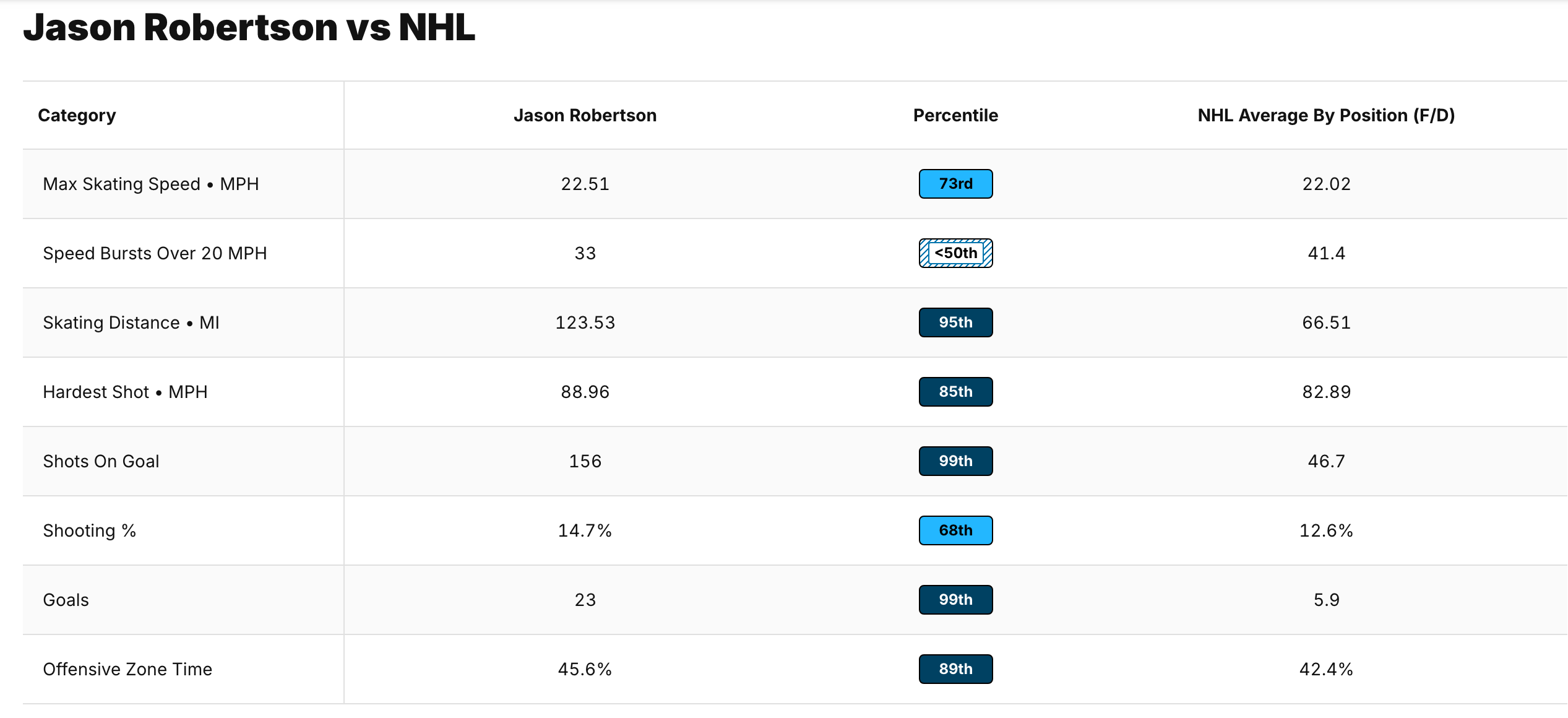
For comparison’s sake, Clayton Keller has been reported to have made Team USA as one of its final forward selections.
Keller is, to be clear, a very good player. But if you want to come up with a overly simple explanation for why he might have gotten a spot over Robertson (other than his getting a free spot because of being on a team that beat Switzerland in overtime this summer at IIHF Worlds) the below might just hold a hint or two:
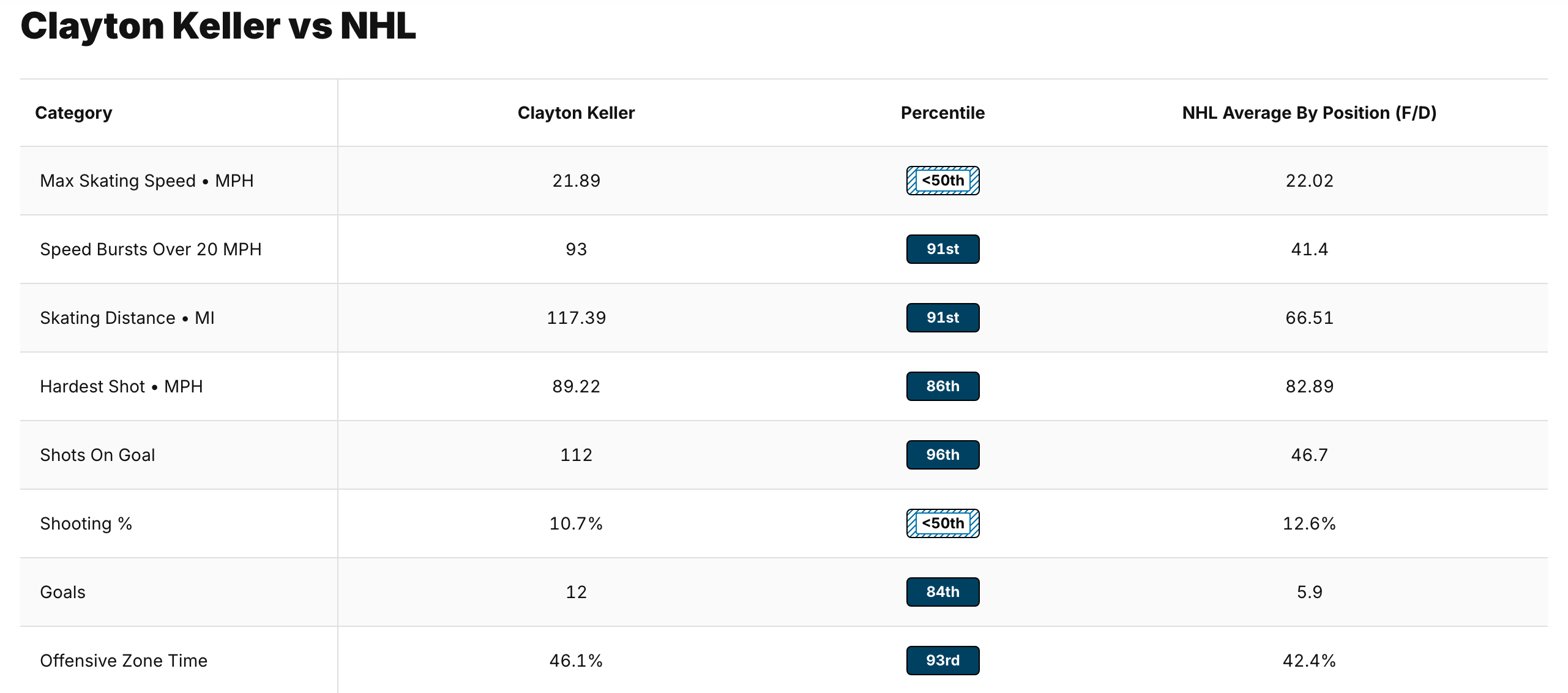
Keller doesn’t have the max speed of Robertson, but he does have a lot more speed bursts over 20mph, which means you can see him skating fast a bit more often, or “working hard,” if you prefer. (Though, interestingly, Keller and Robertson tend to cover a similar amount of distance.)
Keller and Robertson both generate very high levels of shots and offensive zone time, but Robertson is far and away the better player at converting those looks into goals.
I wonder if it might be at least possible that the aesthetics of Keller’s game make it a preferable choice for Guerin to the hard realities of Robertson’s.
But of course, we will probably never know for sure.
Any re-draft of 2017 would almost certainly have Robertson as one of the top five selections overall, if not the top three. Because year after year, Robertson has proven doubters wrong, and proven Dallas right.
Unfortunately for Robertson, he can only prove Team USA wrong for doubting him if they give him a chance in the first place. For whatever reason, they do not seem inclined to do so. And if Robertson couldn’t crack that roster after everything he did in 2025, you have to wonder what it will take for him to ever do so. I have to think he’s wondering that, too.
Regardless of a forward spot or two, a gold medal is absolutely on the table for whatever USA team goes to Italy next month. The same is true for a few countries, in fact. It’s been 12 years since we’ve seen NHLers at the Olympics, but one thing that I remember quite well is that things don’t always go the way people expect them to.
Still, you can’t help but wonder if Team USA has lessened their chances of repeating the glory of 1996 (let alone 1980) by opting for style over substance. Sadly, it wouldn’t be the first time.
Great article. Just can’t wrap my head around Robo not making the team because as Billy said loosely “checking matters.” Jack Hughes doesn’t check and was borderline ragdolled in 4 nations. Matthews, who I think should be on the team but not captain by any stretch, doesn’t throw his weight around. Crazy that a team that struggled to score refuses to bring a guy who is a pure goal scorer, and as you pointed out, solid defensively. Anyway, great article as always, hope you had a happy holidays Robert!
It's impossible to prove it, and I completely understand not wanting to touch it with a ten foot pole when you can't use stats or any evidence to back it up, but a lot of people are looking at the optics of why Robertson wasn't selected - or even taken seriously - and why some other players have been, notably one or two that have been out most or all of the season so far - and noticing the one big difference between them that has nothing to do with play. 🤷♀️