
How to Be Patient without Compromising Your Expectations: A Trip Back to 2006
Some of y'all have been around the block a time or two

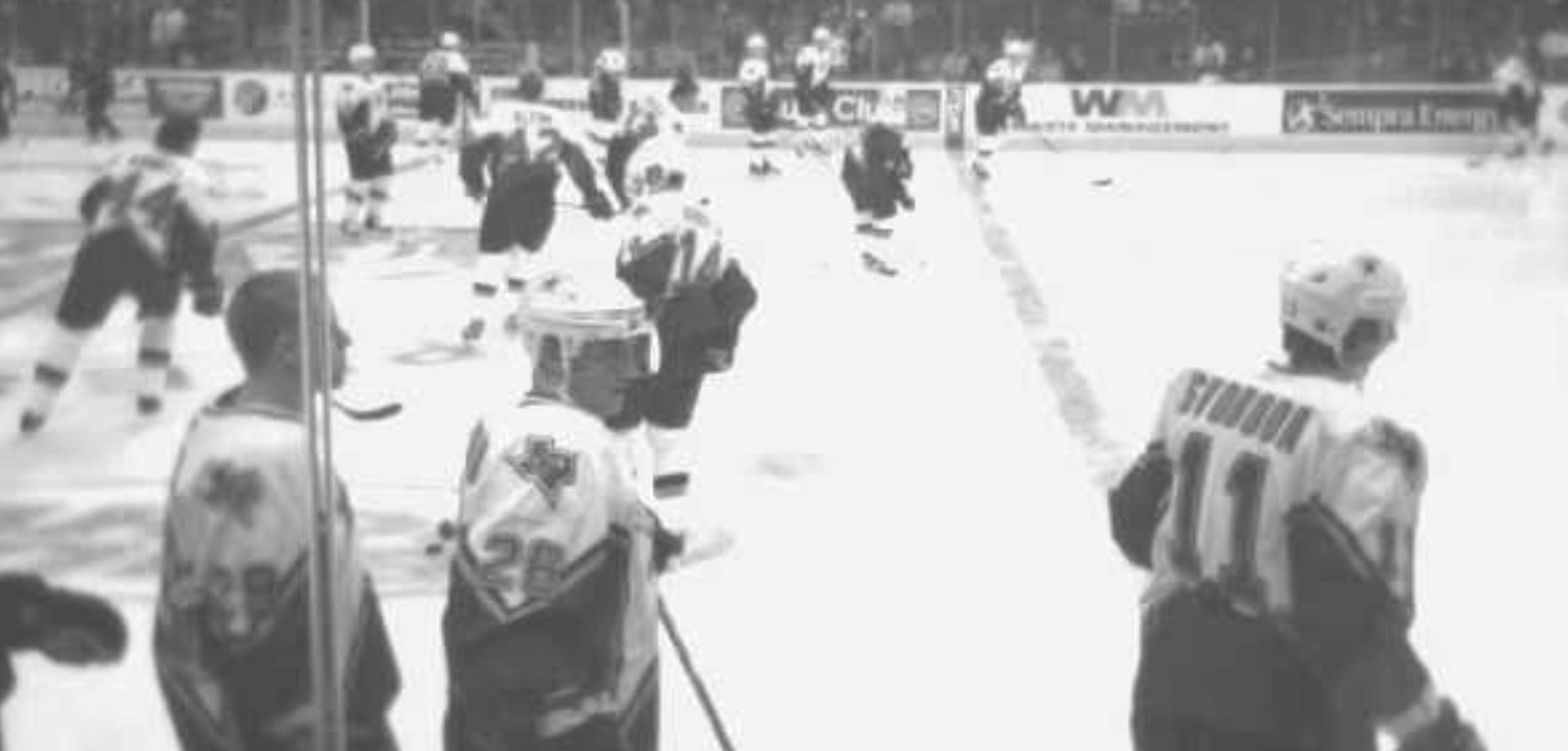
It is April 1, 2006. I’m finishing my sophomore year of college in Los Angeles, and my older brother tells me some good news: the Kings have a promotion that allows college students to get premium seats at an exceptional discount.
As I recall, we got glass seats just to the right of the penalty boxes for something like 60 bucks a pop. Even granting that this was 20(!) years ago, it still felt like a great deal. Seeing any hockey game from the front row is an experience everyone should have if they ever get the opportunity, and doing so in a game between two division rivals with the Stars in first place? Well, that seemed like the perfect way to wrap up the first season after the lockout, particularly for a poor college student like myself.
These were, after all, the first-place Dallas Stars, the same club sitting on 49 wins and 102 points with nine games left to play.
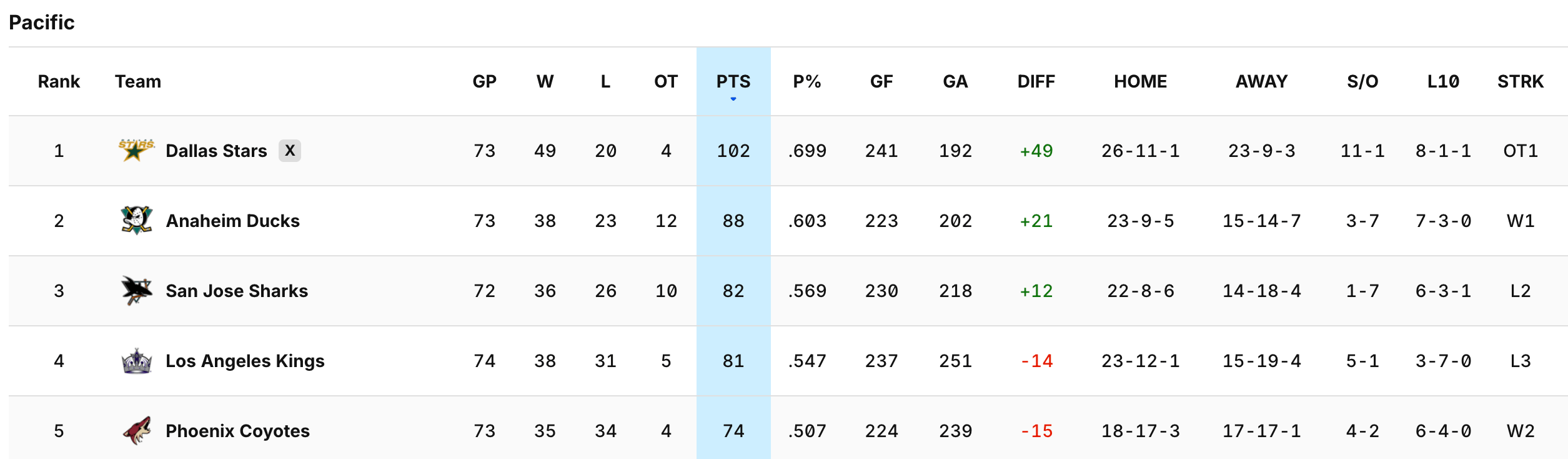
For context, the Stars’ .699 points percentage at that time was better than the West-winning Stars of 2024, that team of the 113-point season. The 2005-06 Stars were known for being shootout fiends, sure; they were also a really, really good team.
(I talked with Jussi Jokinen in Finland a couple years ago about those shootouts and many other things, if you’d like to revisit that piece here.)
Anyway, here John and I were in Los Angeles, and we were pumped to watch the Stars up close after viewing a barn-burner in Anaheim the night before that ended in an uncharacteristic shootout loss, with the Ducks taking a 5-4 win. Andy MacDonald had scored a goal to tie the game up with less than three minutes remaining in the third, and Marty Turco had let in the first two shots of the skills competition while Jokinen and Antti Miettinen went 0-for-2.
It was a bummer of a game, but I recall us talking at the time about how at least we saved the good tickets for the Kings game, which would surely have a better result than the shootout loss to the Ducks. Surely!
It is April 1, 2006. I’m finishing my sophomore year of college in Los Angeles, and my older brother tells me some good news: the Kings have a promotion that allows college students to get premium seats at an exceptional discount.
As I recall, we got glass seats just to the right of the penalty boxes for something like 60 bucks a pop. Even granting that this was 20(!) years ago, it still felt like a great deal. Seeing any hockey game from the front row is an experience everyone should have if they ever get the opportunity, and doing so in a game between two division rivals with the Stars in first place? Well, that seemed like the perfect way to wrap up the first season after the lockout, particularly for a poor college student like myself.
These were, after all, the first-place Dallas Stars, the same club sitting on 49 wins and 102 points with nine games left to play.
For context, the Stars’ .699 points percentage at that time was better than the West-winning Stars of 2024, that team of the 113-point season. The 2005-06 Stars were known for being shootout fiends, sure; they were also a really, really good team.
(I talked with Jussi Jokinen in Finland a couple years ago about those shootouts and many other things, if you’d like to revisit that piece here.)
Anyway, here John and I were in Los Angeles, and we were pumped to watch the Stars up close after viewing a barn-burner in Anaheim the night before that ended in an uncharacteristic shootout loss, with the Ducks taking a 5-4 win. Andy MacDonald had scored a goal to tie the game up with less than three minutes remaining in the third, and Marty Turco had let in the first two shots of the skills competition while Jokinen and Antti Miettinen went 0-for-2.
It was a bummer of a game, but I recall us talking at the time about how at least we saved the good tickets for the Kings game, which would surely have a better result than the shootout loss to the Ducks. Surely!
Really, there was every reason to expect good things against the fourth-place Kings, who were stumbling their way to another playoff-less season. The Stars were rolling with the perfectly cromulent backup goalie Johan Hedberg, while Mathieu Garon was getting the start in goal for LA.
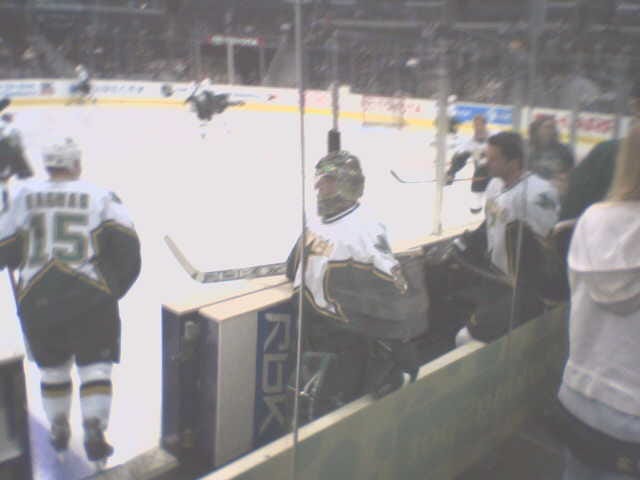
That would be the same Mathieu Garon who was in net for one of the craziest Stars games in history back in Game 1 of that same year, when the Kings roared out to a 4-0 lead in the first period after a year without hockey—only for the Stars to judo-flip them with a vengeance, scoring five consecutive goals of their own to win 5-4 in regulation. (I would include highlights here if they existed, but alas.)
That post-lockout season of My NHL hockey was ridiculous in a lot of ways, but the easiest thing to point to is the preposterous number of power plays teams were getting that season. At the league’s behest, referees were instructed to boost offense by calling more penalties, and that resulted in an average of twelve power plays per game in 2005-06, which equated to almost half a game’s worth of power play time every night.
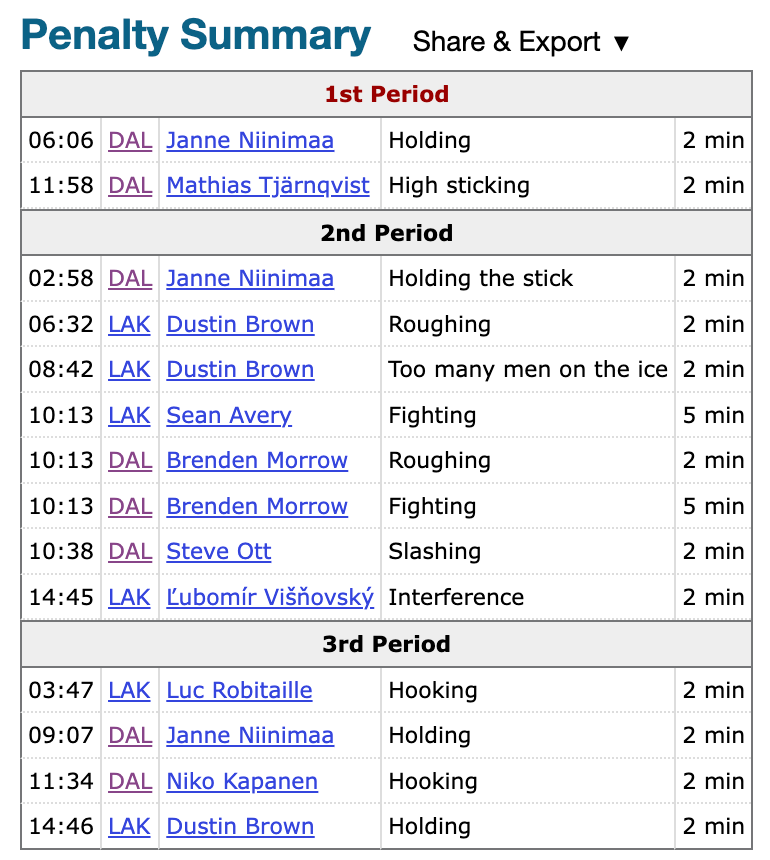
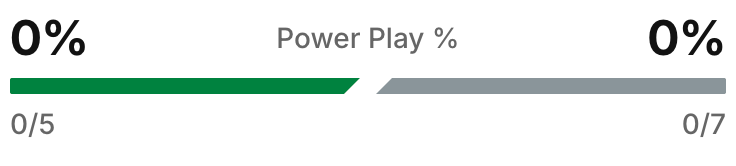
And as it turned out, April 1, 2006 was no exception. By my count, there were exactly twelve power plays awarded that night: Seven to LA, five to Dallas.
It didn’t make for good hockey, but in theory, it made for more exciting hockey. In theory. So after making our way down to our seats, John and I geared up for a great hockey-watching experience. If you didn’t pick up on it yet, this has all been a little trick that we writers like to call “foreshadowing.”
Anyone who remembers that Game 7 against Vancouver in 2007 knows just how terrible a hockey game can be to watch when penalties start corrupting the contest, and this game was no exception. With the Stars playing the second night of a back-to-back on the road against a Kings roster needing rejuvenation that was still a couple years away, the game wound up being pretty ugly.
How ugly? Well, if you’ve never been in a building where all twelve power plays get frittered away, then you haven’t lived. Because there is no better way to take the crowd out of a game than to make even the apparent advantages feel pointless, as happened that night.
I remember Sean Avery and Brenden Morrow mixing it up during one of the Stars’ five power plays, with Morrow getting an extra roughing minor for dealing out some sort of retribution that Avery assuredly deserved. (Little wonder that Avery’s arrival in Dallas a couple of years later didn’t go terribly well.)
The Kings scored a goal during some of the rare five-on-five time in the first period, but even that goal wasn’t exciting from what my fuzzy memory recalls. I think it was a rebound or a tip-in by Jeremy Roenick,1 and it was assisted by two future Dallas Stars: Avery and Mattias Norström.
At the time, I distinctly remember my brother and I commenting to each other that even if the Stars lost, at least we could hope to see an interesting game with a fair amount of goals from our front-row seats. In retrospect, we probably cursed things with this wish, because here are all of the goals that would end up being scored that game:
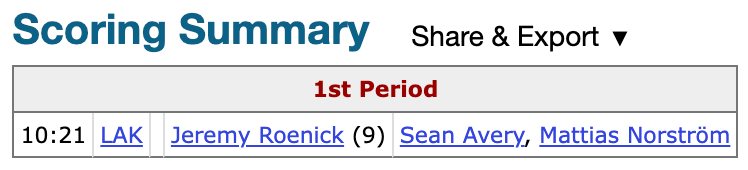
It was with wry humor that we observed after the game how we basically saw the worst-case scenario for the seats we’d shelled out decent (in 2006) money for. Not only had the Stars not even won, or even scored, but even the home team’s offense was barely in attendance. The game could have ended in a forfeit, and the score still would have been 1-0.
Incidentally, it also would have saved us both a lot of time and money.
In the grand scheme of things, this game did end up mattering much for either team. Dallas still won the Pacific Division (finishing 3rd in the NHL, in fact), and the Kings still missed the playoffs. What did a sleepy Saturday loss really matter to anyone but the people who had invested time and money into watching it?
In 2006, that 112-point Stars team would begin a promising playoff run against the 95-point Colorado Avalanche. Jason Arnott had just put up the best of his three seasons in Dallas after the Joe Nieuwendyk/Jamie Langenbrunner trade, but Arnott’s 32 goals and 44 assists from the regular season did not carry over to the postseason. Brenden Morrow wound up being the only one of the Stars’ top-five playoff scorers that postseason under the age of 32, while three of the top-five scorers were 35 years old.
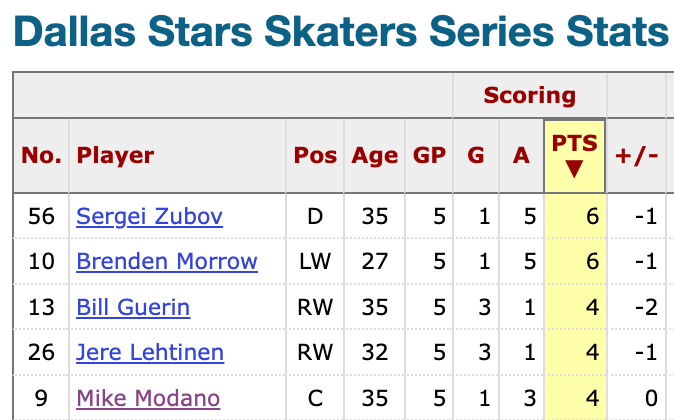
The Stars were run over by Joe Sakic and company in a crushing 4-1 series upset, or at least that’s how it felt after the fact. In reality, the series was a lot closer than that, with three of the four Avalanche wins coming in overtime. I am not saying that this 2006 series was the karmic deposit that the Stars withdrew from in 2025 (or 2024, or even 2020), but I am also not not saying that. It always comes around, Colorado.
For the record, you can watch the Stars’ only win in that series against Colorado, if you’re inclined to do such a thing.
After the whirlwind of lockout recovery fandom that began in earnest with the Stars’ 5-4 comeback over the Kings, perhaps some regression was due, and it hit hard in the playoffs. But for me, that 1-0 loss to the Kings lives larger in my memory. That was a sign of an otherwise good team’s lurking floor, and the Avalanche found a way to put the Stars on their back just as those listless Kings did back on April Fools’ Day.
At the time, I recall reading and hearing about how those Stars were flawed, and how they needed to move on from their aging core. The same held true the next year, when the 107-point Stars had the misfortune of running into Avatar Roku Roberto Luongo and losing an even more heartbreaking first-round series. Surely that core was done, and it was time to admit the Stars needed to mix it up, right?
This is where it’s important to recognize what a team’s core actually is, even when the name-brand players might seem to be a different group. Because while Modano, Lehtinen, and Zubov were still around in 2008 like they were in 2006, the Stars had done some good work to help them out with a stronger supporting cast over the subsequent years.
Mike Ribeiro and Loui Eriksson had become critical top-six contributors that allowed some of the older players to carry less of a load (even if they still got big minutes), and Dave Tippett’s defensive system allowed the Stars to work magic in the playoffs in front of Marty Turco. With the arrivals in trade of Norström and (most critically of all) Brad Richards, the Stars had announced their intentions: they were going to try to win one more championship, and they didn’t care where they finished in the regular season.
Expectations were far lower going into those 2008 playoffs, because even after the Richards acquisition, the Stars still finished with just 97 points, good for fifth in the West. Mike Ribeiro had led the team in scoring, and his game was often criticized for being more of an east-west style than the playoffs usually allowed. Could this hodge-podge Stars team that had flamed out in their last three first-round series really make any noise?
You know what happened, of course. Those 2008 Stars went on the best playoff run since the 2000 Cup Final, and Ribeiro’s2 game produced 17 points in 18 playoff games. It was a magical run that reinvigorated the fan base, even if the Stars ran into one of the best teams of the last quarter-century in an absolutely stacked ‘08 Detroit team.
On the one hand, that 2008 run is a reminder not to overreact to first-round playoff frustration. Every series is its own animal, and it’s often tough to predict which year’s club is going to be the club when it comes to playoff success. Some of that is due to randomness, some of it is injury luck, and some of it is just a result of what does and doesn’t coalesce come playoff time. Chemistry and playoff willpower are tough things to find, and tougher ones to repeat.
On the other hand, that 2008 run is also a lesson about just how viciously a Cup window can slam shut, when it finally does. Because of course you remember the next part: after finally breaking through with a couple of postseason series victories, the Stars wouldn’t win another playoff round for eight years, and with an entirely different team. Modano, Lehtinen, and Turco all wrapped up their careers, Brad Richards left for New York, and even the beloved Brenden Morrow got traded before Jamie Benn led the team to a new playoff era.
It’s silly to compare eras one-to-one, but these 2026-27 Stars of today don’t feel completely different from some of those ‘03-06 Stars teams under Dave Tippett. They’ve found their defensive game, and they have gotten production from aging veterans while younger figures have taken over some of the main roles. Jim Nill made perhaps his own version of the Brad Richards trade in acquiring Mikko Rantanen, and this version won’t be leaving town any time soon. Still, advancing in the playoffs no longer feels like a guarantee, and there are real questions about what might happen when the lack of draft picks over the last few years finally catch up with them, particularly with the loss of players like Mavrik Bourque and Logan Stankoven, who could otherwise have been a bridge to the new core.
If there’s a lesson in all this, it might be that 2008 was made sweeter by the disappointment that preceded it. Or perhaps you’d say that the five years of drought that followed that ‘08 run serve more as a warning sign than anything else.
Perspective is not the most fun way to live a sports fan’s life, but I do think it helps keep you sane. This year’s Stars team might have a great run in it, something akin to the 2018 Washington Capitals who won it all after two better teams endured two straight second-round losses. It’s okay to moderate expectations while still keeping hope alive.
I’ll still have a best-case scenario story to write about these Dallas Stars, but this isn’t that. Instead, today was a bit of a self-indulgent moment in which to remember that every season is its own thing, full of its own peaks and valleys. The 2026-27 Stars team will surely have its moments, as all teams do. They’ll probably also have their equivalents of a 1-0 Saturday loss to the Kings along the way.
Either way, I’d rather try to contextualize and enjoy what we get rather than look to preempt anticipation with protective cynicism. That’s true from shift to shift, from period to period, and from game to game. And in July, it’s also worth remembering that it’s true from season to season. Nobody really knows what’s going to happen next, and thank goodness for that.
Or as the kids today might know him, the almost-politician Roenick.
Ribeiro, it must be said, has a much uglier past off the ice, most recently pleading guilty to some pretty despicable stuff a couple years ago.