
How the Dallas Stars' Penalty Kill Propelled Them Past the Winnipeg Jets
It wasn't all about Connor Hellebuyck

After looking at the power play on Monday, I figured it only made sense today to focus on the other side of things: Alain Nasreddine’s perpetually great penalty kill, which finished 4th-best in the NHL last season.
But rather than looking at a big sample size across the entire season, I wanted to point out what the unit did against the best power play in the NHL when it mattered most. The Stars’ penalty kill quieted the Jets’ fearsome man-advantage in the playoffs, holding them to just 3-for-21 on the job in the series, a 14% conversion rate that would have ranked 30th in the NHL over the regular season.
In other words, the Stars’ PK and Jake Oettinger fired a shrink ray at the most fearsome power play in the league, and they ended up winning the series dramatically with, fittingly, a power play goal of their own.
To be clear, the Stars’ power play was also massive in this series, and you cannot and should not forget the 5-for-16 performance Steve Spott’s group rattled off, concluding with that Harley winner (off a nice pass from Seguin). But I didn’t find looking at the power play goals themselves quite as instructive in the systemic sense, even though they generated a couple of Grade-A’s from the bumper position, including a deft tip-in by Roope Hintz.
All that to say, yes: The Power Play was very good against Winnipeg, which was particularly crucial given the power play disparity in the series. But today, it’s time to look at the other side of the special teams victory the Stars managed in May: the Penalty Kill.
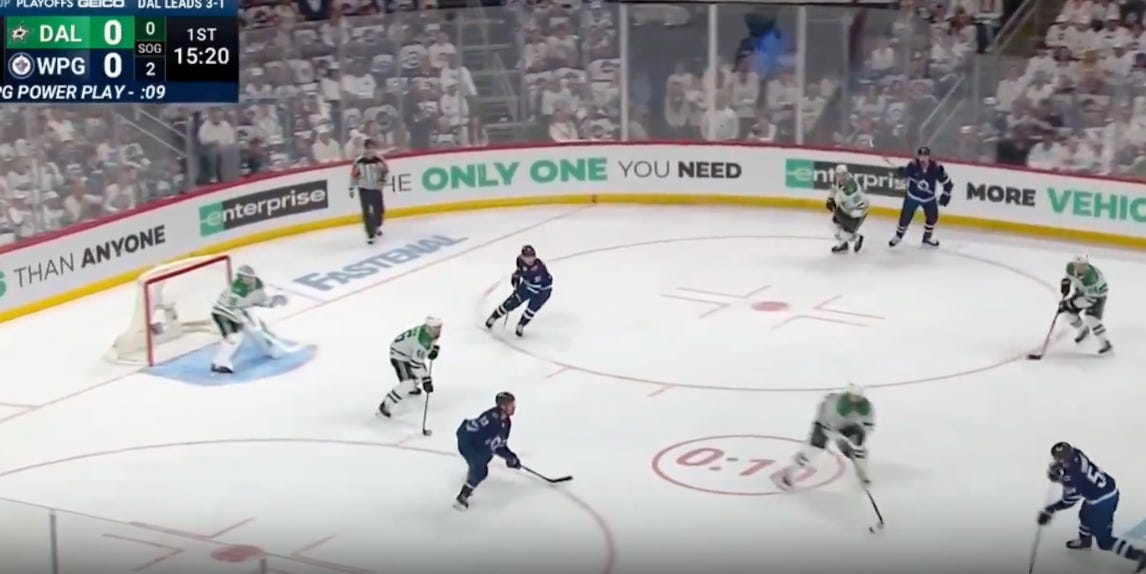
Let’s start with Game 1, when the Jets got a first period chance to break the 0-0 tie. One of the most distinctive features of this 1-2-1 penalty kill formation from Dallas is their willingness to allow opportunities down low, trusting Jake Oettinger and the net-front defenseman to prevent those from getting cashed in.
Winnipeg tried that play twice in their first power play of the series, too, but to no avail.
Note how aggressive Hintz and Johnston are atop the diamond PK unit here. the Stars are basically daring the Jets to exploit space by either going back to a second man on the point, or else to feed it down load and try to cram the net.
The idea is you have one (sometimes two) players attacking high, while one of your other two players guards against the cross, with one final defenseman guarding the most dangerous plays closest to the net.
Look at the screenshot below, and you can see Ceci (at the bottom of the diamond) is edging towards Gabe Vilardi in the bumper position between the circles, while Johnston (53) is more concered with Mark Scheifele (55 in blue) at the far wall. Lindell is telescoping out in case Connor tries to shoot, with Hintz defending the one-time feed for Pionk at the point.
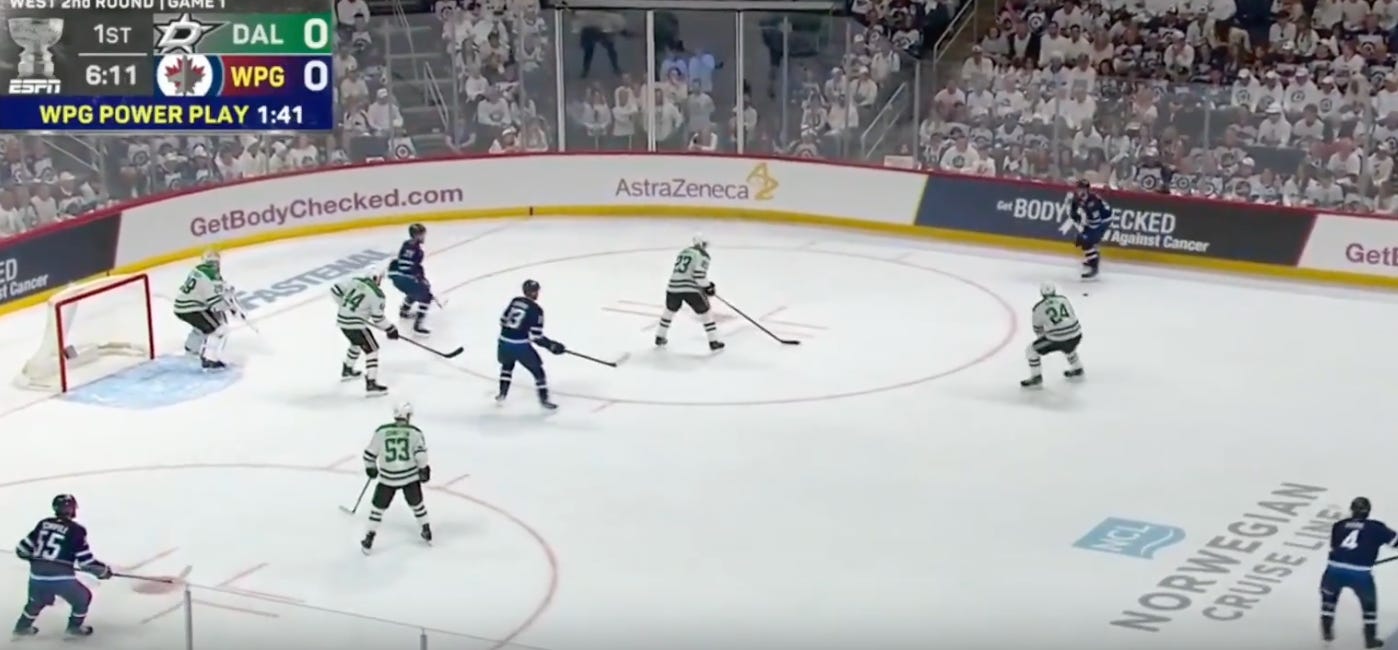
If you remember Monday’s piece on the Stars’ 1-3-1, then you already anticipated the best play for Winnipeg here, because it’s the same one: a quick 1-2 passing sequence down low to Nik Ehlers then right back up to Vilardi in the slot for a one-timer.
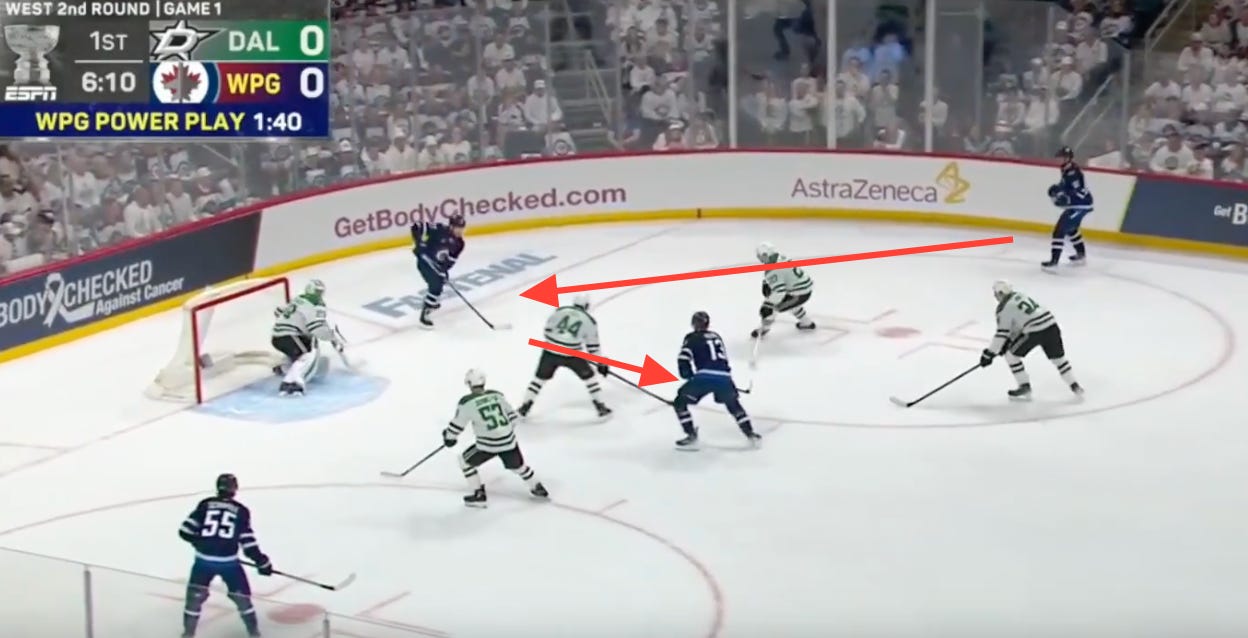
Indeed, Connor feeds it down to Ehlers, but Ceci has actually backed away from the crease to defend Vilardi, basically handing over the net to the attacking player, which might seem odd, but as we’ll see, it’s a feature, not a bug.
With Johnston still guarding the backdoor pass, Ehlers has nothing left but taking it to the house, so he tries to beat Oettinger, and the Stars’ goalie shuts him down.
Later in that same power play, Winnipeg tries the same stuff play on the other side, against a weary group of Stars.
This time, the tired PK group has collapsed toward their net, but Lindell again, like Ceci did before, ensures the bump back up to the slot isn’t avialable, so Vilardi has no real passing options.
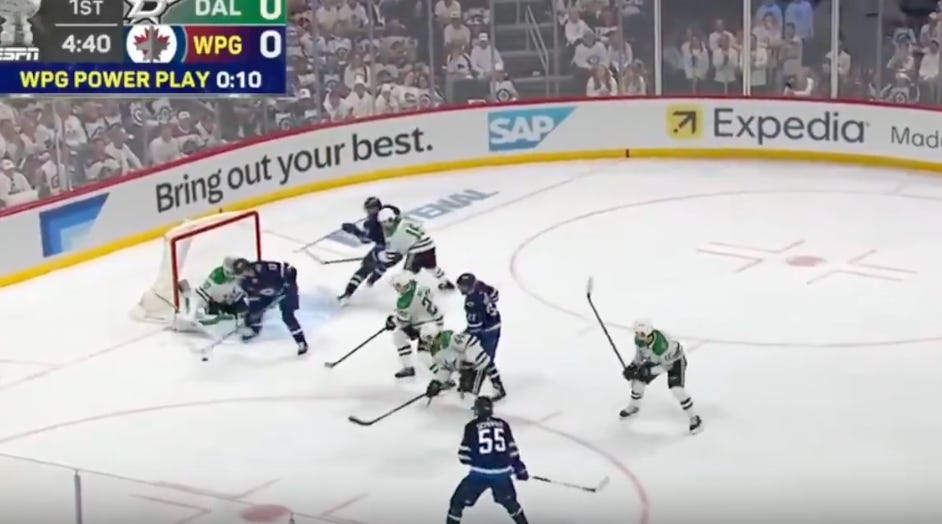
Vilardi draws it out to his forehand, but the omnipresent Lindell gets there just in time to mess up the shot, and Vilardi has to gather the puck again with Ceci now attacking him. Oettinger will eventually smother a prayer from below the goal line, getting the whistle.
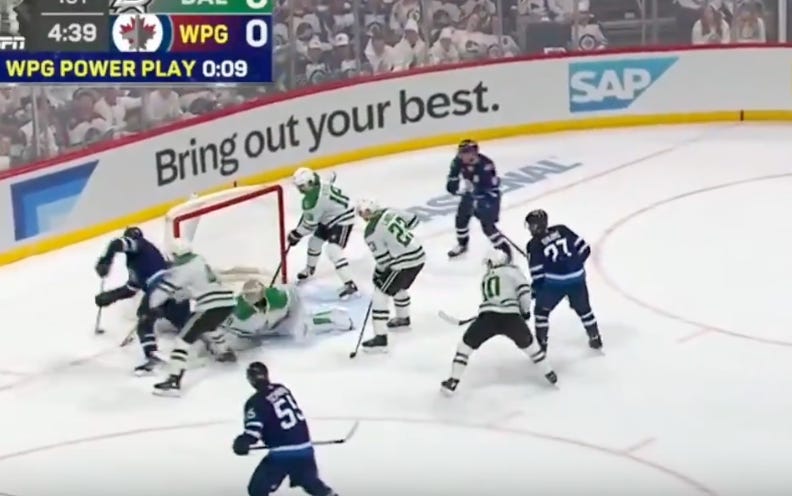
It’s a theme in the Stars’ approach that was especially apparent in this series: Nasreddine’s group basically daring the Jets the take the chances down low they’re giving them, trusting the large Oettinger to snuff out looks from a sharp angle close to the net, even if they’re open ones.
Once more, from the same game, at the end of another power play.
Kyle Connor opens up for the one-timer, but he has no traffic in front, and Oettinger is getting over pretty easily, so he holds instead. When he sees Lindell curling up to (you guessed it) take away the pass to Vilardi (13) in the slot, Connor once again takes the ice Dallas gives him, but with a twist: passing to Vilardi at the last second.
But Oskar Bäck has stayed engaged, and his stick check foils Vilardi’s shot.
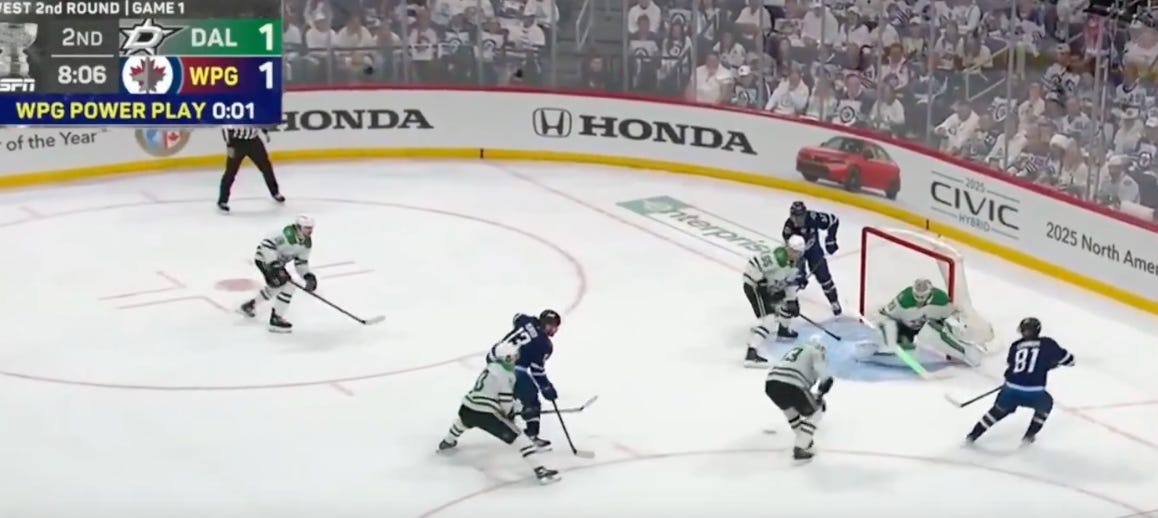
Vilardi will eventually get another whack at the puck, but by that time, Oettinger is atop his crease, cutting down the angle. Another successful kill.
Last clip from Game 1: Oettinger was electric late, when the Jets poured it on 6-on-5. It’s not technically a PK, but the Stars treated it more or less like one, and the Jets got a fantastic look in desperation time.
If you can, watch only Cody Ceci on that clip, and you’ll see a grand old time. But more than that, note how Oettinger doesn’t push himself out of position even after the dangerous Scheifele shot from the goalie’s right side.
That control and poise from Oettinger allowed him to be close enough to get back with his glove hand late in the scramble, which ended with Dallas preserving the win Mikko Rantanen’s hat trick earned them.
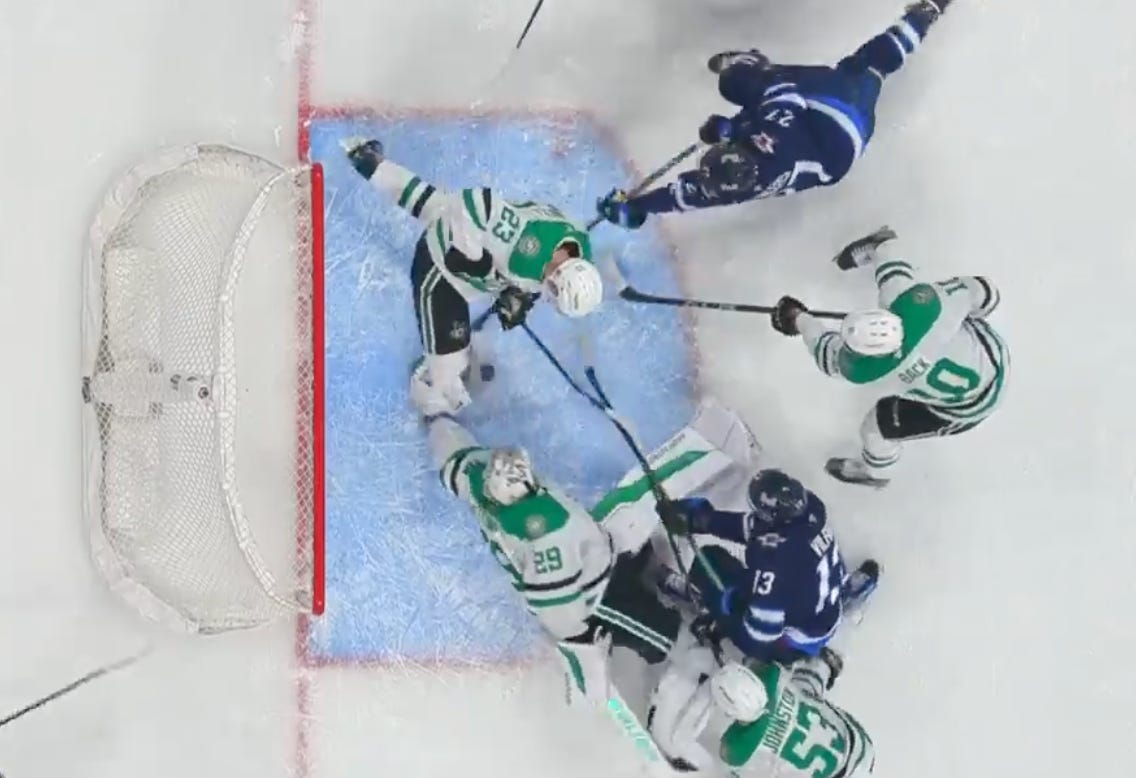
Sequences like that one are what still make it tough for me to point fingers at Jake Oettinger for the Stars’ elimination. Knocking out both Colorado and especially Winnipeg was an incredibly impressive display, and Oettinger deserves every bit of the praise he got after two rounds.
In Game 2, the Jets got a four-minute power play thanks to a Seguin high-sticking call right off the bat. And again, you notice our theme: Dallas allowing the pass down low, the net-front defenseman backing off to cover the bumper, and Oettinger holding the fort from the angle.
Note Oettinger’s stick here, as he tentatively begins a stick check that doesn’t pan out. Thankfully his shoulder doesn’t dip too much in the process, and he stays big enough to make the save.
A little later, the Jets got sick of trying to beat Oettinger from the angle, so they tried to use the down-low forward as a relay point rather than the shooting position, but the pass doesn’t get relayed cleanly:
Eventually, the Jets did score a power play goal on a broken play and a nice bounce, but it’s hardly evidence of much other than the fact that it’s helpful to have four minutes of power play time.
Funny enough, it’s Ceci’s successful block of another attempted pass down low to Vilardi (far left) that leads to the goal. Ehlers gathers the puck again, then fires it off the post, where it lay perfectly for the putback goal.
Not much to say about that one, other than maybe they would have been better off letting the pass get through to the wide-open guy near the net.
Despite their shutout win in Game 2, Winnipeg was still scuffling to the tune of 1-for-9 on the power play after the first two games. But the frusrtation really reached its zenith in Games 3 and 4, when the Stars took a 3-1 lead in the series while the Jets’ power play got stymied on seven attemps across the two games.
Early in Game 3, it looked like the Jets were trying to simplify their approach, just looking for a good shot with some traffic and hoping for the best.
Again, you see the Stars’ complete willingness to allow that sort of a chance, so long as the middle of the ice is secure. They trusted their goaltender, and he vindicated that faith.
On their next power play, Kyle Connor once again had some space, so he simply stepped into it and took a shot, again with a man on the doorstep. But again, Oettinger found it.
In Game 4 (the Mikael Granlund game), the simpler approach finally bore fruit for Winnipeg, even though the goal came just a tick after the power play had expired.
This one is just a bad goal that Jake Oettinger got surprised by.
Perhaps Oettinger figured he’d shut down so many of these, there was no need to worry? Who knows. The Stars would win the game anyway because, you know, Mikael Granlund.
In Game 5, the Jets finally began to execute their most dangerous power play plans with consistency, and their two PPGs carried them to their last victory of the season.
Before looking at the goals, I wanted to point out something else interesting the Jets were doing at times in their breakouts. As opposed to the drop plays Dallas and a lot of NHL teams use, the Jets would sometimes break out with four guys back, often pushing the forechecking forwards back a little ways, where they weren’t able to cut the ice in half.
That can lead to good chances on set plays against a PK backed off and standing a little too still on their own blue line, like so:
Here you see Cody Ceci frantically turning and realizing a streaking Nik Ehlers is trying to beat him to the bank pass off the end boards. Ceci just does enough to prevent a wide-open shot, but the ensuing chaos leaves Vilardi wide open on the doorstep for a Grade-A chance that Oettinger has to stop. He does.
That breakout again caused issues for Dallas later in the same power play,
It’s a simple play by the second unit, but you can see the issues in the neutral zone. With four players wide, the top Dallas forward (Benn) can’t be too aggressive, so he backs off a bit to see what Perfetti is going to try before he attacks the puck, and that means Winnipeg is able to make a pass at the blue line to circumvent Granlund and gain the zone with speed.
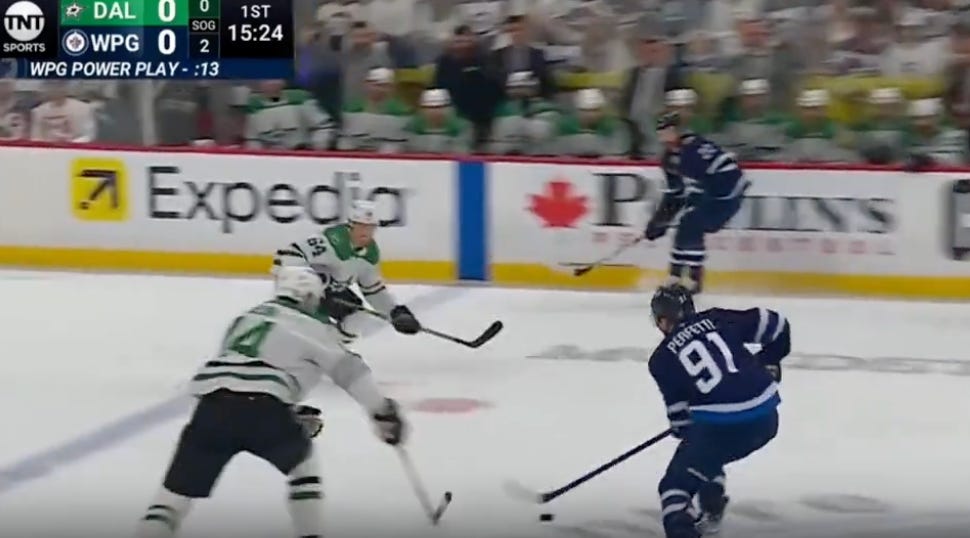
Harley sees Granlund getting beat, so he steps up to seal the corner, but the feed comes back across to Dylan Samberg (54 blue) who has acres of space, and he steps into it.
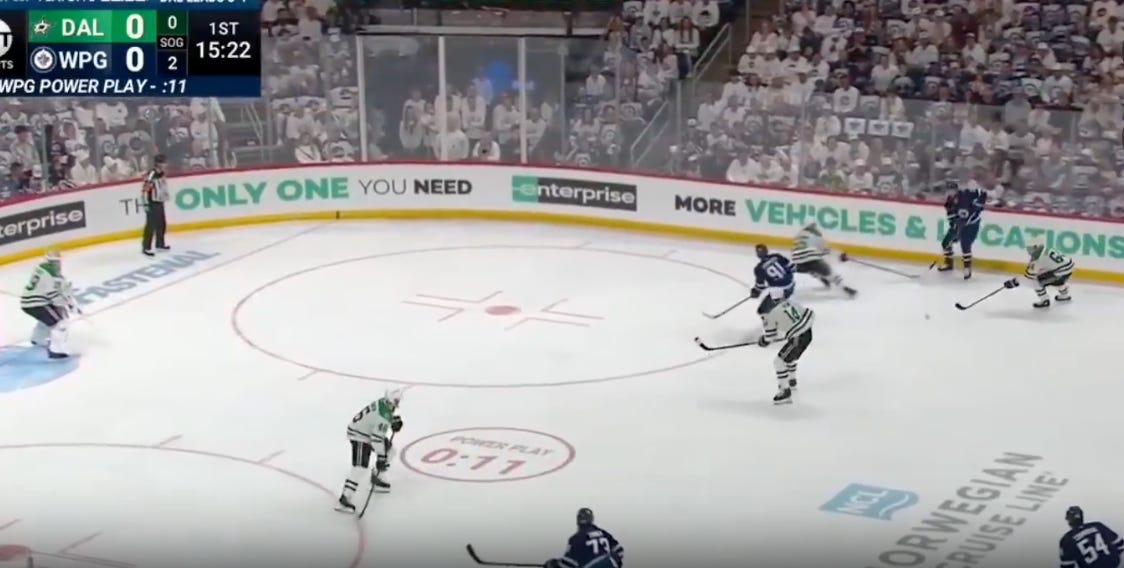
At this point, no real PK box exists, and Winnipeg has a 3-on-2 advantage in the middle of the ice. Samberg fires it with traffic, probably looking for a tip. It nearly bounces favorably for Winnipeg, but Oettinger saves his team’s bacon.
That breakout option somewhat neutralized Dallas’s ability to slow down Winnipeg’s entries in this game, and it made their job a lot tougher once they had to start defending in their own zone.
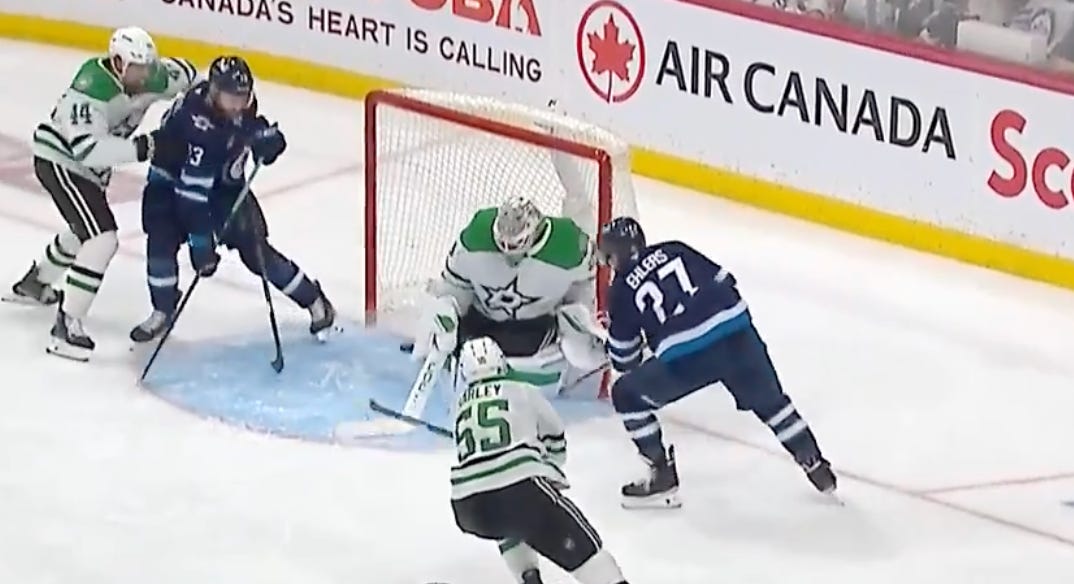
One power play goal came on a 5-on-3, utilizing the same player down low for a cram play. Except this time, Dallas is down two men, so there’s even more time and space, and neither Harley nor Johnston is able to recover anywhere close to in time to prevent a shot far side from beating Oettinger.
Ceci is properly more concerned with his man on the back post (though it’s debatable how well he’s defending him), and Harley gets sucked away from the net a bit more than he probably should have here.
But really, Oettinger would want this one back, as he gets his stick extended to prevent the cross, only for that motion to prevent him from protecting the far side with his pad, and it slides in underneath his stick and past his right toe. Whoopsie.
Winnipeg would then seal things with their third and final power play goal of the series, as the second unit more or less outworks some tired penalty killers late in a penalty.
Harley ends up not anticipating the backhand feed from Iafallo below the goal line (to whom Lyubushkin is telescoping), but in his defense, Granlund’s mishandle means both forwards are solidly out of the play here.
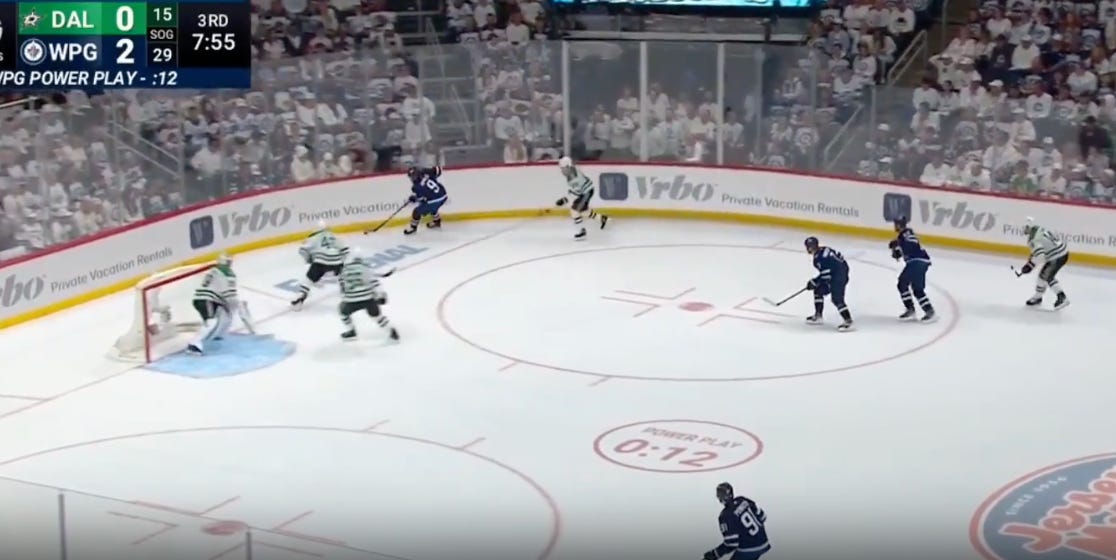
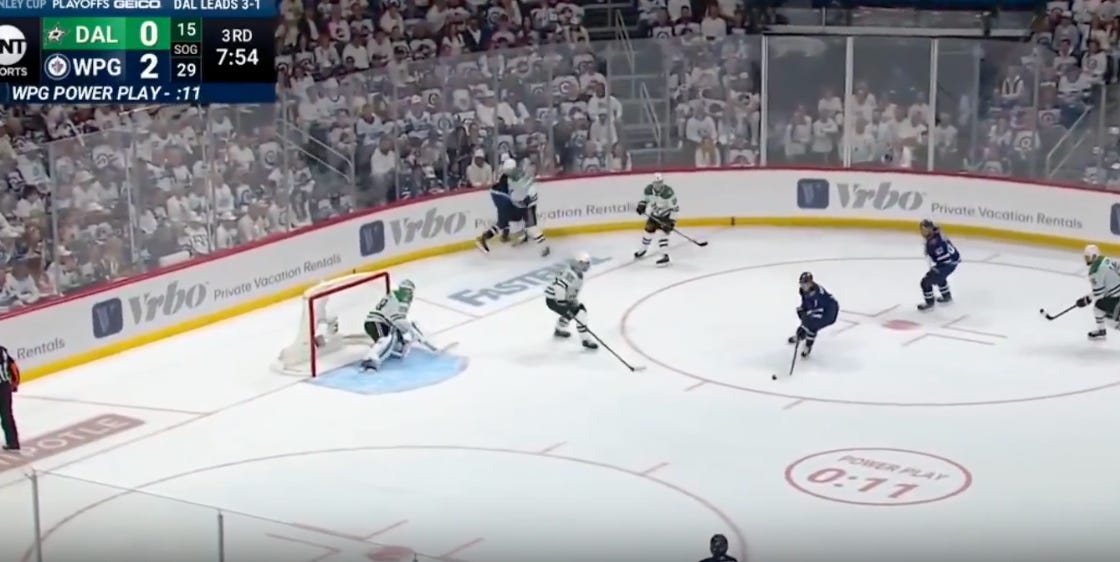
Also, to Vlad Namestnikov’s credit, he receives the puck in A Prime Scoring Area, and he then makes the most of it, whistling it right past the ear of Oettinger, just under the bar.
But that would be it for Winnipeg’s power play, as the Stars didn’t give them a chance on the job in Game 6 (though Scheifele did score their lone goal on a delayed penalty call). Though the Stars did get this save from Oettinger in a 1-1 tie with 8 minutes remaining, in you case you forgot about how the Stars got to overtime:
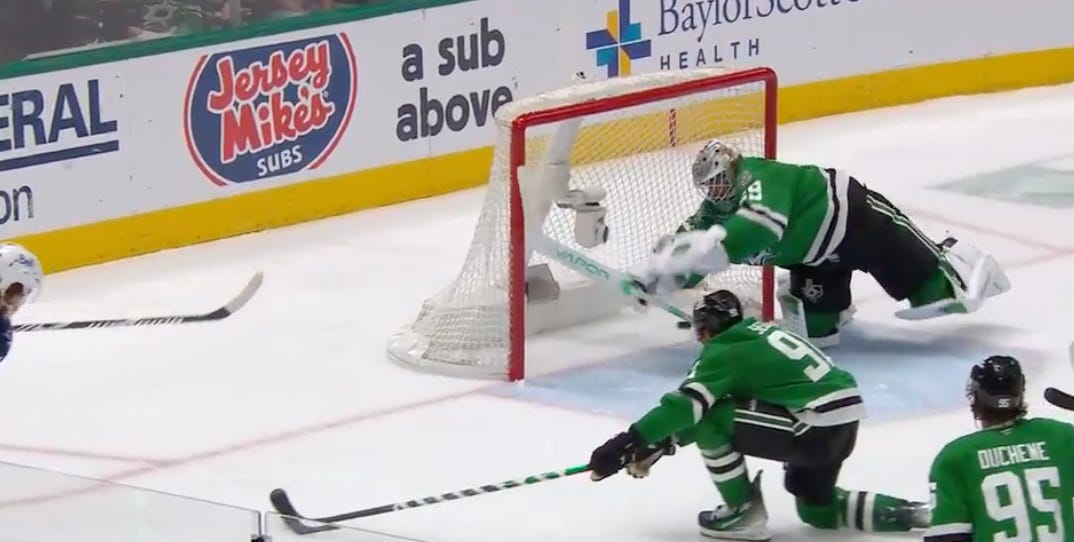
So, yeah. The Jets series was a battle against the best goalie in the league (who was also voted the best player in the league that year) and the best power play in the NHL. And Dallas walked away from the match scoring more power play goals on fewer chances, possible sending both goaltender and power play into serious self-examination after the series.
The Stars’ penalty kill bent at times in this series, but Nasreddine’s group simply refused to break. Oettinger cleaned up far more than he spilled, and it all ended with Dallas eliminating the Presidents’ Trophy team.
In summary, here were the three power play goals Dallas allowed:
One on a broken play after the successful Ceci block
One at 5-on-3
One by the second unit on a frantic rush entry that Dallas never really settled down from.
For my money, that series was one of the most impressive performances by Dallas’s PK and goaltender of the last three years, even moreso than their adjustments against Colorado back in 2024.
And if you’re about to raise your hand and “well, actually” me about how the Oilers’ power play ran roughshod over Dallas in the next round by going 6-for-16, I would simply point out that the Stars’ response to that issue was to hire the Oilers' power play coach, which seems like a pretty good way to prepare for that matchup in the future.
Nasredinne will have some different personnel to work with next year (with Radek Faksa likely to feature prominently), but if the past is any indication, the Stars’ penalty kill will retain the ability to dictate the terms of engagement, no matter how fearsome the opponent. Sometimes the best way to fight firepower is with a really good fire extinguisher.