

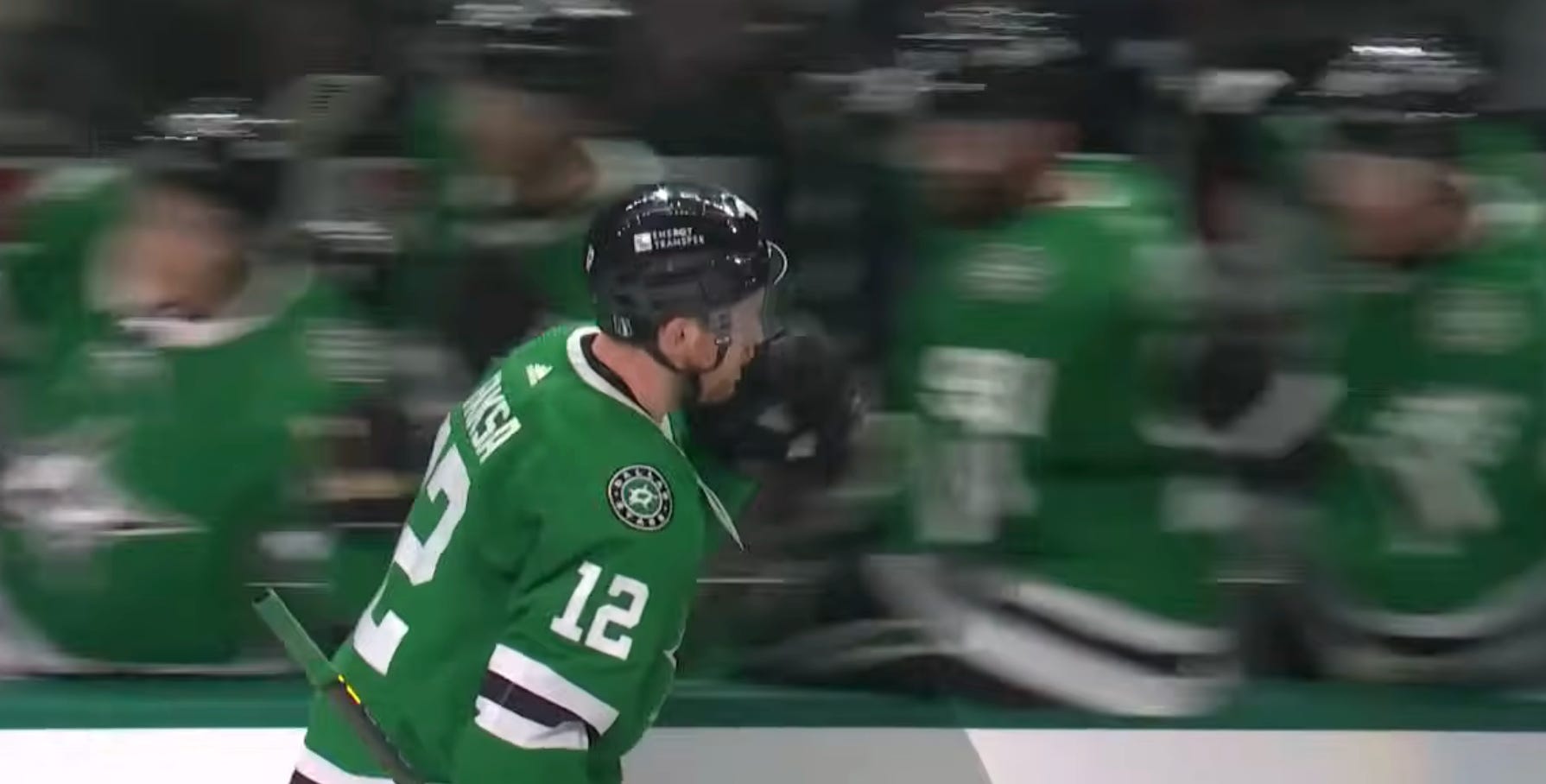
When Jim Nill first announced that the Dallas Stars had brought back Radek Faksa this summer, one sentence stuck out:
The other parts of Faksa’s game that Nill cited were his defensive prowess, penalty-killing ability, faceoff skill, and physicality. The last of those qualities in particular was something Nill said the Stars didn’t have enough of during their 2025 playoff run, while Faksa certainly displayed it with St. Louis in the first round, where they came within seconds of eliminating the Winnipeg Jets in seven games.
Today, it was announced that Radek Faksa had also been selected to play for Team Czechia at the Winter Olympics, so those qualities will all get another big stage on which to display themselves. Faksa makes the seventh player from the Stars roster to be named as an Olympic participant.
Faksa was the Stars’ first-round draft pick in 2012. His story has been told in great detail over the years, but the element that always sticks out is how he and his mother decided that Faksa would leave home at 11 years old to live 90 minutes away in Trinec, in a hotel room paid for by the team.
After doing that for six years, Faksa would head to Canada in 2011 to play junior hockey, with the Kitchener Rangers of the OHL. (In fact, the coach of Faksa’s 2011-12 Rangers team was none other Steve Spott, the former assistant coach in Dallas.)
Many Stars fans know the story from there. Faksa eventually became a staple of the AHL’s Texas Stars, and he would play 21 playoff games during the team’s 2013-14 Calder Cup championship run. Two years later, Faksa would get called up midseason to the dynamite 2015-16 Dallas Stars team, locking down a lineup spot for the regular season and the playoffs, where he scored 3 goals in 13 games while playing over 16 minutes a night.
Faksa’s pedigree was always known as a checking-line center, someone who could use his 6-foot-3, 215-lb frame to hold serve while occasionally chipping in some offense. And he has ended up being exactly that, with his 17-goal, 33-point season under Ken Hitchcock in 2017-18 marking a career high. The scoring is usually secondary for Faksa, even if there have been some very entertaining goals over the course of his career:
However, Faksa’s journey with the Stars ended after 2024, when they traded Faksa to St. Louis for future considerations. The Stars had to clear cap space, and the final year of Faksa’s $3.25 salary cap hit was the name they ended up opting to move.
It was also a move that wound up being to Faksa’s benefit, however. Under Pete DeBoer, Faksa’s longtime position as a bottom-six centerman had diminished, as well as his regular lineup spot. For the first time in his career, his role didn’t feelt like a guarantee, and Faksa told his general manager after the season that a change of scenery might not be the worst thing for him.
“There’s an excitement [this year] when you talk to him,” Jim Nill said. “Things weren’t going well here in his last year, when we finally let him go. He wasn’t in a good place.”
In 2023-24, Faksa had begun to experience healthy scratches. He was also moved to the left wing on occasion, and both of those realities were difficult adjustments for Faksa.
While he scored a memorable goal in the Stars’ Game 7 victory over Vegas, that goal came after sitting out for Games 3-6 of that series. Faksa then played in just four of the Stars’ next 12 playoff games in the next two rounds of that playoff run, before being sent to St. Louis that summer for future considerations.
But to Faksa’s credit, he proved St. Louis wise to have picked him and his cap hit up— particularly when the playoffs rolled around. In Game 7 of a hard-fought contest between the Presidents’ Trophy Jets and a wild card Blues team that had surged after the midseason hiring of Jim Montgomery, Faksa scored what looked likely to be the clinching goal, putting the Blues up 3-1 at the end of the second period.
Heartbreakingly, the Blues would blow that two-goal lead late in the third period of Game 7, surrending two 6-on-5 goals before going on to lose the series in double overtime. Faksa’s line got regular shifts, and they weren’t on the ice for any of the three Jets goals. But ultimately, Winnipeg made it through to the second round, where Dallas defeated the Jets in another memorable overtime contest in Game 6.
Faksa would finish the Blues’ series with five points in seven games while centering a line with Nathan Walker and Alexey Toropchenko. Despite heavy defensive-zone deployment, the trio never surrendered a single goal at even-strength, also scoring six themselves along with a 59% expected goals share that underscored the line’s dominant performance.
Overall, Faksa’s St. Louis season was filled with highs and lows, including suffering a cut from a skate blade in December in an area just a bit too close for comfort. So after the whirlwind of a first year on a different team, Faksa was never expecting to get a chance to make a return to Dallas so soon after being the victim of a salary cap dump.
“Very emotional to leave Dallas, because we spent so much time here,” Faksa said earlier this year. “I spent like a third of my life here, right? It’s like my second home here.”
In a video the Stars put out recently, Faksa and his family talk candidly about how they were shocked and delighted to receive what eventually became a three-year offer from the Stars to return to the city both of their children were born in.
(You should watch that video.)
Faksa said in training camp this year that he was never expecting to come back after Dallas traded him, so they had sold their old house, which meant they had to start over from “zero,” buying a new home and doing all the other things you have to do when you move back to a city for what you might call a second first time.
This first time, however, Faksa is far different from the player, and the person, he was in 2015-16.
“He’s gone from a young guy himself to walking around with two children,” Nill said. “It’s neat to see. It’s really a pleasure to watch that type of thing. They’re part of the team. They’ve grown up with the team, and they know what they’re trying to instill here.”
This year, Faksa has continued playing the role that he did for St. Louis in the playoffs. Under new head coach Glen Gulutzan (who ran training back way back during Faksa’s first year with the Stars in 2012), Faksa’s role is clear: Be a fourth-line center with defensive-zone deployment who can play on the penalty kill.
Gulutzan doesn’t roll four lines quite as symmetrically as DeBoer often liked to do, and that means Faksa’s ice time is just a tick under 12 minutes per night—the lowest average of his career. That’s due in large part to how Gulutzan tends to lean more heavily on his top lines, which makes sense when you have players like Mikko Rantanen, Jason Robertson, Wyatt Johnston, and Roope Hintz at the top of the lineup.
The results of Faksa’s return have been clear to see. He’s been a staple of a penalty kill unit that has surged up to 7th-best in the NHL after a slow start, and he’s chipped in more offense at even-strength than many might have expected, even leading the team in primary assists at 5-on-5 for a good part of the first half of the season. With 15 points in 41 games, he’s already matched his point total from last year’s 70 games in St. Louis.
But perhaps the most impressive thing about Faksa’s return this year is how stout his defensive game still is, just three days before his 32nd birthday. Because in over 383 minutes of ice time at 5-on-5 this year, Faksa has only been on the ice for 8 goals against, while seeing 12 go in for Dallas. The +4 margin is even more impressive when you look at the goals-against rate for Faksa of just 1.25 GA per 60 minutes, which is easily the lowest on the Stars this year of any regular player, despite Faksa’s having played with a wide variety of linesmates in the first half of the season.
In fact, if you look at all 350 of the forwards in the NHL to have played at least 300 minutes at 5-on-5 this season, Faksa miniscule goals-allowed rate gets even more impressive: He’s 4th out of those 350 forwards. Oh, and he’s also done that despite having the 14th-lowest offensive zone faceoff% among that group, too.
Faksa’s job is clear: Win your shift, and turn it over to the next line. This Stars team isn’t built like the DeBoer squads, where every line is expected to score. Instad, it has been built in such a way that you can easily see the value of a player like Faksa, who can be trusted in any situation, with any lintemates, against even the best competition—even if he isn’t racking up points.
On a team that lost scoring wingers like Mikael Granlund and Mason Marchment for salary-cap reasons this summer, Faksa’s $2 million salary much more easily fits the Stars’ plans this year. And if he keeps ensuring the Stars are on the right side of the ledger after his shifts, there’s every reason to believe that number will end up being a bargain.
Faksa’s on-ice performance is clearly accomplishing the goal his coaches have in mind. But perhaps just as importantly, he’s also brought a lot of joy back to a Stars team that may have needed it right now, given how last year ended, along with how injuries have affected the team this year.
“When you’re drafted by a team, there’s a pride that goes with that,” Nill said. “And when he had a chance to come back, you just see it in the dressing room. He’s happy.”
Back in training camp, Faksa was asked if it felt like he had been gone for a whole year, and his answer said it all.
“Yeah, the first couple of days it felt like that,” Faksa said. “And now I feel like I never left.”
Given how much the homecoming to Dallas has meant to Faksa this year, I have no doubt that playing Olympic hockey for the first time will mean the world to him, just as wearing his team’s jersey did when he played for his country back in the 2016 World Cup of Hockey.
It would hardly be a surprise for Team Czechia to discover next month, as the Stars have this year, that Faksa always tends to have a positive effect, both on and off the ice. In talking with Faksa in the past few days about the potential of playing for Czechia, Faksa said all the right things: It would be an honor if he were selected, but of course, nothing had been made official at that time.
But now that Faksa has been selected, there’s every reason to think Team Czechia will be getting a very important player in Milan next month, just as Dallas has this season.
Update: Radek Faksa spoke with Mike Heika this morning in Carolina about being selected for the Olympics, which you can watch here.
Love articles like this Robert, thanks very much, helped make my day
Great article Robert! You are a machine!