

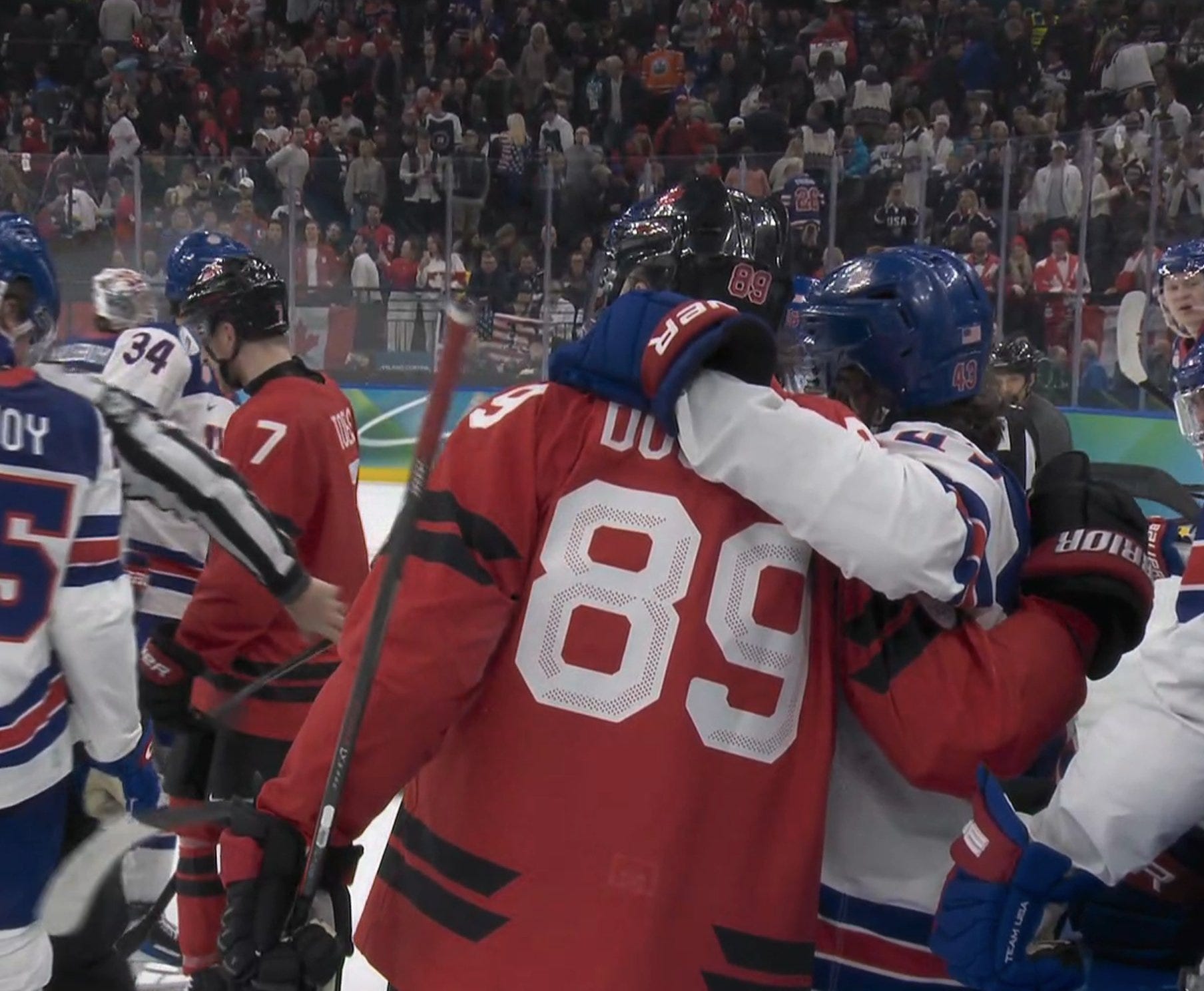
Connor Hellebuyck won this game for the USA.
The comparisons to Ryan Miller from 16 years ago in Vancouver are easy, and proper. But whereas Miller was simply keeping the USA in the game for far longer than they deserved against a far superior opponent, this USA side had every right to be on equal footing, especially against a Canadian side without Sidney Crosby or Josh Morrissey.
In fact, pause on that for a moment. Sidney Crosby ultimately chose not to play in a gold medal game after suffering what looked like a knee injury two games ago. Think about that decision, about a player nearing the end of his career, choosing to give up on that opportunity, to cede the possibility of a Kirk Gibson moment.
But that’s Sidney Crosby, because it always has been. Unlike Matthew Tkachuk at Four Nations, Crosby didn’t “gut it out” and choose to take up a roster spot in hopes he could find a big moment without the ability to play big minutes, even with a 13th forward available on expanded Olympic rosters. However close Crosby was—and he sounded probable in the 24 hours leading up to the game—Crosby ultimately decided that letting his team play for Gold with 13 healthier Canadian forwards was a better option than asking them to carry him with a flat tire.
And he was absolutely right, because Canada’s skaters were the far better group from pretty much the first intermission onwards:
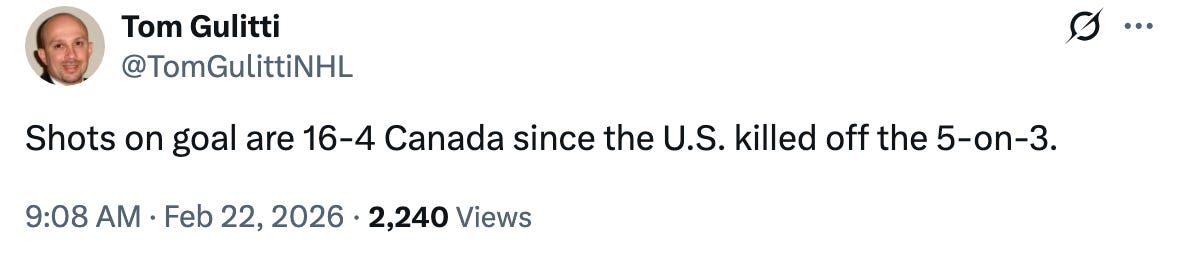
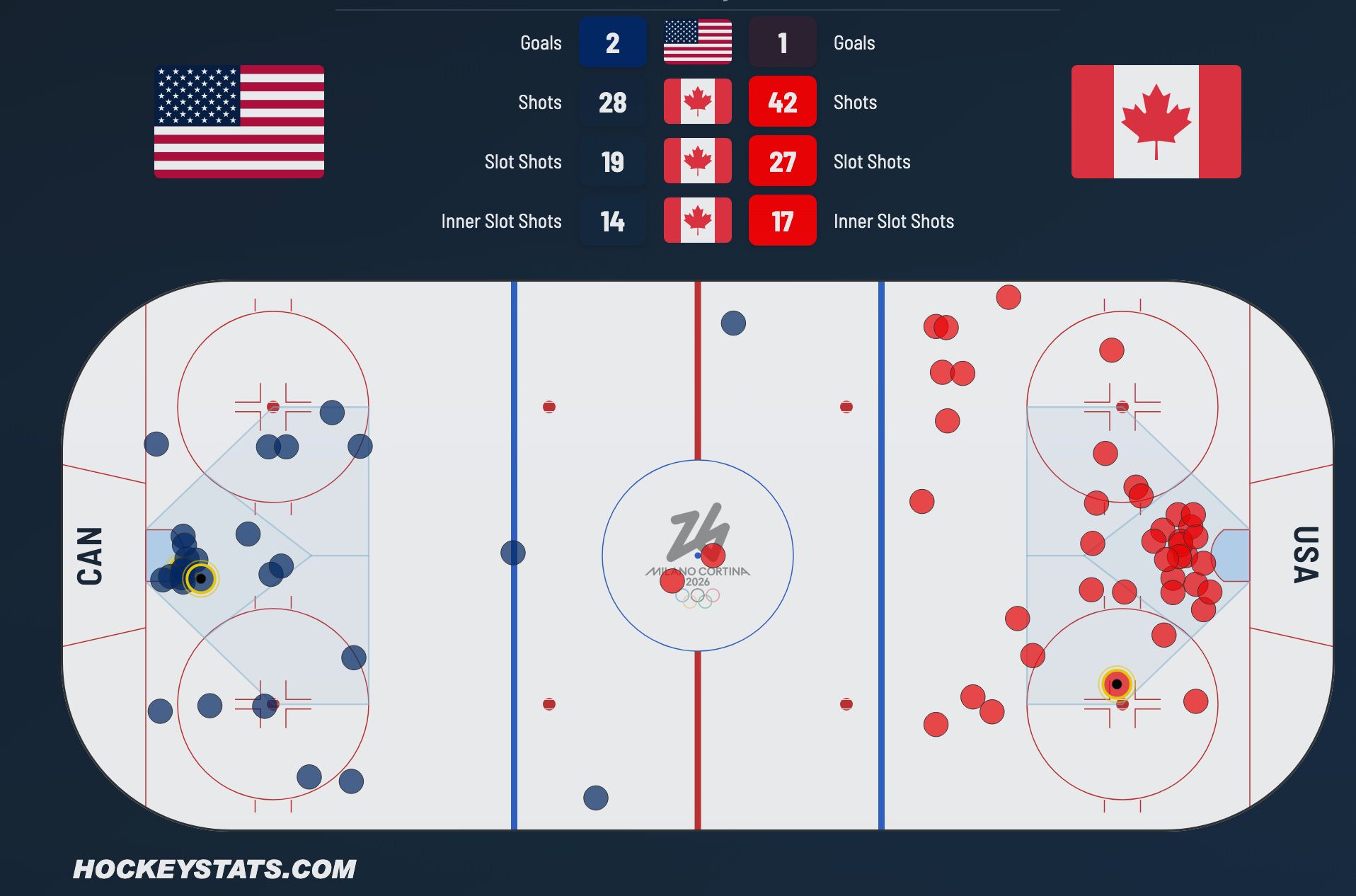
Bill Guerin and USA Hockey will be taking a victory lap for a long time after this one, and winning gold means you get to do that. They brought home the prize, flipping the results of Four Nations by exactly the one goal they believed they could.
You cannot argue with results on the biggest stage, in the biggest game. The USA can point to a 100% penalty kill in the tournament to say that JT Miller and Vinny Trocheck were The Right Calls, and what can you really retort with? Cole Caufield wasn’t needed in overtime, because the Brothers Hughes stepped up in the biggest moments, as great players always seem to do.
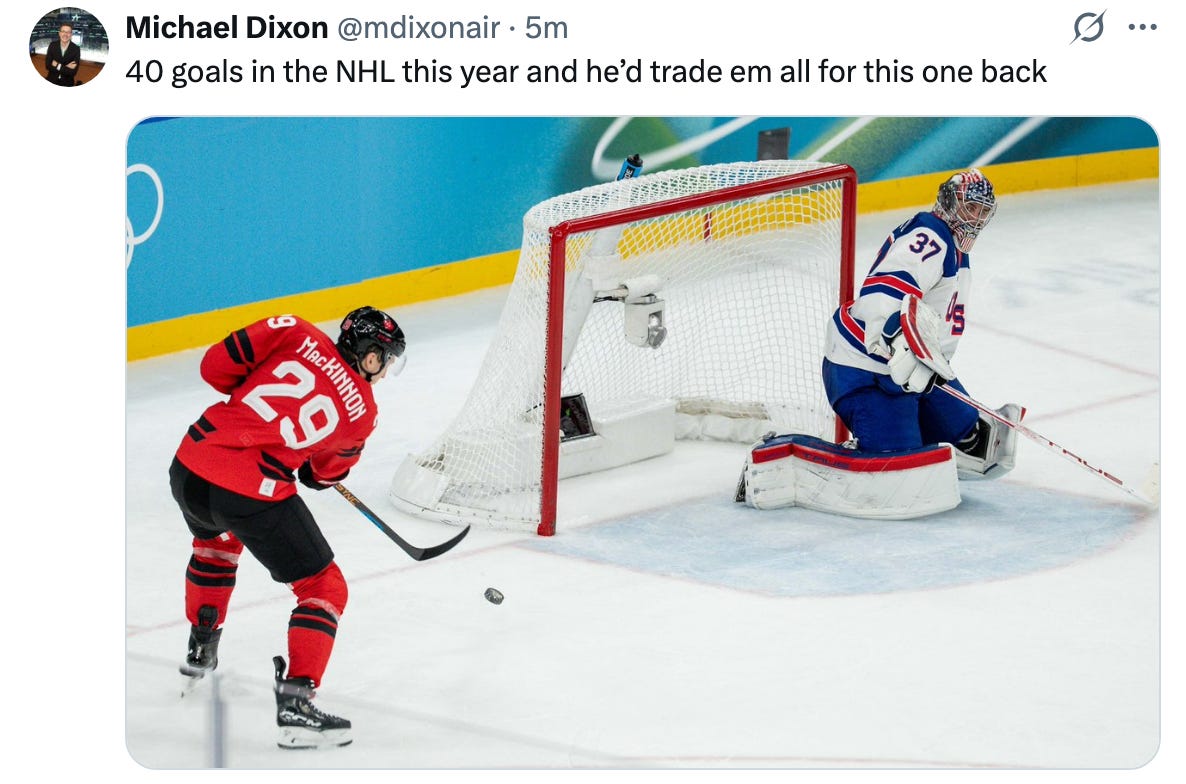
And that’s where trying to torque this game into a referendum about roster selection negatively or positively is a misguided approach, I think. Canada missed multiple open nets, including a MacKinnon chance with a gaping net in the final 10 minutes that he shanked off the side of the goal that he’ll be re-living for the rest of his life.
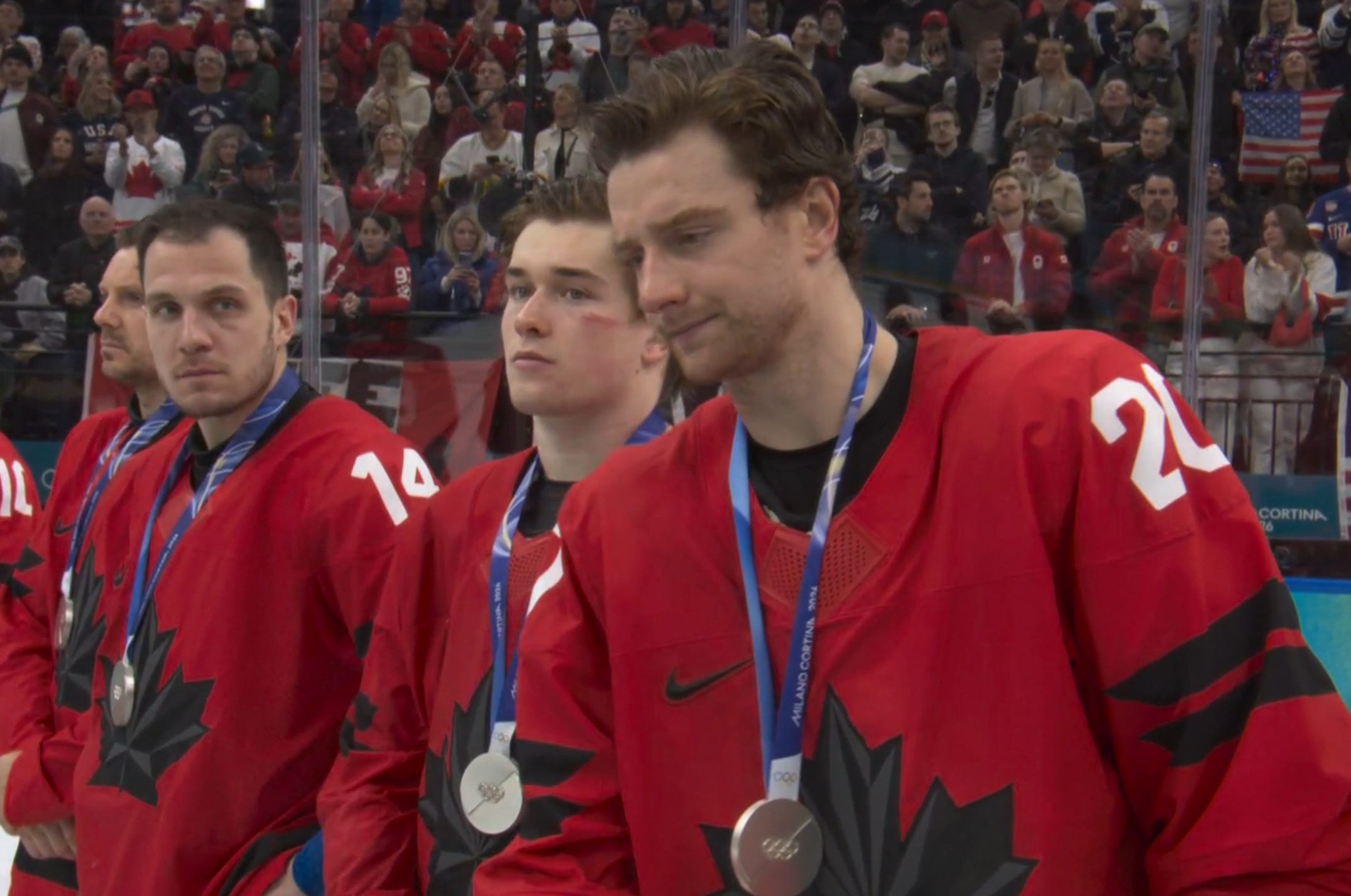
From their side, Canada will be feeling, to a man, like they let each other down, like they panicked in crunch time and couldn’t find that extra goal. Like Auston Matthews at Four Nations, in other words.
Games like these are defined by a handful of moments, even as hundreds of smaller plays either spark or douse plenty of other dangerous sequences. So very much hangs in the balance on every shift, and you can only play your heart out when you get sent over the boards, even if it’s only for one shift (like the 0:38 Clayton Keller got tonight).
Jordan Binnington had to come up with his own saves, too. That’s what made this different from 2010, as the USA really and truly had the depth to mount strong pushes when they could, and it forced Canada’s goaltending into some truly spectacular saves. Credit to Binnington, who found a way to stop all but one puck in regulation, which is as much as you can ask any goaltender to do in the Gold Medal Game.
The other thing that was true about this game is the defensive play was indeed at another level, with players backchecking and stick checking and body checking for all they were worth. The offensive talent on both sides meant any mistake could instantly turn into something special, and that got the very best in defensive efforts from all involved. Charlie McAvoy chest-trapping a puck out of the crease behind Hellebuyck was one of many such examples.
The pace was every bit as thrilling as it was at Four Nations, and possibly even more so. The intensity and pressure had to be off the charts, and I really do think that factored into some of the miscues by Canada, who just haven’t seemed quite as deadly in their past three games, despite having easily the best forward group in the tournament.
Celebrini was great in this tournament, but his inability to hit the net on the late power play will haunt him almost as much as MacKinnon’s miss. The 5-on-3 opportunity Canada couldn’t capitalize on was horrific, and in a way, it’s to their great credit that they still tied it up after that, when it would have been so easy to sag for a while.
Ultimately, their best players were leaned upon hard. Celebrini played 12:52, MacKinnon played 21:21, and McDavid played 24:01. Jack Eichel was the only forward for the USA to hit that mark, with 20:14. Was a bit of heavier usage in what looked like a deep Canada lineup on paper just a necessity of injuries, or something else? Certainly that approach got Canada a final 40 minutes of dominance, but if you can’t grab a lead in the process, you’re going to get analyzed to death, and I’m sure Cooper will have some discussions to that effect.
Harley, Makar, and Toews were all over 20 minutes in this one, too. And speaking of the one Stars player to actually play in this game, Harley stepped up like crazy in this tournament, becoming the clear #3 defensemen for Canada as players like Drew Doughty and Shea Theodore fell further down the lineup. From a Stars perspective, Thomas Harley is the best story from this tournament, with Miro Heiskanen’s performance for Finland a strong second.
We’ll get into the game itself below, but I just can’t shake the feeling that some fatigue on the top players might have contributed to the decisions on the overtime goal, in which McDavid turned the corner on Jack Hughes, of all people…
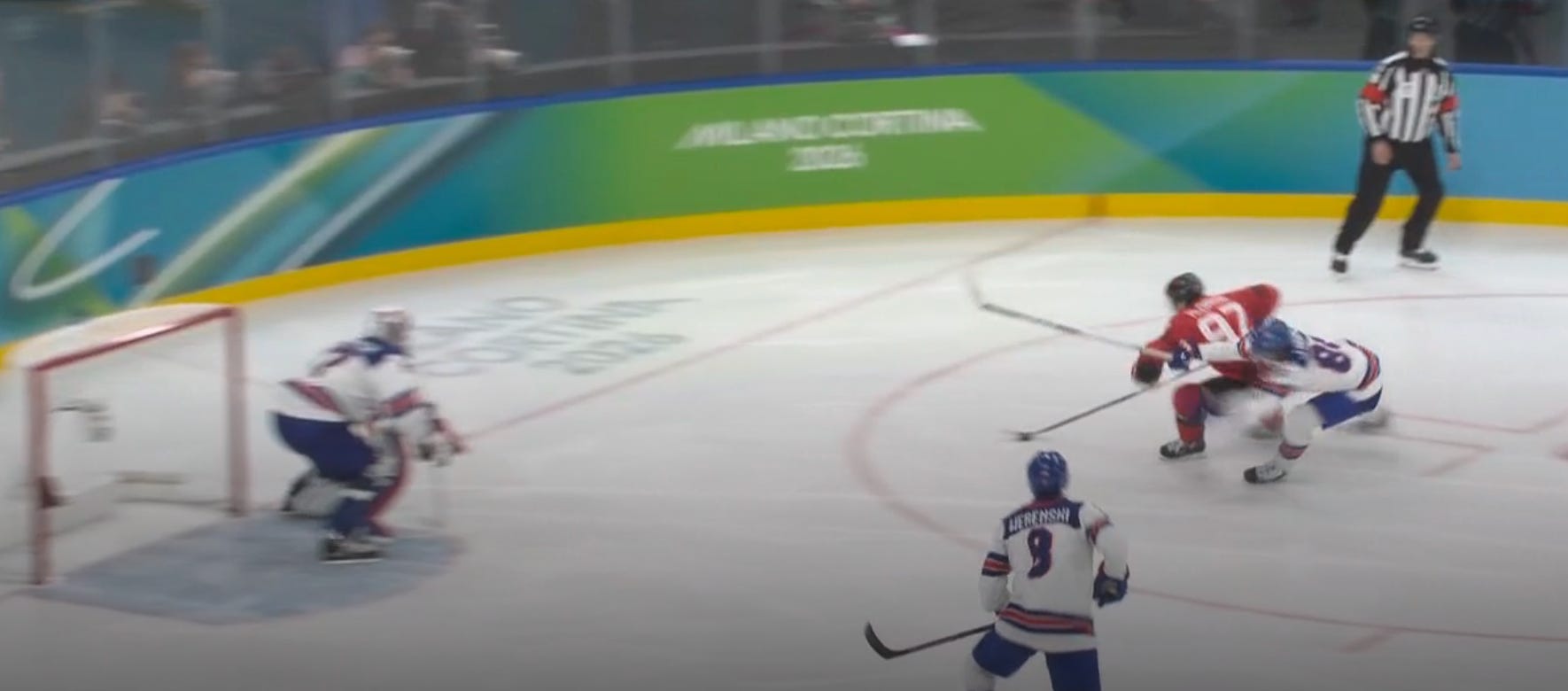
Only for Hellebuyck to get his goal stick out and swat the puck off McDavid’s stick.
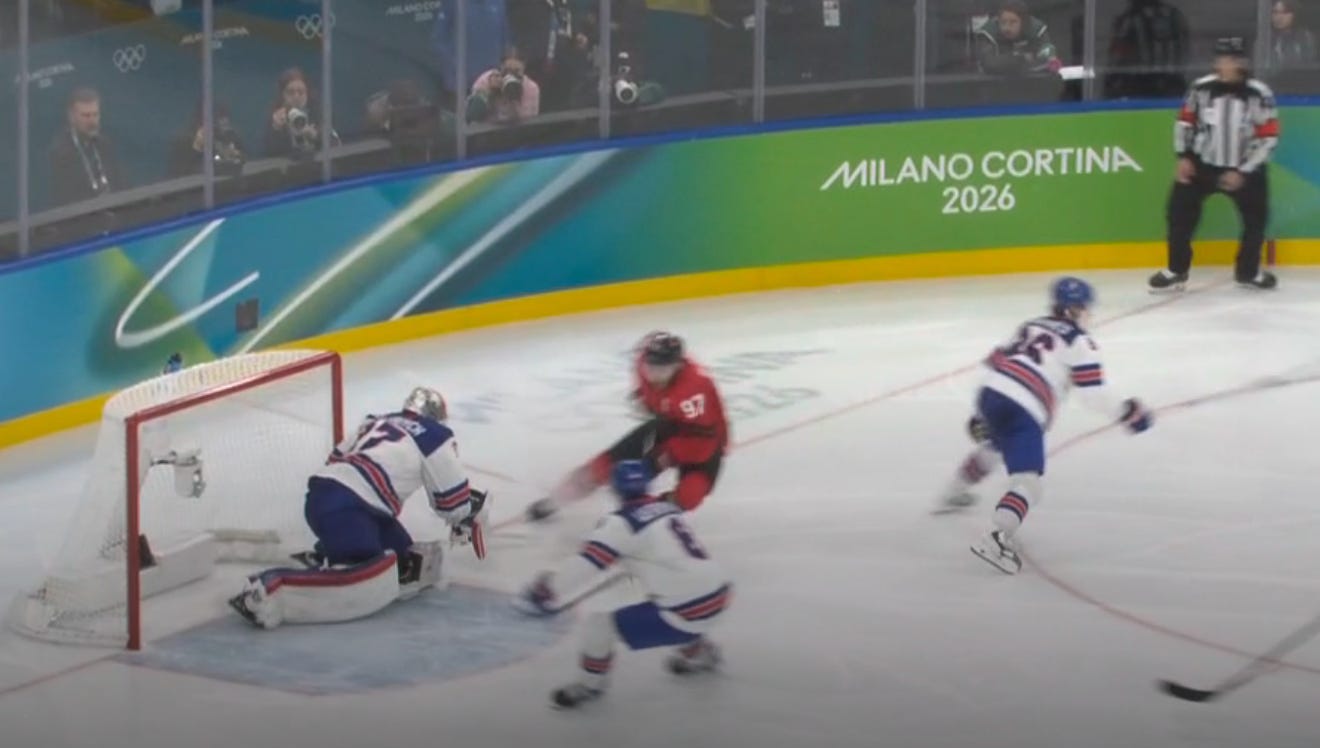
The puck would roll behind the net, and Canada wouldn’t get hold of it again.

Jack Hughes could easily have been the goat of the game, in the classic sense. His penalty to take the US off the late power play could have been the dagger, as could his getting beaten by McDavid in overtime.
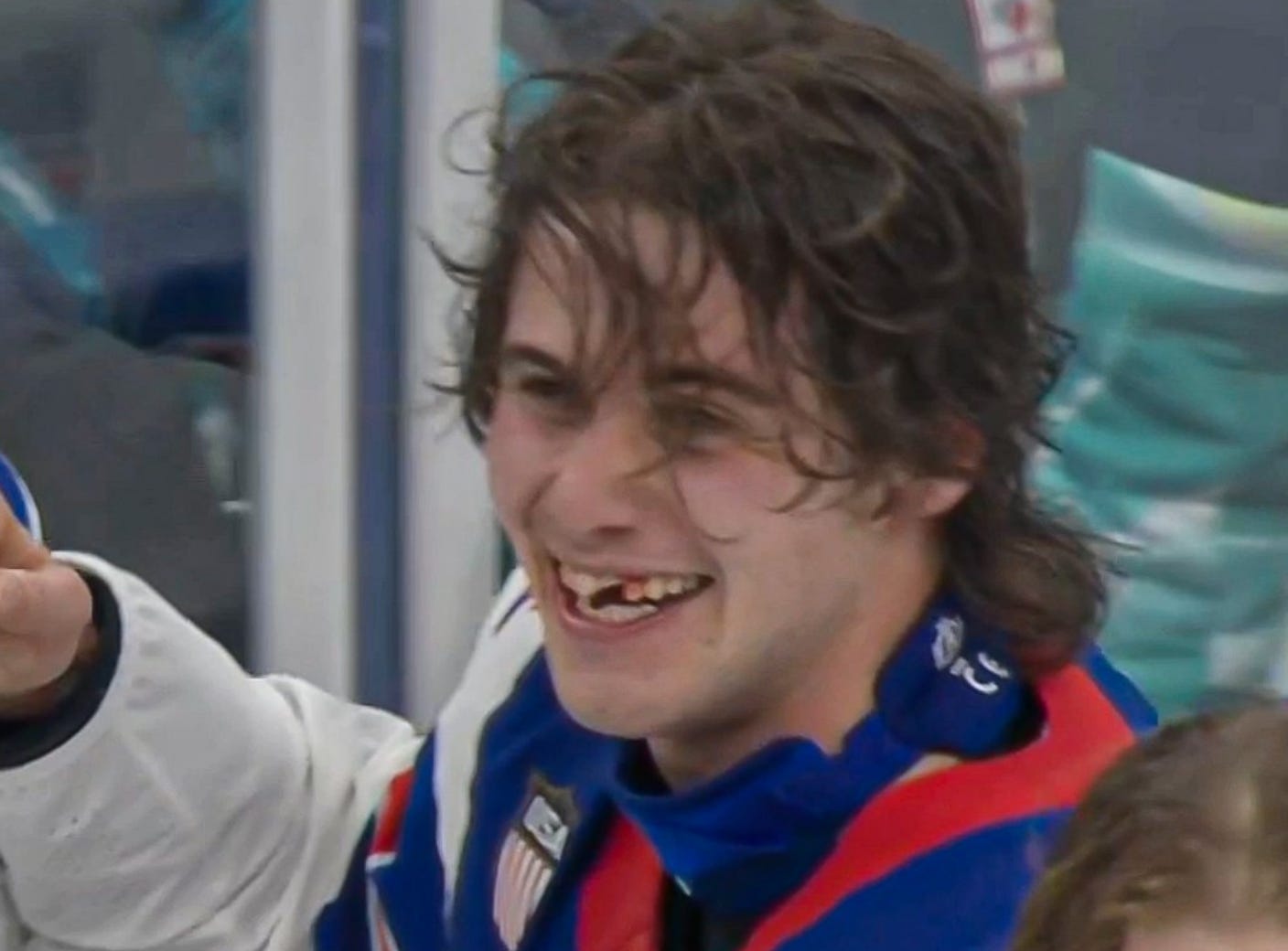
But winning means those things won’t be the story, because that’s how these winner-take-all games work. In the end, he traded some teeth for the biggest goal of his life, and one imagines he would take that trade every time. Who wouldn’t? Because Hughes is now the name that will be spoken alongside (and with increasing frequency, instead of) Eruzione. That’s what was always on the line for the USA here: Glory, however you get there, and Jack Hughes, Matt Boldy, and Connor Hellebuyck found a way to do it.
In the Olympics more than almost anything else, the final score is what people will remember, just as this game was one that I’ll never forget.
The game began with the Tkacheichel line vs. Mach 3, as the kids are surely saying. And in a good sign for the US, Thomas Harley and Drew Doughty would end up spending over a minute in their own end under heavy US pressure and multiple failed clearances in the top-flight matchup, though all the best chances were sent wide of the net.
The physical play was also a big story early, and a loud, Canada-leaning crowd only accentuated every play. But the biggest hit might have come five minutes in, when Tom Wilson caught Dylan Larkin bringing the puck behind the net and laid a huge hit on him that a good number of human beings wouldn’t have gotten up from. But in this game, I imagine the adrenaline was making a lot of things possible.
Two players who could’ve used a bit more of that physicality were Cale Makar and Devon Toews, who allowed Matt Boldy to pull off an unbelievable goal where he chipped it up into the air, then batted it along before splitting the defense, heading in and beating Jordan Binnington with a slick against-the-grain move along the ice to make it 1-0 on the USA’s first shot on goal of the game.
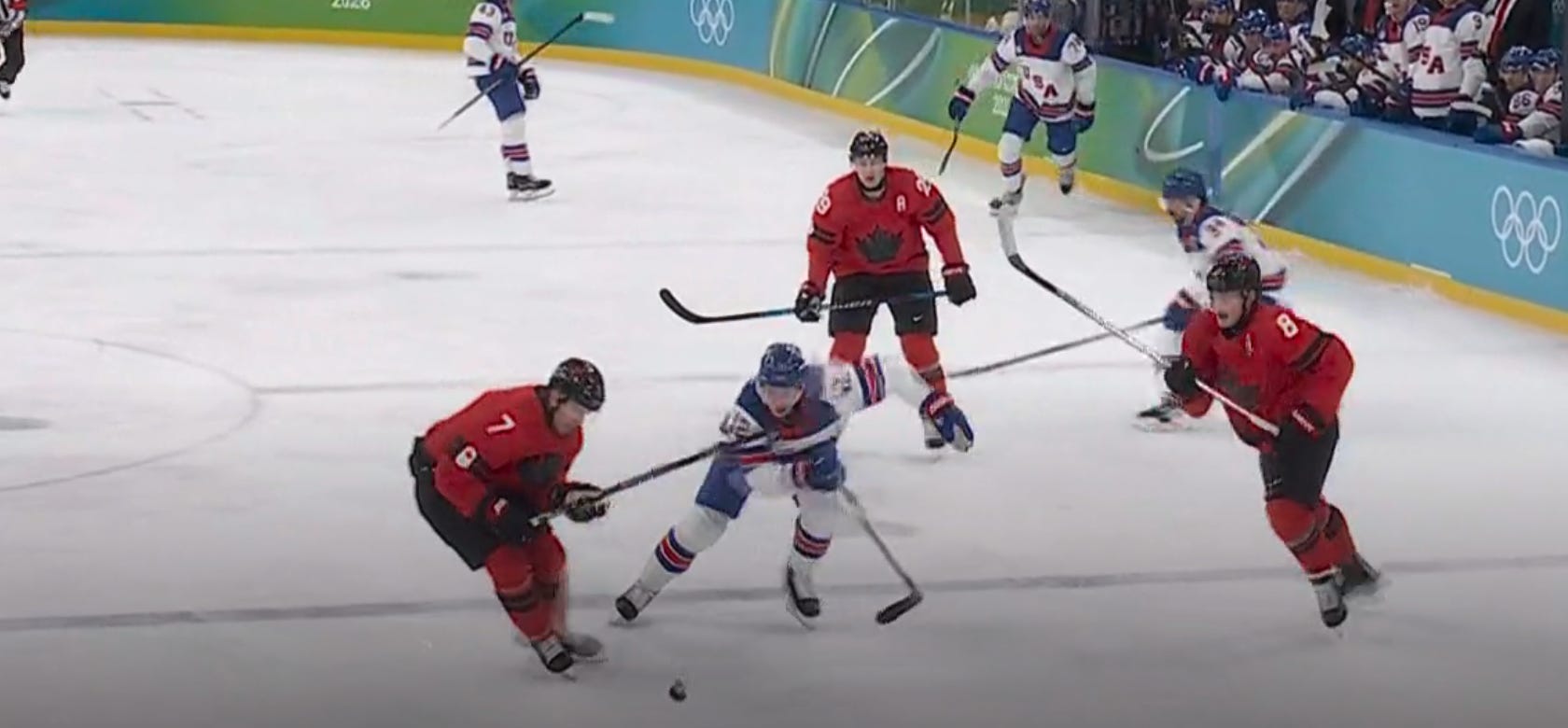
Auston Matthews made multiple outstanding defensive plays in the first period, but those were nearly canceled out by a horrible giveaway by Brady Tkachuk, which reminded everyone just how tight the margins are in a game like this. You can make five outstanding plays and not score on any of them, only to have one mistake sink your battleship.
The officiating was about as minimal as you’d expect in a game like this, and Canada probably had a case on one or two uncalled plays earlier in the first. But Brock Nelson got position on on Shea Theodore and company late in the period, and a stick in the wrong spot drew the nearly automatic call, giving the United States of America’s hockey team a chance to double their lead on the power play. But sedulous Canadian work (and one pass too many by Auston Matthews) kept the score at 1-0 with the period winding down.
Drew Doughty matched Brady Tkachuk’s earlier giveaway with an egregious one of his own in the final seconds of the period, but a shot with traffic didn’t wind up in the net, and Canada was permitted to take a breather.
Canada came out with jump to start the second period, and a few close calls made sure Connor Hellebuyck was wide awake under heavy Canadian pressure. It felt like that was the moment for Team Canada to grab some momentum back, but Hellebuyck was in the right spot consistently, and Canada couldn’t
But Binnington had to make his own big saves as Brock Nelson got a gift from Devon Toews, and Dylan Larkin got his own Grade-A look almost out of nowhere. But the Blues’ goaltender came out high to make both stops, and Canada kept the game within reach.
Connor McDavid’s breakaway halfway through the game was another such moment, but he couldn’t quite open up Hellebuyck with dekes, and a timely Brock Faber whack on the arm disrupted him at the last second.
Canada finally would draw a power play, and then a second one 30 seconds after to give themselves a gilt-edged opportunity to turn the game around. But the thing about these opportunities is that they can really take the wind out of your sails if you squander them, and a couple of horrible decisions by Canada (Like MacKinnon one-timing a puck from the outfield, missing, and clearing it himself) along with nice goaltending and aggressive PK’ing from the USA (Brock Faber played all ~90 seconds of the 5-on-3) sent Canada back to the bench empty-handed on their biggest chance of the game.
One of the ways momentum manifests itself after a kill like that is in the other team’s shooters. The more unbeatable a goalie starts to feel, the more reluctant a team becomes to shoot on Grade-B chances, lest they “waste” a possession. That can lead to fewer pucks on net, resulting in fewer rebound chances and less chaos around the net overall—in other words, an easier time for a goaltender.
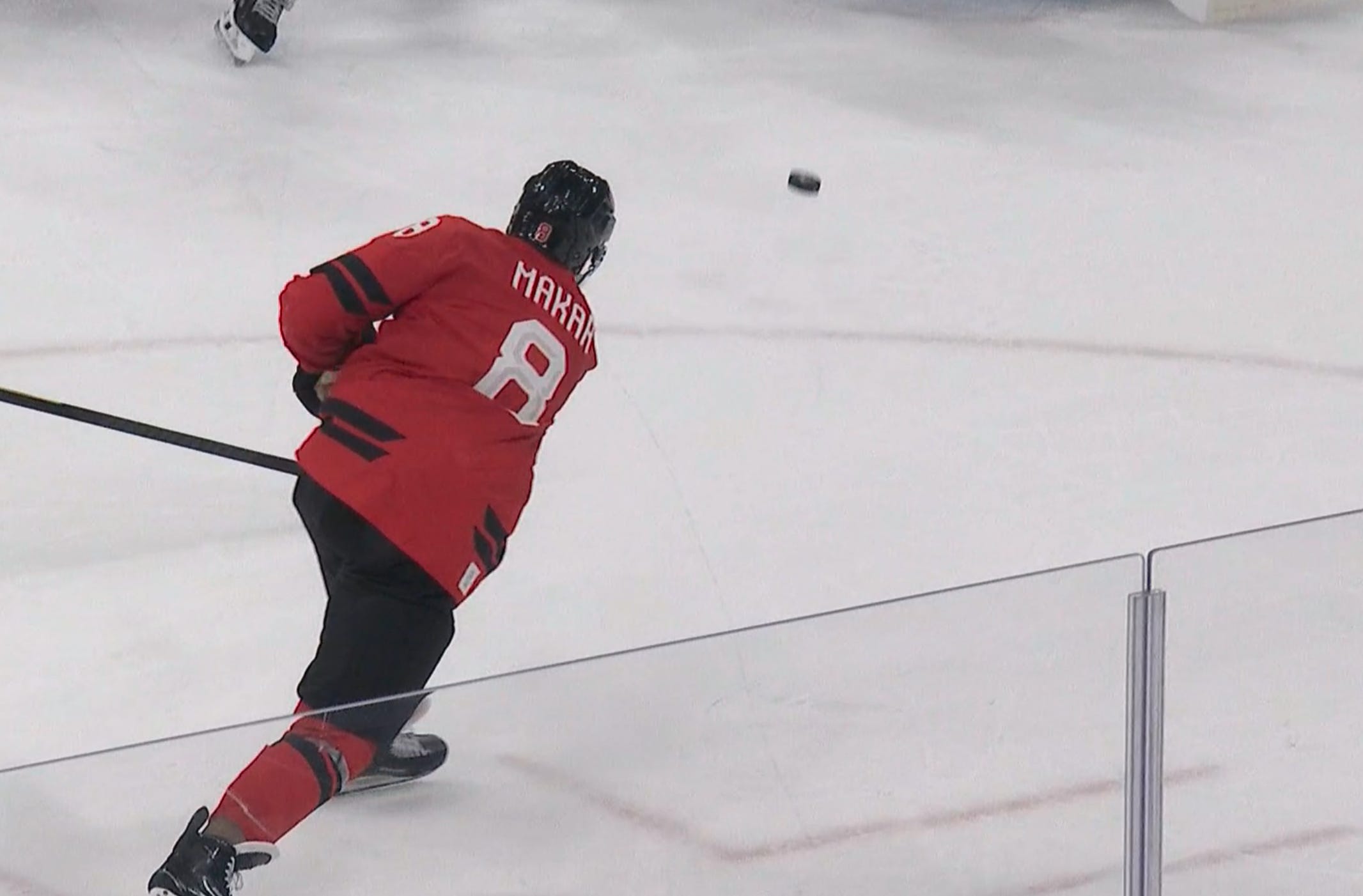
But Cale Makar didn’t win a Norris Trophy by passing up shots. So when he found himself with space at the circle, he fired a perfect shot just inside the far post that went over the pad and under Hellebuyck’s blocker to tie the game.
The USA nearly restored their lead with one of their rare (in the second period) scoring chances, as Jake Guentzel deflected a shot that went behind Binnington and off the far post, but stayed out.
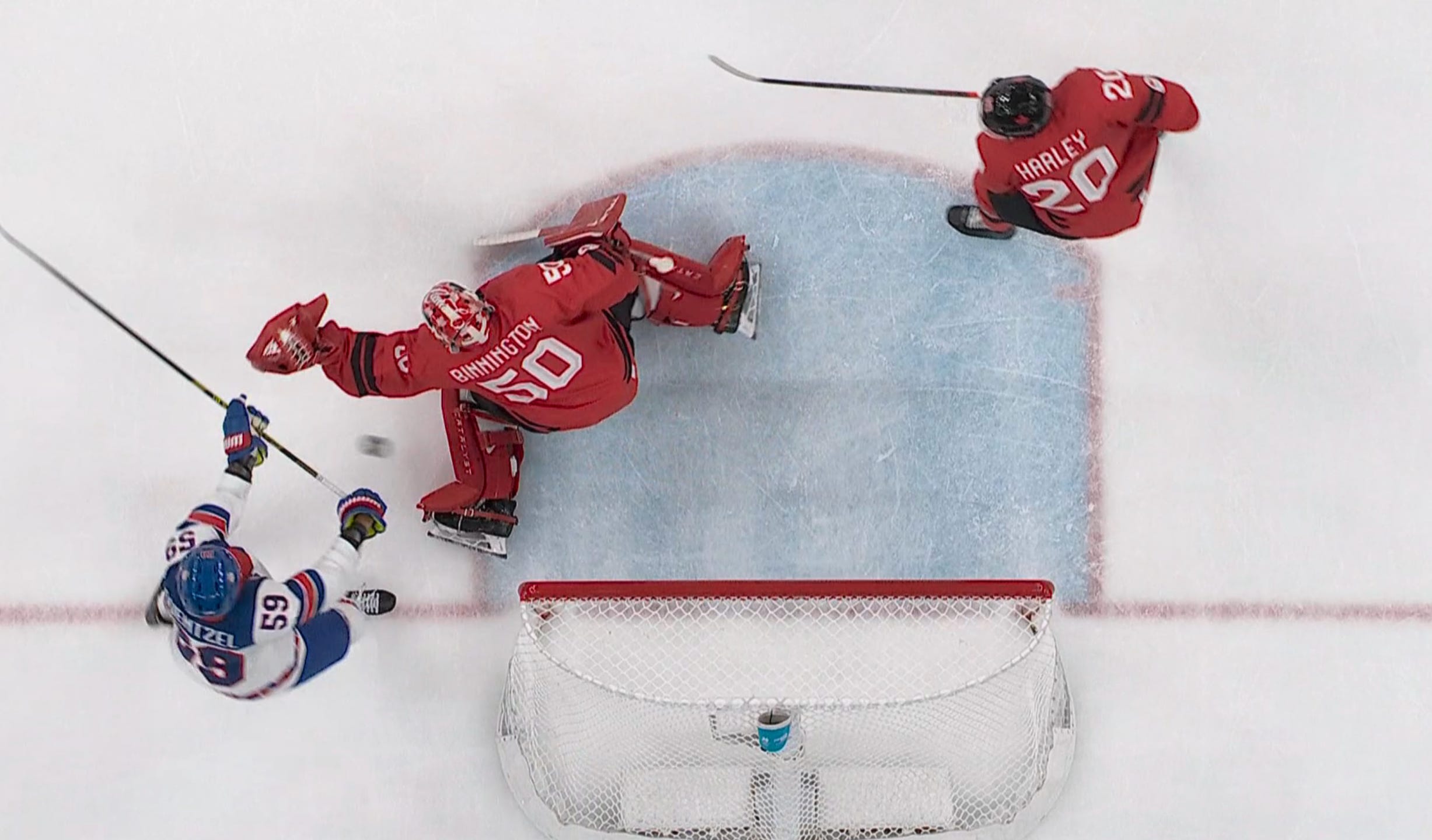
(It may have caught some of his glove as well as the shaft of his stick, which would have ruled the goal out anyway.)
How Devon Toews didn‘t make it 2-1 for Canada 90 seconds into the third period, I’ll never understand. But after a gorgeous bit of passing, the defenseman got a puck on his tape with the goal mouth gaping, only for Hellebuyck to reach behind him in utter desperation with the paddle of his stick, and make the save.
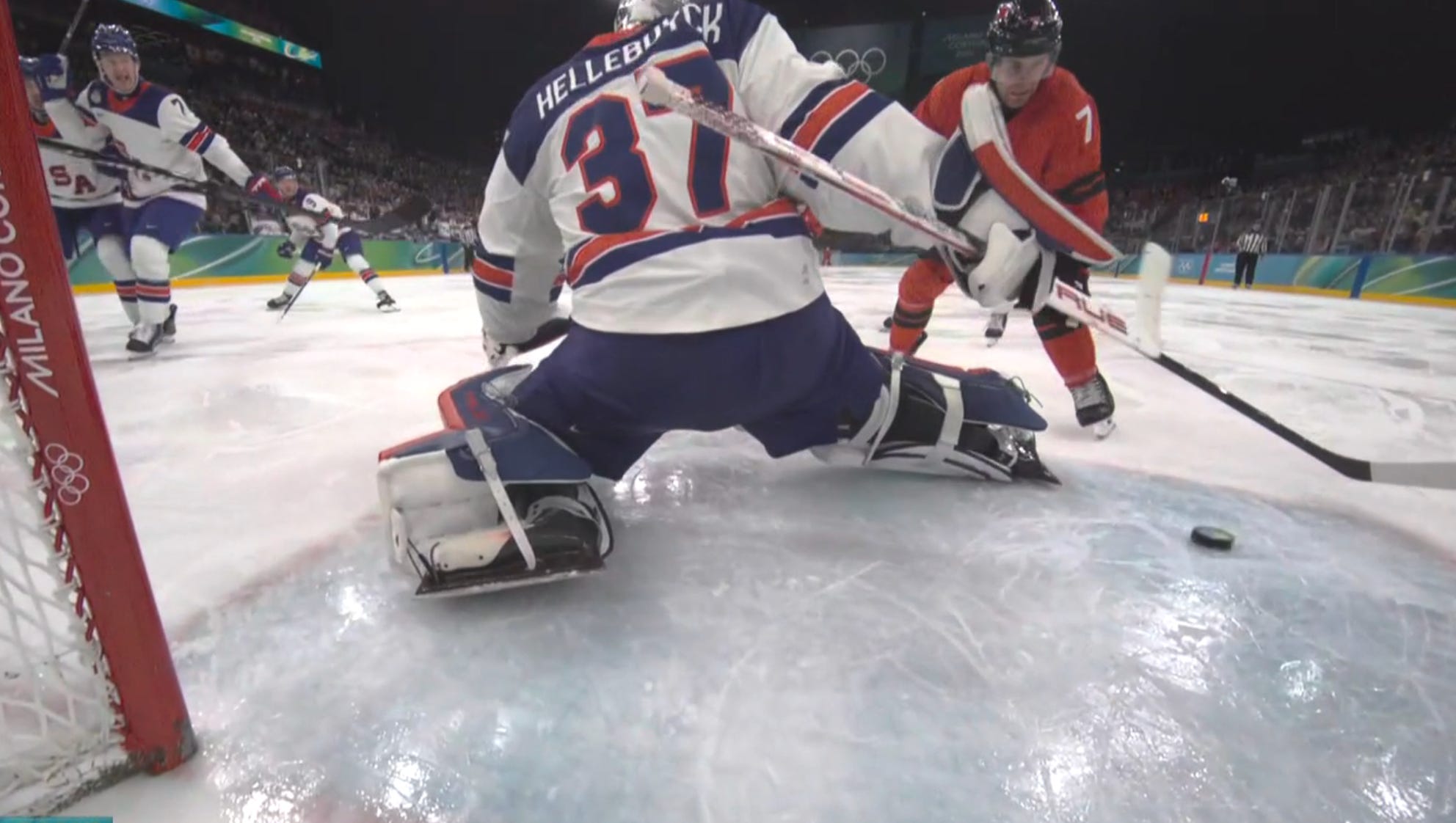
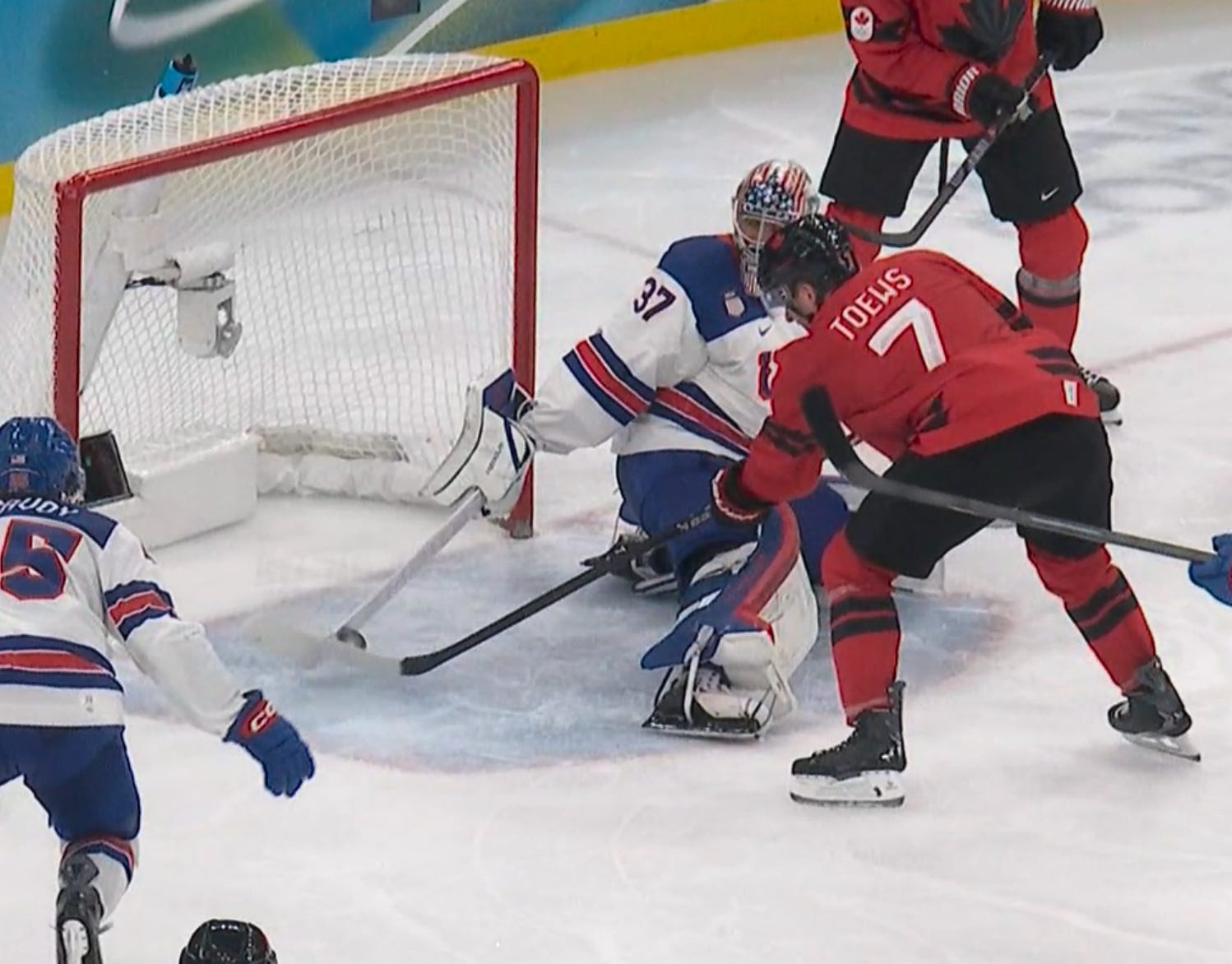
Unbelievable.
Celebrini would get a breakaway not too long after that, but once again, Hellebuyck kept the game level all by himself. And that’s when you really and truly felt like Hellebuyck and the USA had traveled back to 2010.
Except in this case, the Hart Trophy player for Canada shanked a wide-open chance to take the lead, when Nate MacKinnon put this chance into the side of the net:
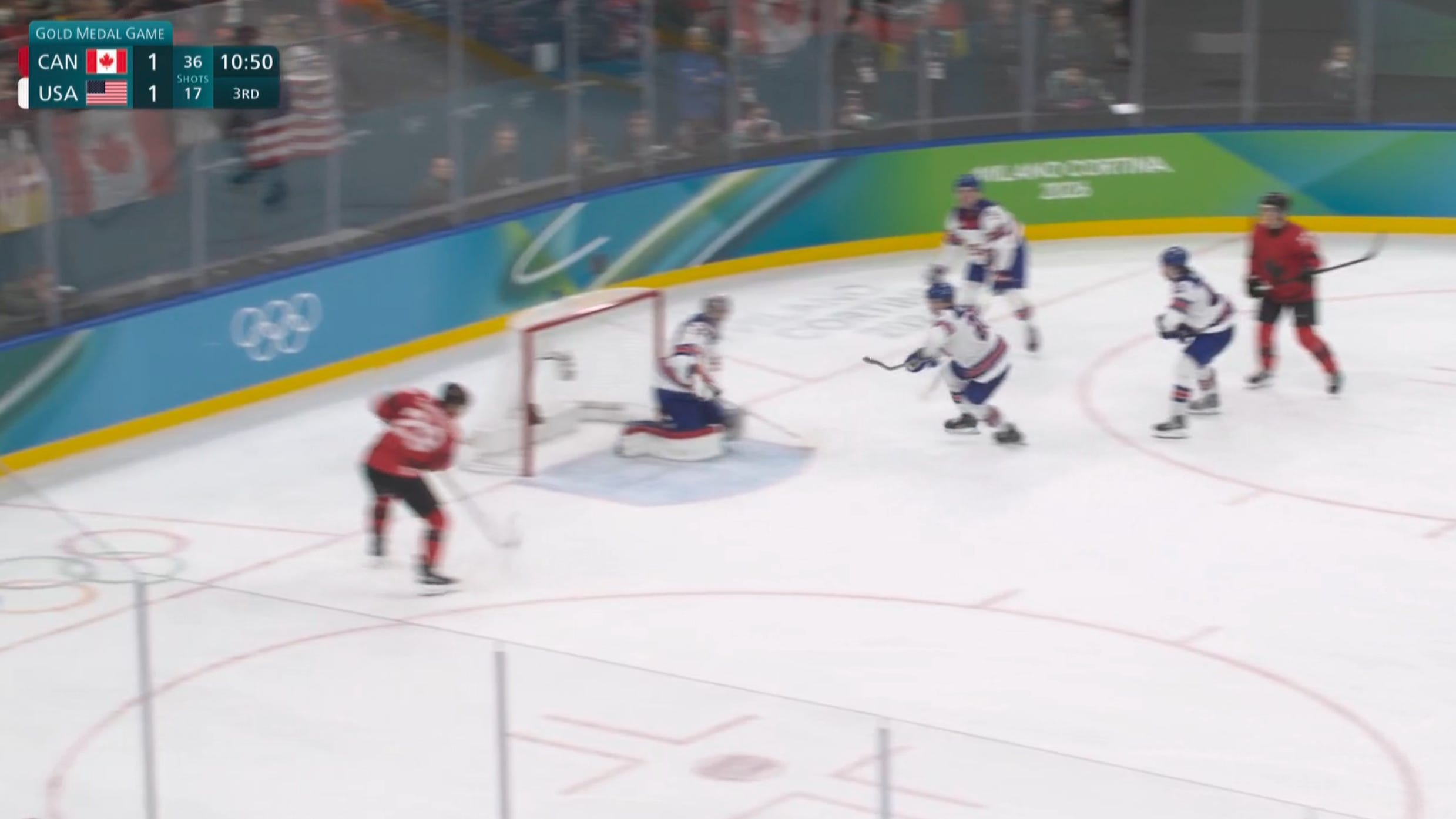
Yes, he had plenty of time. No, I do not understand. Yes, this game was insane.
The USA got one good chance when a rebound fell to Tage Thompson with Binnington sprawling, but the puck didn’t get through.
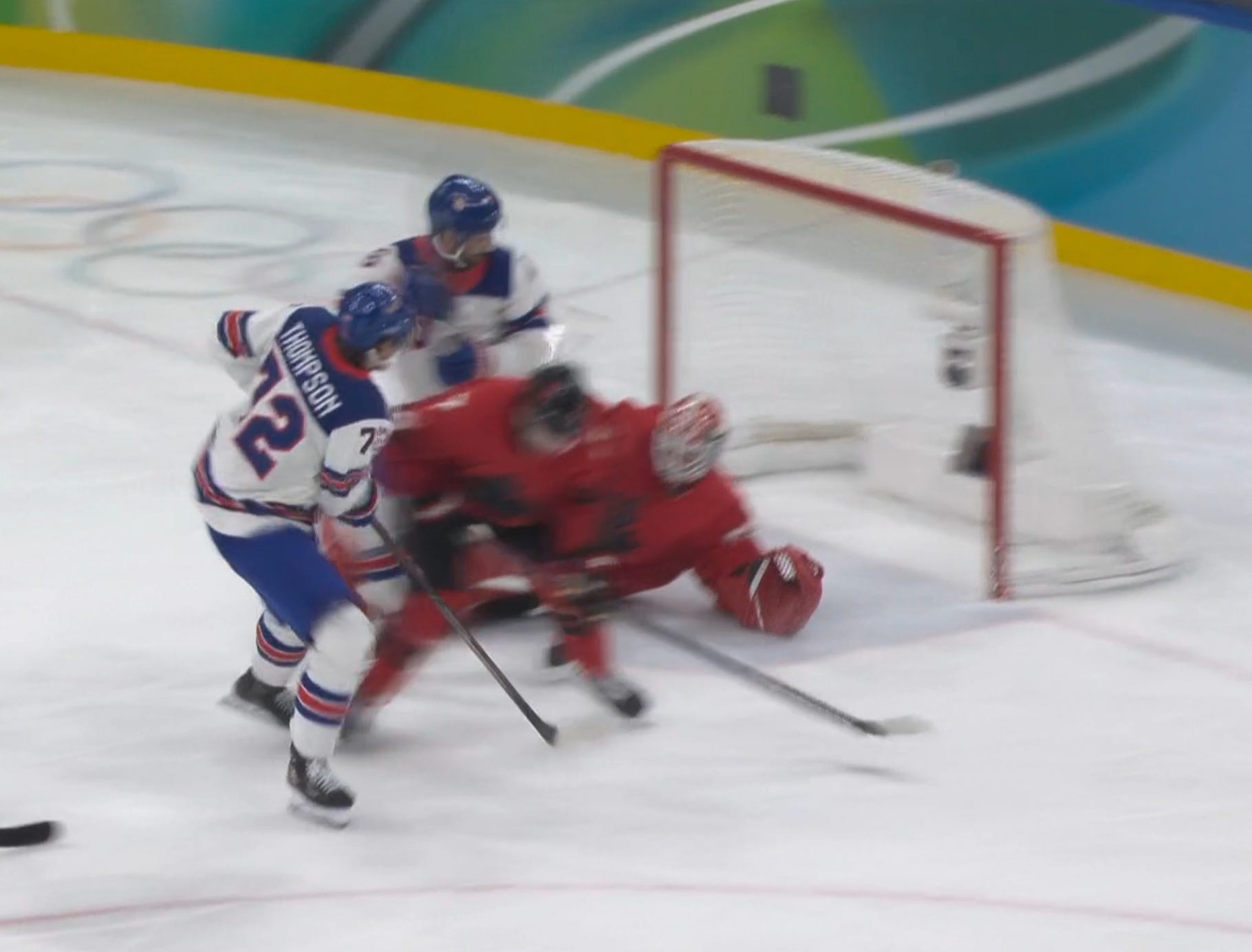
Canada kept the pedal to the metal however, and the USA ought to have taken a Too Many Men on the Ice penalty in the midst of the push. But instead, it would be Canada heading to the box a couple minutes later.
That’s because Sam Bennett got a (fairly rare) shift in the third period, and he found a way to take a needless, reckless penalty, as is his wont, getting his stick up high and opening Jack Hughes’s face to take a double minor with under 7 minutes remaining.
But the USA squandered most of four minutes on the job, though a couple of agonizing chances just couldn’t find sticks to finish them, and then Jack Hughes would himself squander the rest of the power play by taking his own high-sticking penalty along the boards after getting caught on the wrong side of the puck.
That meant 50 seconds of 4-on-4 with 3:23 remaining, and then a minute or so of Canada 5-on-4 power play in a 1-1 game. But impossibly, unbelievably, the USA survived chance after chance, as Celebrini missed the net on multiple slot one-timers with Hellebuyck at his mercy.
Thus, we proceeded to 3-on-3 overtime with both teams having plenty of reasons to regret it.
Overtime
Jordan Binnington’s glove save on Quinn Hughes a minute into overtime ought to have been the moment.
It was a magical, big-time stop. But the thing about 3-on-3 is that you pay for every chance you don’t bury at the other end, and Canada would load up another Hughes brother after two players were caught at the wrong end.
McDavid was already going to be caught deep, and a 3-on-2 is no laughing matter. Perhaps that’s why Cale Makar made the choice to pinch at the offensive blue line, trying to poke a puck off Jack Hughes’s stick to create a 2-on-1 or even a 2-on-0 with McDavid, rather than back off to defend a deadly, odd-man rush in overtime.
Instead, Hughes poked the puck past Makar and down the ice, and 3-on-1 was brewing. MacKinnon was the only one left back, and he tried to get over to win the puck from Werenski, but he appeared to pull up at the very last moment, and that allowed the USA defenseman to grab it instead.
That’s when Zach Werenski found a wide-open Jack Hughes coming down the middle of the ice. And Hughes promptly fired a low shot that headed five-hole on Binnington, who looked like he was reading a shot going low glove instead:
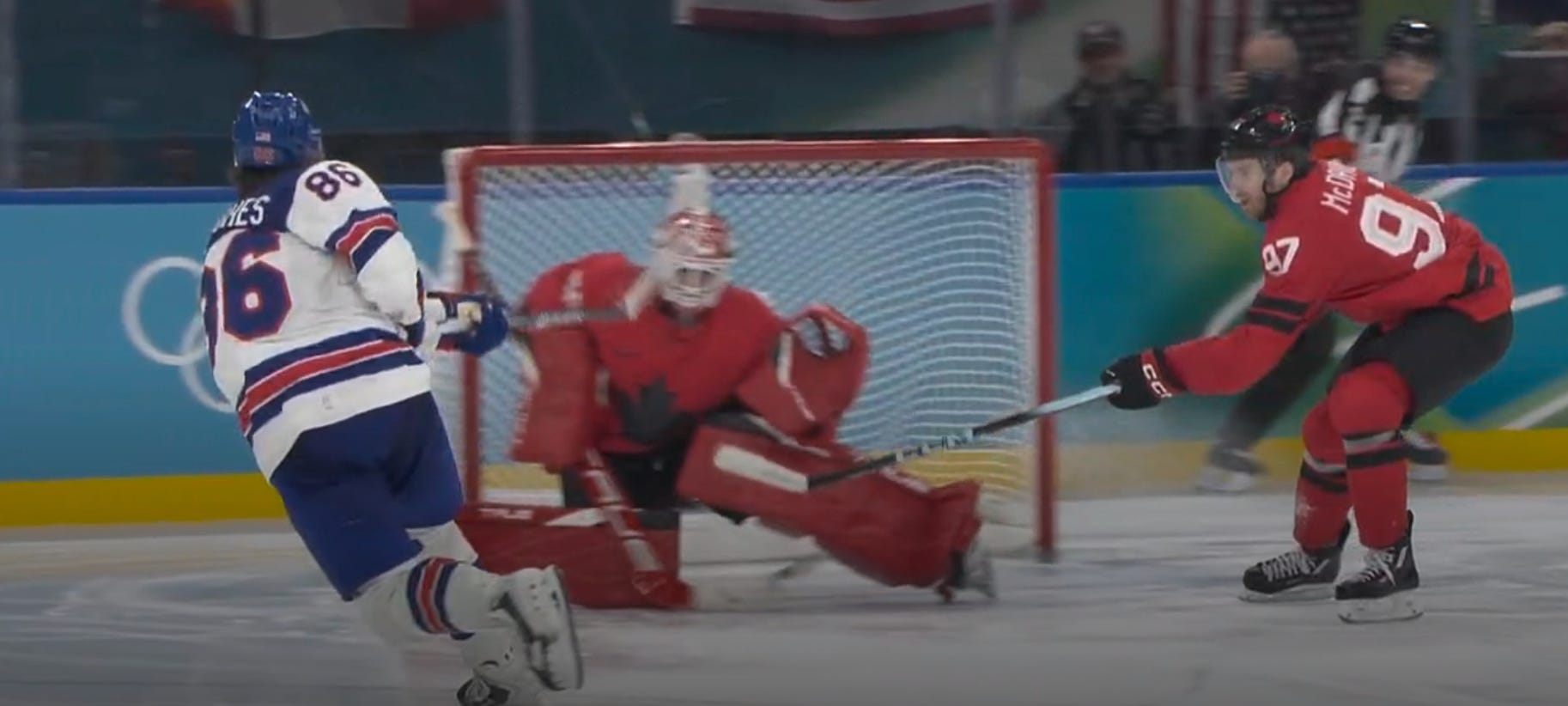
The puck flew under the goaltender, with the MVP of the whole tournament right there to watch it, helpelessly.
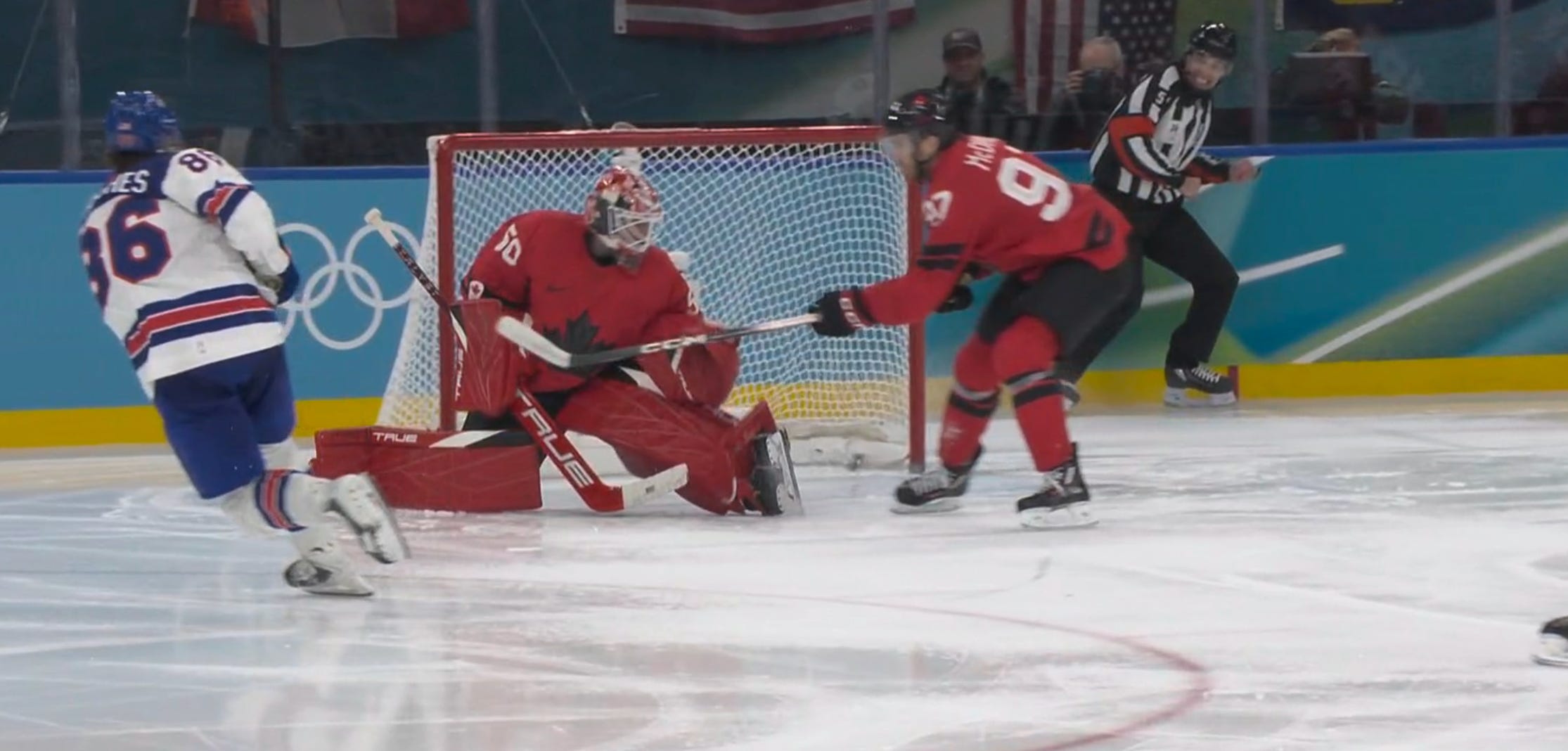
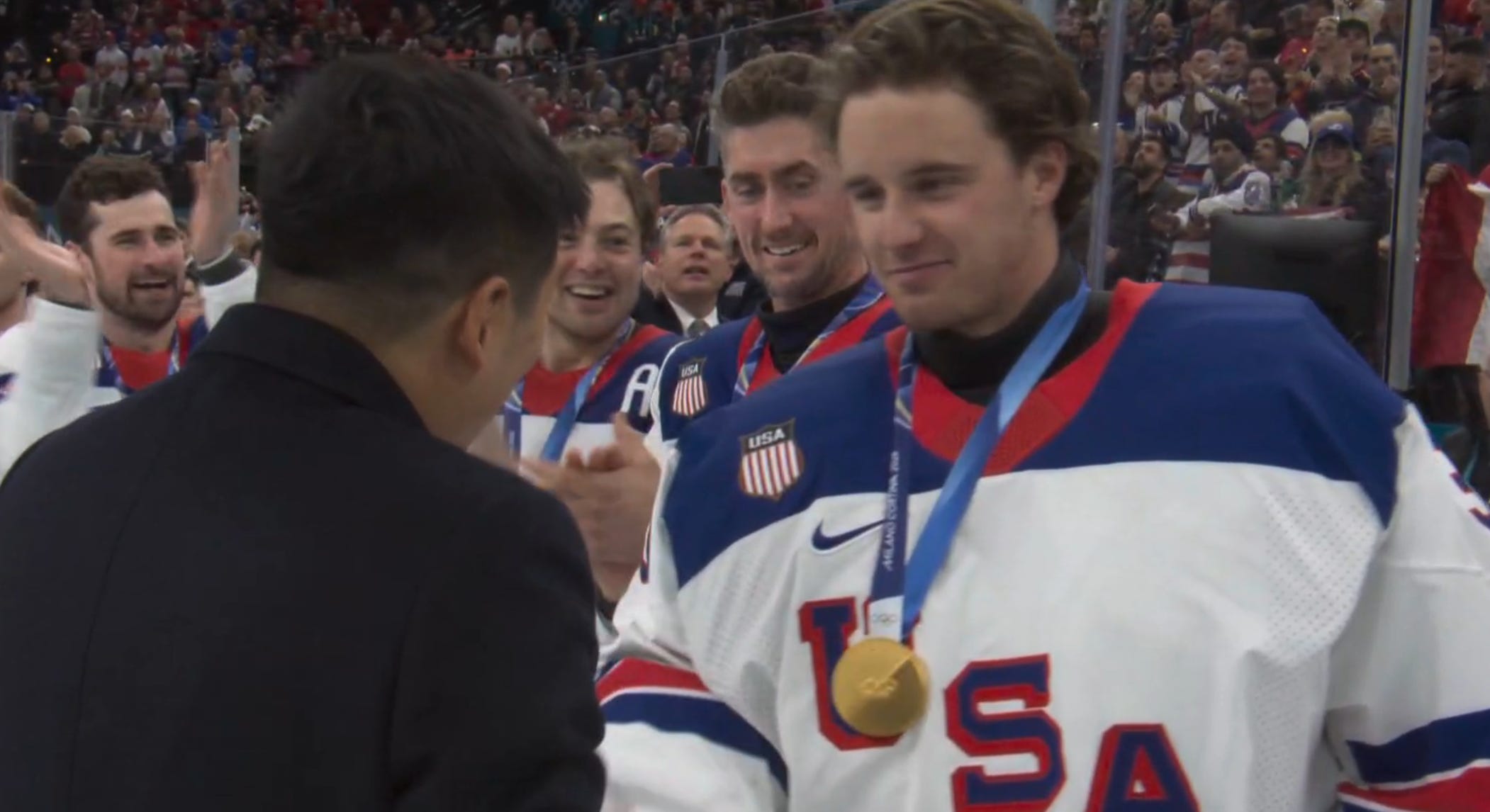
That’s how the USA finally won a gold medal in Olympic Hockey for the first time in a long time. I can’t remember when they won it last—someone needs to look that up—but it sure feels like it’s been a while.
Jake Oettinger and Thomas Harley will now come home with their respective medals, and we’ll all try to pretend that a February NHL game can hold up in the shadow of a tournament like this one.
The Olympics, man.
I'm going to take issue with the roster selection point. What actually happened is that the otherwise clearly superior team got goalied -- something that can always happen in any hockey game. The Team USA won the gold despite the roster, not because of it -- and they won because the players who were their best players played like it at the crucial moments. Maybe they don't have to rely on space alien level goaltending if they pick better players for the rest of their roster in the first place. Sure, that's just rank speculation, but let's be honest about what actually happened -- Hellebucyk's superhuman performance enabled Team USA to steal a game in which they were mostly outplayed in every other respect.
Also, let's hope that we get the Team Canada Thomas Harley for the rest of the season. He was getting close to being himself anyway -- I have to think that his injury earlier in the season had a lot to do with it. And Miro Heiskanen was, well, Miro Heiskanen as well. Let's hope that Mikko Rantanen is okay.
Absolutley awesome game. Hockey at its best. Excited to see how 1 gold medal, 1 silver medal, and 4 bronze medals juice the Stars through the rest of the season.