
Club 45: Wyatt Johnston and Jason Robertson Led the Way for the 2025-26 Dallas Stars
It's time for some more very serious player grades

In Disneyland and its associated resorts around the world, there’s an exclusive location called Club 33. It started as a location for Walt Disney himself to host special guests for meals without being bothered by the hoi polloi, but it’s now become yet another way for a theme park to tantalize grown adults with the allure of exclusivity.
Best of all, you can become a member, maybe! All you have to do is “express your interest,” which seems to involve a screening process presumably designed to weed out the crazy people from those willing to plop down like $35,000 for the privilege of paying $130 for a nice meal inside a theme park.
When you have the cultural cachet of Disney, you can sell mystique like this any time you feel like it, and they do. But like most things marketed as exclusive and upscale, it’s essentially just a VIP experience. If you’re lucky enough to get into Club 33 or its associated locations around the world, then you, too, can experience an edible, ephemeral piece of Disneyana.
But you know what’s more exclusive than Club 33 is a little something called Club 45. If I’m doing my math right, something called “Club 45” would be, like, 12 times more exclusive than a “Club 33.” (No need to check my math, I’m sure that’s right.) And the numbers bear that out, too.
Here are all the players to have scored at least 45 goals in a single NHL season for the Minnesota North Stars/Dallas Stars franchise: Dino Ciccarelli (2x), Brian Bellows, Mike Modano, Bill Goldsworthy, Wyatt Johnston, and Jason Robertson (also 2x).
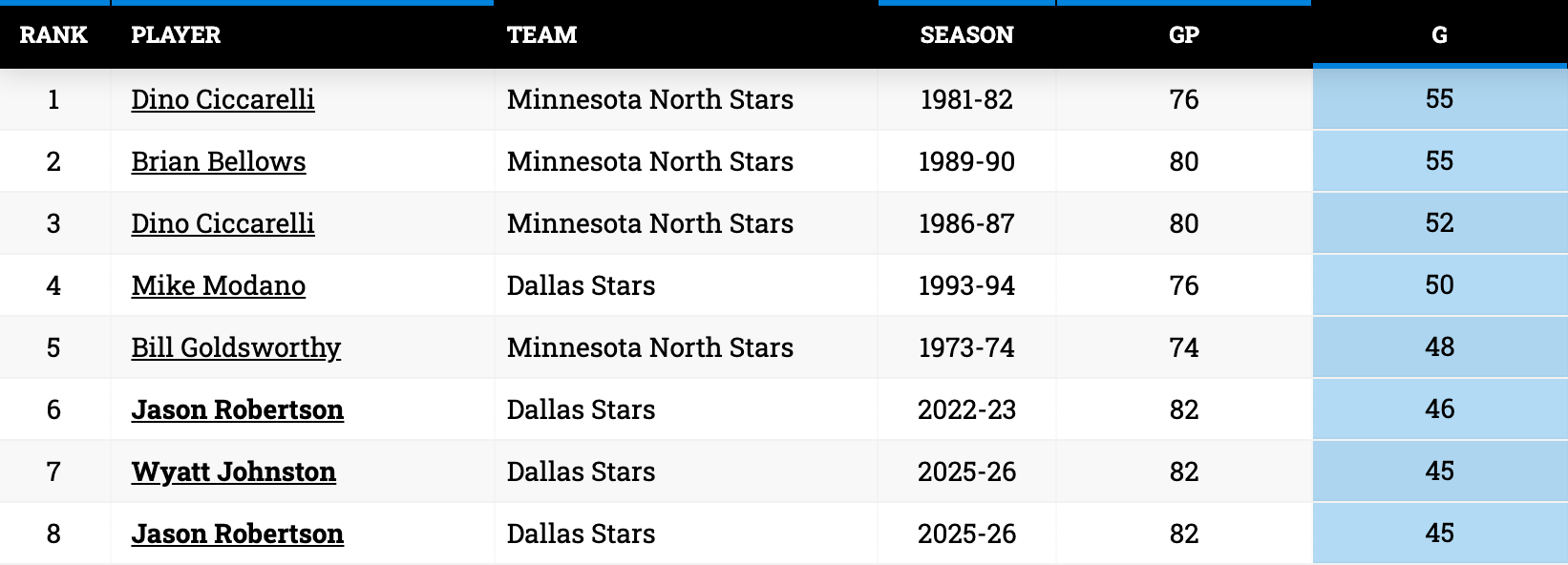
That’s right: there have been just six Stars/North Stars players to score at least 45 goals in a single season. Half of those happened during a very different era of hockey, where goaltending was often more of a whispered rumor than any real obstacle to scoring. Check the numbers if you don’t believe me.
Average goals per game in the Minnesota era (1967-1993): 3.48
Average goals per game in the Dallas era (1993-2026): 2.85
Yes, offense has finally gotten back up to the three goals per game mark in the last five years, and the league has benefited as a result. But we are still a long ways away from the heady days of the 1980s.
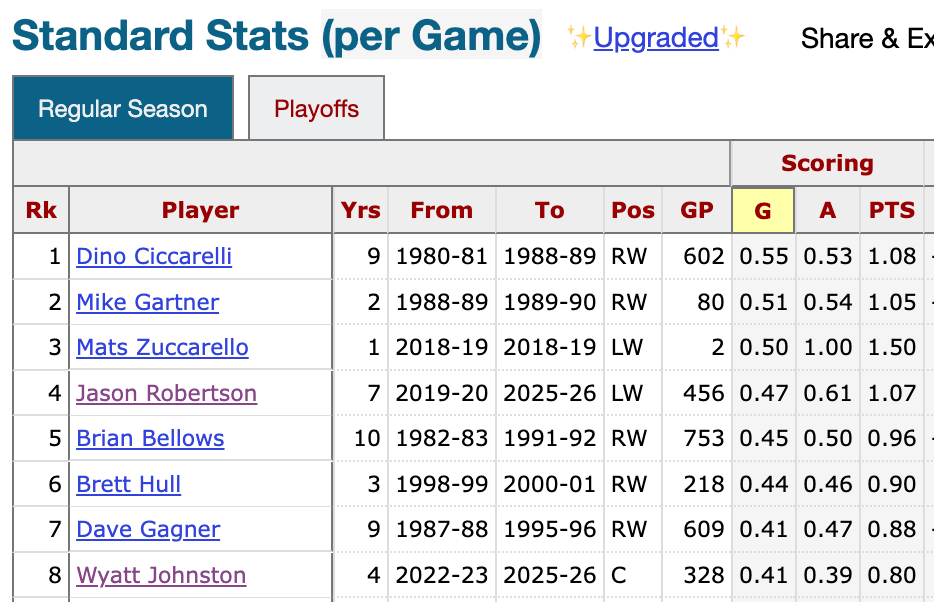
That’s what makes what Jason Robertson and Wyatt Johnston have been doing so remarkable. Robertson is already second in franchise history in goals per game for players with at least 100 games played for MNS/DAL, which Johnston is not far behind, in sixth.
Here’s an ugly screenshot from the invaluable Hockey-Reference.com, just to show my work:
Johnston started out the year with four goals in his first four games, while Robertson took about a month to heat up. But once both got going, there was very little opponents could do to stop either of them.
That also held true in the playoffs, when Robertson and Johnston combined for 9 of the Stars’ 15 goals against Minnesota, as well as 4 of the team’s 5 even-strength tallies. The Stars’ best scorers kept scoring in the postseason, even if few others could do the same.
The 2025-26 season may not be remembered as fondly as some other recent campaigns, but what Robertson and Johnston did this year was genuinely remarkable. So, let’s remark upon them with some made-up grades.
Wyatt Johnston - P
The “P” stands for Power Play Prowess, of course. Johnston became just the fourth player in the past 20 years to score 27 power play goals in a season. And he’s really the third, considering that one of those four was Ilya Kovalchuk in the juiced My NHL season of 2005-06, when NHL teams got literally twice as many power plays per game as they did this year.
There’s a tendency to dismiss power play goals as less valuable than even-strength markers, and I get it. You have an advantage, so you’re scoring goals under more favorable circumstances than when the other team has all their defenders out there. But to me, that’s like a batter being notorious for hitting home runs in 3-1 counts. Sure, you’d rather have someone mashing dingers on every pitch, but it’s a heck of a weapon to have someone so adept at punishing a team the moment they make a mistake. After all, if scoring on power plays were easy, Alex Ovechkin probably would have gotten over the 25 PPG mark at least once.
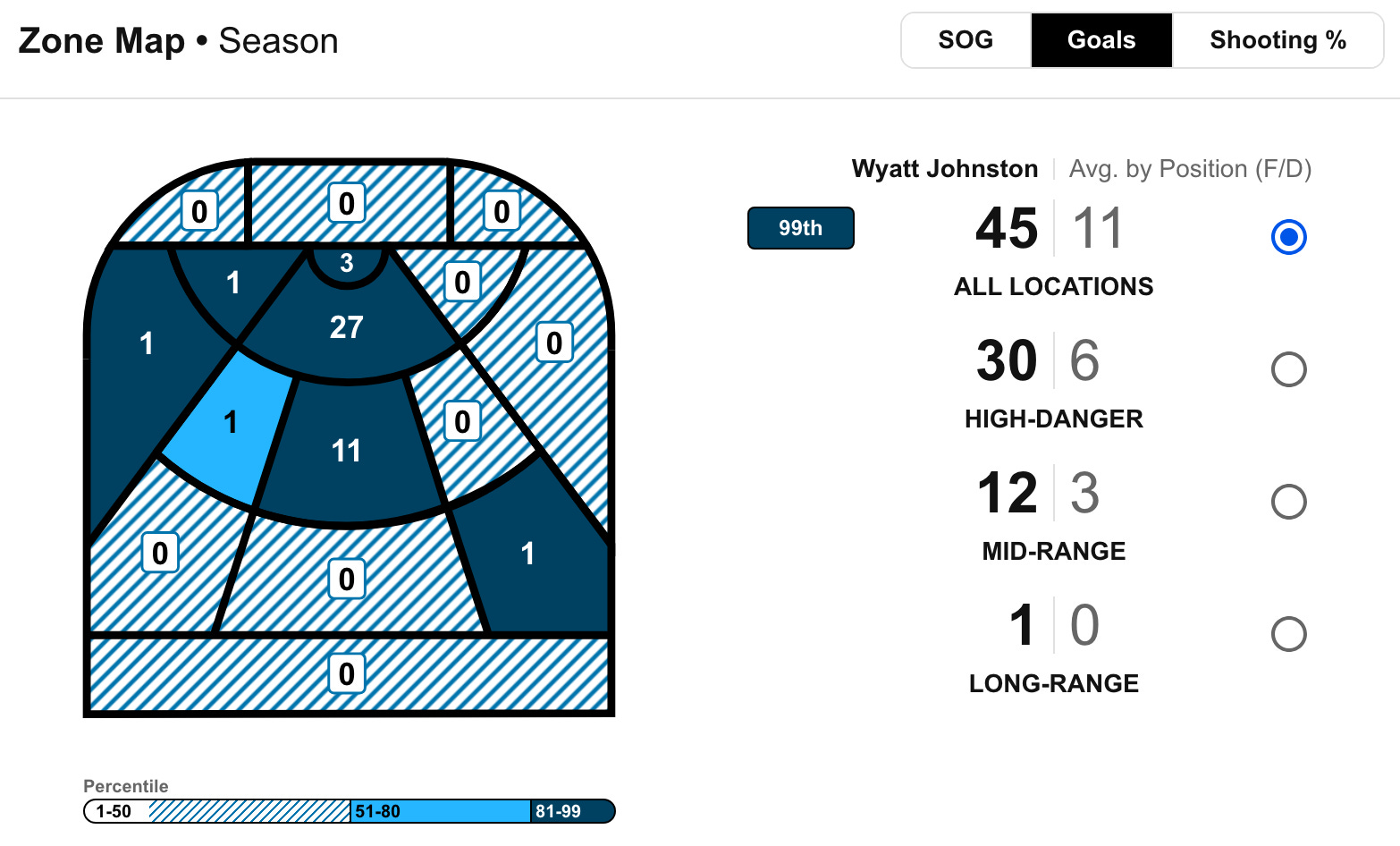
Johnston isn’t Ovechkin, however. Instead of being an unstoppable cannon mounted in a predictable position, he was a sniper in a ghillie suit, always creeping around too close for comfort, which is to say he was basically always in the slot.
This is only a partial highlight reel from this season through January, but it’s compact enough for our purposes right now. Just watch how often Johnston reads the play to get his stick blade open, and how little time he needs to release it:
Johnston obliterated the franchise record for power play goals in a season, but he also tallied 18 even-strength goals (or 17, if you don’t count his one empty-netter). Far from a power play merchant, Johnston was simply an elite scoring machine this year, doing things at 22 years old that almost defy explanation.
It is no exaggeration to call Johnston a cornerstone of the team. I mean, just look at his four seasons in Dallas to date:
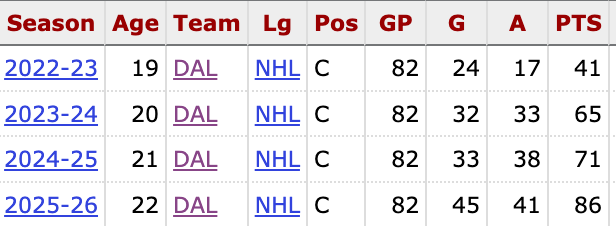
That’s an absurd share of offense, particularly for a player drafted 23rd overall. Johnston already has 263 career points, while nobody else in his draft class has even hit the 200-point mark yet.
Scoring is the most expensive thing to acquire and keep in the NHL. It’s why Michael Bunting will get a lot more in free agency than Dallas will be able to pay him, and it’s why Wyatt Johnston will make an average of $8.4 million per season for the next four years. He’ll probably be able to command at least double that amount when he hits free agency in 2030, but we’re not concerned with the future right now. We’re talking about a remarkable season in the recent past.
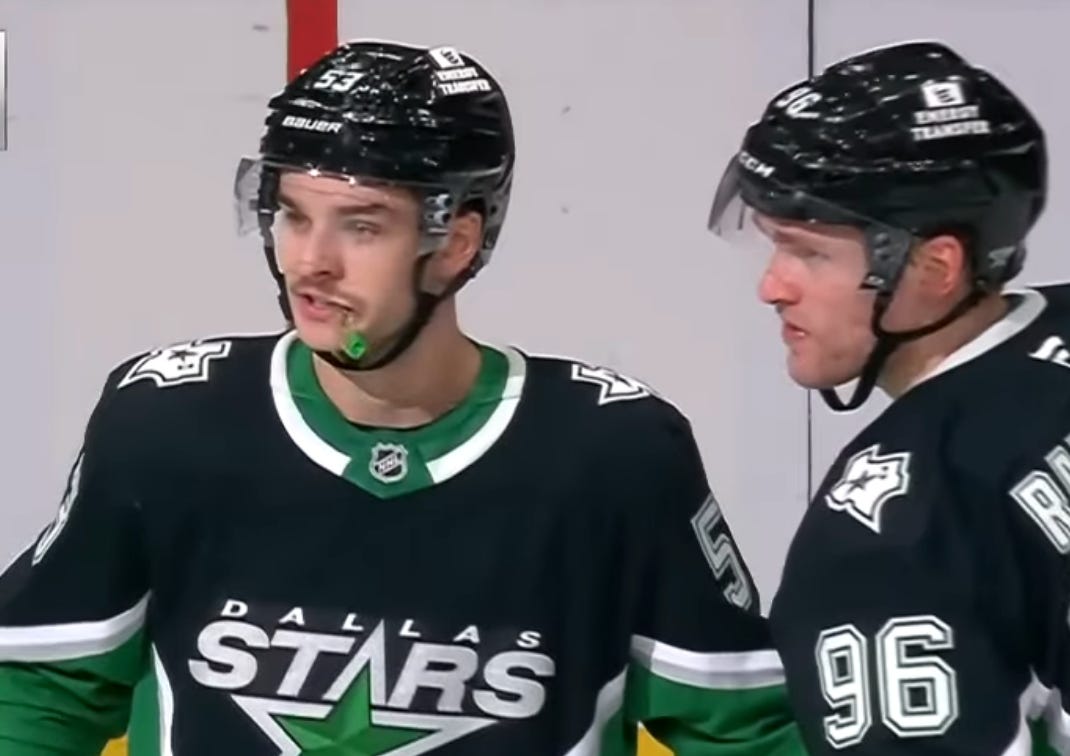
The only real downsides of Johnston’s season were on the defensive side. His -5 plus/minus in the regular season raises some eyebrows when set next to his 86 points, and his defensive metrics were similarly, ah, *flutters hand unevenly*. But Johnston would be far from the first 22-year-old to be fine-tuning the details of how to shut down the elite NHL talent he found himself facing. Really, Johnston’s defensive usage itself was a testament to how important he’s become. (And it’s not like he wasn’t scoring himself, either!)
Johnston’s faceoff percentage also dipped below 48%, as he had to handle the bulk of the right-side draws after Tyler Seguin was lost for the season. Johnston also wasn’t asked to do much penalty-killing this year, so those numbers don’t include many shorthanded draws, either. In fact, Johnston’s faceoff struggles (such as they were) extended to the power play, where teams normally have an advantage. Johnston went just 50.8% on power play draws, while Benn, Hintz, Hryckowian, Duchene, Seguin, and Steel all went at least 60% on the dot. Again, it can be tough to be the main/only right-shot faceoff guy on the team.
I find it hard to be anything other than optimistic about Johnston’s improving the margins of his game as time goes along, however. Given how outstanding the core of his game already is, I’m taking the over on Johnston’s defensive metrics and faceoff numbers next year. He’s simply too good, too disciplined, and too smart not to round off the few remaining corners his game has left.
This year’s playoffs were tougher for almost everyone. In 40 minutes against Kirill Kaprizov, Johnston lost the 5v5 scoring battle handily, to the tune of 5-0—a major contrast to his matchup work against MacKinnon and McDavid1 the postseason prior.
In fairness, the 5v5 scoring was far from a Johnston-only issue for Dallas, though. Besides, Johnston’s double overtime goal in Game 3 will stay in your memory for a long time, because playoff overtime goals tend to do that.
I still remember Cody Eakin’s overtime goal in 2016, and Mattias Norström’s overtime winner in 2008. And you surely remember Steve Ott’s remarkable breakaway overtime goal against Colorado in 2004, right? You are going to remember that goal by Johnston, which put the Stars up 2-1 in the series, for a long time, as well you should.
Wyatt Johnston isn’t perfect, because no player is. But he was the leading edge of Dallas’s attack in high-leverage moments, and he scored the types of goals that make you believe we’re only beginning to see the best of what he has to offer.
After all, he’s already done things that literally no other Star has ever done, by which of course I mean his setting up that prank on Lian Bichsel.

Jason Robertson - R
The other member of Club 45 was Jason Robertson, who led the club with 96 points on the year, with 51 assists on top of what is somehow just the second-highest goal total of his career.
Robertson also set a club record of his own, scoring in seven straight games in mid-November to set the Dallas Stars mark. It might be hard to remember right now, but Jason Robertson and Wyatt Johnston really carried this team in some otherwise tough stretches. You do not get to 112 points without your best players doing special things, and two of the Stars’ best forwards very much did that.
However, you might also have forgotten that Robertson’s record-setting goal streak came after a nine-game goal drought. Despite putting up seven assists during that time (while the team cobbled together a 6-1-2 record), Robertson hadn’t scored in what, for him, felt like eons. There was talk early in the season about how Robertson didn’t have a recent foot surgery slowing him down this year, so what was the problem?
But every time I talked to Robertson during that period, he exuded confidence. He knew he was still getting to good areas, and he knew the chance-generation was there. So when he finally got back on the board with a huge third-period tally in Ottawa, it was vindication more than relief that you saw.
From there, Robertson went off. In his final 66 games, Robertson scored at a 50-goal pace, putting up 42 goals and 40 assists while the team finished 41-16-9.
Three of Robertson’s goals came in the midst of that November hot streak, in what ended up being his only hat trick of the season—a natural feat in multiple senses:
Robertson also sits just one hat trick behind Benn, Seguin, and Modano in Dallas Stars history. His scoring was and is prolific, elite, unstoppable, and everything in between. Robertson’s 96 points were 10th in the NHL, and he and Johnston tied for 4th in the whole league in goals.
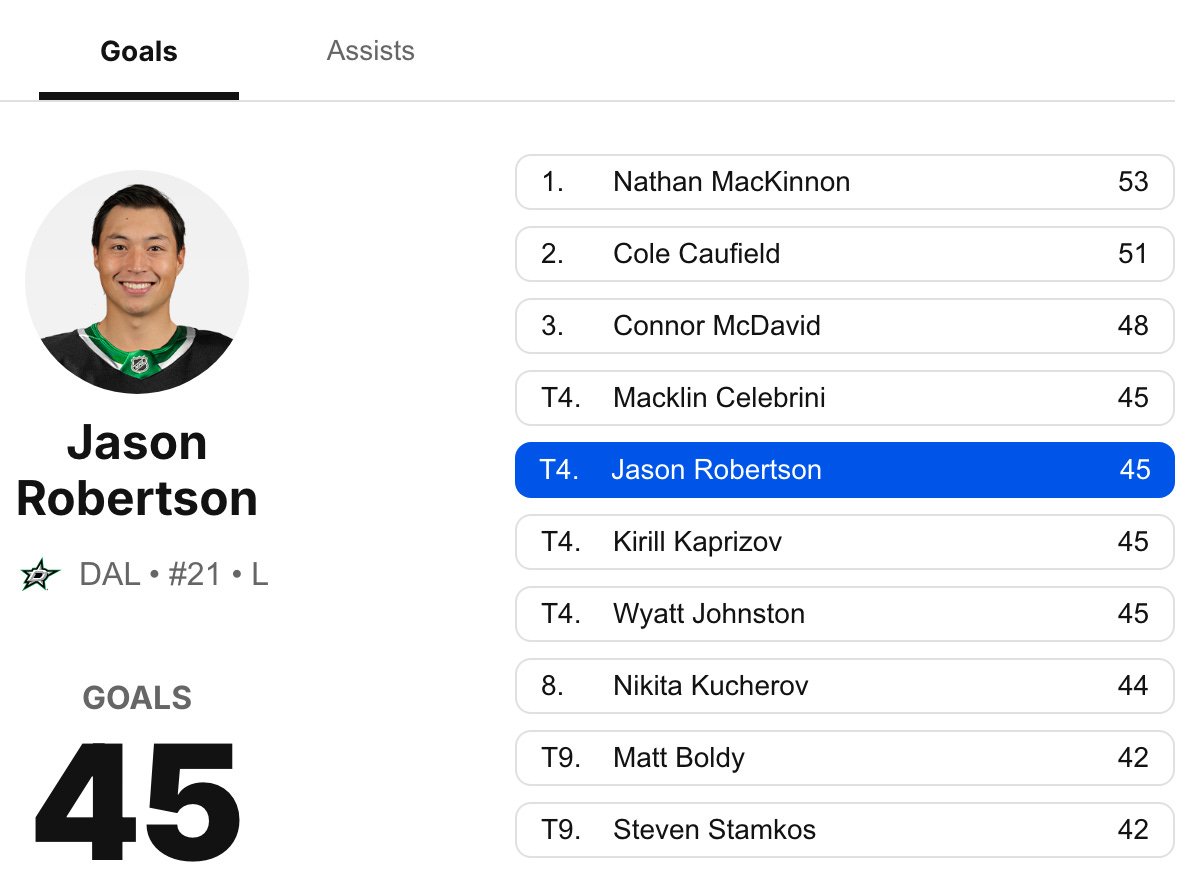
This year, Robertson’s goal-scoring carried over into the postseason, as he tallied in five straight games against Minnesota, winding up with eight points over the six games in total. In a series with precious little space available in prime areas, Robertson did what he’s done his entire career, and found a way to score.
This montage is long, but I think it’s worth appreciating the many different ways in which Robertson created goals this season. Having both him and Johnston to worry about must be nothing short of a nightmare for opposing teams, particularly on the power play.
Robertson also led the team in average ice time among forwards, surpassing even Mikko Rantanen (by four seconds) with an average of 20:15 per night. And why wouldn’t you keep going to Robertson, given how much he tilted the ice in Dallas’s favor?
Put it this way: on the seven line trios on which Robertson played at least 40 minutes at 5-on-5, all of them had a 51%+ shots-on-goal share (despite Dallas as a whole being a 49% team over the regular season).
On the results end, things reflected that reality: all but one of those trios were at least a +4 in their time together. Here’s an eye chart to that effect:
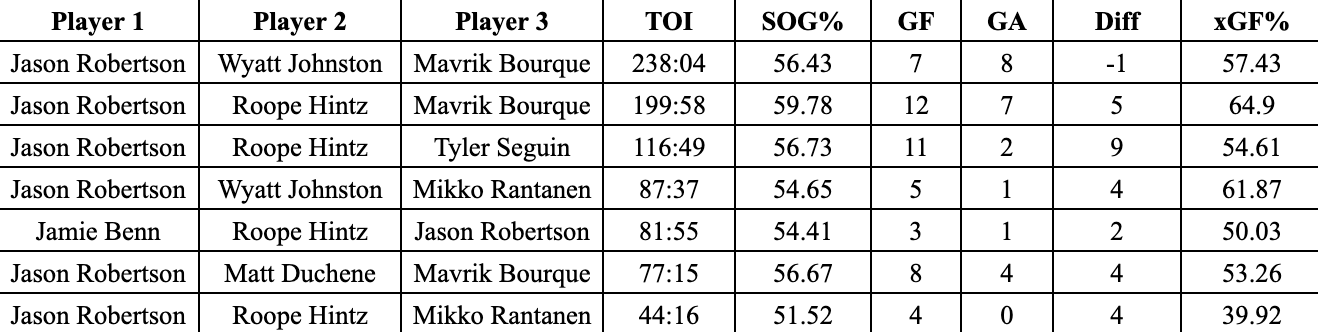
Matt Duchene filled in admirably for Roope Hintz after the Olympics, but there’s no denying that we were thoroughly robbed of seeing what this team’s true depth could have looked like in playoffs, had both Seguin and Hintz been available.
Back in February of 2024, I wrote about how Robertson’s defensive game belied his reputation. The way he goes about his game is more incisive than the methods that tend to get defensive plaudits, and besides, wingers haven’t won Selke awards since Jere Lehtinen. But when Robertson is on the ice—with anyone—the Stars’ defensive results always tend to improve. His +22 was second on the team, behind only Esa Lindell.
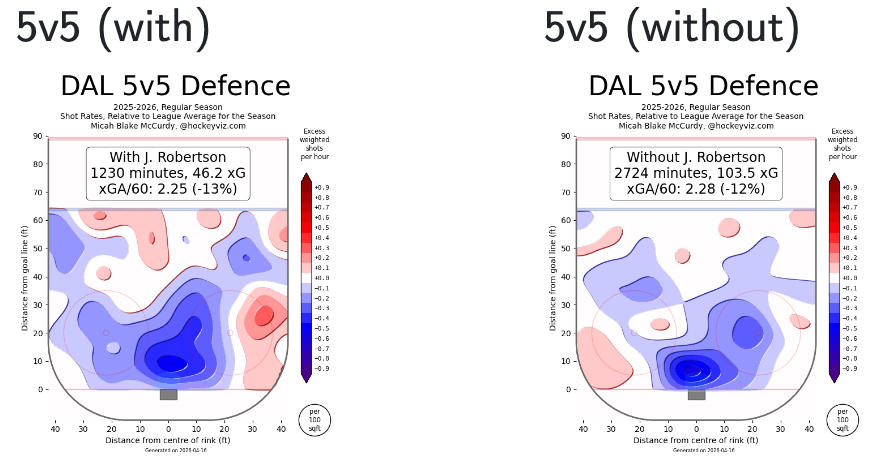
It might also interest you to know that Robertson actually started more of his shifts in the defensive zone, on average, than Wyatt Johnston did. That’s not a slight on Johnston at all—why wouldn’t you try to get him as close to the other net as possible?—but rather some additional context for Robertson’s work. He wasn’t asked to do the heaviest defensive lifting like Roope Hintz, or even Tyler Seguin, but Robertson did excel in the duties he was asked to perform. He usually does.
Robertson’s “R” grade for this season stands for Redoubtable, a word that carries a sense of both fear and admiration. His performance this season was indeed nothing short of admirable, and his scoring prowess instilled fear in every goalie he faced.
This summer, that fear is of a different sort, as Stars fans have to wait and see how the Stars navigate Robertson’s need of a contract ahead of his final year before free agency. No one is irreplaceable, but some players are far more difficult to replace than others. If the Stars and Robertson can’t find a contract they can agree upon, Jim Nill will have the toughest job of his entire Dallas career in charting a new path forward.
Robertson and Johnston’s four years together in Dallas have coincided with the best sustained run the franchise has had since Ken Hitchcock’s arrival in 1996. There is still work to be done, and both of them still have the biggest thing of all to prove. But if they put up more seasons like this one, they’ll give the Stars every chance in the world of finally returning to the most exclusive NHL club there is.
In the 2024-25 postseason, Johnston broke even in goals while on the ice against both of those Hart winners during his 60+ minutes matched up against them. Goals were 1-1 against MacKinnon and 2-2 against McDavid.
Thanks for the upbeat review/view into the Stars 2 stars future!
A healthy Rant next year will make it 3.
Robo showed his game can improve at 26, his puck possession skills are phenomenal… add his work ethic and determination and commitment to the game… pay the man. He’s earned it, and with his attitude he’ll continue to! Plus he’s a good guy!!!
Wyatt is still just a kid… maturing… he’s 4 yrs away from his peak… unimaginable! Can’t wait to watch it!!!
I very much hope Johnston is back on the PK next season. I think it will give him the opportunity to work on his defensive game and make the PK more dangerous (not single-handedly but they were better the season before when Hintz and Johnston put in routine PK minutes)