
Breaking Down a Breakdown: How Jason Robertson, Miro Heiskanen, and Jake Oettinger Jump-Started a Vegas Comeback
It's a crazy town, I hear

The Stars are on a three-game winning streak, and they’ve won three straight games in dramatic fashion thanks to last-minute goals from Jason Robertson and Thomas Harley, a surge in production from Matt Duchene, and a shootout win where Oettinger stopped two shots in a row while Robertson and Rantanen scored at the other end.
We even had a nice defensive play from Jason Robertson last night that I’m sure a bunch of you folks were trying to print out and fax to Bill Guerin, somehow. There was a lot of good mixed up in three nervy third periods, and I think Glen Gulutzan was pretty smart not to get hyperfocused on the mistakes last night. The process as a whole has been improving, and that is the most important thing, in January.
However, it would be disingenuous to celebrate the good things without being honest about the bad. So in the interest of fairness today, we’re going to dive a little deeper in a couple of moments last night where three of the Stars’ best and most important players faltered.
Blowing a three-goal lead in the third period is bad, always. But if you’re Gulutzan, I think it’s pretty reasonable to look at a couple of the culprits and say that you can pretty well expect them to do better next time.
But hey, you be the judge. Let’s get started.
Miro Heiskanen Defending 2-on-1s
Thursday night was not Miro Heiskanen’s best game. The Marner line in particular got the better of the matchup during their time on the ice together, with scoring chances 4-1 in Vegas’s favor, shot attempts 8-3 for Vegas, and shots on goal 5-1. Marner also scored a goal, as you may recall.
Edit: Heiskanen also made this rough play on the first Vegas goal, which I failed to mention in the initial post, but I’m sure you all remember it very clearly. All told, a night he’ll be happy to move on from.
But two Heiskanen moments on the power play stuck out to me in this one in particular. Vegas has the 10th-ranked penalty kill in the league, which is good, but not world-beating. However, they seemed to have the Stars’ number all night on the man-advantage, and the Stars finally got burned later on.
But first, let’s talk about this blocked Heiskanen shot for Vegas that created a shorthanded rush in the second period:
Yes, it’s Mark Stone, and he’s one of the best defensive forwards in the league for a reason. But Heiskanen decision to shoot here feels like an overzealous adherence to the team’s general push to put more pucks on net:
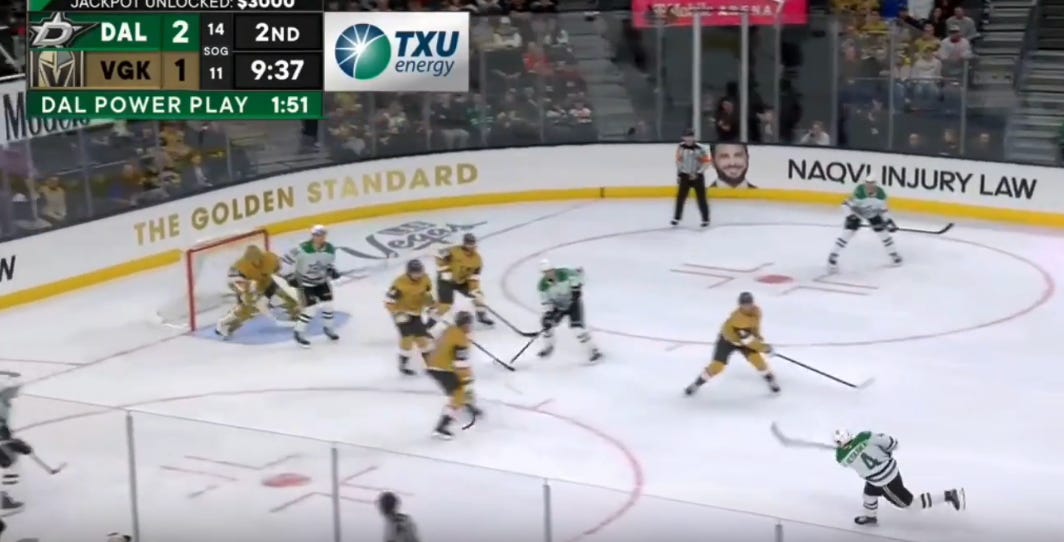
There’s a better play there, with multiple Vegas players clogging the shooting lane before the puck has a chance to get to Hintz at the netfront. And Stone’s block leads to a rush against that Stone (61 in gold) and Eichel (9) managed to squander. But don’t miss Heiskanen’s smart stick sweep here after Stone’s pass across, which I think prevents Eichel’s sending it right back to Stone.
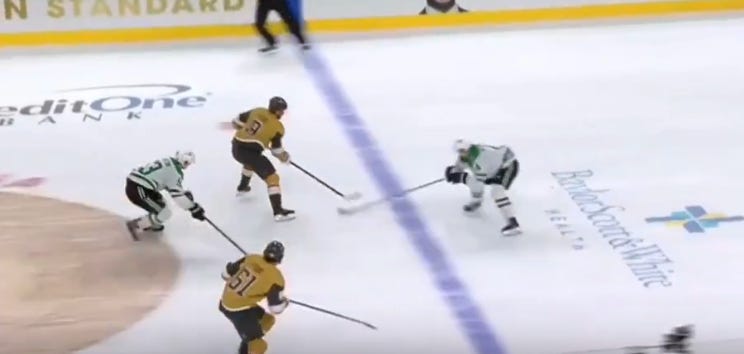
And from there, Heiskanen smartly recognizes that Eichel is on his backhand, so he maintains pressure, and the play fizzles.
But a shorthanded Vegas goal was scored on another breakdown, when Jason Robertson (whom we’ll discuss below) turned over a puck in a terrible spot on the power play, leading to another shorthanded 2-on-1 rush. And you know the Stars’ elite power play is having a rough night when they give up these kinds of chances repeatedly.
So on this rush in the third, with Dallas still up 4-1, Miro Heiskanen has to make a tough choice in a tough spot, and he makes a pretty poor one, all things considered:
Okay, now before we break this down, let’s look at some excellent video work from the inimitable Mike Kelly and the irrepressible Jason Demers talking about 2-on-1 play. It’s an excellent video, if you haven’t seen it already:

Demers does a good job hitting all the most important points here: If you’re the defenseman on a 2-on-1, your stick can’t be passively blocking the lane all on its own. Sometimes the best play involves the defenseman hitting the ice, but that can only happen if your positioning is sound, with a shoulder in the main passing lane.
The defender needs to be faking and pressuring the puck carrier while maintaining a hold on the middle of the ice, but also guarding against the most dangerous thing of all: a completed pass to the other attacker.
How dangerous is that pass across? Over twice as deadly, this year, as a shot by the initial puck carrier:
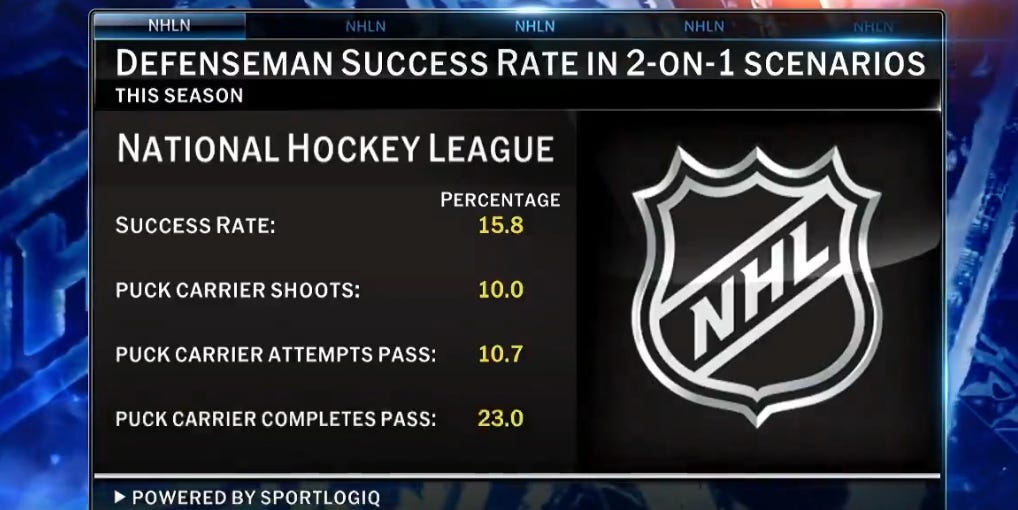
Here’s a good example Demers and Kelly used of a good play by Heiskanen against Minnesota:
First off, that play is a different situation, where Heiskanen was able to close down in the neutral zone and force a pass to start while still having time and space to get over after the first pass.
In fact, it’s somewhat similar to Heiskanen’s defense on the Eichel 2-on-1 earlier. Heiskanen closes down near the blue line after an early pass, arriving at the puck again well before the top of the faceoff circles.
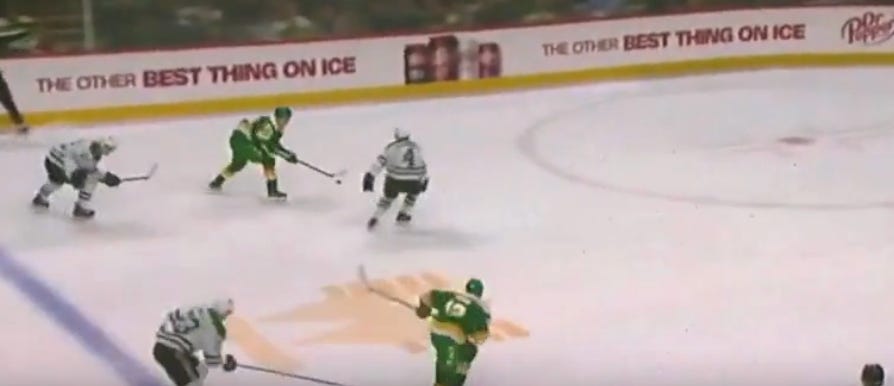
That means that even if the pass gets completed here, Heiskanen’s goalie still has a chance to reset and face the shooter before he gets between the circles.
It’s important to credit Heiskanen for how he turns his skates here, too. By closing down early with his elite skating, Heiskanen can now match the puck carrier’s pace and use his stick and both skates to eliminate the pass almost entirely, which results in a low-percentage shot (that I’m guessing may have been an attempt to bank it off Oettinger’s far pad for a rebound):
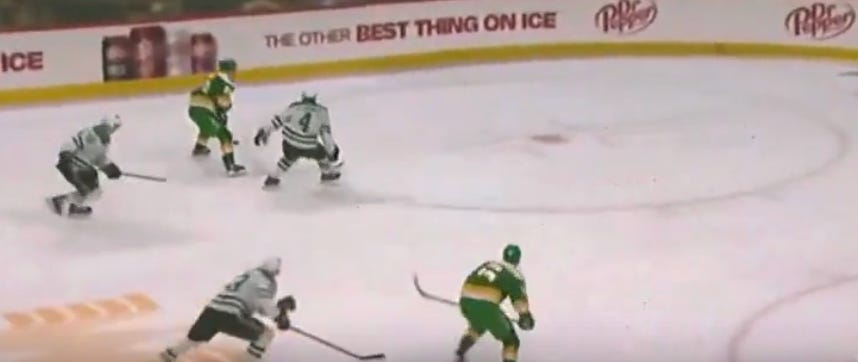
Overall, it was great work by Heiskanen to close down early and stay on his skates to match the puck carrier’s pace, then to essentially dictate the decision of the attacker with smart, aggressive play.
Now, let’s go back and watch how Heiskanen plays the second 2-on-1 in Vegas one more time:
First, note the three separate shoulder checks he makes as he gets back to defend. That’s a great start, and it’s one reason he backs off, rather than selling out to attack Kolesar with the puck (though giving Reilly Smith a wide-open breakaway probably would have ended up being preferable to what did happen).
Unfortunately, Heiskanen’s execution after his read is not great. Because his shoulder isn’t even with the passing lane, he ends up caught in between a half-slide and a lunge, with only his stick in the passing lane, which Kolesar easily gets the puck past, as it’s not even completely on the ice:
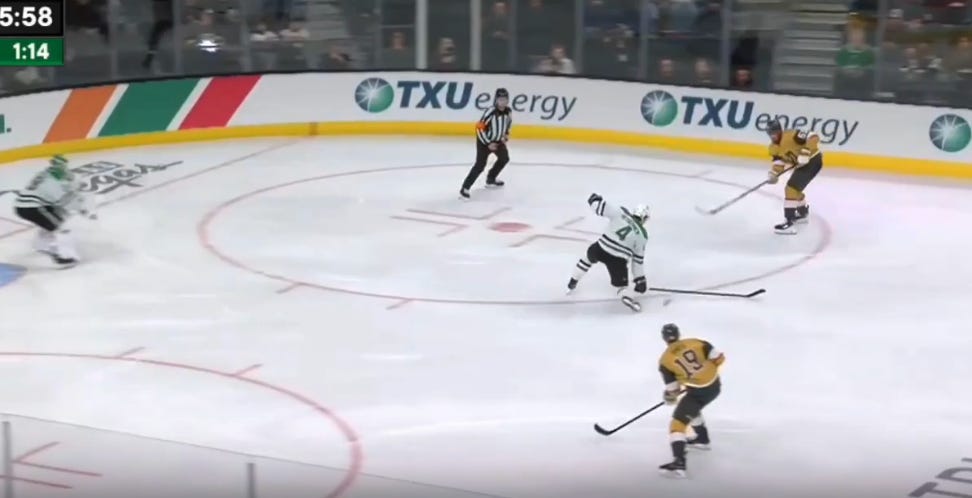
I really do wonder if Heiskanen was planning to fake going down on the ice in order to get Kolesar to go for a toe-drag around him, after which Heiskanen was planning to pop back up and poke the puck away. Purely a guess, but that would explain a lot of the decision-making here.
Instead, Kolesar recognizes the bad spot Heiskanen is in at the right instant, and he gets the puck across to Smith, who hits his spot as Oettinger comes sliding across. (And we’ll talk about Oettinger more down below.)
Jason Robertson
Jason Robertson has been playing exceptionally this year, but his turnover for the shorthanded goal in the third period was a bad, bad mistake, and it ended up sparking a comeback that never should have happened.
As you can see from the video, Jason Robertson very much wants to draw a Vegas player to him, then feed Heiskanen up top (who will then have the option of a shot with traffic or a feed to Rantanen (96 in white) on the other side.
(How many people do you think Bill Guerin has sent this clip to, this morning? I would be willing to bet that the answer is not zero.)
But Keegan Kolesar (55 in gold) closes down that passing lane, eventually forcing Robertson to attempt a risky play, trying to slip his man in a dangerous spot high along the boards.
Watch it again, and you can see Kolesar read the play perfectly:
In fact, I think Kolesar even gets his stick in between Robertson’s skates, allowing him to steal the puck cleanly and completely negate Robertson’s attempt to protect the puck from low or high along the boards. It’s incisive and well-executed, and Kolesar deserves a lot of credit for it:
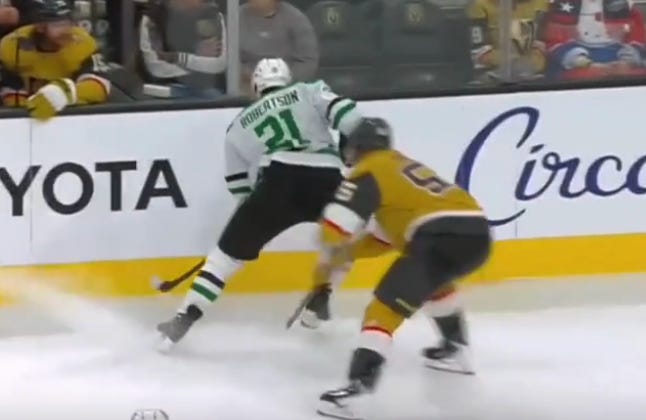
Now, Robertson does lose the handle on the puck a tiny bit just before the turnover, and that puts him in a bad spot. But he absolutely has to recognize the danger present here and make a better decision than he does.
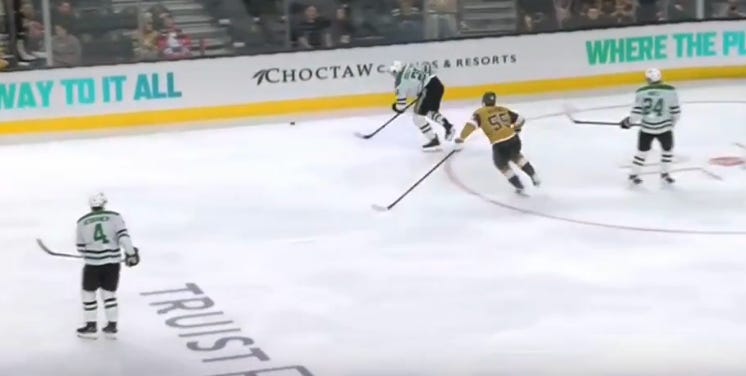
You can’t go back to Heiskanen there with Kolesar’s stick positioning, and Robertson doesn’t want to just fling it down the boards and risk an easy Vegas clearance. So instead, he takes a chance at beating his man, and the Stars paid dearly for it.
All told, I’ll still take Jason Robertson’s decision-making on the power play over almost anyone else’s. One would expect he’ll learn from this, and he’s probably watched this clip about twenty times more than anyone else ever will.
So, yeah. Robertson was, I am sure, very glad to have scored in the shootout. And speaking of people who performed in clutch time in the shootout…
Jake Oettinger
Oettinger has not been having a great year. We’re nearly two-thirds of the way into the season, and Oettinger’s in the midst of one of the two roughest stretches of his career, with the other coming late in the 2022-23 season.
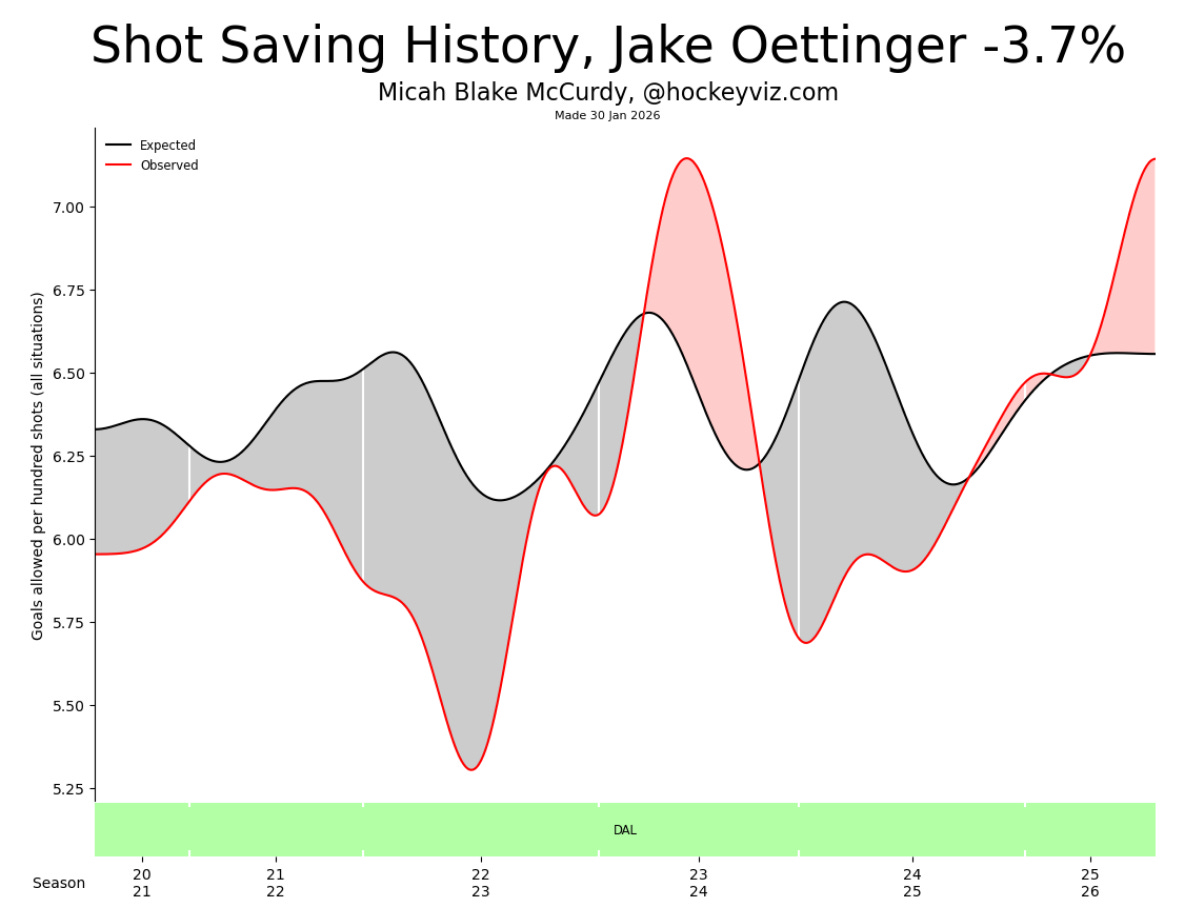
If you know anything about Oettinger’s history, you know that he played most of the 2022-23 season with an injury suffered in October of 2022. And by the end of the year, it got to the point where he had to have offseason ankle surgery in July of 2023.
That led to a slow start for him in 2023-24 as well, given his lack of normal summer training time. But in the second half of that year, he rounded into form, and he had a strong playoffs that year despite the Stars’ offense disappearing against Edmonton in the third round (the first time). Oettinger was not the problem against the Oilers in 2024.
Last year, Oettinger was largely meeting expectations during the regular season, but nothing more than that. However, he did step up against Colorado and Winnipeg in the first two rounds before faltering against Edmonton, giving up a chunk more goals than expected. (Not sure if anyone has talked about this?)
That made for a complicated debriefing session, as Oettinger was a big reason Dallas got back to the third round to begin with, only to stop being part of the solution against Edmonton.
And this year, Oettinger has once again been less than elite, even with a better defensive structure for Dallas than they had last year. That’s not ideal.
A bit disquieting, that. But today isn’t about Oettinger’s career trajectory (and barely half a season under a new coach is hardly enough to be drawing long-term conclusions from anyway), so enough of the charts for now. Let’s talk about two goals in particular last night.
First, let’s talk about that 2-on-1 Smith goal, but from Oettinger’s perspective this time:
Remember that stat about 2-on-1 passes above? That’s why I don’t put this on the goalie. That’s a deadly pass, and Smith puts it high in the corner, short side, exactly where he means to.
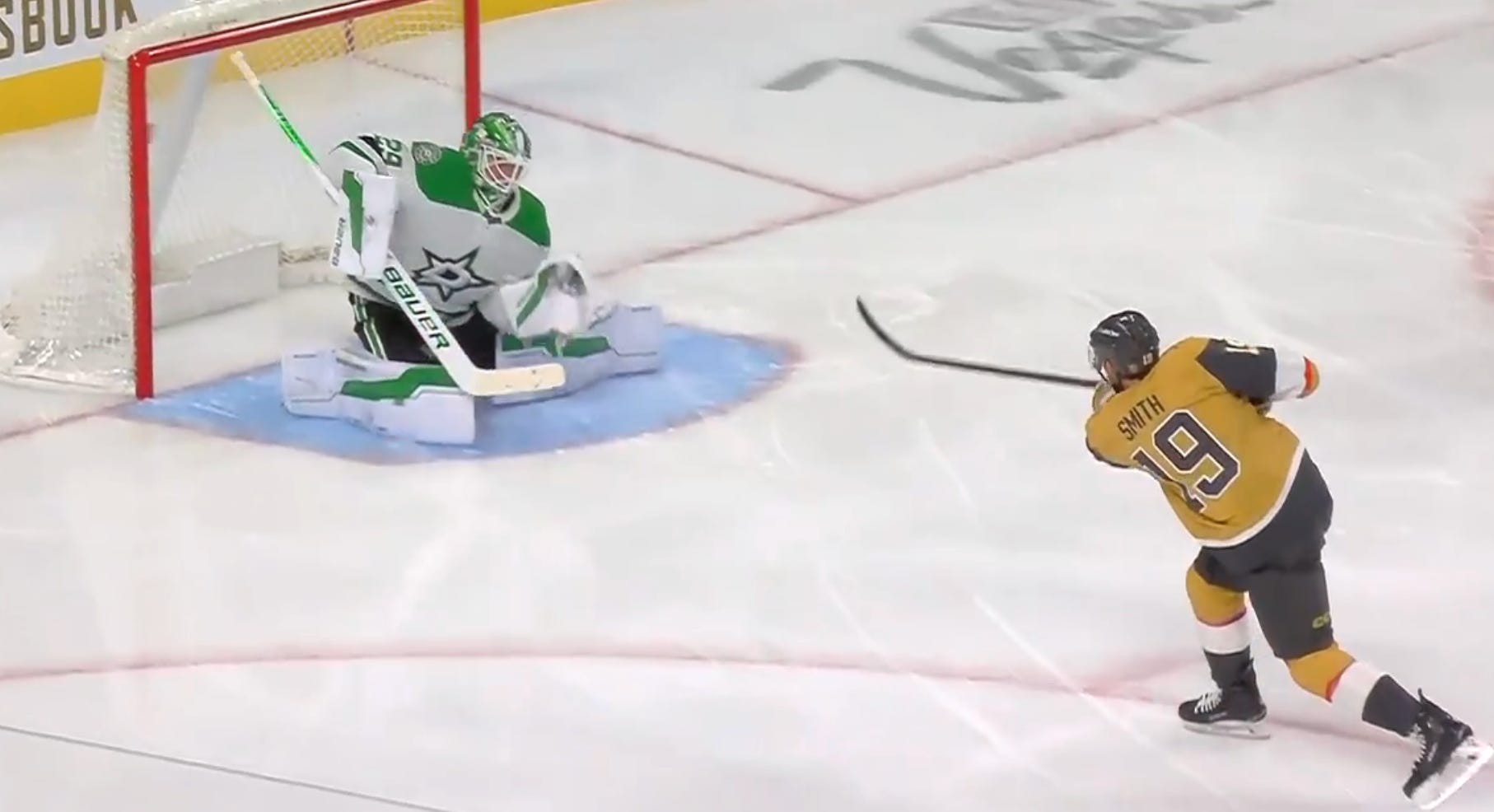
Now, the reason that spot is going to be open is because Oettinger has to load up for a big push across after keeping his angle against Kolesar (who is on his forehand and may well shoot at any time). After Kolesar passees to Smith, Oettinger makes sure to seal the ice as he slides across, lest he give Smith the easiest spots to shoot at down low. That forces Smith to catch and release quickly up high, and Smith hits his spot in the top corner like the pro he is. It’s a premium scoring chance for a reason.
But when a team sees a three-goal lead evaporate in a single period, there is usually going to be at least one goial that you reasonably say the goaltender ought to have come up with. And for me, that was Vegas’s third tally, by Ivan Barbashev.
First off: Roope Hintz (24 in white) needs to do better here, I think.
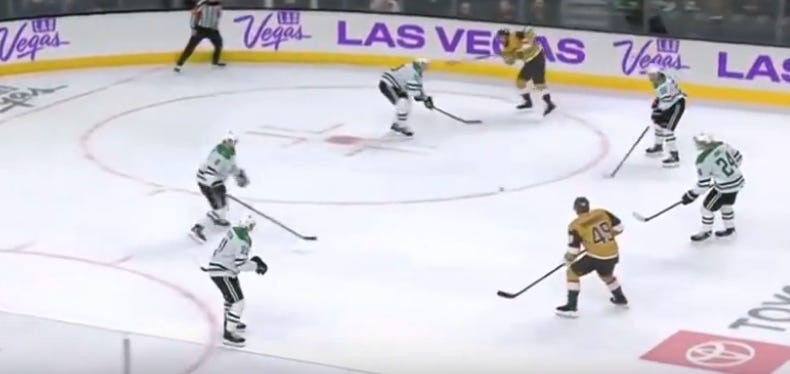
This pass gets to Barbashev far, far too easily, and Hintz never manages to apply any back pressure before Barbashev shoots. A centerman needs to take a couple more strides on the backcheck there, for my money, and Hintz doesn’t do so.
Furthermore, Mavrik Bourque (who had a whale of a game otherwise) doesn’t recognize that Andersson is jumping up on the weak side soon enough, and allows the defenseman to receive the pass in stride and carry it in with speed, immediately causing problems for Dallas.
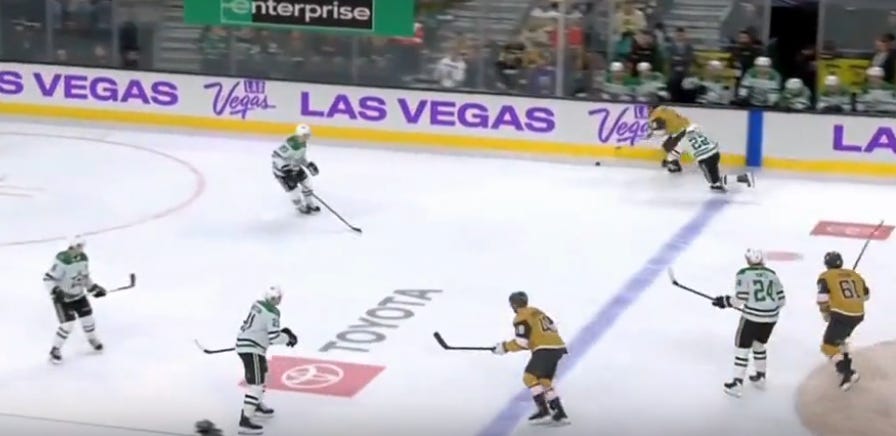
But still, this is far from an odd-man rush, and Robertson (21) and Hintz (24) both appear to be assuming someone else will be stepping up on Barbashev. But nobody does, and Heiskanen can’t close him down quickly enough to prevent the clean shot. It’s just not great defending, to start.
But we’re talking about Oettinger, and even after the defensive lapses, this is ultimately a shot you need your franchise goaltender to come up with, no matter how it comes about. Watch this angle:
Here’s the damning moment, I’d say:
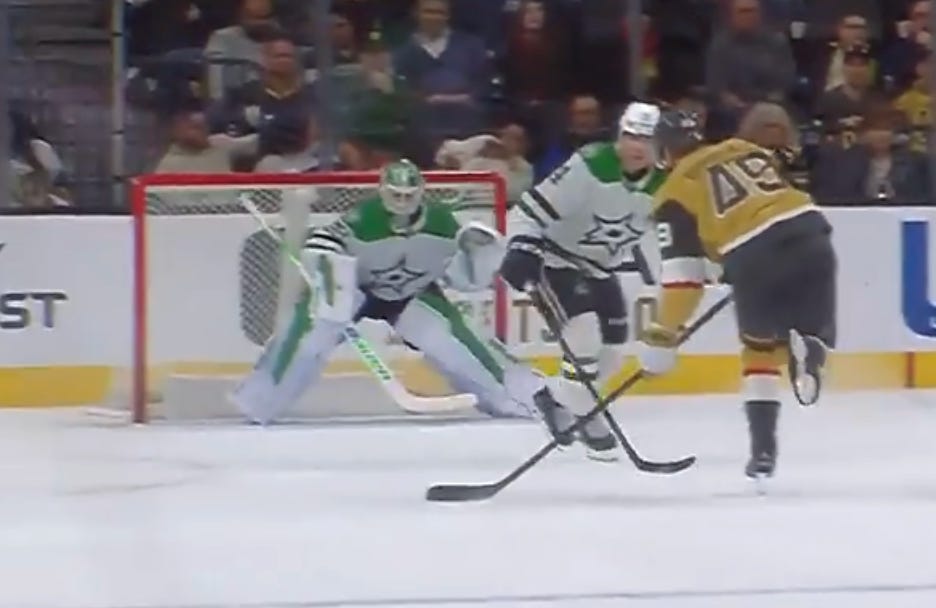
Oettinger has a clear view of the puck (though not the shooter’s eyes, which do matter), and the goalie appears to just flat-out misread it off the blade of the shooter.
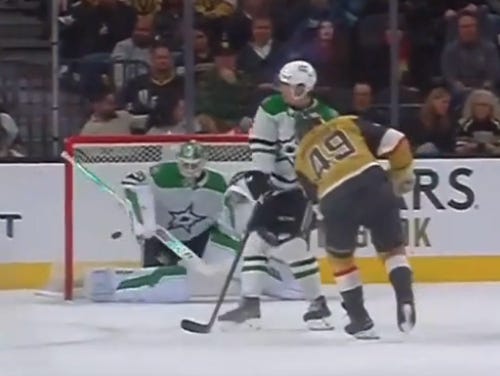
No corner has been picked here. It’s simply a nasty snap shot from an NHL scorer that beats the blocker to the side of the net. Crucially, Oettinger is quite deep in his net here, so he isn’t using his size to cut down the angle. That means he has to cover a lot of the net with blocker arm extension, and he’s not able to do it in time.
Additionally, Oettinger’s blocker doesn’t lash out directly to the side, but rather flinches upward for a moment before then stretching out horizontally. It’s almost a load-up of its own that slows the blocker down a tad, and Oettinger pays for it.
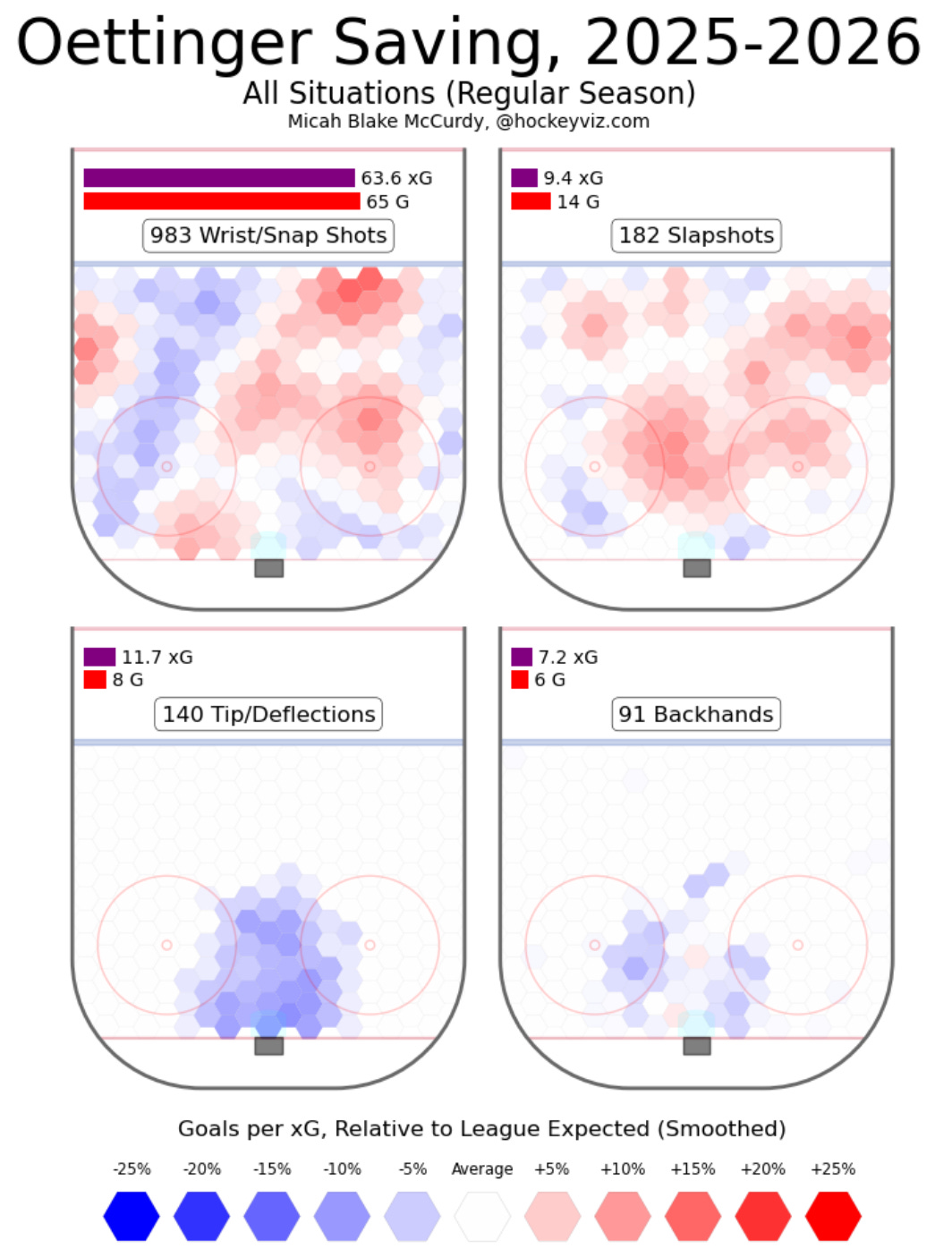
I’ll be frank here: I don’t know enough about all the mechanics of modern goaltending to say whether this is just a misread of the shot, an inherent limitation of blocker save attempts by any goaltender, or an actual flaw in Oettinger’s approach here. But I do know that Oettinger has been allowing more blocker-side (right side, for him) goals than league-average this year:
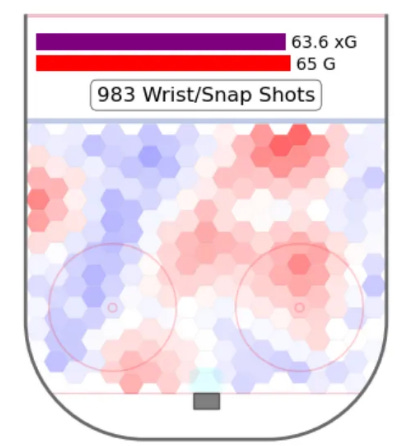
You could nitpick a goalie about almost any goal, yes. And a goalie like Oettinger is going to say that he should come up with almost every single one, if he makes the perfect read and play. But shots from Oettinger’s right have been more dangerous than you’d like for them to be, this year.
In this game, Oettinger was one of a few of the Stars’ best players who didn’t come up with the play they’d usually expect him to make in a costly moment.
However, just like Robertson, Oettinger also redeemed himself in the shootout with excellent stops on Jack Eichel and Pavel Dorofeyev. Thus, Oettinger and Dallas came out with two points. And points are the whole idea, after all.
I’m sure it can be maddening for a coach to see great players show both the highs and lows of their game over the course of a season, let alone during a single game.
I do wonder if part of DeBoer’s choice to point the finger at Oettinger after the Stars’ second elimination by Edmonton was just a result of that cumulative frustration, that impotent angst of seeing a player who can play great suddenly not do that, despite all the other things that you’ve tried to set up and prevent. With goalies in particular, there is almost nothing a head coach can do beyond hoping they’ll get the next one, and when there is no next one to get, I’m sure it’s crushing. Certainly DeBoer sounded like a defeated man, last May.
The Stars are still in the middle of their Stanley Cup window, and Jason Robertson, Miro Heiskanen, and Jake Oettinger are big reasons why. If the third period against Vegas taught us anything about those players, it’s that they are all human beings, capable of mistakes in big moments.
But if their larger bodies of work have also taught us anything, it’s that they all have the ability to come up with incredible plays in those very same moments. The paradox of the whole thing is this: the very reason these athletes are capable of disappointing you is because they’ve raised your expectations so terribly high to begin with.
Sports, like most things, are so great for the very same reasons they can be so devastating. Love is always a terrible risk, and a choice to keep taking that risk. The Stars play in Utah tomorrow night.
Keeping faith in Starsland hasn't come easily this year.
It's always easy to be a critic, especially at arm's length. A blip here or there should be expected and accepted in any hockey season. Losing streak, schmoozing streak. The team has won three straight games.
Looking at the underlyings (several of them) instead of the overall record is not fun, however. Forget about the Stars absolutely needing their power play to beat the 31st-place Blues twice in a row, or giving up three-goal deficits in the third period two games in a row. Those things aren't great but they are the least of what the Stars need to address if they are to be successful in the postseason. And, success in the postseason was the primary premise for a shift in system philosophies this year.
This is just one small aspect and there are many more...but let's just look briefly at play with a man advantage versus five-on-five play. The latter of which constitutes about 75-80% of every NHL game. A state of play more common in the playoffs, at first glance, anyway. (The penalty rates in the playoffs are actually much the same as during the regular season. Or have been for several years now.)
The difference being the severity of what is called in the playoffs as a penalty are much more lenient than what is called during the regular season. The Stars are not an aggressive team. They are among the lowest in hits delivered (also an indicator of a team that doesn't have the puck very much, so yes that's another caveat). Having said that, a team that is less aggressive is more likely to lose the "even-up-calls-so-as-not-to-influence-the-game" penalty balance BS that happens during the NHL playoffs.
Or put more simply, the Stars hoping for ticky-tack calls and relying on their power play to bail them out is less likely to succeed in the playoffs than during the regular season. Touch calls always go in favour of the team who has been committing felony assault on their opponents while their own ticky-tack fouls get dismissed because: Ogie Oglethorpe on their team already spent 5 minutes in the box for driving someone's face into the boards. (It wouldn't be fair to the assaulting team or to poor Ogie to call a judicious game. Things have to be even-Steven in the playoffs, at all costs.)
*cough, "Florida Panthers" cough, vomit, cough*
That's a lot of words to say..."Oh boy, that doesn't bode well for the Stars."
This season, the Stars power play has been elite with a capital E. That's good. At 5v5, the Stars offense has been embattled with an even bigger E.
Here are the Points per 60 Minutes (P/60) Ranks at 5v4 versus 5v5:
Stars 5v4 Ranks -
Out of all the players who have played at least 50 minutes during a five-on-four situation, the Stars have FOUR out of the top 12 players in the league. It's kind of crazy. Bananas, really, to have 33 percent of the top 5v4 scorers on one team. I’m sure you can guess who those players are: Rantanen, Robertson, Hintz, and Johnston.
The first power play unit is special together.
Stars 5v5 Ranks -
At a minimum of 200 minutes played 5v5, the P/60 ranks of the Stars', umm, Stars is much less rosy. Here are the top six Stars rankings at P/60 @ 5v5:
28. Benn
43. Rantanen
58. Robertson
136. Johnston
149. Seguin
211. Hintz
You'll notice that two of those players have played at least 13 years with the Stars, one is injured and the other is a 3rd or fourth liner.
The Stars elite power play performers have not been elite during the most common state of the game. There are four active players in the top 200. That could become a problem in the playoffs.
As a measuring stick, the Golden Nights have four players in the top 30. The Stars next opponent, who some dismiss as an also-ran, the Mammoth have 5 in the top 40. The Senators (ughh...) have 6 in the top 100.
As a ridiculously unattainable measuring stick, the Colorado Avalanche have 14 players in the top 200. Fourteen as opposed to four.
What happens the next time Roope Hintz gets his foot severed from his ankle in a playoff game, and then has the same thing attempted in the game he returns without the Stars getting one power play out of it?
The Simple Answer to the 5v5 Scoring Situation:
IDK, man! IDK.
The only thing I do know is I am tempering my expectations of this team but am still hanging on to the hope being sold in the points column. It seems the league-wide pundits hold onto similar hopes. The problem is they mostly look at the standings instead of watching the games.
Maybe I should follow their lead. It seems to be a more peaceful outlook, at the very least.
I would love a game where we had a substantial lead and kept it.